Recognition: 2 theorem links
· Lean TheoremRemnant recoil and host environments of GWTC-4.0 binary black-hole mergers
Pith reviewed 2026-05-10 19:46 UTC · model grok-4.3
The pith
Merger remnants from five recent binary black-hole events are likely ejected from globular clusters, limiting repeated mergers there while leaving nuclear star clusters as viable sites.
A machine-rendered reading of the paper's core claim, the machinery that carries it, and where it could break.
Core claim
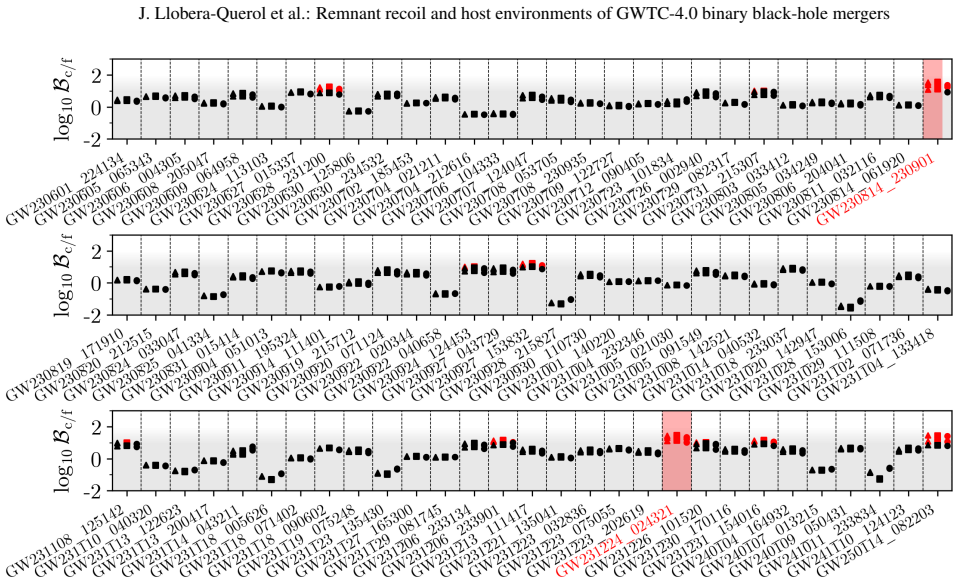
We identified five events showing preference for a dynamical origin, including the most massive O4a event GW231123_135430, while excluding the high-spinning O4b event GW241011_233834. Typical recoil velocities of analyzed events are of order a few hundred km/s, with extended high-velocity tails. These kicks suggest that merger remnants are likely ejected from typical globular clusters, while retention in nuclear star clusters remains possible but not guaranteed. Our results disfavour efficient hierarchical growth in globular clusters, whereas nuclear star clusters remain viable environments for repeated mergers.
What carries the argument
Bayes-factor comparison of event posteriors against synthetic field and cluster population models, combined with recoil-velocity posteriors derived from the IMRPhenomXPNR waveform that includes multipole asymmetries.
If this is right
- Five events, including GW231123_135430, are more consistent with dynamical formation than with isolated-field formation.
- Merger remnants typically receive kicks of a few hundred km/s that exceed escape velocities of most globular clusters.
- Nuclear star clusters can retain a non-negligible fraction of remnants, allowing repeated mergers.
- Efficient hierarchical growth is disfavoured inside globular clusters.
- The classification and retention results are sensitive to the choice and completeness of the population models.
Where Pith is reading between the lines
- Improved or larger population models could reclassify additional events and alter the inferred retention fractions.
- If nuclear star clusters prove to retain remnants at higher rates, they become the more plausible sites for building intermediate-mass black holes through successive mergers.
- Future detectors that deliver higher-precision spins and masses will tighten the Bayes-factor distinctions between channels.
- The high-velocity tails imply that even dense environments experience occasional ejections, so hierarchical growth is never guaranteed.
Load-bearing premise
The analysis depends on the specific astrophysical population models adopted for field and cluster binaries and on the assumed relative abundances of those channels in the local universe.
What would settle it
New population models that reverse the Bayes-factor preference for the five flagged events, or that produce recoil distributions dominated by velocities below typical globular-cluster escape speeds, would falsify the dynamical-origin assignments and the ejection conclusions.
Figures




read the original abstract
Determining the astrophysical origin of binary black holes and whether merger remnants are retained in their birth environments is essential for understanding hierarchical mergers and the growth of intermediate-mass black holes. We identified the gravitational-wave (GW) events most consistent with dynamical formation and assessed whether their merger remnants are retained in globular clusters, nuclear star clusters, or galactic potentials. We considered the 84 events consistent with binary-black-hole (BBH) mergers from the first part of the fourth observing run (O4a) of the LIGO-Virgo-KAGRA (LVK) GW detector network, and 3 selected events from the second part (O4b). We compared parameter-estimation posteriors with synthetic population models for field and cluster binaries using Bayes factors, accounting for the relative abundances of these formation channels in the local Universe. We computed recoil-velocity posteriors for all events using the IMRPhenomXPNR waveform model, which incorporates multipole asymmetries. We identified five events showing preference for a dynamical origin, including the most massive O4a event GW231123_135430, while excluding the high-spinning O4b event GW241011_233834. Typical recoil velocities of analyzed events are of order a few hundred km/s, with extended high-velocity tails. These kicks suggest that merger remnants are likely ejected from typical globular clusters, while retention in nuclear star clusters remains possible but not guaranteed. Our results disfavour efficient hierarchical growth in globular clusters, whereas nuclear star clusters remain viable environments for repeated mergers. Although results depend on the adopted astrophysical population models, this analysis highlights the importance of improved and larger population models, as well as higher-quality detections enabled by future developments in GW detectors.
Editorial analysis
A structured set of objections, weighed in public.
Referee Report
Summary. This manuscript analyzes 87 binary black hole merger events from GWTC-4.0 (84 from O4a plus 3 selected O4b events). It compares their LVK parameter-estimation posteriors to synthetic field and cluster population models via Bayes factors (incorporating a prior on relative channel abundances in the local Universe) to classify formation channels, identifies five events (including GW231123_135430) with preference for dynamical origin while excluding GW241011_233834, computes recoil-velocity posteriors for all events with the IMRPhenomXPNR waveform model, and concludes that typical kicks of a few hundred km/s eject remnants from typical globular clusters while permitting possible retention in nuclear star clusters, thereby disfavouring efficient hierarchical growth in GCs but leaving NSCs viable.
Significance. If the population-model dependence can be shown to be robust, the work supplies useful observational constraints on BBH formation channels and post-merger retention in different environments, with implications for hierarchical merger scenarios and intermediate-mass black hole growth. The choice of IMRPhenomXPNR for recoil estimates (accounting for multipole asymmetries) is a methodological strength that improves upon simpler kick prescriptions.
major comments (2)
- [Methods] Methods section: the synthetic population models for field and cluster binaries (mass/spin distributions and the specific prior or fixed value for their relative abundance ratio) are not described in sufficient detail, nor are robustness checks against variations in these assumptions provided. Because the Bayes factors that classify events as dynamical (e.g., the inclusion of GW231123_135430 and exclusion of GW241011_233834) are sensitive to the high-mass and high-spin tails of the cluster model, as the abstract itself acknowledges, the five-event dynamical sample and all downstream recoil statistics rest on an incompletely specified foundation.
- [Results] Results section: the claim that the recoil velocities 'disfavour efficient hierarchical growth in globular clusters' is load-bearing for the central interpretation, yet it is supported only by the statement that typical kicks are 'a few hundred km/s with extended high-velocity tails.' No quantitative comparison to GC escape-velocity distributions or retention fractions is shown, so the strength of the disfavouring cannot be evaluated independently of the model-dependent event selection.
minor comments (2)
- [Abstract] Abstract: the selection criteria for the three O4b events are not stated, which is needed for context even in the abstract.
- [Figures] Figure captions: several panels comparing posteriors or recoil distributions would benefit from explicit listing of the events shown and clarification of line styles or color coding for field versus cluster models.
Simulated Author's Rebuttal
We thank the referee for their careful reading of the manuscript and for the constructive comments, which have helped us improve the clarity and rigor of the presentation. We address the two major comments point by point below and have revised the manuscript to incorporate additional details and quantitative comparisons as suggested.
read point-by-point responses
-
Referee: [Methods] Methods section: the synthetic population models for field and cluster binaries (mass/spin distributions and the specific prior or fixed value for their relative abundance ratio) are not described in sufficient detail, nor are robustness checks against variations in these assumptions provided. Because the Bayes factors that classify events as dynamical (e.g., the inclusion of GW231123_135430 and exclusion of GW241011_233834) are sensitive to the high-mass and high-spin tails of the cluster model, as the abstract itself acknowledges, the five-event dynamical sample and all downstream recoil statistics rest on an incompletely specified foundation.
Authors: We agree that the Methods section requires a more explicit description of the population models to enable independent evaluation of the Bayes factor results. In the revised manuscript we have expanded the relevant subsection to provide the precise functional forms and parameter values for the mass and spin distributions of both the field and cluster synthetic populations, together with the specific prior (or fixed value) adopted for the relative channel abundance ratio in the local Universe. We have also added a dedicated robustness subsection that varies the high-mass cutoff and the spin distribution tails of the cluster model over ranges consistent with current astrophysical uncertainties and recomputes the Bayes factors for the events in question. These checks show that the dynamical preference for the five events (including GW231123_135430) and the exclusion of GW241011_233834 remain stable, although we retain the caveat already stated in the abstract regarding sensitivity to the high-mass and high-spin tails. revision: yes
-
Referee: [Results] Results section: the claim that the recoil velocities 'disfavour efficient hierarchical growth in globular clusters' is load-bearing for the central interpretation, yet it is supported only by the statement that typical kicks are 'a few hundred km/s with extended high-velocity tails.' No quantitative comparison to GC escape-velocity distributions or retention fractions is shown, so the strength of the disfavouring cannot be evaluated independently of the model-dependent event selection.
Authors: We accept that the interpretation would be strengthened by an explicit quantitative comparison between the recoil-velocity posteriors and the escape-velocity distributions of the relevant environments. Although the original manuscript reports the typical recoil values and the presence of high-velocity tails, it does not include a direct integration against escape-velocity distributions or retention fractions. In the revised Results section we now provide this comparison, using representative escape-velocity ranges drawn from the literature for globular clusters (approximately 10–100 km s⁻¹) and nuclear star clusters (typically several hundred km s⁻¹ or higher). We report the posterior probability of retention (i.e., the fraction of each event’s recoil posterior lying below the escape velocity) for both classes of cluster, thereby quantifying the low retention probability in typical globular clusters and the comparatively higher (though still not guaranteed) retention probability in nuclear star clusters. This addition supplies the independent quantitative support requested while remaining tied to the model-dependent event selection already discussed. revision: yes
Circularity Check
No circularity: recoil and channel classification use external waveform model and synthetic populations
full rationale
The derivation computes recoil-velocity posteriors directly from the external IMRPhenomXPNR waveform applied to LVK parameter-estimation posteriors, then obtains formation-channel preferences via Bayes-factor comparison against independent synthetic field and cluster population models whose relative abundances are taken as external inputs. No step equates a claimed prediction to a quantity defined or fitted by the paper itself, no load-bearing self-citation chain appears, and the abstract explicitly flags dependence on the adopted population models rather than smuggling an ansatz or uniqueness theorem. The central claims therefore remain independent of the paper's own fitted quantities and are self-contained against external benchmarks.
Axiom & Free-Parameter Ledger
free parameters (1)
- relative abundances of field versus cluster binaries
axioms (1)
- domain assumption IMRPhenomXPNR waveform model accurately incorporates multipole asymmetries for recoil-velocity computation
Lean theorems connected to this paper
-
IndisputableMonolith/Foundation/RealityFromDistinction.leanreality_from_one_distinction unclear?
unclearRelation between the paper passage and the cited Recognition theorem.
We compared parameter-estimation posteriors with synthetic population models for field and cluster binaries using Bayes factors... We computed recoil-velocity posteriors for all events using the IMRPhenomXPNR waveform model
-
IndisputableMonolith/Foundation/AlexanderDuality.leanalexander_duality_circle_linking unclear?
unclearRelation between the paper passage and the cited Recognition theorem.
Typical recoil velocities of analyzed events are of order a few hundred km/s... These kicks suggest that merger remnants are likely ejected from typical globular clusters
What do these tags mean?
- matches
- The paper's claim is directly supported by a theorem in the formal canon.
- supports
- The theorem supports part of the paper's argument, but the paper may add assumptions or extra steps.
- extends
- The paper goes beyond the formal theorem; the theorem is a base layer rather than the whole result.
- uses
- The paper appears to rely on the theorem as machinery.
- contradicts
- The paper's claim conflicts with a theorem or certificate in the canon.
- unclear
- Pith found a possible connection, but the passage is too broad, indirect, or ambiguous to say the theorem truly supports the claim.
Reference graph
Works this paper leans on
-
[1]
Aasi, J. et al. 2015, Class. Quant. Grav., 32, 074001
2015
- [2]
- [3]
-
[4]
Abac, A. G. et al. 2025f [arXiv:2508.18083]
work page internal anchor Pith review Pith/arXiv arXiv
-
[5]
Abac, A. G. et al. 2025g [arXiv:2508.18082]
work page internal anchor Pith review Pith/arXiv arXiv
- [6]
-
[7]
Abbott, R. et al. 2020, Astrophys. J. Lett., 900, L13
2020
-
[8]
Acernese, F. et al. 2015, Class. Quant. Grav., 32, 024001
2015
-
[9]
Aghanim, N. et al. 2020, Astron. Astrophys., 641, A6, [Erratum: As- tron.Astrophys. 652, C4 (2021)]
2020
-
[10]
Ajith, P. et al. 2011, Phys. Rev. Lett., 106, 241101
2011
-
[11]
Akutsu, T. et al. 2021, PTEP, 2021, 05A101 Álvarez, C. A., Wong, H. W. Y ., Liu, A., & Calderón Bustillo, J. 2024, Astrophys. J., 977, 220
2021
-
[12]
2022, Astrophys
Anagnostou, O., Trenti, M., & Melatos, A. 2022, Astrophys. J., 941, 4
2022
-
[13]
2019, MNRAS, 486, 5008
Antonini, F., Gieles, M., & Gualandris, A. 2019, MNRAS, 486, 5008
2019
-
[14]
& Rasio, F
Antonini, F. & Rasio, F. A. 2016, Astrophys. J., 831, 187
2016
-
[15]
Antonini, F., Toonen, S., & Hamers, A. S. 2017, Astrophys. J., 841, 77
2017
-
[16]
A., Cutler, C., Sussman, G
Apostolatos, T. A., Cutler, C., Sussman, G. J., & Thorne, K. S. 1994, Phys. Rev. D, 49, 6274
1994
-
[17]
G., Buonanno, A., Faye, G., & Ochsner, E
Arun, K. G., Buonanno, A., Faye, G., & Ochsner, E. 2009, Phys. Rev. D, 79, 104023, [Erratum: Phys.Rev.D 84, 049901 (2011)]
2009
-
[18]
Ashton, G. et al. 2019, Astrophys. J. Suppl., 241, 27
2019
-
[19]
Askar, A., Baldassare, V . F., & Mezcua, M. 2023, arXiv e-prints, arXiv:2311.12118
-
[20]
2017, Mon
Askar, A., Szkudlarek, M., Gondek-Rosi´nska, D., Giersz, M., & Bulik, T. 2017, Mon. Not. Roy. Astron. Soc., 464, L36
2017
-
[21]
2013, Phys
Baird, E., Fairhurst, S., Hannam, M., & Murphy, P. 2013, Phys. Rev. D, 87, 024035
2013
-
[22]
G., Centrella, J., Choi, D.-I., et al
Baker, J. G., Centrella, J., Choi, D.-I., et al. 2006, Astrophys. J. Lett., 653, L93
2006
- [23]
- [24]
-
[25]
& Rezzolla, L
Barausse, E. & Rezzolla, L. 2009, Astrophys. J. Lett., 704, L40
2009
-
[26]
& Lardo, C
Bastian, N. & Lardo, C. 2018, ARA&A, 56, 83
2018
-
[27]
& Hilker, M
Baumgardt, H. & Hilker, M. 2018, MNRAS, 478, 1520
2018
-
[28]
2020, PASA, 37, e046
Baumgardt, H., Sollima, A., & Hilker, M. 2020, PASA, 37, e046
2020
-
[29]
S., Fragos, T., Qin, Y ., et al
Bavera, S. S., Fragos, T., Qin, Y ., et al. 2020, Astron. Astrophys., 635, A97
2020
-
[30]
Bekenstein, J. D. 1973, Astrophys. J., 183, 657
1973
-
[31]
2020, ApJ, 905, L15
Belczynski, K. 2020, ApJ, 905, L15
2020
-
[32]
L., et al
Belczynski, K., Bulik, T., Fryer, C. L., et al. 2010, ApJ, 714, 1217
2010
-
[33]
2016, A&A, 594, A97
Belczynski, K., Heger, A., Gladysz, W., et al. 2016, A&A, 594, A97
2016
-
[34]
2002, ApJ, 572, 407
Belczynski, K., Kalogera, V ., & Bulik, T. 2002, ApJ, 572, 407
2002
-
[35]
A., et al
Belczynski, K., Kalogera, V ., Rasio, F. A., et al. 2008, ApJS, 174, 223
2008
-
[36]
Belczynski, K. et al. 2020, Astron. Astrophys., 636, A104
2020
-
[37]
2021, Phys
Biscoveanu, S., Isi, M., Varma, V ., & Vitale, S. 2021, Phys. Rev. D, 104, 103018
2021
-
[38]
2024, Phys
Borchers, A., Ohme, F., Mielke, J., & Ghosh, S. 2024, Phys. Rev. D, 110, 024037
2024
-
[39]
2025, scri
Boyle, M., Iozzo, D., Stein, L., et al. 2025, scri
2025
- [40]
-
[41]
Boyle, M., Owen, R., & Pfeiffer, H. P. 2011, Phys. Rev. D, 84, 124011 Article number, page 16 J. Llobera-Querol et al.: Remnant recoil and host environments of GWTC-4.0 binary black-hole mergers
2011
-
[42]
Breivik, K. et al. 2020, Astrophys. J., 898, 71 Brügmann, B., Gonzalez, J. A., Hannam, M., Husa, S., & Sperhake, U. 2008, Phys. Rev. D, 77, 124047
2020
-
[43]
2022, ApJ, 935, 167
Collaboration, A. 2022, ApJ, 935, 167
2022
-
[44]
S., Collaboration, V ., & Collaboration, K
Collaboration, L. S., Collaboration, V ., & Collaboration, K. 2025, GWTC-4.0: Parameter estimation data release
2025
-
[45]
Colleoni, M., Vidal, F. A. R., García-Quirós, C., Akçay, S., & Bera, S. 2025, Phys. Rev. D, 111, 104019
2025
-
[46]
Colloms, S., Berry, C. P. L., Veitch, J., & Zevin, M. 2025, in 24th International Conference on General Relativity and Gravitation (GR24) and 16th Edoardo Amaldi Conference on Gravitational (Amaldi16) Waves
2025
-
[47]
Doctor, Z., Farr, B., & Holz, D. E. 2021, Astrophys. J. Lett., 914, L18
2021
-
[48]
El-Badry, K., Quataert, E., Weisz, D. R., Choksi, N., & Boylan-Kolchin, M. 2019, MNRAS, 482, 4528 Estellés, H., Buonanno, A., Enficiaud, R., Foo, C., & Pompili, L. 2025 [arXiv:2506.19911] Estellés, H., Colleoni, M., García-Quirós, C., et al. 2022, Phys. Rev. D, 105, 084040
-
[49]
Farah, A. M., Vijaykumar, A., & Fishbach, M. 2026 [arXiv:2601.03456]
work page internal anchor Pith review Pith/arXiv arXiv 2026
-
[50]
& Silk, J
Fragione, G. & Silk, J. 2020, MNRAS, 498, 4591
2020
-
[51]
L., Belczynski, K., Wiktorowicz, G., et al
Fryer, C. L., Belczynski, K., Wiktorowicz, G., et al. 2012, ApJ, 749, 91
2012
-
[52]
L., Olejak, A., & Belczynski, K
Fryer, C. L., Olejak, A., & Belczynski, K. 2022, ApJ, 931, 94
2022
-
[53]
Fuller, J. & Ma, L. 2019, Astrophys. J. Lett., 881, L1 García-Quirós, C., Colleoni, M., Husa, S., et al. 2020, Phys. Rev. D, 102, 064002
2019
-
[54]
& Berti, E
Gerosa, D. & Berti, E. 2019, Phys. Rev. D, 100, 041301
2019
-
[55]
& Fishbach, M
Gerosa, D. & Fishbach, M. 2021, Nature Astron., 5, 749
2021
-
[56]
2020, Phys
Gerosa, D., Vitale, S., & Berti, E. 2020, Phys. Rev. Lett., 125, 101103
2020
-
[57]
2024, Phys
Ghosh, S., Kolitsidou, P., & Hannam, M. 2024, Phys. Rev. D, 109, 024061
2024
-
[58]
Y ., Zhao, H., Pringle, J
Gnedin, O. Y ., Zhao, H., Pringle, J. E., et al. 2002, ApJ, 568, L23
2002
-
[59]
A., Sperhake, U., Brügmann, B., Hannam, M., & Husa, S
Gonzalez, J. A., Sperhake, U., Brügmann, B., Hannam, M., & Husa, S. 2007, Phys. Rev. Lett., 98, 091101
2007
-
[60]
2019, A&A Rev., 27, 8
Gratton, R., Bragaglia, A., Carretta, E., et al. 2019, A&A Rev., 27, 8
2019
-
[61]
Hamers, A. S. & Safarzadeh, M. 2020, Astrophys. J., 898, 99
2020
-
[62]
E., et al
Hamilton, E., London, L., Thompson, J. E., et al. 2021, Phys. Rev. D, 104, 124027
2021
- [63]
-
[64]
& Lousto, C
Healy, J. & Lousto, C. O. 2018, Phys. Rev. D, 97, 084002
2018
-
[65]
O., & Zlochower, Y
Healy, J., Lousto, C. O., & Zlochower, Y . 2014, Phys. Rev. D, 90, 104004
2014
-
[66]
1980, General Relativity and Gravitation: One Hundred Years After the Birth of Albert Einstein
Held, A., ed. 1980, General Relativity and Gravitation: One Hundred Years After the Birth of Albert Einstein. V olume 2 (Plenum)
1980
-
[67]
2018, Mon
Hong, J., Vesperini, E., Askar, A., et al. 2018, Mon. Not. Roy. Astron. Soc., 480, 5645, [Erratum: Mon.Not.Roy.Astron.Soc. 491, 5793 (2020)]
2018
-
[68]
R., Pols, O
Hurley, J. R., Pols, O. R., & Tout, C. A. 2000, Mon. Not. Roy. Astron. Soc., 315, 543
2000
-
[69]
R., Tout, C
Hurley, J. R., Tout, C. A., & Pols, O. R. 2002, Mon. Not. Roy. Astron. Soc., 329, 897
2002
-
[70]
E., & Khanna, G
Islam, T., Field, S. E., & Khanna, G. 2023, Phys. Rev. D, 108, 064048
2023
-
[71]
Islam, T. & Wadekar, D. 2025 [arXiv:2511.11536]
-
[72]
S., Rui, N
Kremer, K., Ye, C. S., Rui, N. Z., et al. 2020, Astrophys. J. Suppl., 247, 48
2020
-
[73]
2001, Mon
Kroupa, P. 2001, Mon. Not. Roy. Astron. Soc., 322, 231
2001
-
[74]
2022, Astron
Li, G.-P. 2022, Astron. Astrophys., 666, A194
2022
- [75]
-
[76]
2025, arXiv e-prints, arXiv:2509.08298, doi:10.48550/arXiv.2509.08298
Li, G.-P. & Fan, X.-L. 2025b [arXiv:2509.08298]
-
[77]
2025, arXiv e-prints, arXiv:2507.17551, doi: 10.48550/arXiv.2507.17551
Li, Y .-J., Tang, S.-P., Xue, L.-Q., & Fan, Y .-Z. 2025 [arXiv:2507.17551] LIGO Scientific Collaboration, Virgo Collaboration, & KAGRA Collaboration. 2018, LVK Algorithm Library - LALSuite, Free software (GPL) LIGO Scientific Collaboration, VIRGO Collaboration, K. C. 2025 [arXiv:2509.07348]
-
[78]
& Lai, D
Liu, B. & Lai, D. 2021, Mon. Not. Roy. Astron. Soc., 502, 2049
2021
-
[79]
2025, arXiv e-prints, arXiv:2511.13820, doi:10.48550/arXiv.2511.13820
Liu, B. & Lai, D. 2025 [arXiv:2511.13820]
-
[80]
Lousto, C. O. & Healy, J. 2019, Phys. Rev. D, 100, 104039
2019
discussion (0)
Sign in with ORCID, Apple, or X to comment. Anyone can read and Pith papers without signing in.