Recognition: no theorem link
Context-Agent: Dynamic Discourse Trees for Non-Linear Dialogue
Pith reviewed 2026-05-10 18:32 UTC · model grok-4.3
The pith
Modeling conversation history as a dynamic tree lets LLMs handle branching dialogues with better coherence and efficiency.
A machine-rendered reading of the paper's core claim, the machinery that carries it, and where it could break.
Core claim
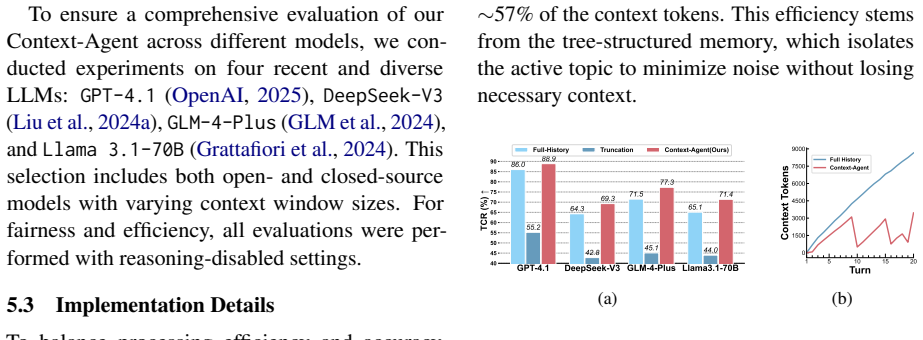
Context-Agent models multi-turn dialogue history as a dynamic tree structure that mirrors the non-linear flow of conversation. Each node represents a turn or topic segment, and branches capture parallel or refined threads so the model can maintain and navigate multiple paths instead of a single sequence. Experiments across LLMs show higher task completion rates and improved token efficiency on the new NTM benchmark for long-horizon non-linear dialogues.
What carries the argument
Dynamic discourse tree: a tree whose nodes store dialogue turns and whose branches represent distinct topics or refinements, allowing selective navigation of relevant history.
If this is right
- Task completion rises in extended interactions that involve topic shifts or instruction changes.
- Token consumption drops because the model can ignore irrelevant branches and attend only to needed history.
- Coherence holds better across multiple turns when the conversation splits into parallel threads.
- The same tree-based context works with different underlying language models without architecture changes.
Where Pith is reading between the lines
- The tree structure might reduce forgetting of earlier constraints in multi-step tasks that resemble dialogue branches.
- Explicit branching could be combined with retrieval methods to let models pull in external facts tied to specific conversation threads.
- Real-user tests could check whether the tree's navigation choices match how people naturally recall past parts of a talk.
- Similar dynamic trees might apply to non-dialogue sequences such as step-by-step reasoning or planning chains.
Load-bearing premise
That building and traversing the tree will reliably capture natural discourse branches without adding coherence problems or heavy maintenance costs.
What would settle it
Running Context-Agent and a standard linear baseline on the same set of long non-linear dialogues from the NTM benchmark and finding no gain in task completion or token use would show the tree structure does not deliver the claimed benefit.
Figures




read the original abstract
Large Language Models demonstrate outstanding performance in many language tasks but still face fundamental challenges in managing the non-linear flow of human conversation. The prevalent approach of treating dialogue history as a flat, linear sequence is misaligned with the intrinsically hierarchical and branching structure of natural discourse, leading to inefficient context utilization and a loss of coherence during extended interactions involving topic shifts or instruction refinements. To address this limitation, we introduce Context-Agent, a novel framework that models multi-turn dialogue history as a dynamic tree structure. This approach mirrors the inherent non-linearity of conversation, enabling the model to maintain and navigate multiple dialogue branches corresponding to different topics. Furthermore, to facilitate robust evaluation, we introduce the Non-linear Task Multi-turn Dialogue (NTM) benchmark, specifically designed to assess model performance in long-horizon, non-linear scenarios. Our experiments demonstrate that Context-Agent enhances task completion rates and improves token efficiency across various LLMs, underscoring the value of structured context management for complex, dynamic dialogues. The dataset and code is available at GitHub.
Editorial analysis
A structured set of objections, weighed in public.
Referee Report
Summary. The paper introduces Context-Agent, a framework that models multi-turn dialogue history as a dynamic tree structure to better capture the hierarchical and branching nature of natural conversations, contrasting with the standard linear sequence approach. It also proposes the Non-linear Task Multi-turn Dialogue (NTM) benchmark for evaluating long-horizon non-linear dialogue scenarios. Experiments across various LLMs report gains in task completion rates and token efficiency, with code and dataset released on GitHub.
Significance. If the efficiency and completion gains prove robust after full overhead accounting, the work offers a promising direction for structured context management in LLMs handling complex, dynamic dialogues. The new NTM benchmark and public code release are clear strengths that support reproducibility and further research in non-linear discourse modeling.
major comments (2)
- [Experiments] Experiments section: The reported token efficiency improvements lack any explicit accounting or ablation of the tokens and LLM calls consumed by tree construction, branch selection, updates, pruning, and navigation operations. Without this breakdown, it is impossible to confirm that the net context savings are positive, especially as branch count grows, directly undermining the central efficiency claim.
- [Method and Experiments] §3 (Method) and Experiments: The framework assumes the dynamic tree reliably represents non-linear discourse without introducing coherence issues or excessive maintenance overhead, but no analysis or metrics are provided on tree navigation costs or failure modes in branch selection, leaving the practical advantage over linear baselines unverified.
minor comments (3)
- [Abstract] Abstract: The claim that the dataset and code 'is available at GitHub' should include the precise repository URL to enable immediate access and verification.
- [Experiments] The description of 'various LLMs' in the experiments should specify exact model names, versions, and prompting details for reproducibility.
- [Method] Notation for tree operations (e.g., branch selection or pruning rules) could be formalized with pseudocode or equations to clarify the implementation.
Simulated Author's Rebuttal
We thank the referee for the detailed and constructive feedback. We address each major comment below and commit to revisions that directly strengthen the experimental validation of our efficiency claims and the analysis of tree operations.
read point-by-point responses
-
Referee: [Experiments] Experiments section: The reported token efficiency improvements lack any explicit accounting or ablation of the tokens and LLM calls consumed by tree construction, branch selection, updates, pruning, and navigation operations. Without this breakdown, it is impossible to confirm that the net context savings are positive, especially as branch count grows, directly undermining the central efficiency claim.
Authors: We agree that the current experiments do not provide a full overhead breakdown, which is required to rigorously support the net efficiency gains. In the revised manuscript we will add a dedicated ablation subsection that quantifies tokens and LLM calls for tree construction, branch selection, updates, pruning, and navigation. The analysis will include scaling behavior as branch count increases and will report net context savings relative to linear baselines. revision: yes
-
Referee: [Method and Experiments] §3 (Method) and Experiments: The framework assumes the dynamic tree reliably represents non-linear discourse without introducing coherence issues or excessive maintenance overhead, but no analysis or metrics are provided on tree navigation costs or failure modes in branch selection, leaving the practical advantage over linear baselines unverified.
Authors: The referee is correct that the manuscript currently lacks quantitative metrics on navigation costs and branch-selection failure modes. We will extend the experiments section with new metrics including average navigation steps per turn, branch-selection accuracy against ground-truth discourse trees, observed coherence issues, and failure cases. These will be compared directly to the linear baselines to verify practical advantages. revision: yes
Circularity Check
No circularity detected in derivation or claims
full rationale
The manuscript introduces Context-Agent as an externally motivated framework that represents dialogue history via a dynamic tree structure and evaluates it on a newly introduced NTM benchmark. All performance claims rest on experimental measurements of task completion and token usage across LLMs rather than on any equations, fitted parameters, or self-referential definitions. No self-citations are used to justify uniqueness or load-bearing premises, no ansatzes are smuggled, and no known empirical patterns are merely renamed. The derivation chain is therefore self-contained and non-circular.
Axiom & Free-Parameter Ledger
axioms (1)
- domain assumption Dialogue history possesses an inherently hierarchical and branching structure that linear sequences fail to capture.
Reference graph
Works this paper leans on
-
[1]
Yuanning Feng, Sinan Wang, Zhengxiang Cheng, Yao Wan, and Dongping Chen
Agent ai: Surveying the horizons of multi- modal interaction.arXiv preprint arXiv:2401.03568. Team GLM, Aohan Zeng, Bin Xu, Bowen Wang, Chen- hui Zhang, Da Yin, Dan Zhang, Diego Rojas, Guanyu Feng, Hanlin Zhao, and 1 others. 2024. Chatglm: A family of large language models from glm-130b to glm-4 all tools.arXiv preprint arXiv:2406.12793. Aaron Grattafiori...
-
[2]
LLMs Get Lost In Multi-Turn Conversation
Sufficient context: A new lens on retrieval augmented generation systems. InThe Thirteenth In- ternational Conference on Learning Representations, ICLR 2025. Wai-Chung Kwan, Xingshan Zeng, Yuxin Jiang, Yufei Wang, Liangyou Li, Lifeng Shang, Xin Jiang, Qun Liu, and Kam-Fai Wong. 2024. Mt-eval: A multi- turn capabilities evaluation benchmark for large lan- ...
work page internal anchor Pith review arXiv 2025
-
[3]
Parth Sarthi, Salman Abdullah, Aditi Tuli, Shubh Khanna, Anna Goldie, and Christopher D
From isolated conversations to hierarchical schemas: Dynamic tree memory representation for llms.arXiv preprint arXiv:2410.14052. Parth Sarthi, Salman Abdullah, Aditi Tuli, Shubh Khanna, Anna Goldie, and Christopher D Manning
-
[4]
InThe Twelfth International Conference on Learning Representations
Raptor: Recursive abstractive processing for tree-organized retrieval. InThe Twelfth International Conference on Learning Representations. Zhihua Su and Qiang Zhou. 2022. Speaker clustering in textual dialogue with pairwise utterance relation and cross-corpus dialogue act supervision. InProceed- ings of the 29th International Conference on Compu- tational...
2022
-
[5]
TopoDIM: One-shot Topology Generation of Diverse Interaction Modes for Multi-Agent Systems
Topodim: One-shot topology generation of diverse interaction modes for multi-agent systems. arXiv preprint arXiv:2601.10120. Gemma Team, Aishwarya Kamath, Johan Ferret, Shreya Pathak, Nino Vieillard, Ramona Merhej, Sarah Perrin, Tatiana Matejovicova, Alexandre Ramé, Morgane Rivière, and 1 others. 2025. Gemma 3 technical report.arXiv preprint arXiv:2503.19...
work page internal anchor Pith review Pith/arXiv arXiv 2025
-
[6]
Qwen3 technical report.arXiv preprint arXiv:2505.09388. Shunyu Yao, Noah Shinn, Pedram Razavi, and Karthik Narasimhan. 2024. τ-bench: A benchmark for tool- agent-user interaction in real-world domains, 2024. URL https://arxiv. org/abs/2406.12045. Feiyuan Zhang, Dezhi Zhu, James Ming, Yilun Jin, Di Chai, Liu Yang, Han Tian, Zhaoxin Fan, and Kai Chen. 2025....
work page internal anchor Pith review Pith/arXiv arXiv 2024
-
[7]
Topic and Branch Management 1:(a topic, Ttarget)←Ψ(q t+1,{S(T i)}Ti∈Ht)▷Topic decision 2: UpdateT act, ncur based ona topic 3:n ∗ fork ←arg max ni∈Tact Sim(ϵ(qt+1), vi)▷Find fork point 4:ifH filter(n∗ fork, ncur)then 5:a branch ←Φ(q t+1,Path(n cur), R(qt+1))▷Branch decision 6:else 7:a branch ←CONTINUE 8:end if 9: UpdateB act, ncur based ona branch andn ∗ fork
-
[8]
Node Update 10: Create new noden new as child ofn cur 11:s new ←S node(nnew)▷Summarize new node 12:n cur ←n new
-
[9]
battery life
Context Construction 13:C path ← {c i |n i ∈Path(n cur)}▷Content of active path 14:C inactive ← {S(B j)|B j ̸=B act} ∪ {S(Tk)|T k ̸=T act} ▷Summaries of inactive parts 15:C t+1 ←Concat(C path, Cinactive) 16:returnC t+1 A.5 Model Implementation Details This section provides the specific prompts used to guide the lightweight language models for decision- ma...
-
[10]
Our family of three (with a 10-year-old child) is planning an 8-day international trip with a budget of around $20,000
You are an intelligent travel itinerary assistant. Our family of three (with a 10-year-old child) is planning an 8-day international trip with a budget of around $20,000. How about Japan, Australia orThailand? We plan to travel during winter
-
[11]
Could you provide a detailed itinerary for Hokkaido, Japan?3
I think Japan is a good destination. Could you provide a detailed itinerary for Hokkaido, Japan?3. Besides those activities, what other child-friendly attractions or experiences are available in Hokkaido?6. Regarding Thailand, how should our family of three handle visas? Is it visa-on-arrival or must we apply in advance? Any important notes?
-
[12]
Let’s focus on Phuket first. Please recommend two types of itineraries: one focused purely on beach relaxation and hotel-based activities, and another including some boat excursions and local cultural experiences—I’d also like to try Thai massage
-
[13]
Let’s consider Thailand instead
Hokkaido in winter might be too cold, and our child may not adapt well. Let’s consider Thailand instead. Which is more suitable for a family trip: Phuket or Chiang Mai?
-
[14]
Understood
What about Chiang Mai that you mentioned earlier? If we go to Chiang Mai, how could we arrange a relaxing beach resort stay?9. Understood. Returning to our Phuket itinerary, I prefer the version with boat excursions, but I don’t want it to be too exhausting. I’d also like to try snorkeling and surfing.8. Which offers a more comfortable flying experience: ...
-
[15]
Is flying internationally still safe nowadays? I’ve recently seen many reports of aviation accidents and feel a bit scared—what should I do?
-
[16]
Could you recommend some local dishes that don’t contain seafood?
I just remembered my daughter is allergic to seafood. Could you recommend some local dishes that don’t contain seafood?
-
[17]
By the way, I noticed some flights with layovers in Singapore—do we need an additional visa for transiting through Singapore?
-
[18]
What local specialty dishes should we try? 412 56 78 101112 131010 14
I’d like to find a five-star hotel in Chiang Mai with an executive lounge, preferably featuring a private beach and family suites.11. What local specialty dishes should we try? 412 56 78 101112 131010 14
-
[19]
yes” or “no
After consideration, we’ve decided to go to Phuket. However, I’ve changed my mind—I no longer want to snorkel. Could you prepare a complete travel memorandum for us? It should include a detailed destination overview, budget planning, recommended experiences, local food suggestions, and pre-trip visa information. 15Add New Node 15 Figure 6: The topic tree ...
-
[20]
This in- 1.Your role is a Python programming assistant
The user then explores two potential locations in Thailand: Phuket and Chiang Mai, requesting different types of itineraries and activities. This in- 1.Your role is a Python programming assistant. Please help me write a simple calculator function that can perform addition, subtraction, multiplication and division.2.The function should take two numbers and...
-
[21]
Coding Support
Add the division by zero case to the function, and throw a ZeroDivisionErrorexception.9. Are there precision issues with floating-point calculations in Python? For example, why doesn't 0.1 + 0.2 equal 0.3?10. Taking into account the floating pointprecision issue, we changed it to process only integer operations, but retained the addition, subtraction, mul...
discussion (0)
Sign in with ORCID, Apple, or X to comment. Anyone can read and Pith papers without signing in.