Recognition: 2 theorem links
· Lean TheoremHaematocrit and Shear Rate Modulate Local Cell-free Layer Thickness and Platelet Margination in Blood Flow Along a Sinusoidal Wall
Pith reviewed 2026-05-10 19:27 UTC · model grok-4.3
The pith
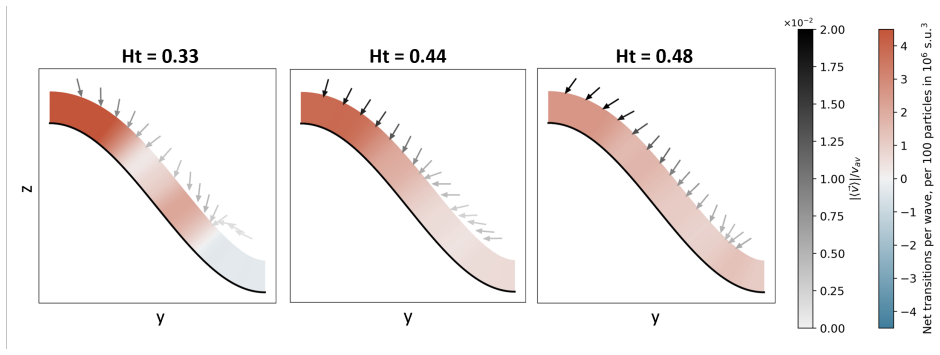
Hematocrit primarily governs platelet margination along sinusoidal walls modeling platelet aggregates, with accumulation at crests when cell-free layer thickness matches platelet size.
A machine-rendered reading of the paper's core claim, the machinery that carries it, and where it could break.
Core claim
Three-dimensional immersed-boundary lattice-Boltzmann simulations of blood flow with deformable red blood cells and nearly rigid spherical platelets along a sinusoidal wall show that platelet margination is primarily governed by hematocrit and is more pronounced where cell-free layer thickness is comparable to platelet size. At low hematocrit, platelets preferentially accumulate at wall crests, promoting high-amplitude aggregate growth. Increasing hematocrit produces a more uniform platelet distribution along the surface. The sinusoidal geometry creates a crest-valley wall shear rate gradient that may allow distinct shear-dependent adhesion pathways to operate at different locations.
What carries the argument
The sinusoidal wall geometry, used as a model for the topography of flow-aligned platelet aggregates, analyzed through three-dimensional immersed-boundary lattice-Boltzmann simulations of deformable red blood cells and rigid platelets.
If this is right
- Low hematocrit favors localized platelet buildup at wall crests that accelerates further aggregate growth.
- Higher hematocrit spreads platelets evenly, producing flatter aggregate profiles over time.
- Crest-to-valley shear rate differences imply that different adhesion mechanisms may control growth at peaks versus troughs.
- The feedback between wall shape and platelet margination drives the evolving morphology of platelet aggregates.
Where Pith is reading between the lines
- The findings suggest that low red blood cell counts could increase the chance of localized, high-amplitude clots in vessels with surface irregularities.
- Therapies might target local shear rates or hematocrit to steer aggregate growth toward less dangerous shapes.
- The same mechanism could apply to other vessel features such as stenoses, where similar cell-free layer and margination effects might occur.
- Varying hematocrit in controlled channels with defined wave patterns would provide a direct test of the predicted shift in platelet distribution.
Load-bearing premise
The sinusoidal wall shape accurately represents the surface created by real platelet aggregates and the chosen mechanical properties for red blood cells and platelets produce realistic dynamics without major simulation artifacts.
What would settle it
Microfluidic experiments tracking platelet positions along a sinusoidal surface while varying hematocrit to test whether crest accumulation at low levels gives way to uniform distribution at higher levels.
Figures




read the original abstract
The geometry of blood vessels strongly affects hemostasis and thrombosis through red blood cell (RBC) dynamics and platelet margination. Growing platelet aggregates, in turn, reshape the local vessel wall topography, leading to a strongly coupled system. However, it is not well understood how surface heterogeneities alter local hemodynamics and platelet margination, thereby driving further aggregate growth. This study investigates how hematocrit (Ht) and shear rate affect RBC dynamics, cell-free layer (CFL) thickness, and platelet margination near a sinusoidal wall. The sinusoidal wall, with crests and valleys aligned with the flow direction, serves as a model of the flow-aligned platelet aggregates observed in microfluidic experiments [Pero et al., CRPS, 2024]. We perform three-dimensional immersed-boundary-lattice-Boltzmann simulations of particulate blood flow with deformable RBCs and nearly rigid spherical platelets. Our results show that platelet margination is primarily governed by Ht and is more pronounced in regions where the CFL thickness is similar to the platelet size. At low Ht, platelets preferentially accumulate at crests, promoting high-amplitude aggregate growth. Increasing Ht leads to a more uniform platelet distribution along the surface, consistent with experimental observations. The sinusoidal geometry generates a pronounced crest-valley wall shear rate gradient, suggesting that distinct shear-dependent adhesion pathways may dominate at different surface locations. Our findings provide mechanistic insights into the morphological evolution of platelet aggregates and may ultimately inform targeted therapeutic strategies for thrombosis based on shear-sensitive drug-delivery.
Editorial analysis
A structured set of objections, weighed in public.
Referee Report
Summary. The manuscript presents three-dimensional immersed-boundary lattice-Boltzmann simulations of particulate blood flow with deformable red blood cells and nearly rigid platelets near a sinusoidal wall modeling flow-aligned aggregates. It examines the effects of hematocrit (Ht) and shear rate on cell-free layer (CFL) thickness and platelet margination, concluding that margination is primarily governed by Ht, is more pronounced where local CFL thickness approximates platelet size, shows crest-preferential accumulation at low Ht, and becomes more uniform at higher Ht.
Significance. If the numerical trends are robust, the work supplies mechanistic detail on how vessel-wall topography couples to local hemodynamics and platelet distribution, with potential relevance to thrombosis progression and shear-dependent therapies. The direct numerical simulation framework with deformable cells is a methodological strength that enables local analysis not readily available from experiments.
major comments (3)
- [Abstract and Methods] The abstract states that the simulations support the listed trends in CFL and margination, yet the manuscript provides no validation against experimental CFL thickness or margination data, no mesh-convergence study, and no sensitivity tests to RBC bending/shear moduli or near-wall repulsion parameters. These omissions are load-bearing because the reported Ht-dependent crest-valley differences rest on the fidelity of the near-wall hydrodynamics.
- [Results and Discussion] The central claim that margination shifts from crest-preferential at low Ht to uniform at high Ht, and that this promotes high-amplitude aggregate growth, assumes the fixed sinusoidal geometry decouples from growth dynamics. No test of this assumption (e.g., comparison to a dynamic aggregate-growth simulation) is presented, weakening the link between margination statistics and morphological evolution.
- [Results] The pronounced crest-valley wall-shear-rate gradient is invoked to suggest distinct shear-dependent adhesion pathways, but no quantitative mapping from the simulated local shear rates to specific adhesion kinetics or experimental adhesion data is supplied.
minor comments (2)
- [Abstract] The citation 'Pero et al., CRPS, 2024' in the abstract should be expanded to a full reference with journal, volume, and page information.
- [Figures] Figure captions and legends should explicitly state the number of independent realizations or statistical sampling used for the reported platelet distributions and CFL profiles.
Simulated Author's Rebuttal
We thank the referee for the constructive comments and positive assessment of the work's significance. We address each major comment point by point below, with revisions incorporated where feasible to strengthen the manuscript without misrepresenting our current results.
read point-by-point responses
-
Referee: [Abstract and Methods] The abstract states that the simulations support the listed trends in CFL and margination, yet the manuscript provides no validation against experimental CFL thickness or margination data, no mesh-convergence study, and no sensitivity tests to RBC bending/shear moduli or near-wall repulsion parameters. These omissions are load-bearing because the reported Ht-dependent crest-valley differences rest on the fidelity of the near-wall hydrodynamics.
Authors: We agree that explicit validation, mesh convergence, and parameter sensitivity are important to support the near-wall results. In the revised manuscript we have added a dedicated mesh-convergence subsection in Methods demonstrating that CFL thickness and platelet number density converge for the resolutions used. We have also included sensitivity tests varying RBC bending and shear moduli within physiological ranges and altering the near-wall repulsion strength; the reported Ht-dependent crest-valley differences and margination trends remain qualitatively unchanged. For validation we now compare our straight-channel CFL thicknesses to published experimental values and note consistency with margination trends in aggregate-forming flows, while acknowledging that direct experimental CFL data for sinusoidal walls are not yet available. The abstract has been updated to reflect these additions. revision: yes
-
Referee: [Results and Discussion] The central claim that margination shifts from crest-preferential at low Ht to uniform at high Ht, and that this promotes high-amplitude aggregate growth, assumes the fixed sinusoidal geometry decouples from growth dynamics. No test of this assumption (e.g., comparison to a dynamic aggregate-growth simulation) is presented, weakening the link between margination statistics and morphological evolution.
Authors: We accept that the fixed sinusoidal geometry is an approximation that does not capture dynamic aggregate growth. The present simulations isolate the hydrodynamic effect of an established topography on margination, which is a necessary first step toward understanding morphological evolution. In the revised Discussion we have added an explicit paragraph stating this modeling choice, its limitations, and the need for future coupled growth simulations. We have also softened the language linking margination statistics directly to aggregate amplitude to avoid implying a completed dynamic proof. revision: partial
-
Referee: [Results] The pronounced crest-valley wall-shear-rate gradient is invoked to suggest distinct shear-dependent adhesion pathways, but no quantitative mapping from the simulated local shear rates to specific adhesion kinetics or experimental adhesion data is supplied.
Authors: We have expanded the Results section to report explicit local wall-shear-rate values (crest versus valley) for all Ht and shear-rate cases. The Discussion now includes quantitative estimates and references to experimental literature on shear-dependent adhesion (vWF-GPIb at high shear, integrin pathways at lower shear) to map the simulated rates onto likely dominant mechanisms. A full kinetic adhesion model lies outside the hydrodynamic scope of this study; we have clarified this boundary in the text. revision: partial
Circularity Check
No circularity: results emerge from direct numerical simulation
full rationale
The paper reports outcomes from three-dimensional immersed-boundary lattice-Boltzmann simulations of deformable RBCs and rigid platelets in a sinusoidal channel. No analytical derivation, parameter fitting, or self-referential equation chain is present that would reduce the reported CFL thickness, margination statistics, or Ht/shear-rate trends to quantities defined by construction within the paper. The sinusoidal geometry is motivated by a citation to prior experimental work, but this external reference supplies only the wall shape and does not enter the simulation outputs as a fitted or self-defined input. All quantitative claims are generated by solving the discretized fluid-structure interaction equations with stated parameters; they are therefore independent of any internal redefinition or renaming of results.
Axiom & Free-Parameter Ledger
axioms (2)
- domain assumption The immersed boundary method accurately represents the mechanics of deformable red blood cells in shear flow.
- domain assumption Platelets can be treated as nearly rigid spheres without loss of essential margination behavior.
Lean theorems connected to this paper
-
IndisputableMonolith/Cost/FunctionalEquation.leanwashburn_uniqueness_aczel unclear?
unclearRelation between the paper passage and the cited Recognition theorem.
We perform three-dimensional immersed-boundary-lattice-Boltzmann simulations of particulate blood flow with deformable RBCs and nearly rigid spherical platelets... κS =5.3 µN m−1 and κα =0.5 N m−1... κB =2·10−19 N m
-
IndisputableMonolith/Foundation/RealityFromDistinction.leanreality_from_one_distinction unclear?
unclearRelation between the paper passage and the cited Recognition theorem.
The CFL is defined as the region where the local RBC volume fraction is below 50% of the tube Ht... capture region... 1.5 rplt
What do these tags mean?
- matches
- The paper's claim is directly supported by a theorem in the formal canon.
- supports
- The theorem supports part of the paper's argument, but the paper may add assumptions or extra steps.
- extends
- The paper goes beyond the formal theorem; the theorem is a base layer rather than the whole result.
- uses
- The paper appears to rely on the theorem as machinery.
- contradicts
- The paper's claim conflicts with a theorem or certificate in the canon.
- unclear
- Pith found a possible connection, but the passage is too broad, indirect, or ambiguous to say the theorem truly supports the claim.
Reference graph
Works this paper leans on
-
[1]
Slaaf, Harry C
Geert Jan Tangelder, Dick W. Slaaf, Harry C. Teir- linck, Rinus Alewijnse, and Robert S. Reneman. Localization within a thin optical section of fluores- cent blood platelets flowing in a microvessel.Mi- crovascular Research, 23(2):214–230, May 1982
1982
-
[2]
Tilles and Eugene C
Arno W. Tilles and Eugene C. Eckstein. The near- wall excess of platelet-sized particles in blood flow: Its dependence on hematocrit and wall shear rate. Microvascular Research, 33(2):211–223, March 1987
1987
-
[3]
P. A. Aarts, S. A. Van Den Broek, Gerrit W. Prins, G. D. Kuiken, Jan J. Sixma, and Robert M. Heethaar. Blood platelets are concentrated near the wall and red blood cells, in the center in flowing blood.Arteriosclerosis ., 8(6):819–824, 1988
1988
-
[4]
Yeh and E.C
C. Yeh and E.C. Eckstein. Transient lateral trans- port of platelet-sized particles in flowing blood sus- pensions.Biophysical Journal, 66(5):1706–1716, May 1994
1994
-
[5]
Rosa D’Apolito, Giovanna Tomaiuolo, Francesca Taraballi, Silvia Minardi, Dickson Kirui, Xuewu Liu, Armando Cevenini, Roberto Palomba, Mauro Ferrari, Francesco Salvatore, Ennio Tasciotti, and Stefano Guido. Red blood cells affect the margina- tion of microparticles in synthetic microcapillar- ies and intravital microcirculation as a function of their size ...
2015
-
[6]
Microfluidic interactions be- tween red blood cells and drug carriers by im- age analysis techniques.Medical engineering and physics, 38(1):17–23, 2016
Rosa D’Apolito, Francesca Taraballi, Silvia Mi- nardi, Xuewu Liu, Sergio Caserta, Armando Cevenini, Ennio Tasciotti, Giovanna Tomaiuolo, and Stefano Guido. Microfluidic interactions be- tween red blood cells and drug carriers by im- age analysis techniques.Medical engineering and physics, 38(1):17–23, 2016
2016
-
[7]
Noninertial lateral migration of vesicles in bounded poiseuille flow.Physics of Fluids, 20(11), November 2008
Gwennou Coupier, Badr Kaoui, Thomas Podgorski, and Chaouqi Misbah. Noninertial lateral migration of vesicles in bounded poiseuille flow.Physics of Fluids, 20(11), November 2008
2008
-
[8]
Key contribu- tors to cell-free layer formation: An experimental investigation of hematocrit and shear rate gradient
Maya Salame and Marianne Fenech. Key contribu- tors to cell-free layer formation: An experimental investigation of hematocrit and shear rate gradient. Microvascular Research, 162:104859, November 2025
2025
-
[9]
Lift and down-gradient shear-induced dif- fusion in red blood cell suspensions.Phys Rev Lett ., 110(10):108101, 2013
Xavier Grandchamp, Gwennou Coupier, Aparna Srivastav, Christophe Minetti, and Thomas Pod- gorski. Lift and down-gradient shear-induced dif- fusion in red blood cell suspensions.Phys Rev Lett ., 110(10):108101, 2013
2013
-
[10]
Hong Zhao and Eric S. G. Shaqfeh. Shear-induced platelet margination in a microchannel.Physical Review E, 83(6):061924, June 2011
2011
-
[11]
Fogelson and Keith B
Aaron L. Fogelson and Keith B. Neeves. Fluid mechanics of blood clot formation.Annual Review of Fluid Mechanics, 47(1):377–403, January 2015
2015
-
[12]
Effect of tube diameter and capil- lary number on platelet margination and near-wall dynamics.Rheologica Acta, 55(6):511–526, De- cember 2015
Timm Krüger. Effect of tube diameter and capil- lary number on platelet margination and near-wall dynamics.Rheologica Acta, 55(6):511–526, De- cember 2015
2015
-
[13]
Reasor, Marmar Mehrabadi, David N
Daniel A. Reasor, Marmar Mehrabadi, David N. Ku, and Cyrus K. Aidun. Determination of critical parameters in platelet margination.Ann Biomed Eng ., 41(2):238–249, 2013
2013
-
[14]
Fedosov, and Gerhard Gompper
Kathrin Müller, Dmitry A. Fedosov, and Gerhard Gompper. Margination of micro-and nano-particles in blood flow and its effect on drug delivery.Scien- tific reports, 4(1):4871, 2014
2014
-
[15]
Spann, James E
Andrew P. Spann, James E. Campbell, Sean R. Fitzgibbon, Armando Rodriguez, Andrew P. Cap, Lorne H. Blackbourne, and Eric S.G. Shaqfeh. The effect of hematocrit on platelet adhesion: Ex- periments and simulations.Biophysical Journal, 111(3):577–588, August 2016
2016
-
[16]
Fedosov, and Gerhard Gompper
Kathrin Müller, Dmitry A. Fedosov, and Gerhard Gompper. Understanding particle margination in blood flow – a step toward optimized drug delivery systems.Medical Engineering and amp; Physics, 38(1):2–10, January 2016
2016
-
[17]
Platelet adhesion to collagen.Thrombosis and Haemostasis, 74(01):454–459, 1995
Jan J Sixma, G Henrita Van Zanten, Edwin U M Saelman, Marilyn Verkleji, Hanneke Lankhof, H Karel Nieuwenhuis, and Philip G de Groot. Platelet adhesion to collagen.Thrombosis and Haemostasis, 74(01):454–459, 1995
1995
-
[18]
Herbig and Scott L
Bradley A. Herbig and Scott L. Diamond. Thrombi produced in stagnation point flows have a core–shell structure.Cellular and molecular bio- engineering, 10(6):515–521, 2017
2017
-
[19]
Shaun P. Jackson. The growing complexity of platelet aggregation.Blood, 109(12):5087–5095, June 2007
2007
-
[20]
S. W. Schneider, S. Nuschele, A. Wixforth, C. Gorzelanny, A. Alexander-Katz, R. R. Netz, and M. F. Schneider. Shear-induced unfolding triggers adhesion of von willebrand factor fibers. Proceedings of the National Academy of Sciences, 104(19):7899–7903, May 2007
2007
-
[21]
Colace, E
T. Colace, E. Falls, X. L. Zheng, and S. L. Dia- mond. Analysis of morphology of platelet aggre- gates formed on collagen under laminar blood flow. Annals of Biomedical Engineering, 39(2):922–929, October 2010
2010
-
[22]
Eleonora Pero, Giovanna Tomaiuolo, and Ste- fano Guido. The combined role of hematocrit and shear flow on the morphology of platelet ag- gregates by fast fourier transform and 4d confo- cal microscopy.Cell Reports Physical Science, 5(11):102288, November 2024
2024
-
[23]
Walton, Marcus Lehmann, Tyler Skorczewski, Lori A
Bethany L. Walton, Marcus Lehmann, Tyler Skorczewski, Lori A. Holle, Joan D. Beckman, Jeremy A. Cribb, Micah J. Mooberry, Adam R. Wufsus, Brian C. Cooley, Jonathan W. Homeister, Rafal Pawlinski, Michael R. Falvo, Nigel S. Key, Aaron L. Fogelson, Keith B. Neeves, and Alisa S. Wolberg. Elevated hematocrit enhances platelet accumulation following vascular in...
2017
-
[24]
Hoekstra
Yue Hao, Gábor Závodszky, Claudia Tersteeg, Mo- jtaba Barzegari, and Alfons G. Hoekstra. Image- based flow simulation of platelet aggregates under 14 different shear rates.PLOS Computational Biology, 19(7):e1010965, July 2023
2023
-
[25]
Hoekstra, and Gábor Závodszky
Yue Hao, Claudia Tersteeg, Alfons G. Hoekstra, and Gábor Závodszky. The effect of flow-derived mechanical cues on the growth and morphology of platelet aggregates under low, medium, and high shear rates.Computers in Biology and Medicine, 180:109010, September 2024
2024
-
[26]
Ying Zhang and Thomas G. Fai. Influence of the vessel wall geometry on the wall-induced migration of red blood cells.PLoS computational biology, 19(7):e1011241, 2023
2023
-
[27]
Recktenwald, Katharina Graessel, Yaz- dan Rashidi, Jann Niklas Steuer, Thomas John, Stephan Gekle, and Christian Wagner
Steffen M. Recktenwald, Katharina Graessel, Yaz- dan Rashidi, Jann Niklas Steuer, Thomas John, Stephan Gekle, and Christian Wagner. Cell-free layer of red blood cells in a constricted microflu- idic channel under steady and time-dependent flow conditions.Physical Review Fluids, 8(7):074202, July 2023
2023
-
[28]
Shear-responsive drug delivery systems in medical devices: Focus on thrombosis and bleeding.Ad- vanced Functional Materials, 33(37), June 2023
Saeedreza Zeibi Shirejini, Josie Carberry, Karen Alt, Shaun D Gregory, and Christoph E Hagemeyer. Shear-responsive drug delivery systems in medical devices: Focus on thrombosis and bleeding.Ad- vanced Functional Materials, 33(37), June 2023
2023
-
[29]
Molloy, Yu Yao, Helene Kammoun, Thomas Bonnard, Thomas Hoefer, Karen Alt, Fran- cisco Tovar-Lopez, Gary Rosengarten, Paul A
Christopher P. Molloy, Yu Yao, Helene Kammoun, Thomas Bonnard, Thomas Hoefer, Karen Alt, Fran- cisco Tovar-Lopez, Gary Rosengarten, Paul A. Ramsland, and A. D. Van Der Meer. Shear- sensitive nanocapsule drug release for site-specific inhibition of occlusive thrombus formation.Jour- nal of thrombosis and haemostasis, 15(5):972–982, 2017
2017
-
[30]
Krüger, F
T. Krüger, F. Varnik, and D. Raabe. Efficient and accurate simulations of deformable particles immersed in a fluid using a combined immersed boundary lattice boltzmann finite element method. Computers& Mathematics with Applications, 61(12):3485–3505, June 2011
2011
-
[31]
Springer Vieweg
Timm Krüger.Computer Simulation Study of Col- lective Phenomena in Dense Suspensions of Red Blood Cells under Shear. Springer Vieweg. in Springer Fachmedien Wiesbaden GmbH, Wies- baden, 1st ed. edition, 2012. Description based on publisher supplied metadata and other sources
2012
-
[32]
Crossover from tumbling to tank- treading-like motion in dense simulated suspen- sions of red blood cells.Soft Matter, 9(37):9008– 9015, July 2013
Timm Krüger, Markus Gross, Dierk Raabe, and Fathollah Varnik. Crossover from tumbling to tank- treading-like motion in dense simulated suspen- sions of red blood cells.Soft Matter, 9(37):9008– 9015, July 2013
2013
-
[33]
Timm Krüger, David Holmes, and Peter V . Coveney. Deformability-based red blood cell sep- aration in deterministic lateral displacement de- vices—a simulation study.Biomicrofluidics, 8(5), September 2014
2014
-
[34]
H Qian, D D’Humières, and P Lallemand
Y . H Qian, D D’Humières, and P Lallemand. Lat- tice bgk models for navier-stokes equation.Eu- rophysics Letters (EPL), 17(6):479–484, February 1992
1992
-
[35]
P. L. Bhatnagar, E. P. Gross, and M. Krook. A model for collision processes in gases. i. small amplitude processes in charged and neutral one- component systems.Physical Review, 94(3):511– 525, May 1954
1954
-
[36]
Springer Interna- tional Publishing, 2017
Timm Krüger, Halim Kusumaatmaja, Alexandr Kuzmin, Orest Shardt, Goncalo Silva, and Er- lend Magnus Viggen.The Lattice Boltzmann Method: Principles and Practice. Springer Interna- tional Publishing, 2017
2017
-
[37]
Discrete lattice effects on the forcing term in the lattice boltzmann method.Physical Review E, 65(4):046308, April 2002
Zhaoli Guo, Chuguang Zheng, and Baochang Shi. Discrete lattice effects on the forcing term in the lattice boltzmann method.Physical Review E, 65(4):046308, April 2002
2002
-
[38]
Yeshiva University, 1972
Charles Samuel Peskin.Flow patterns around heart valves: a digital computer method for solving the equations of motion. Yeshiva University, 1972
1972
-
[39]
Charles S. Peskin. The immersed boundary method. Acta Numerica, 11:479–517, January 2002
2002
-
[40]
RAMANUJAN and C
S. RAMANUJAN and C. POZRIKIDIS. Deforma- tion of liquid capsules enclosed by elastic mem- branes in simple shear flow: large deformations and the effect of fluid viscosities.Journal of Fluid Mechanics, 361:117–143, April 1998
1998
-
[41]
Improved mea- surements of the erythrocyte geometry.Microvas- cular Research, 4(4):335–347, October 1972
Evan Evans and Yuan-Cheng Fung. Improved mea- surements of the erythrocyte geometry.Microvas- cular Research, 4(4):335–347, October 1972
1972
-
[42]
Skalak, A
R. Skalak, A. Tozeren, R.P. Zarda, and S. Chien. Strain energy function of red blood cell membranes. Biophysical Journal, 13(3):245–264, March 1973
1973
-
[43]
Bending resistance and chemically induced moments in membrane bilayers.Biophysi- cal journal, 14(12):923–931, 1974
Evan A Evans. Bending resistance and chemically induced moments in membrane bilayers.Biophysi- cal journal, 14(12):923–931, 1974. 15
1974
-
[44]
CRC press, 1980
Eustace Anthony Evans.Mechanics and thermody- namics of biomembranes. CRC press, 1980
1980
-
[45]
Configurations of fluid membranes and vesicles.Advances in physics, 46(1):13–137, 1997
Udo Seifert. Configurations of fluid membranes and vesicles.Advances in physics, 46(1):13–137, 1997
1997
-
[46]
Effective slip in pressure-driven stokes flow.Journal of Fluid Mechanics, 489:55–77, 2003
Eric Lauga and Howard A Stone. Effective slip in pressure-driven stokes flow.Journal of Fluid Mechanics, 489:55–77, 2003
2003
-
[47]
John Wiley & Sons, 2003
Ingo Dierking.Textures of liquid crystals. John Wiley & Sons, 2003
2003
-
[48]
Nematic order in nanoscopic liquid crystal droplets.Physical Review E, 60(1):638, 1999
Mesfin Tsige, Milind P Mahajan, C Rosenblatt, and PL Taylor. Nematic order in nanoscopic liquid crystal droplets.Physical Review E, 60(1):638, 1999
1999
-
[49]
Recktenwald
Yazdan Rashidi, Christian Wagner, and Steffen M. Recktenwald. Impact of sequential bifurcations on the cell-free layer of healthy and rigid red blood cells.Lab on a Chip, 25(19):5055–5064, 2025
2025
-
[50]
Recktenwald
Yazdan Rashidi, Othmane Aouane, Alexis Darras, Thomas John, Jens Harting, Christian Wagner, and Steffen M. Recktenwald. Cell-free layer develop- ment and spatial organization of healthy and rigid red blood cells in a microfluidic bifurcation.Soft Matter, 19(33):6255–6266, 2023
2023
-
[51]
Antaki, and Mehrdad Massoudi
Wei-Tao Wu, Nadine Aubry, James F. Antaki, and Mehrdad Massoudi. Simulation of blood flow in a sudden expansion channel and a coronary artery. Journal of Computational and Applied Mathemat- ics, 376:112856, October 2020
2020
-
[52]
Johnson, and Aleksander S
Junfeng Zhang, Paul C. Johnson, and Aleksander S. Popel. Effects of erythrocyte deformability and aggregation on the cell free layer and apparent vis- cosity of microscopic blood flows.Microvascular research, 77(3):265–272, 2009
2009
-
[53]
The influence of red blood cell deformability on hematocrit profiles and platelet margination.PLOS Computational Biol- ogy, 16(3):e1007716, March 2020
Benjamin Czaja, Mario Gutierrez, Gábor Závod- szky, David de Kanter, Alfons Hoekstra, and Omolola Eniola-Adefeso. The influence of red blood cell deformability on hematocrit profiles and platelet margination.PLOS Computational Biol- ogy, 16(3):e1007716, March 2020
2020
-
[54]
Fischer, Alexander Farutin, Petia M
Zaiyi Shen, Thomas M. Fischer, Alexander Farutin, Petia M. Vlahovska, Jens Harting, and Chaouqi Misbah. Blood crystal: Emergent order of red blood cells under wall-confined shear flow.Physi- cal Review Letters, 120(26):268102, June 2018
2018
-
[55]
Hariprasad and Timothy W
Daniel S. Hariprasad and Timothy W. Secomb. Two-dimensional simulation of red blood cell mo- tion near a wall under a lateral force.Physical Review E, 90(5):053014, 2014
2014
-
[56]
Platelet adhesion under flow.Mi- crocirculation, 16(1):58–83, January 2009
Zaverio Ruggeri. Platelet adhesion under flow.Mi- crocirculation, 16(1):58–83, January 2009
2009
-
[57]
Qi, Eimear Dunne, Irene Oglesby, Ing- mar Schoen, Antonio J
Qin M. Qi, Eimear Dunne, Irene Oglesby, Ing- mar Schoen, Antonio J. Ricco, Dermot Kenny, and Eric S.G. Shaqfeh. In vitro measurement and mod- eling of platelet adhesion on vwf-coated surfaces in channel flow.Biophysical Journal, 116(6):1136– 1151, March 2019
2019
-
[58]
Springer
Timothy A. Springer. von willebrand factor, jedi knight of the bloodstream.Blood, 124(9):1412– 1425, August 2014
2014
-
[59]
Angerer, Marina Napoleone, Armin J
Hsieh Chen, Jennifer I. Angerer, Marina Napoleone, Armin J. Reininger, Stefan W. Schnei- der, Achim Wixforth, Matthias F. Schneider, and Alfredo Alexander-Katz. Hematocrit and flow rate regulate the adhesion of platelets to von willebrand factor.Biomicrofluidics, 7(6), November 2013
2013
-
[60]
Brian Savage, Enrique Saldívar, and Zaverio M. Ruggeri. Initiation of platelet adhesion by arrest onto fibrinogen or translocation on von willebrand factor.Cell, 84(2):289–297, 1996
1996
-
[61]
Engineering approaches in sirna delivery.International Journal of Pharmaceutics, 525(2):343–358, June 2017
Anna Angela Barba, Sara Cascone, Diego Cac- cavo, Gaetano Lamberti, Gianluca Chiarappa, Michela Abrami, Gabriele Grassi, Mario Grassi, Giovanna Tomaiuolo, Stefano Guido, Valerio Bru- cato, Francesco Carfì Pavia, Giulio Ghersi, Vin- cenzo La Carrubba, Roberto Andrea Abbiati, and Davide Manca. Engineering approaches in sirna delivery.International Journal o...
2017
discussion (0)
Sign in with ORCID, Apple, or X to comment. Anyone can read and Pith papers without signing in.