Recognition: 2 theorem links
· Lean TheoremThermodynamics, Phase Transitions, and Geodesic Structure of F(R)-Phantom BTZ Black Holes
Pith reviewed 2026-05-10 19:58 UTC · model grok-4.3
The pith
F(R) phantom BTZ black holes confirm second-order phase transitions via Ehrenfest relations and support stable orbits in phantom regimes.
A machine-rendered reading of the paper's core claim, the machinery that carries it, and where it could break.
Core claim
The core discovery is that these F(R)-phantom BTZ black holes satisfy both Ehrenfest equations at the critical point, confirming a second-order phase transition in the thermodynamic system. The thermodynamic potentials are derived from the metric and shown to be consistent. For the orbital dynamics, the effective potential for timelike and null geodesics reveals that stable circular orbits for test particles exist only in the phantom regime when the curvature is negative, and the phantom configuration also supports stable photon circular orbits.
What carries the argument
The key machinery consists of the F(R)-modified action coupled to phantom power-Maxwell electrodynamics, which determines the black hole metric used for both thermodynamic calculations and geodesic effective potentials.
If this is right
- The system exhibits a second-order phase transition concurrent with the critical point.
- Stable timelike circular orbits exist only in the phantom regime for negative curvature backgrounds.
- The phantom configuration allows for stable circular photon orbits.
- Stability regions in canonical and grand canonical ensembles are affected by the phantom field and scalar curvature.
Where Pith is reading between the lines
- The phase transition verification could extend to other modified gravity models with exotic matter sources.
- Stable orbits in the phantom case might influence the dynamics of matter accretion and the resulting observational signatures.
- Further study of the geodesic structure could connect to the black hole shadow or lensing effects in such spacetimes.
Load-bearing premise
The particular choice of the F(R) function together with the phantom sign in the nonlinear electrodynamics must generate solutions that fulfill the first law and Ehrenfest relations without introducing unaccounted instabilities.
What would settle it
A direct computation at the critical point that shows one of the Ehrenfest relations is violated, or an effective potential analysis that finds no stable circular orbit for phantom parameters in negative curvature.
Figures



read the original abstract
This paper investigates phantom BTZ black holes within the high-curvature gravity theory framework, specifically using a special case of power-Maxwell theory, which functions as a nonlinear electrodynamics source called $F(R)-$conformally invariant Maxwell gravity. We examine how the phantom or anti-Maxwell field affects the structure of these black holes and how the theory's parameters influence their horizon structure. Additionally, we derive the conserved and thermodynamic potentials associated with these black holes, thereby establishing their conformance to the foundational first law of thermodynamics. Next, the stability characteristics of BTZ black holes endowed with phantom and Maxwell fields are explored under canonical and grand canonical ensemble conditions by inspecting their heat capacity and Gibbs free energy profiles. This assessment reveals how the phantom field and scalar curvature affect these stability regions. We then perform a rigorous analytical verification of the Ehrenfest equations to determine whether the critical behavior of the phantom BTZ black hole corresponds to a second-order phase transition. Our results demonstrate adherence to both Ehrenfest relations, thereby confirming the occurrence of a second-order phase transition within the black hole system concurrent with the critical point. Furthermore, we explore the geodesic structure of the obtained solutions to analyze the motion of massive and massless test particles in the $F(R)$-phantom BTZ spacetime. The analysis demonstrates that stable timelike circular orbits exist only in the phantom regime for negative curvature backgrounds, while the phantom configuration also allows for stable circular photon orbits. These results underscore the significant influence of the phantom field and the $F(R)$ correction on the spacetime geometry and orbital dynamics.
Editorial analysis
A structured set of objections, weighed in public.
Referee Report
Summary. The paper derives solutions for phantom BTZ black holes in F(R) gravity with power-Maxwell nonlinear electrodynamics, obtains thermodynamic potentials and verifies the first law, analyzes stability via heat capacity and Gibbs free energy in canonical and grand canonical ensembles, analytically confirms both Ehrenfest relations at the critical point to establish a second-order phase transition, and examines geodesic motion to identify regimes with stable timelike circular orbits (only in phantom regime for negative curvature) and stable photon orbits.
Significance. If the thermodynamic derivations are correct, the work extends black hole thermodynamics in modified gravity by providing an explicit check of Ehrenfest relations for phase transitions and mapping geodesic stability to the phantom and curvature parameters. The analytical (rather than numerical) verification of the two Ehrenfest equations and the orbit classification are potentially useful contributions if the entropy is the Wald entropy appropriate to F(R).
major comments (2)
- [Thermodynamic potentials and Ehrenfest verification] Thermodynamic section (first law and Ehrenfest verification): In F(R) gravity the Wald entropy is S = (A/4G) F'(R) evaluated at the horizon, so the derivatives entering the Ehrenfest relations (∂S/∂T, ∂²S/∂T², etc.) differ from the pure area-law expressions. The manuscript asserts analytic satisfaction of both Ehrenfest equations at the heat-capacity divergence point, yet gives no indication that the F'(R) factor was inserted before differentiation. If the standard BTZ area entropy was used instead, the reported equality of the two ratios would be an artifact rather than a property of the F(R)-phantom solution.
- [Stability analysis and critical behavior] Stability and critical-point analysis: The F(R) coupling and phantom-field strength are free parameters that appear to have been chosen to produce the reported horizon structure, heat-capacity divergence, and stability regions. The paper should state the explicit ranges of these parameters for which the solutions satisfy the null energy condition and the first law with the correct Wald entropy; without such constraints the phase-transition claim risks being parameter-tuned rather than generic.
minor comments (2)
- [Geodesic structure] Geodesic section: The effective potential for timelike and null geodesics should be written explicitly (including the metric function f(r) and the conserved quantities E and L) so that the conditions for stable circular orbits can be reproduced from the given expressions.
- [Metric solution] Notation: The distinction between the phantom and Maxwell cases is sometimes blurred in the text; consistently label the sign flip of the Maxwell term and its effect on the metric function.
Simulated Author's Rebuttal
We thank the referee for the careful reading of the manuscript and the constructive comments. We address each major point below and will incorporate clarifications and additions in the revised version.
read point-by-point responses
-
Referee: Thermodynamic section (first law and Ehrenfest verification): In F(R) gravity the Wald entropy is S = (A/4G) F'(R) evaluated at the horizon, so the derivatives entering the Ehrenfest relations (∂S/∂T, ∂²S/∂T², etc.) differ from the pure area-law expressions. The manuscript asserts analytic satisfaction of both Ehrenfest equations at the heat-capacity divergence point, yet gives no indication that the F'(R) factor was inserted before differentiation. If the standard BTZ area entropy was used instead, the reported equality of the two ratios would be an artifact rather than a property of the F(R)-phantom solution.
Authors: We agree that explicit use of the Wald entropy is essential in F(R) gravity. The derivations in the manuscript employed S = (A/4) F'(R) (with G=1) for the entropy, and the analytic verification of both Ehrenfest relations was performed with this expression, including the F'(R) dependence in all temperature derivatives. However, the intermediate differentiation steps were not displayed in sufficient detail, which may have obscured this. In the revised manuscript we will insert the explicit steps showing how F'(R) enters ∂S/∂T and the second derivatives, confirming that the reported satisfaction of the Ehrenfest equations is not an artifact. revision: yes
-
Referee: Stability and critical-point analysis: The F(R) coupling and phantom-field strength are free parameters that appear to have been chosen to produce the reported horizon structure, heat-capacity divergence, and stability regions. The paper should state the explicit ranges of these parameters for which the solutions satisfy the null energy condition and the first law with the correct Wald entropy; without such constraints the phase-transition claim risks being parameter-tuned rather than generic.
Authors: We accept this criticism. The manuscript presents results for specific choices of the F(R) coupling and phantom strength that yield the reported thermodynamics and geodesics, but does not delineate the full allowed intervals. In the revised version we will add a dedicated paragraph (or subsection) specifying the ranges of these parameters that simultaneously satisfy the null energy condition, ensure a positive Hawking temperature, and permit the first law to hold with the Wald entropy. This will clarify the domain in which the second-order phase transition and stability features are physically realized rather than tuned. revision: yes
Circularity Check
No significant circularity; thermodynamic and geodesic derivations are independent of inputs
full rationale
The paper selects a specific F(R) form and phantom Maxwell source, solves the field equations for the metric, then computes thermodynamic quantities (mass, temperature, entropy) directly from that metric to verify the first law. Heat capacity and Gibbs free energy are obtained from these potentials, the critical point is located via heat-capacity divergence, and Ehrenfest relations are checked analytically at that point. Geodesic equations follow from the same metric. None of these steps reduce by construction to the input ansatz or to a fitted parameter; the Ehrenfest verification is a non-trivial consistency test on the derived potentials rather than an identity. No self-citations are load-bearing, no uniqueness theorems are invoked, and no renaming of known results occurs. The chain is therefore self-contained against the metric solution.
Axiom & Free-Parameter Ledger
free parameters (2)
- F(R) coupling constant
- Phantom field strength parameter
axioms (2)
- domain assumption The spacetime is asymptotically AdS with BTZ-like topology in three dimensions.
- domain assumption The first law of black hole thermodynamics holds for the derived mass, entropy, and potentials.
invented entities (1)
-
Phantom field
no independent evidence
Reference graph
Works this paper leans on
-
[1]
(13), can inc lude an event horizon when R0 is negative
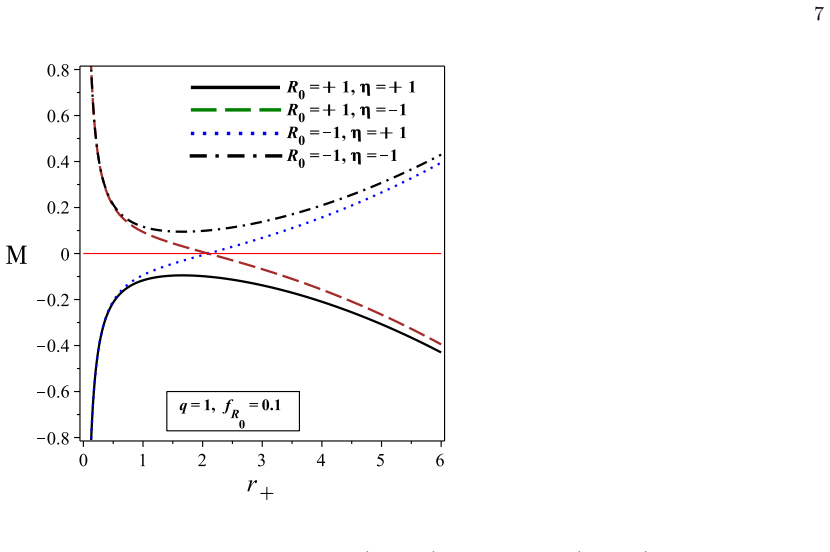
Our analysis shows that the solutions obtained in Eq. (13), can inc lude an event horizon when R0 is negative. This leads to two distinct behaviors for BTZ black holes depending on w hether R0 is negative or positive: 1- For R0 > 0: The solutions yield a real root that does not correspond to the eve nt horizon. Therefore, for R0 > 0, no BTZ black hole sol...
-
[2]
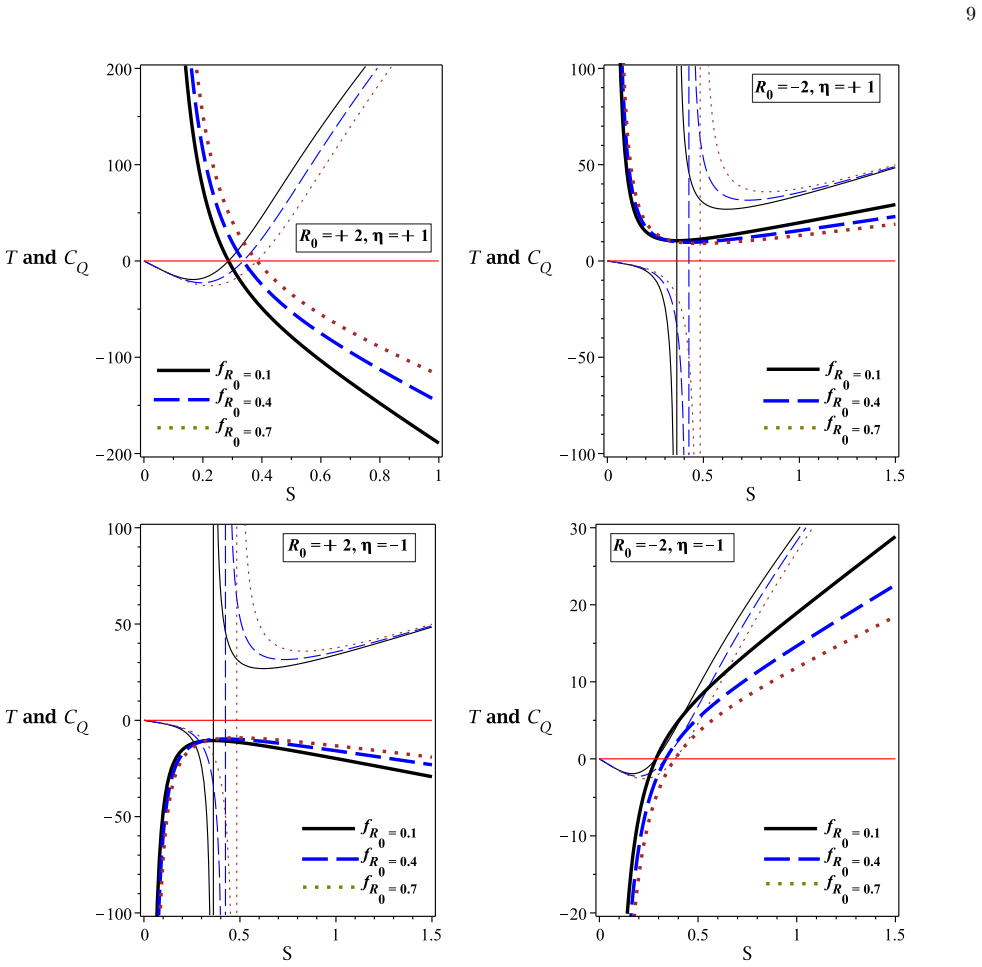
For R0 > 0: Maxwell (η = +1) and phantom (η = − 1) BTZ black holes cannot simultaneously meet the conditions for being physical and stable (see the up-left panel for the Maxwell case and the down-left panel for the phantom case in Fig. 3). Specifically, both the temperature ( T ) and heat capacity ( CQ) cannot be positive at the same time. Furthermore, the...
-
[3]
ForR0< 0: Maxwell (η = +1) and phantom (η = − 1) BTZ black holes, characterized by large entropy or large radius, are physical and stable objects. There are two distinct behaviors observed in Maxwell and phantom BTZ black holes in F (R) gravity: i) For Maxwell BTZ black holes, a phase transition point exists betwee n small unstable and large stable configu...
-
[4]
Substituting back for r, the solution for the trajectory is r (ϕ ) = ηq 21/ 4 (1 +fR0) ( 4℘ (ϕ − ϕ in;g2;g3) − m0 3 )
(93) Equation (91) is of the elliptic type and is solved by the Weierstrass ℘ function [122, 123] y (ϕ ) = ℘ (ϕ − ϕ in;g2;g3), (94) with ϕ in =ϕ 0 + ∫ ∞ y0 dy√ 4y3 − g2y − g3 , where y0 = a3 4r0 + a2 12 depends on the initial position r0 andϕ 0. Substituting back for r, the solution for the trajectory is r (ϕ ) = ηq 21/ 4 (1 +fR0) ( 4℘ (ϕ − ϕ in;g2;g3) − ...
-
[5]
In the phantom regime the effective potential develops a pronounced minimum, indicating the possibility of stable circular orbits
2, and R0 = − 2, with various points marked.the effective potential develops a pro nounced minimum, indicating the possibility of stable circular orbits. In the phantom regime the effective potential develops a pronounced minimum, indicating the possibility of stable circular orbits. In contrast, for t he Maxwell case, the potential is monotonic and no boun...
-
[6]
Hassaine, and C
M. Hassaine, and C. Martinez, Phys. Rev. D 75, 027502 (2007)
2007
-
[7]
Hassaine, and C
M. Hassaine, and C. Martinez, Class. Quantum Gravit. 25, 195023 (2008)
2008
-
[8]
Maeda, M
H. Maeda, M. Hassaine, and C. Martinez, Phys. Rev. D 79, 044012 (2009)
2009
-
[9]
S. H. Hendi, Phys. Lett. B 678, 438 (2009)
2009
-
[10]
S. H. Hendi, Class. Quantum Gravit. 26, 225014 (2009)
2009
-
[11]
Eslam Panah, Europhys
B. Eslam Panah, Europhys. Lett. 134, 20005 (2021)
2021
-
[12]
S. H. Mazharimousavi, Mod. Phys. Lett. A 37, 2250170 (2022)
2022
-
[13]
H. A. Buchdahl, MNRAS 150, 1 (1970)
1970
-
[14]
S. M. Carroll, V. Duvvuri, M. Trodden, and M. S. Turner, Ph ys. Rev. D 70, 043528 (2004)
2004
-
[15]
Cognola, E
G. Cognola, E. Elizalde, S. Nojiri, S. D. Odintsov, and S . Zerbini, JCAP 02, 010 (2005)
2005
-
[16]
Nojiri, and S
S. Nojiri, and S. D. Odintsov, Phys. Rev. D 74, 086005 (2006)
2006
-
[17]
Faraoni, ”f(R) gravity: successes and challenges”, [arXiv:0810.2602]
V. Faraoni, ”f(R) gravity: successes and challenges”, [arXiv:0810.2602]
-
[18]
Nojiri, S
S. Nojiri, S. D. Odintsov, and D. Saez-Gomez, Phys. Lett . B 681, 74 (2009)
2009
-
[19]
T. P. Sotiriou, J. Phys. Conf. Ser. 189, 012039 (2009)
2009
-
[20]
T. P. Sotiriou, and V. Faraoni, Rev. Mod. Phys. 82, 451 (2010)
2010
-
[21]
Nojiri, and S
S. Nojiri, and S. D. Odintsov, Phys. Rept. 505, 59 (2011)
2011
-
[22]
G. J. Olmo, Int. J. Mod. Phys. D 20, 413 (2011)
2011
-
[23]
Bamba, A
K. Bamba, A. N. Makarenko, A. N. Myagky, S. Nojiri, and S. D. Odintsov, JCAP 01, 008 (2014)
2014
-
[24]
Nojiri, S
S. Nojiri, S. D. Odintsov, and V. K. Oikonomou, JCAP 05, 046 (2016)
2016
-
[25]
Nojiri, S
S. Nojiri, S. D. Odintsov, and V. K. Oikonomou, Phys. Rep t. 692, 1 (2017)
2017
-
[26]
G. G. L. Nashed, and S. Capozziello, Phys. Rev. D 99, 104018 (2019)
2019
-
[27]
A. A. Starobinsky, Phys. Lett. B 91, 99 (1980)
1980
-
[28]
Sawicki, and W
I. Sawicki, and W. Hu, Phys. Rev. D 75, 127502 (2007)
2007
-
[29]
Amendola, and S
L. Amendola, and S. Tsujikawa, Phys. Lett. B 660, 125 (2008)
2008
-
[30]
Kobayashi, and K
T. Kobayashi, and K. -i. Maeda, Phys. Rev. D 78, 064019 (2008)
2008
-
[31]
Tsujikawa, Phys
S. Tsujikawa, Phys. Rev. D 77, 023507 (2008)
2008
-
[32]
Capozziello, et al., Astron
S. Capozziello, et al., Astron. Astrophys. 505, 21 (2009)
2009
-
[33]
Babichev, and D
E. Babichev, and D. Langlois, Phys. Rev. D 81, 069901 (2010)
2010
-
[34]
A. V. Astashenok, S. Capozziello, and S. D. Odintsov, JC AP 12, 040 (2013)
2013
-
[35]
A. V. Astashenok, and S. D. Odintsov, Particles. 3, 532 (2020)
2020
-
[36]
Numajiri, Y
K. Numajiri, Y. -X. Cui, T. Katsuragawa, and S. Nojiri, P hys. Rev. D 107, 104019 (2023)
2023
-
[37]
Y. -X. Cui, Z. Yan, K. Numajiri, T. Katsuragawa, and S. No jiri, Phys. Rev. D 110, 084028 (2024)
2024
-
[38]
Capozziello, and R
S. Capozziello, and R. Garattini, Class. Quant. Grav. 24, 1627 (2007)
2007
-
[39]
Nojiri, and S
S. Nojiri, and S. D. Odintsov, Phys. Lett. B 657, 238 (2007)
2007
-
[40]
Nojiri, and S
S. Nojiri, and S. D. Odintsov, Phys. Rev. D 77, 026007 (2008)
2008
-
[41]
S. A. Appleby, and R. A. Battye, JCAP 05, 019 (2008)
2008
-
[42]
Cognola, E
G. Cognola, E. Elizalde, S. Nojiri, S. D. Odintsov, L. Se bastiani, and S. Zerbini, Phys. Rev. D 77, 046009 (2008)
2008
-
[43]
Bamba, and S
K. Bamba, and S. D. Odintsov, JCAP 04, 024 (2008)
2008
-
[44]
Nojiri, and S
S. Nojiri, and S. D. Odintsov, Phys. Rev. D 78, 046006 (2008)
2008
-
[45]
Elizalde, S
E. Elizalde, S. Nojiri, S. D. Odintsov, and D. Saez-Gome z, Eur. Phys. J. C 70, 351 (2010)
2010
-
[46]
Nojiri, S
S. Nojiri, S. D. Odintsov, and V. K. Oikonomou, Class. Qu antum Grav. 34, 245012 (2017)
2017
-
[47]
S. D. Odintsov, V. K. Oikonomou, and L. Sebastiani, Nucl . Phys. B 923, 608 (2017)
2017
-
[48]
Capozziello, and A
S. Capozziello, and A. Troisi, Phys. Rev. D 72, 044022 (2005)
2005
-
[49]
Capozziello, A
S. Capozziello, A. Stabile, and A. Troisi, Phys. Rev. D 76, 104019 (2007)
2007
-
[50]
Multamaki and I
T. Multamaki and I. Vilja, Phys. Rev. D 74, 064022 (2006)
2006
-
[51]
de la Cruz-Dombriz, A
A. de la Cruz-Dombriz, A. Dobado, and A. L. Maroto, Phys. Rev. D 80, 124011 (2009)
2009
-
[52]
T. Moon, Y. S. Myung, and E. J. Son, Gen. Relativ. Gravit. 43, 3079 (2011)
2011
-
[53]
S. H. Hendi, R. B. Mann, N. Riazi, and B. Eslam Panah, Phys . Rev. D 86, 104034 (2012). 21
2012
-
[54]
S. H. Hendi, B. Eslam Panah, and S. M. Mousavi, Gen. Relat iv. Gravit. 44, 835 (2012)
2012
-
[55]
S. Chen, X. Liu, and C. Liu, Chin. Phys. Lett. 30, 060401 (2013)
2013
-
[56]
S. H. Hendi, B. Eslam Panah, and C. Corda, Can. J. Phys. 92, 76 (2014)
2014
-
[57]
Bazeia, et al., Phys
D. Bazeia, et al., Phys. Rev. D 90, 044011 (2014)
2014
-
[58]
Amirabi, M
Z. Amirabi, M. Halilsoy, and S. Habib Mazharimousavi, E ur. Phys. J. C 76, 338 (2016)
2016
-
[59]
Li, and J.-X
G.-Q. Li, and J.-X. Mo, Phys. Rev. D 93, 124021 (2016)
2016
-
[60]
V. K. Oikonomou, Int. J. Mod. Phys. D 25, 1650078 (2016)
2016
-
[61]
Chabab, et al., Lett
M. Chabab, et al., Lett. High Energy. Phys. 02, 05 (2018)
2018
-
[62]
Bhattacharyya, and S
S. Bhattacharyya, and S. Shankaranarayanan, Eur. Phys . J. C 78, 737 (2018)
2018
-
[63]
A. K. Mishra, M. Rahman, and S. Sarkar, Class. Quantum Gr av. 35, 145011 (2018)
2018
-
[64]
G. G. L. Nashed, and S. Nojiri, Phys. Rev. D 102, 124022 (2020)
2020
-
[65]
G. G. L. Nashed, and S. Nojiri, JCAP 11, 007 (2021)
2021
-
[66]
Karakasis, et al., Phys
T. Karakasis, et al., Phys. Rev. D 103, 064063 (2021)
2021
-
[67]
Z.-Y. Tang, B. Wang, and E. Papantonopoulos, Eur. Phys. J. C 81, 346 (2021)
2021
-
[68]
Eslam Panah, J
B. Eslam Panah, J. Math. Phys. 63, 112502 (2022)
2022
-
[69]
De Falco, et al., Eur
V. De Falco, et al., Eur. Phys. J. C 83, 456 (2023)
2023
-
[70]
Karmakar, and U
R. Karmakar, and U. D. Goswami, Eur. Phys. J. C 84, 969 (2024)
2024
-
[71]
G. J. Olmo, and D. Rubiera-Garcia, Phys. Rev. D 84, 124059 (2011)
2011
-
[72]
S. H. Mazharimousavi, and M. Halilsoy, Phys. Rev. D 84, 064032 (2011)
2011
-
[73]
S. H. Hendi, B. Eslam Panah, and R. Saffari, Int. J. Mod. Ph ys. D 23, 1450088 (2014)
2014
-
[74]
M. E. Rodrigues, et al., Phys. Rev. D 94, 024062 (2016)
2016
-
[75]
G. G. L. Nashed, and E. N. Saridakis, Phys. Rev. D 102, 124072 (2020)
2020
-
[76]
E. F. Eiroa, and G. Figueroa-Aguirre, Eur. Phys. J. Plus . 137, 478 (2022)
2022
-
[77]
Eslam Panah, Prog
B. Eslam Panah, Prog. Theor. Exp. Phys. 2024, 023E01 (2024)
2024
-
[78]
G. G. L. Nashed, Phys. Dark Univese. 44, 101462 (2024)
2024
-
[79]
Banados, C
M. Banados, C. Teitelboim, and J. Zanelli, Phys. Rev. Le tt. 69, 1849 (1992)
1992
- [80]
discussion (0)
Sign in with ORCID, Apple, or X to comment. Anyone can read and Pith papers without signing in.