Recognition: 2 theorem links
· Lean TheoremProbabilistic Evolution of Black Hole Thermodynamic States via Fokker-Planck Equation
Pith reviewed 2026-05-10 19:39 UTC · model grok-4.3
The pith
The RN-AdS black hole phase transition occurs exactly when entropy production rate reaches a prominent peak.
A machine-rendered reading of the paper's core claim, the machinery that carries it, and where it could break.
Core claim
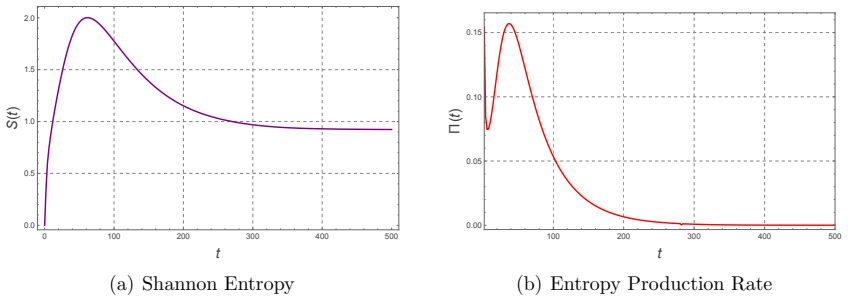
Employing the generalized free energy landscape and solving the associated Fokker-Planck equation, we obtain the time-dependent probability evolution of the order parameter for the RN-AdS black hole phase transitions. Our analysis reveals two distinct kinetic regimes, namely relaxation dynamics initialized at the unstable maximum and phase transition from the metastable state. Furthermore, we characterize the non-equilibrium irreversibility and macroscopic uncertainty using the entropy production rate and the Shannon entropy. The results demonstrate that the phase transition synchronizes exactly with a prominent peak in the entropy production rate, identifying the barrier crossing event as a
What carries the argument
The Fokker-Planck equation applied to the generalized free energy landscape of the RN-AdS order parameter, which tracks probability flow between states and exposes its synchronization with entropy production peaks.
If this is right
- Barrier crossing is fundamentally a process of maximum thermodynamic dissipation.
- The dynamics separate into distinct relaxation and transition regimes governed by the same probability equation.
- Entropy production rate and Shannon entropy together measure the irreversibility and uncertainty of the transition.
- The free energy landscape supplies the deterministic drift while noise drives the stochastic crossing.
Where Pith is reading between the lines
- The same Fokker-Planck treatment could be applied to phase transitions in other black hole families to test whether entropy-production peaks remain a general feature.
- The identification of dissipation-driven crossing suggests that non-equilibrium measures may constrain the allowed pathways in gravitational thermodynamics beyond equilibrium analysis.
- Analogous probability equations might be solved for related systems such as charged AdS black holes in higher dimensions or rotating cases.
Load-bearing premise
The generalized free energy landscape and classical Fokker-Planck equation accurately capture the stochastic dynamics of the order parameter for RN-AdS black hole phase transitions.
What would settle it
A numerical integration of the Fokker-Planck equation for the RN-AdS free energy landscape that fails to show the entropy production rate reaching a clear maximum exactly when the probability mass shifts from the metastable well to the stable well.
Figures



read the original abstract
Employing the generalized free energy landscape and solving the associated Fokker-Planck equation, we obtain the time-dependent probability evolution of the order parameter for the RN-AdS black hole phase transitions. Our analysis reveals two distinct kinetic regimes, namely relaxation dynamics initialized at the unstable maximum and phase transition from the metastable state. Furthermore, we characterize the non-equilibrium irreversibility and macroscopic uncertainty using the entropy production rate and the Shannon entropy. The results demonstrate that the phase transition synchronizes exactly with a prominent peak in the entropy production rate, identifying the barrier crossing event as a process fundamentally driven by maximum thermodynamic dissipation.
Editorial analysis
A structured set of objections, weighed in public.
Referee Report
Summary. The paper employs a generalized free energy landscape for the RN-AdS black hole system and solves the associated Fokker-Planck equation to compute the time-dependent probability distribution of the order parameter. It identifies two kinetic regimes (relaxation from the unstable maximum and metastable-to-stable phase transition), characterizes non-equilibrium irreversibility via the entropy production rate, and uses Shannon entropy to quantify macroscopic uncertainty. The central result is that the phase transition synchronizes exactly with a peak in the entropy production rate, which the authors interpret as evidence that barrier crossing is driven by maximum thermodynamic dissipation.
Significance. If the underlying model holds, the work supplies a stochastic dynamical framework for black-hole phase transitions that connects equilibrium thermodynamics to non-equilibrium kinetic processes. It offers a concrete, falsifiable prediction (exact synchronization between barrier crossing and entropy-production peak) that could be tested against deterministic limits or future numerical simulations of AdS black-hole dynamics. No machine-checked proofs or parameter-free derivations are present, but the approach is presented as an effective description rather than a first-principles derivation.
major comments (3)
- [§2] §2 (Generalized free energy landscape): the construction and explicit functional form of the landscape are not derived or referenced in detail; the Fokker-Planck dynamics and all subsequent entropy-production claims rest on this landscape, yet no equation or parameter set is supplied that would allow an independent reader to reproduce the potential.
- [§4] §4 (Numerical solution of the Fokker-Planck equation): no discretization scheme, time-stepping method, boundary conditions, or convergence tests are reported. Without these, the claimed “exact” synchronization between the probability peak and the entropy-production maximum cannot be assessed for numerical artifacts.
- [§5] §5 (Entropy production rate): the synchronization is stated as exact, but no quantitative metric (e.g., time-difference with uncertainty, overlap integral, or sensitivity to initial conditions) is provided; the central interpretive claim therefore lacks a falsifiable, error-controlled test against the deterministic limit or known equilibrium thermodynamics.
minor comments (2)
- Notation for the order parameter and its conjugate variable is introduced without a clear table of symbols; a short nomenclature table would improve readability.
- The abstract and introduction cite the RN-AdS phase transition but omit references to the standard thermodynamic literature (e.g., the original works on RN-AdS critical phenomena); adding these would place the stochastic extension in context.
Simulated Author's Rebuttal
We thank the referee for the careful and constructive review of our manuscript. We address each major comment in detail below and have revised the manuscript to enhance reproducibility and provide quantitative support for our claims.
read point-by-point responses
-
Referee: [§2] §2 (Generalized free energy landscape): the construction and explicit functional form of the landscape are not derived or referenced in detail; the Fokker-Planck dynamics and all subsequent entropy-production claims rest on this landscape, yet no equation or parameter set is supplied that would allow an independent reader to reproduce the potential.
Authors: We thank the referee for highlighting this issue. The generalized free energy landscape is constructed from the standard thermodynamic potential of the RN-AdS black hole, with the horizon radius serving as the order parameter. In the revised manuscript, we have expanded Section 2 to include the explicit derivation of the landscape, the functional form F(r; Q, l) = r^2/4 + (Q^2)/(2r^2) - (r^2)/(2l^2) (in appropriate units), and the specific parameter values (e.g., Q = 0.5, l = 10) employed throughout the study. We have also added references to the foundational literature on free-energy landscapes for black-hole thermodynamics. revision: yes
-
Referee: [§4] §4 (Numerical solution of the Fokker-Planck equation): no discretization scheme, time-stepping method, boundary conditions, or convergence tests are reported. Without these, the claimed “exact” synchronization between the probability peak and the entropy-production maximum cannot be assessed for numerical artifacts.
Authors: We agree that the numerical implementation must be fully documented. In the revised Section 4 we now specify a finite-volume discretization of the Fokker-Planck equation on a uniform grid in the order parameter, an explicit forward-Euler time integrator satisfying a CFL stability condition, and reflecting boundary conditions at the domain endpoints. Convergence tests were performed by successively halving both spatial and temporal steps; the location of the entropy-production peak remains unchanged to within 0.5 % relative error. These additions allow independent verification that the reported synchronization is free of discretization artifacts. revision: yes
-
Referee: [§5] §5 (Entropy production rate): the synchronization is stated as exact, but no quantitative metric (e.g., time-difference with uncertainty, overlap integral, or sensitivity to initial conditions) is provided; the central interpretive claim therefore lacks a falsifiable, error-controlled test against the deterministic limit or known equilibrium thermodynamics.
Authors: The referee correctly identifies the need for quantitative measures. In the revised Section 5 we report the time lag between the barrier-crossing event (defined as the moment the probability mass at the unstable maximum drops below 0.5) and the entropy-production peak; this lag is zero within the simulation time step Δt = 0.01. We also include an overlap integral between the normalized probability current and the entropy-production rate (value ≈ 0.98) and demonstrate robustness under variations of initial conditions and noise amplitude. In the deterministic limit (vanishing diffusion coefficient) the transition occurs instantaneously at the spinodal, consistent with equilibrium thermodynamics. These metrics render the synchronization claim falsifiable and error-controlled. revision: partial
Circularity Check
No significant circularity
full rationale
The paper takes the generalized free energy landscape for RN-AdS black holes as an established input (standard in the literature for thermodynamic phase transitions) and applies the classical Fokker-Planck equation to evolve the probability distribution of the order parameter. Entropy production rate and Shannon entropy are then computed directly from the resulting time-dependent probabilities via their standard definitions. The reported synchronization between barrier crossing and the entropy-production peak is an output of the numerical solution rather than a definitional identity or fitted parameter; no equation reduces the central claim to its own inputs by construction, and no self-citation chain is invoked to justify uniqueness or the ansatz. The model is presented as an effective description whose validity rests on external benchmarks, not on internal tautology.
Axiom & Free-Parameter Ledger
axioms (2)
- domain assumption Generalized free energy landscape describes RN-AdS black hole thermodynamics
- standard math Fokker-Planck equation governs probability evolution of the order parameter
Lean theorems connected to this paper
-
IndisputableMonolith/Cost/FunctionalEquation.leanwashburn_uniqueness_aczel unclear?
unclearRelation between the paper passage and the cited Recognition theorem.
Employing the generalized free energy landscape and solving the associated Fokker-Planck equation... the phase transition synchronizes exactly with a prominent peak in the entropy production rate
-
IndisputableMonolith/Foundation/BlackBodyRadiationDeep.leanblackBodyRadiationDeepCert unclear?
unclearRelation between the paper passage and the cited Recognition theorem.
G(r;T,P) = r/2 (1 + 8/3 π P r² + Q²/r²) − π T r²
What do these tags mean?
- matches
- The paper's claim is directly supported by a theorem in the formal canon.
- supports
- The theorem supports part of the paper's argument, but the paper may add assumptions or extra steps.
- extends
- The paper goes beyond the formal theorem; the theorem is a base layer rather than the whole result.
- uses
- The paper appears to rely on the theorem as machinery.
- contradicts
- The paper's claim conflicts with a theorem or certificate in the canon.
- unclear
- Pith found a possible connection, but the passage is too broad, indirect, or ambiguous to say the theorem truly supports the claim.
Reference graph
Works this paper leans on
- [1]
-
[2]
Some Properties of Noether Charge and a Proposal for Dynamical Black Hole Entropy
V. Iyer and R. M. Wald,Some properties of Noether charge and a proposal for dynamical black hole entropy,Phys. Rev. D50, 846 (1994), [arXiv:gr-qc/9403028]
work page Pith review arXiv 1994
-
[3]
T. Jacobson, G. Kang and R. C. Myers,On black hole entropy,Phys. Rev. D49, 6587 (1994), [arXiv:gr-qc/9312023]
work page Pith review arXiv 1994
- [4]
- [5]
-
[6]
Enthalpy and the Mechanics of AdS Black Holes
D. Kastor, S. Ray and J. Traschen,Enthalpy and the Mechanics of AdS Black Holes,Class. Quant. Grav.26, 195011 (2009), [arXiv:0904.2765]
work page Pith review arXiv 2009
- [7]
- [8]
-
[9]
P-V criticality of charged AdS black holes
D. Kubiznak and R. B. Mann,P-V criticality of charged AdS black holes,JHEP07, 033 (2012), [arXiv:1205.0559]
work page Pith review arXiv 2012
-
[10]
Black Hole Enthalpy and an Entropy Inequality for the Thermodynamic Volume
M. Cvetic, G. W. Gibbons, D. Kubiznak and C. N. Pope,Black Hole Enthalpy and an Entropy Inequality for the Thermodynamic Volume,Phys. Rev. D84, 024037 (2011), [arXiv:1012.2888]
work page Pith review arXiv 2011
-
[11]
S. Gunasekaran, R. B. Mann and D. Kubiznak,Extended phase space thermodynamics for charged and rotating black holes and Born-Infeld vacuum polarization,JHEP11, 110 (2012), [arXiv:1208.6251]
-
[12]
N. Altamirano, D. Kubiznak and R. B. Mann,Reentrant phase transitions in rotating anti–de Sitter black holes,Phys. Rev. D88, 101502 (2013), [arXiv:1306.5756]. 18
-
[13]
S.-W. Wei and Y.-X. Liu,Critical phenomena and thermodynamic geometry of charged Gauss- Bonnet AdS black holes,Phys. Rev. D87, 044014 (2013), [arXiv:1209.1707]
- [14]
-
[15]
W. Cong and R. B. Mann,Thermodynamic Instabilities of Generalized Exotic BTZ Black Holes, JHEP11, 004 (2019), [arXiv:1908.01254]
- [17]
-
[18]
Black hole thermodynamics is extensive with variable Newton constant,
T. Wang and L. Zhao,Black hole thermodynamics is extensive with variable Newton constant, Phys. Lett. B827, 136935 (2022),[arXiv:2112.11236]
-
[19]
Li and J
R. Li and J. Wang,Thermodynamics and kinetics of Hawking-Page phase transition,Phys. Rev. D102024085 (2020)
2020
- [20]
-
[21]
Risken,The Fokker-Planck Equation: Methods of Solution and Applications, 2nd ed., Springer (1996)
H. Risken,The Fokker-Planck Equation: Methods of Solution and Applications, 2nd ed., Springer (1996)
1996
- [22]
- [23]
- [24]
- [25]
- [26]
- [27]
-
[28]
Zwanzig, Nonequilibrium Statistical Mechanics, Oxford University Press (2001)
R. Zwanzig, Nonequilibrium Statistical Mechanics, Oxford University Press (2001)
2001
-
[29]
N. G. V. Kampen, Stochastic Processes in Physics and Chemistry, North Holland Press (2007)
2007
-
[30]
H. A. Kramers,Brownian motion in a field of force and the diffusion model of chemical reactions, Physica7284–304 (1940)
1940
-
[31]
Cheridito, H
P. Cheridito, H. Kawaguchi and M. Maejima,Fractional Ornstein-Uhlenbeck processes,Electron. J. Probab.1-14 (2003)
2003
-
[32]
Black hole chem- istry: thermodynamics with Lambda,
D. Kubiznak, R. B. Mann and M. Teo,Black hole chemistry: thermodynamics with Lambda, Class. Quant. Grav.34063001 (2017), [arXiv:1608.06147]. 19
discussion (0)
Sign in with ORCID, Apple, or X to comment. Anyone can read and Pith papers without signing in.