Interband optical conductivities in two-dimensional tilted Dirac bands revisited within the tight-binding model
Pith reviewed 2026-05-10 19:19 UTC · model grok-4.3
The pith
A tight-binding model for tilted Dirac bands produces three critical frequencies in interband optical conductivity that are absent from the linearized k·p approximation.
A machine-rendered reading of the paper's core claim, the machinery that carries it, and where it could break.
Core claim
Within the tight-binding model of two-dimensional tilted Dirac bands, three new characteristic critical frequencies appear in the interband longitudinal optical conductivities: partner frequencies whose origins are clarified by Lagrange-multiplier analysis, plus a sharp-peak frequency and a cutoff frequency tied to interband transitions at high-symmetry points. The sharp-peak and cutoff frequencies are enforced by the Pauli exclusion principle and the finite extent of the Brillouin zone; none of the three appear in the corresponding linearized k·p model, while the sharp-peak and cutoff frequencies stay robust against changes in tilting and Dirac-point position.
What carries the argument
The tight-binding Hamiltonian on the full Brillouin zone that incorporates band tilting and Dirac-point shifting, with interband transitions evaluated at high-symmetry points.
If this is right
- The sharp-peak frequency and cutoff frequency remain robust against variations in band tilting and Dirac-point shifting.
- Analytical expressions derived via the Lagrange multiplier method explain the conventional critical frequencies and their partner counterparts.
- The sharp-peak and cutoff frequencies arise from interband optical transitions at high-symmetry points enforced by the Pauli exclusion principle and the finite boundaries of the Brillouin zone.
- The predictions supply concrete signatures that can guide experimental searches for tilt-dependent optical features in 2D Dirac systems.
Where Pith is reading between the lines
- Detection of the sharp-peak frequency would favor lattice-based modeling over continuum approximations when interpreting optical data in real tilted Dirac materials.
- The same high-symmetry-point mechanism could produce analogous robust features in optical conductivity of other lattice Dirac systems whose linearizations are commonly used.
- Temperature or doping sweeps could be used to test whether the cutoff frequency tracks the Brillouin-zone boundary as expected.
- If the partner frequencies are also observed, they would provide a direct experimental handle on the analytic structure of the conductivity integral beyond the linear regime.
Load-bearing premise
That interband transitions within the single-particle tight-binding bands fully determine the measured conductivity without scattering or many-body effects altering the response at those frequencies.
What would settle it
Optical conductivity spectra measured on a specific 2D tilted Dirac material (for example, appropriately strained graphene or a designer lattice) that either show or lack a sharp peak at the frequency predicted by the tight-binding calculation but forbidden in the k·p limit.
Figures
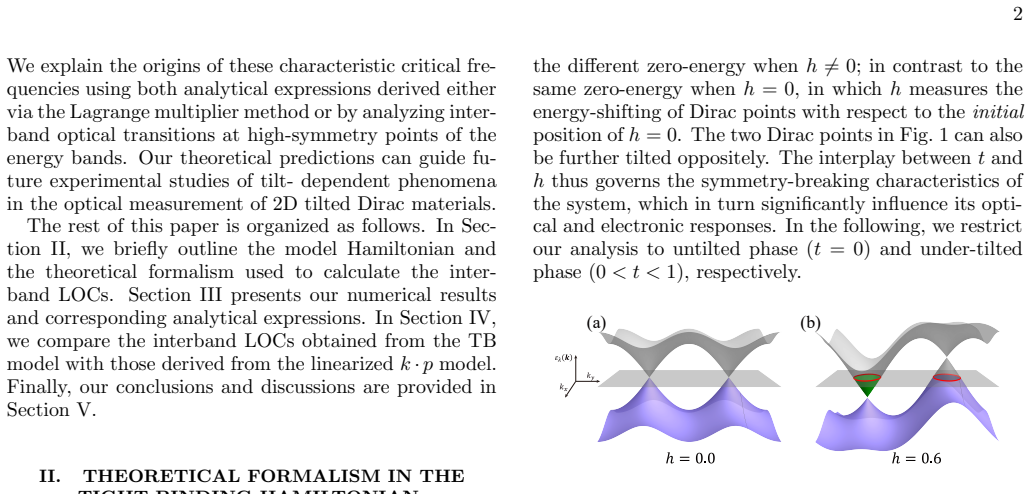


read the original abstract
Within the framework of linear response theory, we theoretically investigated the interband longitudinal optical conductivities (LOCs) in two-dimensional (2D) tilted Dirac bands using a tight-binding (TB) model, incorporating the effects of band tilting and Dirac-point shifting. We identified three characteristic critical frequencies in the interband LOCs of the TB model: the partner frequencies, the sharp- peak frequency, and the cutoff frequency. In contrast to conventional critical frequencies, these three types are consistently absent in the corresponding linearized $k\cdot p$ model. Notably, the sharp-peak frequency and cutoff frequency remain robust against variations in band tilting and Dirac-point shifting. By employing analytical expressions derived via the Lagrange multiplier method, we elucidate the origins of the conventional critical frequencies and their partner counterparts. In contrast, the sharp-peak frequency and cutoff frequency are associated with interband optical transitions at high-symmetry points of the energy bands, arising from the Pauli exclusion principle and the finite boundaries of the Brillouin zone. Our theoretical predictions are intended to guide future experimental studies on tilt-dependent optical phenomena in 2D tilted Dirac systems.
Editorial analysis
A structured set of objections, weighed in public.
Referee Report
Summary. The paper theoretically investigates the interband longitudinal optical conductivities in two-dimensional tilted Dirac bands using a tight-binding model within linear response theory. It identifies three characteristic critical frequencies in the TB model—the partner frequencies, the sharp-peak frequency, and the cutoff frequency—that are absent in the linearized k·p model. The partner frequencies are derived analytically using the Lagrange multiplier method, while the sharp-peak and cutoff frequencies are associated with interband transitions at high-symmetry points, Pauli exclusion principle, and finite Brillouin zone boundaries. These latter two are robust against variations in band tilting and Dirac-point shifting.
Significance. If the results hold, the work demonstrates the necessity of going beyond linearized approximations to capture certain optical features in tilted Dirac systems, providing concrete predictions to guide experiments on tilt-dependent optical phenomena. The analytical derivations via the Lagrange multiplier method and the robustness analysis against tilting and shifting are strengths.
minor comments (3)
- The abstract would benefit from briefly specifying the tight-binding Hamiltonian or key parameters (e.g., hopping amplitudes or tilting strength) to better contextualize the derived frequencies.
- In the section deriving the critical frequencies, the application of the Lagrange multiplier method to locate partner frequencies should include the explicit constraint equations and resulting analytical expressions for verification.
- The discussion of experimental implications could be strengthened by estimating the frequency scales (in eV or THz) for typical materials and suggesting how the sharp-peak and cutoff features might be distinguished from conventional ones in measurements.
Simulated Author's Rebuttal
We thank the referee for their positive and accurate summary of our work on interband longitudinal optical conductivities in two-dimensional tilted Dirac bands using the tight-binding model. The referee correctly highlights the three characteristic critical frequencies (partner, sharp-peak, and cutoff) absent from the linearized k·p model, as well as the analytical derivations and robustness analysis. We appreciate the recommendation for minor revision.
Circularity Check
No significant circularity detected
full rationale
The derivation proceeds from the tight-binding Hamiltonian for tilted Dirac bands, applies linear response theory to obtain interband LOC expressions, and locates critical frequencies analytically via the Lagrange multiplier method on the TB dispersion; the partner, sharp-peak, and cutoff frequencies are shown to arise from explicit features (high-symmetry points, Pauli blocking, finite BZ) absent by construction from the low-energy k·p expansion. No parameter is fitted to data and then relabeled as a prediction, no result is defined in terms of itself, and no load-bearing step reduces to a self-citation or ansatz smuggled from prior work by the same authors. The contrast with k·p is therefore a direct model comparison rather than a circular claim.
Axiom & Free-Parameter Ledger
axioms (2)
- domain assumption Linear response theory applies to calculate interband optical conductivities
- domain assumption The tight-binding model accurately incorporates band tilting and Dirac-point shifting beyond linear approximation
Lean theorems connected to this paper
-
IndisputableMonolith/Foundation/AlexanderDuality.leanalexander_duality_circle_linking unclear?
unclearRelation between the paper passage and the cited Recognition theorem.
We identified three characteristic critical frequencies in the interband LOCs of the TB model: the partner frequencies, the sharp-peak frequency, and the cutoff frequency... associated with interband optical transitions at high-symmetry points... Pauli exclusion principle and the finite boundaries of the Brillouin zone.
-
IndisputableMonolith/Cost/FunctionalEquation.leanwashburn_uniqueness_aczel unclear?
unclearRelation between the paper passage and the cited Recognition theorem.
Re σIB_jj(ω,μ,t,h) = e²π ∫ dkx dky F^{-,+}_jj(k) δ[ω−2Z(kx,ky)ε0] ...
What do these tags mean?
- matches
- The paper's claim is directly supported by a theorem in the formal canon.
- supports
- The theorem supports part of the paper's argument, but the paper may add assumptions or extra steps.
- extends
- The paper goes beyond the formal theorem; the theorem is a base layer rather than the whole result.
- uses
- The paper appears to rely on the theorem as machinery.
- contradicts
- The paper's claim conflicts with a theorem or certificate in the canon.
- unclear
- Pith found a possible connection, but the passage is too broad, indirect, or ambiguous to say the theorem truly supports the claim.
Reference graph
Works this paper leans on
-
[1]
Further, the part- ner frequency ω′ 1 is equal to the conventional critical fre- quency ω1 with ω′ 1 = ω1. It is because the two Fermi surfaces are of the same Fermi wave vector along arbi- trary direction that the characteristic critical frequencies ω′ 1 = ω′ 2 = ω1 = ω2 = 2µ, and the interband LOCs σIB xx(ω, µ > 0, t = 0 , h = 0) = σIB yy(ω, µ > 0, t = ...
-
[2]
This result indicates that a finite energy shift (h > 0) introduces a new characteristic frequency ω′ j and leads to notable anisotropic behavior in the interband LOCs around this frequency. For the doped case (µ > 0) with shifting of Dirac points (h > 0), the physics of interband LOCs becomes richer, since the Fermi wave vectors differ not only between t...
-
[3]
Besides, the part- ner frequency ω′ j is also greater than the maximum of ω− j and ω+ j , namely, ω′ j > Max{ω− j , ω+ j }. As a conse- quence, the interband LOC σIB xx(ω, µ ≥ 0, t = 0 , h = 0) is equal to σIB yy(ω, µ ≥ 0, t = 0 , h = 0) only when ω is either greater than ω′ 2 or less than ω− 1 . Explicitly, for√ h2 + t2ε0 + (−1)jµ ≥ 0, the conventional c...
work page 2015
-
[4]
K.S. Novoselov, A.K. Geim, S.V. Morozov, D. Jiang, Y. Zhang, S.V. Dubonos, I.V. Grigorieva, and A.A. Firsov, Electric Field Effect in Atomically Thin Carbon Films, Science 306, 666 (2004)
work page 2004
-
[5]
A.H. Castro Neto, F. Guinea, N.M.R. Peres, K.S. Novoselov, and A.K. Geim, The electronic properties of graphene, Rev. Mod. Phys. 81, 109 (2009)
work page 2009
-
[6]
S. Katayama, A. Kobayashi, and Y. Suzumura, Pressure- Induced Zero-Gap Semiconducting State in Organic Con- ductor α-(BEDT-TTF)2I3 Salt, J. Phys. Soc. Jpn. 75, 054705 (2006)
work page 2006
- [7]
-
[8]
X.F. Zhou, X. Dong, A.R. Oganov, Q. Zhu, Y.J. Tian, and H.T. Wang, Semimetallic 2D Boron Allotrope with Massless Dirac Fermions, Phys. Rev. Lett. 112, 085502 (2014)
work page 2014
-
[9]
Andrew J. Mannix, X.-F. Zhou, B. Kiraly, Joshua D. Wood, D. Alducin, Benjamin D. Myers, X. Liu, Bran- don L. Fisher, U. Santiago, Jeffrey R. Guest, Miguel J. Yacaman, A. Ponce, Artem R. Oganov , Mark C. Her- sam, and Nathan P. Guisinger, Synthesis of borophenes: Anisotropic, two-dimensional boron polymorphs, Sci- ence, 350, 1513 (2015)
work page 2015
-
[10]
A. Lopez-Bezanilla and P.B. Littlewood, Electronic properties of 8- P mmn borophene, Phys. Rev. B 93, 241405(R) (2016)
work page 2016
-
[11]
A.D. Zabolotskiy and Yu. E. Lozovik, Strain-induced pseudomagnetic field in the Dirac semimetal borophene, Phys. Rev. B 94, 165403 (2016)
work page 2016
-
[12]
K.F. Mak, C. Lee, J. Hone, J. Shan, and T.F. Heinz, Atomically Thin MoS2: A New Direct-Gap Semiconduc- tor, Phys. Rev. Lett. 105, 136805 (2010)
work page 2010
- [13]
-
[14]
X. Qian, J. Liu, L. Fu, and J. Li, Quantum spin Hall ef- fect in two-dimensional transition metal dichalcogenides, Science 346, 1344 (2014)
work page 2014
-
[15]
H.Y. Lu, A.S.Cuamba, S.Y. Lin, L. Hao, R. Wang, H. Li, Y.Y. Zhao, and C.S. Ting, Tilted anisotropic Dirac cones in partially hydrogenated graphene, Phys. Rev. B 94, 195423 (2016)
work page 2016
-
[16]
Y. Ma, L. Kou, X. Li, Y. Dai, and T. Heine, Room tem- perature quantum spin Hall states in two-dimensional crystals composed of pentagonal rings and their quan- tum wells, NPG Asia Mater. 8, 264 (2016)
work page 2016
- [17]
-
[18]
S. Li, Y. Liu, Z.-M. Yu, Y. Jiao, S. Guan, X.-L. Sheng, Y. Yao, and S.A. Yang, Two-dimensional antiferromagnetic Dirac fermions in monolayer TaCoTe2, Phys. Rev. B 100, 205102 (2019)
work page 2019
- [19]
- [20]
-
[21]
K. Sadhukhan and A. Agarwal, Anisotropic plas- mons, Friedel oscillations, and screening in 8- P mmn borophene, Phys. Rev. B 96, 035410 (2017)
work page 2017
-
[22]
Z. Jalali-Mola and S.A. Jafari, Tilt-induced kink in the plasmon dispersion of two-dimensional Dirac electrons, Phys. Rev. B 98, 195415 (2018)
work page 2018
-
[23]
K. Liu, J. Li, Q.-X. Li, and J.-J. Zhu, Anisotropic plasmon dispersion and damping in multilayer 8- P mmn borophene structures, Chin. Phys. B 31, 117303 (2022)
work page 2022
-
[24]
M.A. Mojarro, R. Carrillo-Bastos, and Jes´ us A. May- torena, Hyperbolic plasmons in massive tilted two- dimensional Dirac materials, Phys. Rev. B 105, L201408 (2022)
work page 2022
-
[25]
T. Nishine, A. Kobayashi, and Y. Suzumura, New Plas- mon and Filtering Effect in a Pair of Tilted-Dirac Cone, J. Phys. Soc. Jpn. 80,114713 (2011)
work page 2011
-
[26]
T. Nishine, A. Kobayashi, and Y. Suzumura, Plasmon and Optical conductivity of Massless Dirac Fermions, J. Phys. Soc. Jpn. 79, 114715 (2010)
work page 2010
- [27]
- [28]
-
[29]
S.A. Herrera and G.G. Naumis, Kubo conductivity for anisotropic tilted Dirac semimetals and its application to 8-P mmn borophene: Role of frequency, temperature, and scattering limits, Phys. Rev. B 100, 195420 (2019)
work page 2019
-
[30]
S. Rostamzadeh, ˙Inan¸ c. Adagideli, and M.O. Goerbig, Large enhancement of conductivity in Weyl semimetals with tilted cones: Pseudorelativity and linear response, Phys. Rev. B 100, 075438 (2019). 12
work page 2019
- [31]
- [32]
- [33]
-
[34]
Mojarro, R.Carrillo-Bastos, and Jes´ us A
M.A. Mojarro, R.Carrillo-Bastos, and Jes´ us A. May- torena, Optical properties of massive anisotropic tilted Dirac systems, Phys. Rev. B 103, 165415 (2021)
work page 2021
-
[35]
A. Wild, E. Mariani, and M. E. Portnoi, Optical absorp- tion in two-dimensional materials with tilted Dirac cones, Phys. Rev. B 105, 205306 (2022)
work page 2022
-
[36]
H. Yao, M. Zhu, L. Jiang, and Y. Zheng, Effect of the Dirac-cone tilt on the disorder-broadened Landau levels in a two-dimensional Dirac nodal system, Phys. Rev. B 104, 235406 (2021)
work page 2021
-
[37]
Jayannavar, Signature of tilted Dirac cones in Weiss oscillations of 8- P mmn borophene, Phys
SK Firoz Islam and A.M. Jayannavar, Signature of tilted Dirac cones in Weiss oscillations of 8- P mmn borophene, Phys. Rev. B 96, 235405 (2017)
work page 2017
-
[38]
S.-H. Zhang and W. Yang, Oblique Klein tunneling in 8- Pmmn borophene p-n junctions, Phys. Rev. B97, 235440 (2018)
work page 2018
-
[39]
Z. Kong, J. Li, Y. Zhang, S.-H. Zhang, and J.-J. Zhu, Oblique and asymmetric Klein tunneling across smooth NP junctions or NPN junctions in 8- P mmn borophene, Nanomaterials 11, 1462 (2021)
work page 2021
-
[40]
V.H. Nguyen and J. C. Charlier, Klein tunneling and electron optics in Dirac-Weyl fermion systems with tilted energy dispersion, Phys. Rev. B 97, 235113 (2018)
work page 2018
- [41]
-
[42]
G.C. Paul, SK Firoz Islam, and A. Saha, Fingerprints of tilted Dirac cones on the RKKY exchange interaction in 8-P mmn borophene, Phys. Rev. B 99, 155418 (2019)
work page 2019
-
[43]
S.-H. Zhang, D.-F. Shao, and W. Yang, Velocity- determined anisotropic behaviors of RKKY interaction in 8-P mmn borophene, J. Mag. Mag. Mater. 491, 165631 (2019)
work page 2019
-
[44]
S.-H. Zheng, H.-J. Duan, J.-K. Wang, J.-Y. Li, M.-X. Deng, and R.-Q. Wang, Origin of planar Hall effect on the surface of topological insulators: Tilt of Dirac cone by an in-plane magnetic field, Phys. Rev. B 101, 041408(R) (2020)
work page 2020
-
[45]
H. Rostami and V. Juricic, Probing quantum criticality using nonlinear Hall effect in a metallic Dirac system, Phys. Rev. Res. 2, 013069 (2020)
work page 2020
-
[46]
S.-H. Zhang, D.-F. Shao, Z.-A. Wang, J. Yang, W. Yang, and E. Y. Tsymbal, Tunneling valley Hall effect driven by tilted Dirac fermions, Phys. Rev. Lett. 131, 246301 (2023)
work page 2023
- [48]
-
[49]
P. Sengupta and E. Bellotti, Anomalous Lorenz number in massive and tilted Dirac systems, Appl. Phys. Lett. 117, 223103 (2020)
work page 2020
- [50]
-
[51]
T. Farajollahpour and S.A. Jafari, Synthetic non-Abelian gauge fields and gravitomagnetic effects in tilted Dirac cone systems, Phys. Rev. Res. 2, 023410 (2020)
work page 2020
-
[52]
Z. Faraei and S.A. Jafari, Electrically charged Andreev modes in two-dimensional tilted Dirac cone systems, Phys. Rev. B 101, 214508 (2020)
work page 2020
- [53]
-
[54]
R.A. Ng, A. Wild, M.E. Portnoi, and R.R. Hartmann, Optical valley separation in two-dimensional semimetals with tilted Dirac cones, Sci. Rep. 12, 7688 (2022)
work page 2022
-
[55]
Yonatan Betancur-Ocampo, E. Diaz-Bautista, and Thomas Stegmann, Valley-dependent time evolution of coherent electron states in tilted anisotropic Dirac mate- rials, Phys. Rev. B 105, 045401 (2022)
work page 2022
-
[56]
V.P. Gusynin, S.G. Sharapov, and J.P. Carbotte, Un- usual Microwave Response of Dirac Quasiparticles in Graphene, Phys. Rev. Lett. 96, 256802 (2006)
work page 2006
-
[57]
V.P. Gusynin, S.G. Sharapov, and J.P. Carbotte, Sum rules for the optical and Hall conductivity in graphene, Phys. Rev. B 75, 165407 (2007)
work page 2007
-
[58]
S.A. Mikhailov and K. Ziegler, New Electromagnetic Mode in Graphene, Phys. Rev. Lett. 99, 016803 (2007)
work page 2007
-
[59]
A.B. Kuzmenko, E. van Heumen, F. Carbone, and D. van der Marel, Universal optical conductance of graphite, Phys. Rev. Lett. 100, 117401 (2008)
work page 2008
- [60]
-
[61]
T. Stauber, N.M.R. Peres, and A.K. Geim, Optical con- ductivity of graphene in the visible region of the spec- trum, Phys. Rev. B 78, 085432 (2008)
work page 2008
-
[62]
L. Stille, C.J. Tabert, and E.J. Nicol, Optical signatures of the tunable band gap and valley-spin coupling in sil- icene, Phys. Rev. B 86, 195405 (2012)
work page 2012
-
[63]
Z. Li and J.P. Carbotte, Longitudinal and spin-valley Hall optical conductivity in single layer MoS2, Phys. Rev. B 86, 205425 (2012)
work page 2012
-
[64]
Z. Li and J.P. Carbotte, Hexagonal warping on opti- cal conductivity of surface states in topological insulator Bi2Te3, Phys. Rev. B 87, 155416 (2013)
work page 2013
-
[65]
X. Xiao and W. Wen, Optical conductivities and signa- tures of topological insulators with hexagonal warping, Phys. Rev. B 88, 045442 (2013)
work page 2013
-
[66]
C.-H. Wu, Dynamical polarization and the optical re- sponse of silicene and related materials, Results in Physics 11, 665 (2018)
work page 2018
-
[67]
Wu, Dynamical current–current correlation in two- dimensional parabolic Dirac systems, Phys
C.-H. Wu, Dynamical current–current correlation in two- dimensional parabolic Dirac systems, Phys. Lett. A 383, 550 (2019)
work page 2019
-
[68]
C.-H. Wu, Integer quantum Hall conductivity and lon- gitudinal conductivity in silicene under the electric field and magnetic field, Eur. Phys. J. B 92, 25 (2019)
work page 2019
-
[69]
The Dirac-like energy scale ε0 is typically of the order 0.2 ∼ 2.0 eV. For instance, ε0 is ∼ 1.0 eV for graphene [1], and 1 .5 ∼ 2.0 eV for 8- Pmmn borophene [5–8], 0.2 ∼ 0.5 eV for 1T ′ transition metal dichalcogenides [11], 13 0.3 ∼ 0.5 eV for α-SnS2 [13], 0.6 eV for α-graphyne [14], 0.4 eV for TaCoTe 2 [15], and 0 .5 ∼ 1.0 eV for TaIrTe 4 [16]. We wish...
-
[70]
See Supplemental Materials at xxx for details
-
[71]
In early January 2015, shortly after the online publica- tion of Ref. [11], Hao-Ran Chang first found that the spin-valley-polarized bands and gaps of 1 T ′-MoS2 un- der a vertical electric field can be well described by in- troducing a key term proportional to the vertical elec- tric field—( τ1 ⊗ σ0) Ez Ec ℏv2Λ— to the low-energy k · p Hamiltonian presen...
-
[72]
Fu, Hexagonal warping effects in the surface states of the topological insulator Bi2Te3, Phys
L. Fu, Hexagonal warping effects in the surface states of the topological insulator Bi2Te3, Phys. Rev. Lett. 103, 266801 (2009)
work page 2009
- [73]
-
[74]
M. Nomura, S. Souma, A. Takayama, T. Sato, T. Taka- hashi, K. Eto, K. Segawa, and Y. Ando, Relationship be- tween Fermi surface warping and out-of-plane spin polar- ization in topological insulators: A view from spin- and angle-resolved photoemission, Phys. Rev. B 89, 045134 (2014)
work page 2014
-
[75]
Z. M. Yu, D. S. Ma, H. Pan, and Y. G. Yao, Double reflection and tunneling resonance in a topological insu- lator: Towards the quantification of warping strength by transport, Phys. Rev. B 96, 125152 (2017)
work page 2017
- [76]
-
[77]
C.-Y. Zhu, S.-H. Zheng, H.-J. Duan, M.-X. Deng, R.- Q. Wang, Double Andreev reflections at surface states of the topological insulators with hexagonal warping, Front. Phys. 15, 23602 (2020). Supplemental Materials to “Interband optical conductivities in two-dimensional tilted Dirac bands revisited within the tight-binding model” VI. EXPLICIT EXPRESSION OF...
work page 2020
-
[78]
Analytical results for h = 0, t = 0 and 0 < µ < (1 − t)ε0 If h = 0, t = 0 and µ > 0, the conditions in Eq.(65) and (66) are simultaneously satisfied only when (2 + λζ) = 0. Then the condition in Eq.(67) gives rise to p X2 + Y 2ε0 = |Y |ε0 ≡ ω 2 ≥ 0, (71) λ ω 2 − µ = 0, (72) leading to ω = 2µ λ ≥ 0. (73) Since µ > 0, we get λ = +1, then ω ≡ 2µ. (74)
-
[79]
Therefore, we focus on the condition in Eq.(67), which is independent of ζ
Analytical results for h = 0, 0 < t < 1 and 0 < µ < (1 − t)ε0 From the solution X = 0, the condition in Eq.(65) is automatically satisfied, and the condition in Eq.(66) can be satisfied if a suitable Lagrange multiplier ζ is chosen. Therefore, we focus on the condition in Eq.(67), which is independent of ζ. We have ω 2 = √ X2 + Y 2ε0 = |Y |ε0 = sgn( Y )Y ...
-
[80]
Therefore, we focus on the condition in Eq.(67), which is independent of ζ
Analytical results for h > 0 The condition in Eq.(65) is automatically satisfied, and the condition in Eq.(66) can be satisfied if a suitable Lagrange multiplier ζ is chosen. Therefore, we focus on the condition in Eq.(67), which is independent of ζ. We have√ X2 + Y 2 = |Y | = sgn(Y )Y for X = 0. It is straightforward that the condition in Eq.(67) reduces...
-
[81]
Analytical results for h > 0, 0 ≤ t < 1 and µ = 0 For h > 0, 0 ≤ t < 1 and µ = 0, we have Y+ = + hq (1 + κλt)2 + h2 , +κλ (1 + κλt) hq (1 + κλt)2 + h2 ≥ 0; (101) Y− = − hq (1 − κλt)2 + h2 , −κλ (1 − κλt) hq (1 − κλt)2 + h2 ≥ 0. (102) 18 For κλ = +1, we have Y+ = + hq (1 + t)2 + h2 , (1 + t) hq (1 + t)2 + h2 ≥ 0; (103) Y− = − hq (1 − t)2 + h2 , − (1 − t) h...
discussion (0)
Sign in with ORCID, Apple, or X to comment. Anyone can read and Pith papers without signing in.