Spin-Phonon Renormalization in CrSBr
Pith reviewed 2026-05-10 19:12 UTC · model grok-4.3
The pith
Spin-phonon renormalization in CrSBr makes zone-center optical phonons visible in RIXS only in the antiferromagnetic phase.
A machine-rendered reading of the paper's core claim, the machinery that carries it, and where it could break.
Core claim
In the low-temperature antiferromagnetic phase of CrSBr, Cr L-edge RIXS spectra display zone-center optical phonons with energies of approximately 43.5 meV and 43.1 meV under sigma polarization along the a and b axes and 42.1 meV under pi polarization. These features vanish at room temperature. Density functional theory and phonon calculations assign them to bond-bending optical modes, and the disappearance is explained as a spin-phonon renormalization effect acting on the L-edge electron-phonon RIXS mechanism.
What carries the argument
Spin-phonon renormalization of the L-edge electron-phonon RIXS mechanism, which selectively activates bond-bending optical phonons only when long-range antiferromagnetic order is present.
If this is right
- RIXS becomes a direct spectroscopic reporter of spin-phonon coupling strength in van der Waals magnets.
- The polarization dependence of the observed phonon energies reflects the anisotropy of the magnetic lattice.
- Room-temperature suppression of the peaks follows immediately from loss of magnetic order.
- Density functional theory phonon assignments confirm the modes are zone-center bond-bending vibrations.
Where Pith is reading between the lines
- The same RIXS temperature dependence could serve as a quick diagnostic for spin-phonon coupling in other chromium-based or layered antiferromagnets.
- Magnetic order may systematically modulate low-energy phonon contributions to thermal transport or carrier scattering in two-dimensional magnets.
- Extending the measurements to applied magnetic fields could map how the renormalization strength tracks the magnetic phase diagram.
Load-bearing premise
The temperature-dependent energy-loss peaks are produced by spin-phonon renormalization of the resonant electron-phonon channel rather than by unrelated changes in electronic structure, scattering pathways, or measurement artifacts.
What would settle it
Acquire RIXS spectra on an isostructural non-magnetic compound or on CrSBr above the Néel temperature while holding all other experimental parameters fixed; persistence of the same energy-loss features would falsify the renormalization claim.
Figures
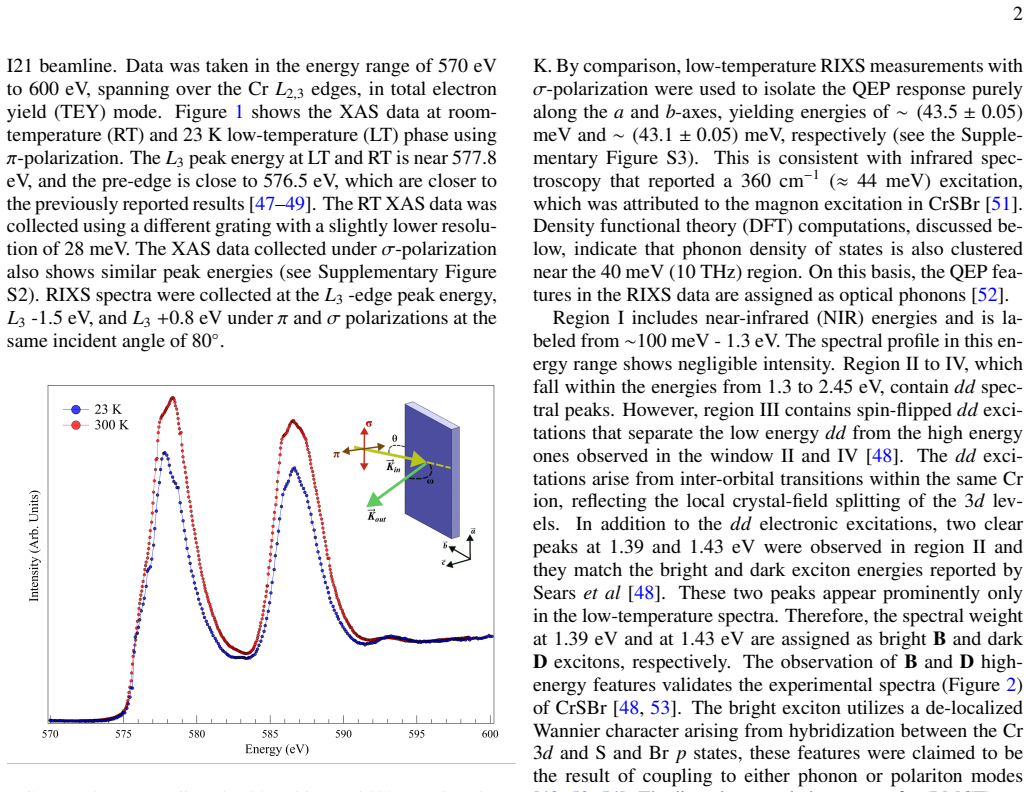


read the original abstract
Direct experimental evidence of spin-phonon coupling in CrSBr is provided by the temperature dependent Cr L-edge resonant inelastic x-ray scattering (RIXS) spectra. Zone-center optical phonons are observed exclusively in the low-temperature antiferromagnetic phase as energy loss features. These phonon modes have energies of approximately, 43.5 meV and 43.1 meV for x-rays that are {\sigma}-polarized along the a and b axes, respectively. While a phonon mode of approximately 42.1 meV is observed under {\pi}-polarization. Density functional theory and phonon mode calculations identify these features as bond-bending optical phonon modes arising in the RIXS spectra. Room temperature melting of these low-energy RIXS peaks is explained in terms of a spin-phonon renormalization effect on the L-edge electron-phonon RIXS mechanism.
Editorial analysis
A structured set of objections, weighed in public.
Referee Report
Summary. The manuscript reports direct experimental evidence of spin-phonon coupling in CrSBr via temperature-dependent Cr L-edge RIXS spectra. Zone-center optical phonons (~43.5 meV for σ-polarization along a, ~43.1 meV along b, and ~42.1 meV for π-polarization) appear exclusively in the low-temperature antiferromagnetic phase as energy-loss features and are identified by DFT phonon calculations as bond-bending optical modes. Their disappearance above TN is attributed to spin-phonon renormalization modifying the L-edge electron-phonon RIXS mechanism.
Significance. If the central interpretation is substantiated, the work provides polarization-resolved RIXS evidence for spin-phonon coupling in a van der Waals antiferromagnet, linking magnetic order to phonon visibility in the RIXS channel. The combination of temperature-dependent measurements and DFT mode assignment is a positive feature; however, the absence of quantitative modeling of the RIXS cross-section limits the strength of the renormalization claim.
major comments (1)
- Abstract and the section explaining the temperature dependence: the manuscript attributes the room-temperature melting of the RIXS peaks to spin-phonon renormalization of the L-edge electron-phonon mechanism but does not present a calculation of the resonant RIXS intensity or cross-section in the paramagnetic phase. The observed temperature dependence could instead arise from the abrupt change in resonance conditions (2p→3d intermediate-state energy, lifetime, and matrix elements) at the magnetic transition, as the Cr 3d bandwidth and orbital occupancy are directly affected by AFM ordering.
minor comments (2)
- The phonon energies are reported as 'approximately' 43.5 meV, 43.1 meV, and 42.1 meV; the manuscript should supply the precise fitted values together with experimental resolution and uncertainty estimates.
- The abstract states that DFT and phonon mode calculations identify the features, but the main text should include the specific computational parameters (functional, supercell size, convergence criteria) used for the mode assignments.
Simulated Author's Rebuttal
We thank the referee for their careful reading of our manuscript and for the constructive feedback. We address the major comment below.
read point-by-point responses
-
Referee: [—] Abstract and the section explaining the temperature dependence: the manuscript attributes the room-temperature melting of the RIXS peaks to spin-phonon renormalization of the L-edge electron-phonon mechanism but does not present a calculation of the resonant RIXS intensity or cross-section in the paramagnetic phase. The observed temperature dependence could instead arise from the abrupt change in resonance conditions (2p→3d intermediate-state energy, lifetime, and matrix elements) at the magnetic transition, as the Cr 3d bandwidth and orbital occupancy are directly affected by AFM ordering.
Authors: We agree that a quantitative calculation of the RIXS cross-section in the paramagnetic phase would strengthen the interpretation. Such a calculation is computationally demanding, requiring methods that properly treat the loss of long-range magnetic order (e.g., beyond standard DFT), and lies outside the scope of the present experimental work. However, several observations argue against an abrupt change in resonance conditions as the primary cause: the incident photon energy was fixed across the temperature range, the dd-excitation manifold shows no discontinuous shift or intensity jump at TN, and the phonon visibility disappears precisely at the magnetic transition temperature. These features are more consistent with a spin-phonon renormalization of the electron-phonon coupling in the RIXS process than with a generic modification of the 2p–3d resonance. In the revised manuscript we will expand the discussion to explicitly consider the alternative scenario raised by the referee, acknowledge the absence of quantitative cross-section modeling as a limitation, and add supporting references on spin-phonon effects observed in related RIXS studies. revision: partial
Circularity Check
No significant circularity: experimental observation plus standard DFT identification
full rationale
The paper reports temperature-dependent Cr L-edge RIXS spectra in which zone-center optical phonons appear exclusively below TN and are assigned to bond-bending modes via conventional DFT phonon calculations. The temperature dependence is interpreted as spin-phonon renormalization of the L-edge electron-phonon channel, but this attribution is an interpretive statement rather than a derived prediction obtained from any fitted parameter or self-referential equation. No load-bearing step reduces by construction to its own inputs; the central claim rests on direct experimental data and externally standard computational tools, rendering the derivation self-contained.
Axiom & Free-Parameter Ledger
axioms (2)
- domain assumption RIXS intensity at L-edge contains electron-phonon coupling contributions that can be renormalized by magnetic order
- standard math DFT correctly assigns the observed 43 meV features to bond-bending optical phonons
Reference graph
Works this paper leans on
-
[1]
Tokura, Y ., Kawasaki, M. & Nagaosa, N. Emerent functions of quantum materials.Nature Physics13, 1056–1068 (2017)
work page 2017
-
[2]
Keimer, B. & Moore, J. E. The physics of quantum materials. Nature Physics13, 1045–1055 (2017)
work page 2017
-
[3]
Basov, D. N., Averitt, R. D. & Hsieh, D. Towards properties on demand in quantum materials.Nature Materials16, 1077–1088 (2017)
work page 2017
-
[4]
Complexity in strongly correlated electronic sys- tems.Science309, 257–262 (2005)
Dagotto, E. Complexity in strongly correlated electronic sys- tems.Science309, 257–262 (2005)
work page 2005
-
[5]
Khomskii, D. I. Transition metal compounds.Cambridge Uni- versity Press(2014)
work page 2014
-
[6]
H.et al.The magnetic genome of two-dimensional van der waals materials.ACS nano16, 6960–7079 (2022)
Wang, Q. H.et al.The magnetic genome of two-dimensional van der waals materials.ACS nano16, 6960–7079 (2022)
work page 2022
-
[7]
Gibertini, M., Koperski, M., Morpurgo, A. F. & Novoselov, K. S. Magnetic 2d materials and heterostructures.Nature nan- otechnology14, 408–419 (2019)
work page 2019
-
[8]
Gong, C. & Zhang, X. Two-dimensional magnetic crystals and emergent heterostructure devices.Science363, eaav4450 (2019)
work page 2019
-
[9]
Burch, K. S., Mandrus, D. & Park, J.-G. Magnetism in two-dimensional van der waals materials.Nature563, 47–52 (2018)
work page 2018
-
[10]
Pathiraja, C. S.et al.Electronic energy scales of crx 3 (x=cl, br, and i) using high-resolution x-ray scattering.Physical Review Research7, 043139 (2025)
work page 2025
-
[11]
Pham, P. V .et al.2d heterostructures for ubiquitous electronics and optoelectronics: principles, opportunities, and challenges. Chemical reviews122, 6514–6613 (2022)
work page 2022
-
[12]
F ¨org, M.et al.Moir ´e excitons in mose2-wse2 heterobilayers and heterotrilayers.Nature communications12, 1656 (2021)
work page 2021
- [13]
-
[14]
Huang, B.et al.Layer-dependent ferromagnetism in a van der waals crystal down to the monolayer limit.Nature546, 270– 273 (2017)
work page 2017
-
[15]
Cenker, J.et al.Direct observation of two-dimensional magnons in atomically thin CrI 3.Nature Physics17, 20–25 (2021)
work page 2021
-
[16]
Wang, Z.et al.Very large tunneling magnetoresistance in lay- ered magnetic semiconductor cri3.Nature communications9, 2516 (2018)
work page 2018
-
[17]
Peng, B.et al.Multiwavelength magnetic coding of helical luminescence in ferromagnetic 2d layered cri3.Iscience25 (2022)
work page 2022
-
[18]
Zhang, Z.et al.Direct photoluminescence probing of ferro- magnetism in monolayer two-dimensional crbr3.Nano letters 19, 3138–3142 (2019)
work page 2019
-
[19]
Fas, T.et al.Direct optical probing of the magnetic properties of the layered antiferromagnet crps4.Advanced Optical Materials 13, 2402948 (2025)
work page 2025
-
[20]
Wu, J.-B., Wu, H. & Tan, P.-H. Magneto-optical interactions in layered magnets.Advanced Functional Materials34, 2312214 (2024)
work page 2024
-
[21]
Ningrum, V . P.et al.Recent advances in two-dimensional mag- nets: Physics and devices towards spintronic applications.Re- search(2020)
work page 2020
-
[22]
Cortie, D. L.et al.Two-dimensional magnets: forgotten history and recent progress towards spintronic applications.Advanced Functional Materials30, 1901414 (2020)
work page 2020
-
[23]
Liu, Y .et al.Spintronics in two-dimensional materials.Nano- Micro Letters12, 93 (2020)
work page 2020
-
[24]
Tang, J.et al.Coherent magnon–photon coupling in the mag- netic semiconductor crsbr.Nano Letters(2025)
work page 2025
-
[25]
Ranhili, J. N.et al.Ultrafast-induced coherent acoustic phonons in the two-dimensional magnet crsbr.Structural Dy- namics12(2025)
work page 2025
-
[26]
Shen, X.et al.Orthogonal magnon-phonon coupling enables information encoding in bulk crsbr.The Journal of Physical Chemistry Letters16, 12625–12632 (2025)
work page 2025
-
[27]
Ziebel, M. E.et al.Crsbr: an air-stable, two-dimensional mag- netic semiconductor.Nano letters24, 4319–4329 (2024)
work page 2024
-
[28]
Tschudin, M. A.et al.Imaging nanomagnetism and magnetic phase transitions in atomically thin crsbr.Nature Communica- tions15, 6005 (2024)
work page 2024
- [29]
-
[30]
J.et al.Exciton-coupled coherent magnons in a 2d semiconductor.Nature609, 282–286 (2022)
Bae, Y . J.et al.Exciton-coupled coherent magnons in a 2d semiconductor.Nature609, 282–286 (2022)
work page 2022
-
[31]
Datta, B.et al.Magnon-mediated exciton–exciton interaction in a van der waals antiferromagnet.Nature Materials1–7 (2025)
work page 2025
-
[32]
Lin, K.et al.Probing the band splitting near theγpoint in the van der waals magnetic semiconductor crsbr.The journal of physical chemistry letters15, 6010–6016 (2024)
work page 2024
-
[33]
Simensen, H. T., Troncoso, R. E., Kamra, A. & Brataas, A. Magnon-polarons in cubic collinear antiferromagnets.Physical Review B99, 064421 (2019)
work page 2019
-
[34]
Vaclavkova, D.et al.Magnon polarons in the van der waals antiferromagnet fe ps 3.Physical Review B104, 134437 (2021)
work page 2021
-
[35]
Godejohann, F.et al.Magnon polaron formed by selectively coupled coherent magnon and phonon modes of a surface pat- terned ferromagnet.Physical Review B102, 144438 (2020)
work page 2020
-
[36]
Rudenko, A. N., R ¨osner, M. & Katsnelson, M. I. Dielectric tun- ability of magnetic properties in orthorhombic ferromagnetic monolayer crsbr.npj Computational Materials9, 83 (2023)
work page 2023
-
[37]
G ¨oser, O., Paul, W. & Kahle, H. Magnetic properties of crsbr. Journal of magnetism and magnetic materials92, 129–136 (1990)
work page 1990
-
[38]
Telford, E. J.et al.Layered antiferromagnetism induces large negative magnetoresistance in the van der waals semiconductor crsbr.Advanced Materials32, 2003240 (2020). 8
work page 2020
-
[39]
Klein, J.et al.The bulk van der waals layered magnet crsbr is a quasi-1d material.ACS nano17, 5316–5328 (2023)
work page 2023
-
[40]
Li, H.et al.Stacking effects on magnetic, vibrational, and opti- cal properties of crsbr bilayers.Physical Review B111, 125411 (2025)
work page 2025
-
[41]
Liu, N.et al.Intralayer strain tuned interlayer magnetism in bilayer crsbr.Physical Review B109, 214422 (2024)
work page 2024
- [42]
-
[43]
Qian, T.-X., Zhou, J., Cai, T.-Y . & Ju, S. Anisotropic electron-hole excitation and large linear dichroism in the two- dimensional ferromagnet crsbr with in-plane magnetization. Physical Review Research5, 033143 (2023)
work page 2023
-
[44]
Lee, K.et al.Magnetic order and symmetry in the 2d semicon- ductor crsbr.Nano Letters21, 3511–3517 (2021)
work page 2021
-
[45]
J., Van Veenendaal, M., Devereaux, T
Ament, L. J., Van Veenendaal, M., Devereaux, T. P., Hill, J. P. & Van Den Brink, J. Resonant inelastic x-ray scattering studies of elementary excitations.Reviews of Modern Physics83, 705– 767 (2011)
work page 2011
-
[46]
Pathiraja, C. S.et al.Comparison of the electronic structures of vx 3(x=br, and i) using high-resolution x-ray scattering.arXiv preprint arXiv:2511.18168(2025)
work page internal anchor Pith review arXiv 2025
-
[47]
Physical Review B112, 125103 (2025)
Por ´ee, V .et al.Resonant x-ray spectroscopies on crsbr: Prob- ing the electronic structure through chromium d-d excitations. Physical Review B112, 125103 (2025)
work page 2025
-
[48]
Sears, J.et al.Observation of anisotropic dispersive dark- exciton dynamics in crsbr.Physical Review Letters135, 146503 (2025)
work page 2025
-
[49]
Hunault, M. O.et al.Direct observation of cr3+3d states in ruby: Toward experimental mechanistic evidence of metal chemistry.The Journal of Physical Chemistry A122, 4399– 4413 (2018)
work page 2018
- [50]
-
[51]
Pawbake, A.et al.Magneto-optical sensing of the pressure driven magnetic ground states in bulk crsbr.Nano Letters23, 9587–9593 (2023)
work page 2023
-
[52]
Mudiyanselage, P. & Shammi, C.Determination of the Elec- tronic Structure of Two-Dimensional Magnetic Materials Using Soft X-rays. Ph.D. thesis, University of Houston (2025)
work page 2025
-
[53]
Wang, T.et al.Magnetically-dressed crsbr exciton-polaritons in ultrastrong coupling regime.Nature Communications14, 5966 (2023)
work page 2023
-
[54]
Wilson, N. P.et al.Interlayer electronic coupling on demand in a 2d magnetic semiconductor.Nature Materials20, 1657–1662 (2021)
work page 2021
-
[55]
Baltensperger, W. & Helman, J. Influence of magnetic order in insulators on optical phonon frequency.Helvetica physica acta 41, 668–+(1968)
work page 1968
-
[56]
Lockwood, D. & Cottam, M. The spin-phonon interaction in fef 2 and mnf 2 studied by raman spectroscopy.Journal of Applied Physics64, 5876–5878 (1988)
work page 1988
-
[57]
Wysocki, A. L. & Birol, T. Magnetically induced phonon split- ting in a cr 2 o 4 spinels from first principles.Physical Review B93, 134425 (2016)
work page 2016
-
[58]
Ament, L., Van Veenendaal, M. & Van Den Brink, J. Deter- mining the electron-phonon coupling strength from resonant in- elastic x-ray scattering at transition metal l-edges.EPL (Euro- physics Letters)95, 27008 (2011)
work page 2011
-
[59]
Pawbake, A.et al.Raman scattering signatures of strong spin- phonon coupling in the bulk magnetic van der waals material crsbr.Physical Review B107, 075421 (2023)
work page 2023
-
[60]
Mondal, P.et al.Raman polarization switching in crsbr.npj 2D Materials and Applications9, 22 (2025)
work page 2025
-
[61]
Lin, K.et al.Strong exciton–phonon coupling as a fingerprint of magnetic ordering in van der waals layered crsbr.ACS nano 18, 2898–2905 (2024)
work page 2024
-
[62]
Giannozzi, P.et al.Advanced capabilities for materials mod- elling with quantum espresso.Journal of physics: Condensed matter29, 465901 (2017)
work page 2017
-
[63]
Journal of physics: Condensed matter21, 395502 (2009)
Giannozzi, P.et al.Quantum espresso: a modular and open- source software project for quantum simulations of materials. Journal of physics: Condensed matter21, 395502 (2009)
work page 2009
-
[64]
Togo, A., Chaput, L., Tadano, T. & Tanaka, I. Implementation strategies in phonopy and phono3py.J. Phys. Condens. Matter 35, 353001 (2023)
work page 2023
-
[65]
First-principles phonon calculations with phonopy and phono3py.J
Togo, A. First-principles phonon calculations with phonopy and phono3py.J. Phys. Soc. Jpn.92, 012001 (2023)
work page 2023
-
[66]
Phonon website:.https://tinyurl.com/phononwebsite
-
[67]
Stokes, H. T., Hatch, D. M. & Campbell, B. J. Isotropy software suite.URL http://iso. byu. edu171(2007)
work page 2007
-
[68]
Bo, X., Li, F., Xu, X., Wan, X. & Pu, Y . Calculated mag- netic exchange interactions in the van der waals layered magnet CrSBr.New Journal of Physics25, 013026 (2023)
work page 2023
-
[69]
Baltensperger, W. & Helman, J. Influence of magnetic order in insulators on the optical phonon frequency.Helv. Phys. Acta 41, 5876 (1968)
work page 1968
-
[70]
Lockwood, D. J. & Cottam, M. G. The spin-phonon interaction in FeF2 and MnF2 studied by raman spectroscopy.Journal of Applied Physics64, 5876–5878 (1988)
work page 1988
-
[71]
Wysocki, A. L. & Birol, T. Magnetically induced phonon split- ting in ACr 2O4 spinels from first principles.Phys. Rev. B93, 134425 (2016)
work page 2016
-
[72]
Goodenough, J. B. Theory of the role of covalence in the perovskite-type manganites [La, M(II)]MnO 3.Phys. Rev.100, 564–573 (1955)
work page 1955
-
[73]
Kanamori, J. Superexchange interaction and symmetry proper- ties of electron orbitals.Journal of Physics and Chemistry of Solids10, 87–98 (1959)
work page 1959
-
[74]
Anderson, P. W. New approach to the theory of superexchange interactions.Phys. Rev.115, 2–13 (1959)
work page 1959
-
[75]
Ament, L. J. P., van Veenendaal, M. & van den Brink, J. Deter- mining the electron-phonon coupling strength from resonant in- elastic x-ray scattering at transition metal l-edges.Europhysics Lett.95, 27008 (2011)
work page 2011
-
[76]
Yang, S.et al.Multi-parameter control of photodetection in van der waals magnet crsbr.Light: Science&Applications14, 67 (2025)
work page 2025
-
[77]
Scheie, A.et al.Spin waves and magnetic exchange hamilto- nian in crsbr.Advanced Science9, 2202467 (2022)
work page 2022
-
[78]
Zhou, K.-J.et al.I21: an advanced high-resolution resonant in- elastic x-ray scattering beamline at diamond light source.Syn- chrotron Radiation29, 563–580 (2022)
work page 2022
-
[79]
Perdew, J. P., Burke, K. & Ernzerhof, M. Generalized gradient approximation made simple.Physical review letters77, 3865 (1996)
work page 1996
-
[80]
Hamann, D. R. Optimized norm-conserving Vanderbilt pseu- dopotentials.Phys. Rev. B88, 085117 (2013)
work page 2013
discussion (0)
Sign in with ORCID, Apple, or X to comment. Anyone can read and Pith papers without signing in.