Trigonal Distortion Driven Ground States in VX3 (X = Br and I)
Pith reviewed 2026-05-21 17:42 UTC · model grok-4.3
The pith
Trigonal distortion of opposite sign selects different orbital ground states for V^{3+} ions in VBr3 versus VI3.
A machine-rendered reading of the paper's core claim, the machinery that carries it, and where it could break.
Core claim
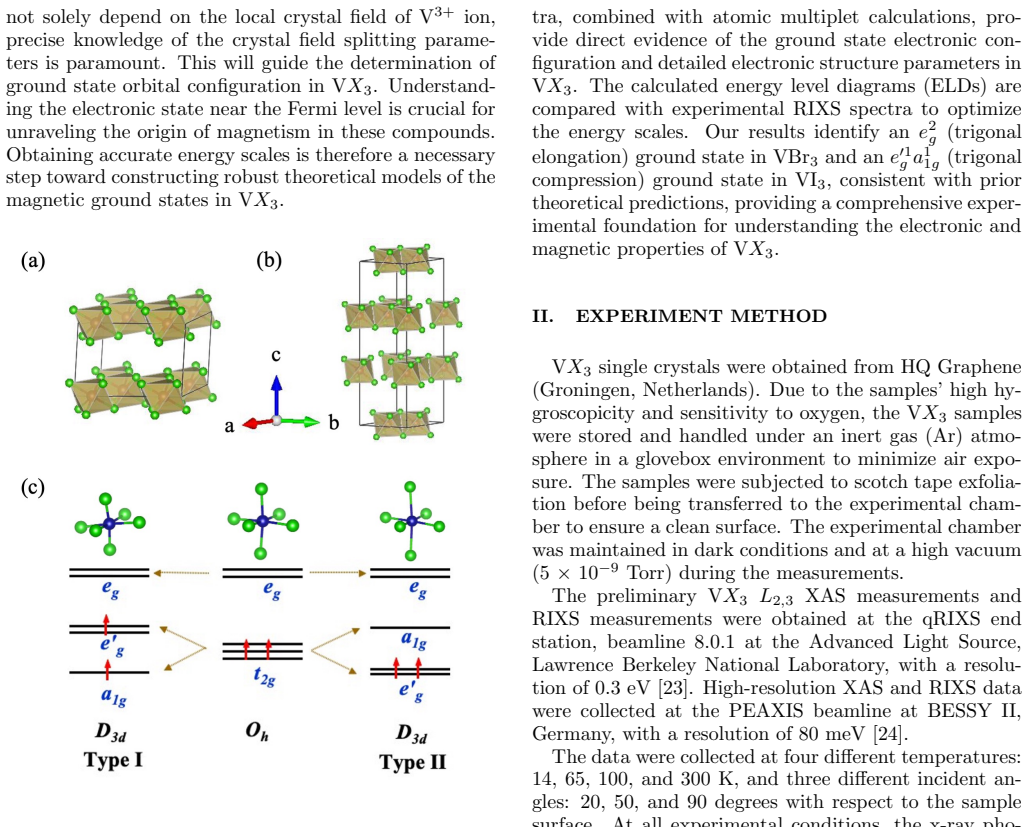
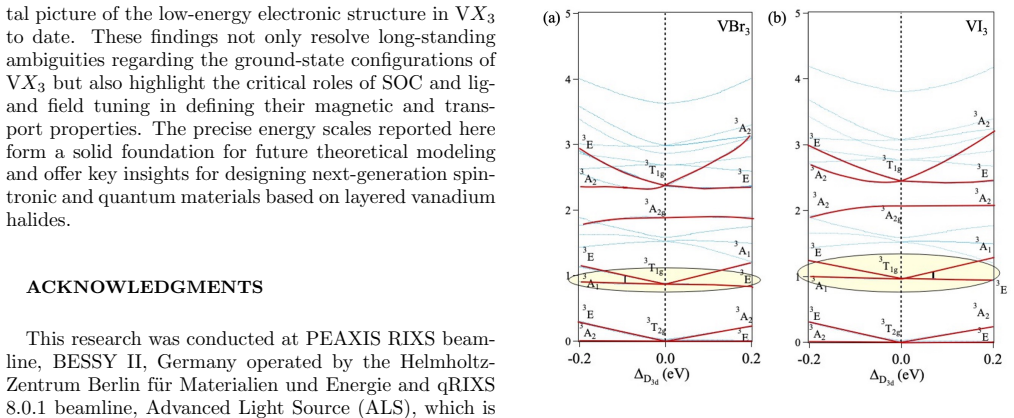
High-resolution RIXS spectra combined with cluster-model calculations determine that the trigonal distortion parameter Δ_D3d equals -0.096 eV in VBr3 and +0.07 eV in VI3. These opposite signs correspond to trigonal elongation in the bromide and compression in the iodide, producing an e'^2_g ground state for VBr3 and an e'^1_g a^1_1g ground state for VI3, both for high-spin V^{3+} (S=1). The same calculations also show increasing covalency from Br to I through changes in the crystal-field and Racah parameters.
What carries the argument
The trigonal distortion parameter Δ_D3d that splits the t_{2g} manifold into e' and a_{1g} levels, thereby fixing the orbital occupancy of the high-spin d^2 configuration in the VX6 octahedra.
If this is right
- The ground state of VBr3 is consistent with trigonal elongation of the coordination octahedra.
- The ground state of VI3 is consistent with trigonal compression of the coordination octahedra.
- Increasing covalency from bromide to iodide is required to reproduce the observed spectral shifts between the two compounds.
- The extracted parameters give the most complete experimental map of the low-energy electronic structure available for designing vanadium-halide spintronic layers.
Where Pith is reading between the lines
- External strain or pressure that reverses the sign of the distortion in one compound could switch its ground state and associated magnetic properties.
- The different orbital occupancies may produce distinct magnetic exchange pathways and therefore different ordering temperatures or spin-wave spectra in the two materials.
- Analogous trigonal-distortion tuning could be used in other transition-metal trihalides to select desired quantum spin states for two-dimensional devices.
Load-bearing premise
The measured RIXS peaks arise primarily from local d-d and charge-transfer excitations whose energies are set by the trigonal distortion without large interference from spin-orbit coupling or interlayer effects.
What would settle it
A direct structural measurement showing that the vanadium octahedra in VI3 are elongated rather than compressed, or new RIXS data that cannot be fit by any positive value of Δ_D3d, would falsify the reported ground-state assignments.
Figures


read the original abstract
Transition-metal halides V$X_3$ ($X$ = Br and I) have emerged as promising candidates for two dimensional spintronic and quantum applications due to their layer-dependent magnetism and tunable electronic states. However, experimental insights into their ground state electronic structures remain limited. Here, we present a comprehensive investigation of V$X_3$ using high resolution resonant inelastic x-ray scattering (RIXS) combined with ligand field multiplet calculations. The RIXS spectra reveal distinct $dd$ and charge-transfer excitations, allowing precise determination of electronic structure parameters, including the crystal field splitting, trigonal distortion, and Racah parameters. The determined parameters showed clear variation, indicating an increase in covalency from Br to I. The trigonal distortion parameters $\Delta_{D_{3d}}$ were determined to be -0.096 eV in VBr$_3$ and 0.07 eV in VI$_3$, indicating a sign opposition between the two compounds, reflecting good agreement with experimental RIXS data. Cluster model calculations yield a high-spin V$^{3+}$ $(S = 1)$ configuration, with an $e'^2_g$ ground state in VBr$_3$ and an $e'^1_ga^1_{1g}$ ground state in VI$_3$, consistent with trigonal elongation and compression, respectively. Our findings provide the most complete experimental determination of the low energy electronic structure in V$X_3$, offering valuable insights for designing 2D magnetic and spintronic materials based on vanadium halides.
Editorial analysis
A structured set of objections, weighed in public.
Referee Report
Summary. The manuscript reports a combined experimental and theoretical study of the electronic structure in VX3 (X=Br and I) using resonant inelastic x-ray scattering (RIXS) and ligand field multiplet calculations. Key results include the extraction of trigonal distortion parameters Δ_D3d = -0.096 eV for VBr3 and Δ_D3d = 0.07 eV for VI3 from fits to dd and charge-transfer excitations in the RIXS spectra. These lead to different ground states: e'^2_g for VBr3 (trigonal elongation) and e'^1_g a^1_1g for VI3 (trigonal compression), both with high-spin S=1 V^{3+}. An increase in covalency from Br to I is also noted.
Significance. Should the reported parameter values and their uniqueness hold upon further scrutiny, this work would provide important experimental benchmarks for the low-energy electronic structure of these layered materials. Such insights are relevant for understanding layer-dependent magnetism and for potential applications in 2D spintronics and quantum devices. The approach of using RIXS to constrain cluster model parameters is well-established in the field and adds to the body of knowledge on vanadium trihalides.
major comments (2)
- [Fitting of RIXS spectra and cluster calculations] The central claim of opposite signs for the trigonal distortion Δ_D3d (and thus opposite ground-state orbital occupations) depends on the assumption that the ligand-field multiplet model uniquely determines these values from the RIXS data. However, no systematic variation of other parameters such as spin-orbit coupling (SOC) or Slater integrals is presented to show that same-sign distortions are incompatible with the measured spectra. A sign flip in Δ_D3d can potentially be compensated by adjustments in SOC or covalency, as noted in the increase in covalency from Br to I.
- [Abstract] The abstract claims 'precise determination' of parameters but provides no error bars, chi-squared statistics, or discussion of alternative models that could yield similar RIXS spectra, which is necessary to support the load-bearing conclusion on ground states.
minor comments (2)
- [Abstract] Consider adding a brief mention of the fitting quality or uncertainties to strengthen the claims.
- [Figure captions or methods] Ensure that the resolution and line widths of the RIXS data are clearly stated to allow assessment of the fitting uniqueness.
Simulated Author's Rebuttal
We thank the referee for their careful reading of our manuscript and for the constructive comments. We address each major point below and have revised the manuscript to strengthen the presentation of our fitting analysis and parameter uncertainties.
read point-by-point responses
-
Referee: [Fitting of RIXS spectra and cluster calculations] The central claim of opposite signs for the trigonal distortion Δ_D3d (and thus opposite ground-state orbital occupations) depends on the assumption that the ligand-field multiplet model uniquely determines these values from the RIXS data. However, no systematic variation of other parameters such as spin-orbit coupling (SOC) or Slater integrals is presented to show that same-sign distortions are incompatible with the measured spectra. A sign flip in Δ_D3d can potentially be compensated by adjustments in SOC or covalency, as noted in the increase in covalency from Br to I.
Authors: We agree that a more explicit demonstration of uniqueness would strengthen the manuscript. The RIXS spectra contain multiple distinct features (dd excitations below 2 eV and charge-transfer excitations above 4 eV) whose positions and relative intensities are simultaneously sensitive to the sign of Δ_D3d. In our fitting procedure the sign is fixed by the requirement to reproduce the observed ordering and intensity ratios of the low-energy dd peaks; reversing the sign of Δ_D3d for either compound produces systematic mismatches that cannot be removed by modest adjustments to SOC or Slater integrals alone, because those parameters primarily affect splittings and overall scaling rather than the trigonal orbital reordering. Nevertheless, we acknowledge that a full sensitivity study was not included. We will add a supplementary section presenting chi-squared values for same-sign trial models and a brief discussion of parameter correlations, together with estimated uncertainties on Δ_D3d obtained from the fit covariance matrix. revision: yes
-
Referee: [Abstract] The abstract claims 'precise determination' of parameters but provides no error bars, chi-squared statistics, or discussion of alternative models that could yield similar RIXS spectra, which is necessary to support the load-bearing conclusion on ground states.
Authors: We accept that the wording 'precise determination' in the abstract may overstate the quantitative rigor without accompanying statistics. We will revise the abstract to state that the parameters, including the opposite signs of Δ_D3d, are obtained from best-fit ligand-field multiplet models to the measured RIXS spectra. In the revised manuscript we will also add a short paragraph in the main text summarizing the fit quality (including representative chi-squared values) and will report estimated uncertainties on the key parameters. These changes will make the abstract consistent with the level of detail already present in the results section while preserving the central claim that the data support opposite trigonal distortions. revision: yes
Circularity Check
No significant circularity; parameters fitted to RIXS data then used for ground-state assignment
full rationale
The paper determines crystal-field, trigonal-distortion, and Racah parameters by fitting ligand-field multiplet calculations to measured RIXS spectra, then computes the resulting high-spin ground-state orbital occupations from those fitted values. This is a standard forward-model fit to external experimental input rather than any self-definitional loop, fitted-input-called-prediction, or self-citation chain. The abstract explicitly states the distortion values 'were determined' from the spectra and that the ground states are 'consistent with' the sign of the fitted distortion; no uniqueness theorem or prior self-work is invoked to force the outcome. The derivation therefore remains self-contained against the RIXS benchmark.
Axiom & Free-Parameter Ledger
free parameters (2)
- trigonal distortion Δ_D3d =
-0.096 eV (VBr3), +0.07 eV (VI3)
- crystal field splitting and Racah parameters
axioms (1)
- domain assumption High-spin V^{3+} (S=1) configuration
Lean theorems connected to this paper
-
IndisputableMonolith/Cost/FunctionalEquation.leanwashburn_uniqueness_aczel unclear?
unclearRelation between the paper passage and the cited Recognition theorem.
The trigonal distortion parameters Δ_D3d were determined to be -0.096 eV in VBr3 and 0.07 eV in VI3... Cluster model calculations yield... e'^2_g ground state in VBr3 and an e'^1_g a^1_1g ground state in VI3
-
IndisputableMonolith/Foundation/RealityFromDistinction.leanreality_from_one_distinction unclear?
unclearRelation between the paper passage and the cited Recognition theorem.
H=H_Coulomb + H_SOC + H_CFT + H_LMCT + H_Exchange
What do these tags mean?
- matches
- The paper's claim is directly supported by a theorem in the formal canon.
- supports
- The theorem supports part of the paper's argument, but the paper may add assumptions or extra steps.
- extends
- The paper goes beyond the formal theorem; the theorem is a base layer rather than the whole result.
- uses
- The paper appears to rely on the theorem as machinery.
- contradicts
- The paper's claim conflicts with a theorem or certificate in the canon.
- unclear
- Pith found a possible connection, but the passage is too broad, indirect, or ambiguous to say the theorem truly supports the claim.
Forward citations
Cited by 1 Pith paper
-
Spin-Phonon Renormalization in CrSBr
RIXS spectra show bond-bending phonons at 43 meV that exist only below the magnetic transition in CrSBr and are attributed to spin-phonon renormalization.
Reference graph
Works this paper leans on
-
[1]
Dahlia R Klein, David MacNeill, Jose L Lado, David Soriano, Efr´ en Navarro-Moratalla, Kenji Watan- abe, Takashi Taniguchi, Soham Manni, Paul Canfield, Joaqu´ ın Fern´ andez-Rossier, et al. Probing magnetism in 2D van der Waals crystalline insulators via electron tun- neling.Science, 360(6394):1218–1222, 2018
work page 2018
-
[2]
Shengwei Jiang, Lizhong Li, Zefang Wang, Kin Fai Mak, and Jie Shan. Controlling magnetism in 2D CrI 3 by elec- trostatic doping.Nature nanotechnology, 13(7):549–553, 2018
work page 2018
-
[3]
Pressure-driven switching of magnetism in layered CrCl3
Azkar Saeed Ahmad, Yongcheng Liang, Mingdong Dong, Xuefeng Zhou, Leiming Fang, Yuanhua Xia, Jianhong Dai, Xiaozhi Yan, Xiaohui Yu, Junfeng Dai, et al. Pressure-driven switching of magnetism in layered CrCl3. Nanoscale, 12(45):22935–22944, 2020
work page 2020
-
[4]
Magnetic proper- ties of CrX3 (X= Cl, Br, I) monolayers in excited states
Prakash Mishra and Tunna Baruah. Magnetic proper- ties of CrX3 (X= Cl, Br, I) monolayers in excited states. Journal of Materials Chemistry C, 12:5216–5221, 2024
work page 2024
-
[5]
Tai Kong, Shu Guo, Danrui Ni, and Robert J Cava. Crys- tal structure and magnetic properties of the layered van der Waals compound VBr 3.Physical Review Materials, 3(8):084419, 2019
work page 2019
-
[6]
Junjie He, Shuangying Ma, Pengbo Lyu, and Petr Nachtigall. Unusual Dirac half-metallicity with intrinsic ferromagnetism in vanadium trihalide monolayers.Jour- nal of Materials Chemistry C, 4(13):2518–2526, 2016
work page 2016
-
[7]
Roberto Sant, Alessandro De Vita, Vincent Polewczyk, Gian Marco Pierantozzi, Federico Mazzola, Giovanni Vinai, Gerrit van der Laan, Giancarlo Panaccione, and NB Brookes. Anisotropic hybridization probed by polar- ization dependent x-ray absorption spectroscopy in VI 3 8 van der Waals Mott ferromagnet.Journal of Physics: Condensed Matter, 35(40):405601, 2023
work page 2023
-
[8]
Lu Liu, Ke Yang, Guangyu Wang, and Hua Wu. Two- dimensional ferromagnetic semiconductor VBr 3 with tunable anisotropy.Journal of Materials Chemistry C, 8(42):14782–14788, 2020
work page 2020
-
[9]
VI 3—a new layered ferromagnetic semi- conductor.Advanced Materials, 31(17):1808074, 2019
Tai Kong, Karoline Stolze, Erik I Timmons, Jing Tao, Danrui Ni, Shu Guo, Zo¨ e Yang, Ruslan Prozorov, and Robert J Cava. VI 3—a new layered ferromagnetic semi- conductor.Advanced Materials, 31(17):1808074, 2019
work page 2019
-
[10]
BingBing Lyu, Le Wang, YiFan Gao, Shu Guo, Xue- feng Zhou, Zhanyang Hao, Shanmin Wang, Yue Zhao, Li Huang, Jifeng Shao, et al. Structural and magnetic phase transitions in quasi-two-dimensional VBr 3.Physi- cal Review B, 106(8):085430, 2022
work page 2022
-
[11]
Shangjie Tian, Jian-Feng Zhang, Chenghe Li, Tianping Ying, Shiyan Li, Xiao Zhang, Kai Liu, and Hechang Lei. Ferromagnetic van der Waals crystal VI3.Journal of the American Chemical Society, 141(13):5326–5333, 2019
work page 2019
-
[12]
Robust intralayer antiferromagnetism and tricriticality in the van der Waals compound VBr 3
D´ avid Hovanˇ c´ ık, Marie Kratochv´ ılov´ a, Tetiana Haidamak, Petr Doleˇ zal, Karel Carva, Aneˇ zka Bendov´ a, Jan Prokleˇ ska, Petr Proschek, Martin M´ ıˇ sek, Denis I Gorbunov, et al. Robust intralayer antiferromagnetism and tricriticality in the van der Waals compound VBr 3. Physical Review B, 108(10):104416, 2023
work page 2023
-
[13]
Alexandru B Georgescu, Andrew J Millis, and James M Rondinelli. Trigonal symmetry breaking and its elec- tronic effects in the two-dimensional dihalides MX 2 and trihalides MX3.Physical Review B, 105(24):245153, 2022
work page 2022
-
[14]
Symmetry break- ing in vanadium trihalides.2D Materials, 11(2):025027, 2024
Luigi Camerano and Gianni Profeta. Symmetry break- ing in vanadium trihalides.2D Materials, 11(2):025027, 2024
work page 2024
-
[15]
Chamini S Pathiraja, Yi-De Chuang, Jayajeewana Ni- ranjana Ranhili Pelige, Deniz Wong, Christian Schulz, Yu-Cheng Shao, Di-Jing Huang, Hsiao-Yu Huang, Amol Singh, and Byron Freelon. Spin-flip determination in crx 3 (x= cl, br, and i) 2d magnets using high-resolution x-ray scattering. InSMT 2025. APS, 2025
work page 2025
-
[16]
VI 3: A two-dimensional Ising ferromagnet
Ke Yang, Fengren Fan, Hongbo Wang, DI Khomskii, and Hua Wu. VI 3: A two-dimensional Ising ferromagnet. Physical Review B, 101(10):100402, 2020
work page 2020
-
[17]
Alessandro De Vita, Thao Thi Phuong Nguyen, Roberto Sant, Gian Marco Pierantozzi, Danila Amoroso, Chiara Bigi, Vincent Polewczyk, Giovanni Vinai, Loi T Nguyen, Tai Kong, et al. Influence of orbital character on the ground state electronic properties in the van der Waals transition metal iodides VI 3 and CrI 3.Nano letters, 22(17):7034–7041, 2022
work page 2022
-
[18]
Xiaosong Zhao and Yukai An. Multiple Topological Phases with Electronic Correlation in Intrinsic Ferromag- netic Semimetal VI 3 Monolayer.Small, 20(50):2407232, 2024
work page 2024
-
[19]
Bulk properties of the van der Waals hard ferromagnet VI3.Physical Review B, 99(4):041402, 2019
Suhan Son, Matthew J Coak, Nahyun Lee, Jonghyeon Kim, Tae Yun Kim, Hayrullo Hamidov, Hwanbeom Cho, Cheng Liu, David M Jarvis, Philip AC Brown, et al. Bulk properties of the van der Waals hard ferromagnet VI3.Physical Review B, 99(4):041402, 2019
work page 2019
-
[20]
Luuk JP Ament, Michel Van Veenendaal, Thomas P De- vereaux, John P Hill, and Jeroen Van Den Brink. Reso- nant inelastic x-ray scattering studies of elementary exci- tations.Reviews of Modern Physics, 83(2):705–767, 2011
work page 2011
-
[21]
Chamini Pathiraja, Jayajeewana N Ranhili, Deniz Wong, Christian Schulz, Yi-De Chuang, Yu-Cheng Shao, Di- Jing Huang, Hsiao-Yu Huang, Amol Singh, and Byron Freelon. Electronic Energy Scales of CrX 3 (X= Cl, Br, and I) using High-resolution X-ray Scattering.arXiv preprint arXiv:2504.04053, 2025
-
[22]
Chamini S. Pathiraja, Jayajeewana N. Ranhili, Deniz Wong, Christian Schulz, Yi-De Chuang, Yu-Cheng Shao, Di-Jing Huang, Hsiao-Yu Huang, Amol Singh, and By- ron Freelon. Electronic energy scales of crx 3 (x= cl, br, and i) using high-resolution x-ray scattering.Phys. Rev. Res., 7:043139, Nov 2025
work page 2025
-
[23]
Yi-De Chuang, Xuefei Feng, Alejandro Cruz, Kelly Hanzel, Adam Brown, Adrian Spucces, Alex Frano, Wei-Sheng Lee, Jaemyung Kim, Yu-Jen Chen, et al. Momentum-resolved resonant inelastic soft X-ray scatter- ing (qRIXS) endstation at the ALS.Journal of Electron Spectroscopy and Related Phenomena, 257:146897, 2022
work page 2022
-
[24]
Christian Schulz, Klaus Lieutenant, Jie Xiao, Tommy Hofmann, Deniz Wong, and Klaus Habicht. Characteri- zation of the soft X-ray spectrometer PEAXIS at BESSY II.Journal of Synchrotron Radiation, 27(1):238–249, 2020
work page 2020
-
[25]
YC Shao, B Karki, W Huang, X Feng, G Sumanasekera, J-H Guo, Y-D Chuang, and B Freelon. Spectroscopic de- termination of key energy scales for the base hamiltonian of chromium trihalides.The journal of physical chemistry letters, 12(1):724–731, 2021
work page 2021
-
[26]
ML Farquhar, RA Wogelius, JM Charnock, P Wincott, CC Tang, M Newville, PJ Eng, and TP Trainor. Surface oxidation of rhodonite: structural and chemical study by surface scattering and glancing incidence XAS tech- niques.Mineralogical Magazine, 67(6):1205–1219, 2003
work page 2003
-
[27]
Dmitry Ruzmetov, Sanjaya D Senanayake, and Shri- ram Ramanathan. X-ray absorption spectroscopy of vanadium dioxide thin films across the phase-transition boundary.Physical Review B—Condensed Matter and Materials Physics, 75(19):195102, 2007
work page 2007
-
[28]
CH Maule, JN Tothill, Paul Strange, and JA Wilson. An optical investigation into the 3d 1 and 3d2 transition- metal halides and oxyhalides, compounds near to delo- calisation.Journal of Physics C: Solid State Physics, 21(11):2153, 1988
work page 1988
-
[29]
Maurits W Haverkort. Quanty for core level spectroscopy-excitons, resonances and band excitations in time and frequency domain. InJournal of Physics: Conference Series, volume 712, page 012001. IOP Pub- lishing, 2016
work page 2016
-
[30]
Multi- plet ligand-field theory using Wannier orbitals.Physical Review B, 85(16):165113, 2012
MW Haverkort, M Zwierzycki, and OK Andersen. Multi- plet ligand-field theory using Wannier orbitals.Physical Review B, 85(16):165113, 2012
work page 2012
-
[31]
A dft based ligand field theory
M Atanasov, CA Daul, and C Rauzy. A dft based ligand field theory. InOptical Spectra and Chemical Bonding in Inorganic Compounds: Special Volume dedicated to Pro- fessor Jørgensen I, pages 97–125. Springer, 2004
work page 2004
-
[32]
RG Woolley. Ligand-field analysis of transition-metal complexes.International Reviews in Physical Chemistry, 6(2):93–141, 1987
work page 1987
-
[33]
Myrtille OJY Hunault, Yoshihisa Harada, Jun Miyawaki, Jian Wang, Andries Meijerink, Frank MF De Groot, and Matti M Van Schooneveld. Direct observation of Cr 3+ 3d states in ruby: Toward experimental mechanistic evi- dence of metal chemistry.The Journal of Physical Chem- istry A, 122(18):4399–4413, 2018
work page 2018
-
[34]
Giulio Racah. Theory of complex spectra. I.Physical Review, 61(3-4):186, 1942
work page 1942
-
[35]
Y Yekta, H Hadipour, E S ¸a¸ sıo˘ glu, C Friedrich, SA Jafari, 9 S Bl¨ ugel, and I Mertig. Strength of effective Coulomb interaction in two-dimensional transition-metal halides MX2 and MX 3 (M= Ti, V, Cr, Mn, Fe, Co, Ni; X= Cl, Br, I).Physical Review Materials, 5(3):034001, 2021
work page 2021
-
[36]
J Krzystek, Adam T Fiedler, Jennifer J Sokol, Andrew Ozarowski, SA Zvyagin, Thomas C Brunold, Jeffrey R Long, Louis-Claude Brunel, and Joshua Telser. Pseu- dooctahedral complexes of vanadium (III): electronic structure investigation by magnetic and electronic spec- troscopy.Inorganic chemistry, 43(18):5645–5658, 2004
work page 2004
-
[37]
Large orbital magnetic moment in VI 3.Nano Letters, 23(4):1175–1180, 2023
David Hovancik, Jiri Pospisil, Karel Carva, Vladimir Se- chovsky, and Cinthia Piamonteze. Large orbital magnetic moment in VI 3.Nano Letters, 23(4):1175–1180, 2023
work page 2023
-
[38]
H Lane, E Pachoud, JA Rodriguez-Rivera, M Songvilay, Guangyong Xu, Peter M Gehring, JP Attfield, RA Ew- ings, and Christopher Stock. Two-dimensional ferromag- netic spin-orbital excitations in honeycomb VI3.Physical Review B, 104(2):L020411, 2021
work page 2021
-
[39]
Mandeep Dalal.A Textbook of Inorganic Chemistry– Volume 1. Dalal Institute, 2017
work page 2017
-
[40]
Chamini Pathiraja, Jayajeewana Niranjana Ran- hili Pelige, Yi-De Chuang, Deniz Wong, Christian Schulz, Yu-Cheng Shao, Di-Jing Huang, Hsiao-Yu Huang, and Byron Freelon. Determination of electronic structure parameters for different halides in crx 3 (x= cl, br, and i) using high-resolution x-ray scattering. Bulletin of the American Physical Society, 2025
work page 2025
-
[41]
Nephelauxetic effect revisited.International Journal of Quantum Chemistry, 109(11):2606–2621, 2009
Andrei L Tchougr´ eeff and Richard Dronskowski. Nephelauxetic effect revisited.International Journal of Quantum Chemistry, 109(11):2606–2621, 2009
work page 2009
-
[42]
Mihail Atanasov, Dmitry Ganyushin, Kantharuban Sivalingam, and Frank Neese. A modern first-principles view on ligand field theory through the eyes of corre- lated multireference wavefunctions.Molecular electronic structures of transition metal complexes II, pages 149– 220, 2012
work page 2012
-
[43]
Keisuke Tomiyasu, Jun Okamoto, Hsiao-Yu Huang, Zhi- Ying Chen, Evelyn Pratami Sinaga, Wen-Bin Wu, Yen- Yi Chu, Amol Singh, R-P Wang, FMF De Groot, et al. Coulomb correlations intertwined with spin and orbital excitations in LaCoO 3.Physical Review Letters, 119(19):196402, 2017
work page 2017
-
[44]
Vladimir I Anisimov, Ferdi Aryasetiawan, and AI Licht- enstein. First-principles calculations of the electronic structure and spectra of strongly correlated systems: the lda+ u method.Journal of Physics: Condensed Matter, 9(4):767, 1997. 10
work page 1997
discussion (0)
Sign in with ORCID, Apple, or X to comment. Anyone can read and Pith papers without signing in.