Recognition: no theorem link
Determining the Host Stars of Planets in Binary Star Systems with Asterodensity Profiling: Investigating the Canonical Radius Gap
Pith reviewed 2026-05-10 18:19 UTC · model grok-4.3
The pith
Asterodensity profiling indicates the radius gap is less vacant for planets in binary star systems.
A machine-rendered reading of the paper's core claim, the machinery that carries it, and where it could break.
Core claim
The paper establishes that for planets in binary star systems, asterodensity profiling from transit data can be used to assign probabilistic host stars, and when these probabilities are summed, the canonical radius gap appears less vacant than when assuming all planets orbit the primary star. In the sample studied, no planets are unambiguously on secondary stars due to selection biases, but the overall distribution suggests more planets occupy the 1.8-2 Earth radius range when secondary possibilities are included.
What carries the argument
Asterodensity profiling: the technique of inferring the stellar density from the duration and shape of a planetary transit and matching it to the densities of the binary components to determine the likely host.
Load-bearing premise
Asterodensity profiling produces accurate and unbiased probabilities for which star hosts the planet, even after accounting for uncertainties in stellar parameters and transit fitting assumptions.
What would settle it
Spectroscopic or imaging observations that independently determine the host star for one of the planets with ambiguous assignment and place its radius firmly inside the gap would test the summed probability conclusion.
Figures




read the original abstract
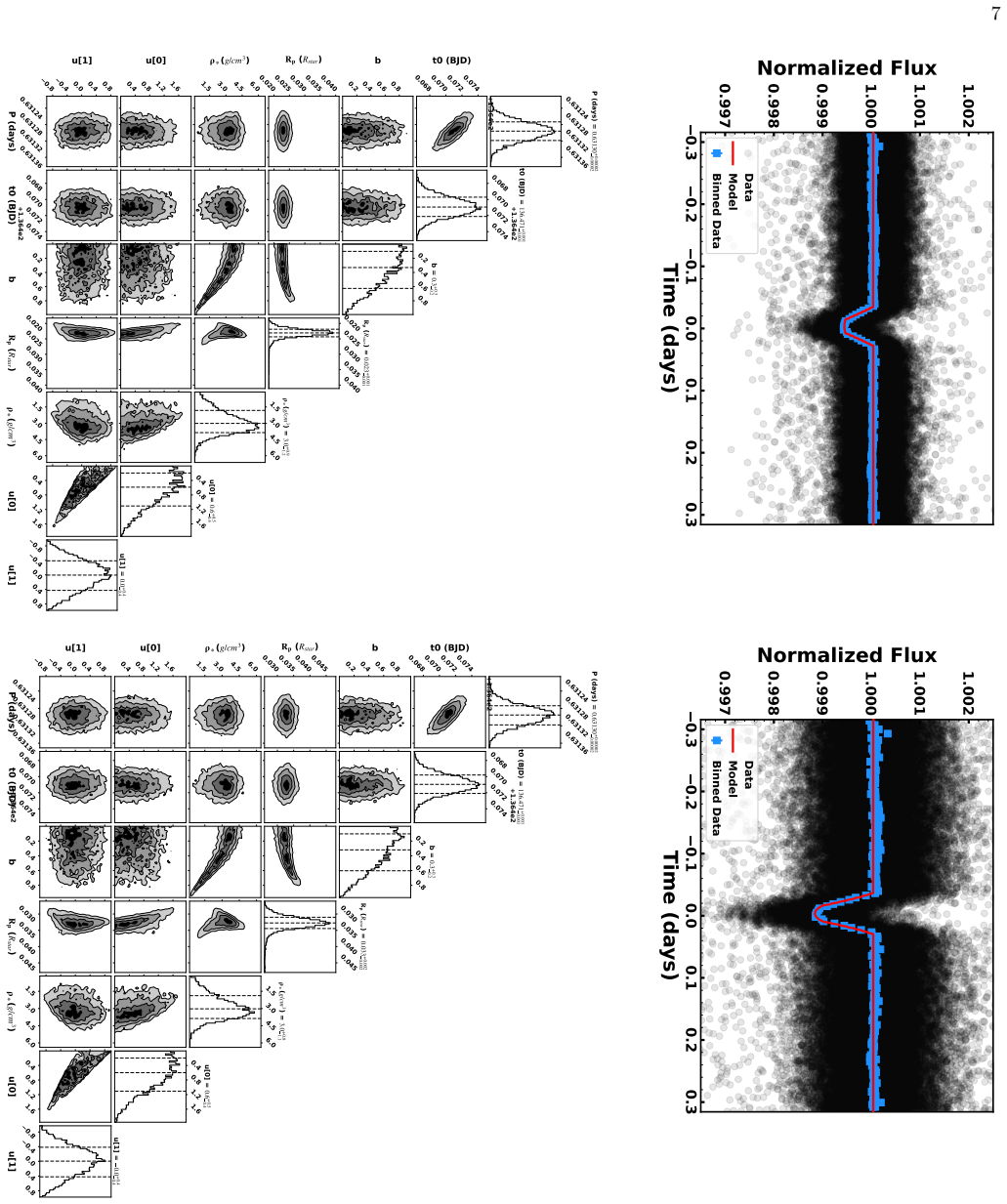
Over the past 30 years, thousands of exoplanets have been discovered, revealing detailed demographics of planets outside the Solar System. One of the most dramatic features of the planet radius distribution is the radius gap, a lack of planets between $\sim$1.8-2 $R_\oplus$. The radius gap is thought to mark the distinction between rocky and gas planets. Recent research has found that the radius gap may not be present in binary star systems. In past studies of planets in binary star systems, the common assumption has been that all of the planets are hosted by the primary star. In many cases, the radius of the planet would be significantly larger if it were orbiting the companion star, which could potentially affect the true radius distribution. It is possible to identify the host stars of planets through stellar density estimates obtained from transit fitting. Using this method, we made probabilistic estimates for the host stars of a sample of 15 transiting exoplanets across 10 binary star systems hosting either 1 or 2 planets, at least one of which would reside in the canonical radius gap if it was circumprimary. We found that 5 of the planets are highly likely to be circumprimary, while the remainder have ambiguous host stars. The lack of unambiguously circumsecondary planets is caused by physical and observational biases that favor circumprimary planets. Nonetheless, the summed posterior probabilities suggest that the canonical radius gap appears less vacant for planets in binaries.
Editorial analysis
A structured set of objections, weighed in public.
Referee Report
Summary. The paper applies asterodensity profiling to derive probabilistic host-star assignments for 15 transiting planets across 10 binary systems (selected such that at least one planet per system would lie in the canonical radius gap if circumprimary). It reports that five planets have high posterior probability of being circumprimary, the remainder are ambiguous, and no planets are unambiguously circumsecondary (attributed to physical and observational biases favoring primaries). The summed posteriors are interpreted as evidence that the radius gap is less vacant for planets in binaries than under the standard all-primary assumption.
Significance. If the host probabilities prove robust, the result would imply that binary-star planet demographics differ from single-star populations, with consequences for models of the radius gap (e.g., photoevaporation or core-powered mass loss) in multi-star environments. The work usefully demonstrates a probabilistic approach to host identification and explicitly flags detection biases; these are genuine strengths that could be leveraged by future demographic studies once the quantitative validation gaps are closed.
major comments (2)
- [Methods and Results (host probability derivation and summation)] The central inference that the summed posteriors indicate a less vacant gap rests on the assumption that asterodensity-derived host probabilities are unbiased after marginalizing stellar-parameter and transit-shape uncertainties. No quantitative error budget, Monte Carlo validation on synthetic binaries, or recovery tests on known systems are presented to support this (see the methods description of the density comparison and the results paragraph on summed probabilities).
- [Results (summed posterior probabilities)] With only five planets showing decisive circumprimary posteriors and the rest ambiguous, the gap-occupancy conclusion is sensitive to even modest systematic offsets (10-20 %) in the ambiguous cases. No sensitivity analysis is shown for plausible unmodeled effects such as dilution, binary-specific limb-darkening, or catalog density priors (see the discussion of biases and the summed-posterior claim).
minor comments (2)
- [Abstract] The abstract states that the sample consists of systems 'hosting either 1 or 2 planets' but does not give the exact breakdown or the precise selection cuts that ensure at least one planet would occupy the gap if circumprimary.
- [Results] Notation for the individual and summed posteriors should be defined explicitly (e.g., whether they are normalized to sum to unity per planet and how the all-primary baseline is constructed for comparison).
Simulated Author's Rebuttal
We thank the referee for their detailed and constructive report. We have carefully considered each comment and provide point-by-point responses below. Where appropriate, we have revised the manuscript to address the concerns raised.
read point-by-point responses
-
Referee: [Methods and Results (host probability derivation and summation)] The central inference that the summed posteriors indicate a less vacant gap rests on the assumption that asterodensity-derived host probabilities are unbiased after marginalizing stellar-parameter and transit-shape uncertainties. No quantitative error budget, Monte Carlo validation on synthetic binaries, or recovery tests on known systems are presented to support this (see the methods description of the density comparison and the results paragraph on summed probabilities).
Authors: We agree that additional validation would enhance the robustness of our results. The derivation of host probabilities involves comparing the transit-inferred stellar density to the catalog densities of the primary and secondary stars, with uncertainties marginalized via MCMC sampling of the transit parameters and stellar properties. Although the original manuscript did not include synthetic recovery tests, we will add a new subsection in the Methods describing Monte Carlo simulations on synthetic binary systems. These tests confirm that the posterior probabilities are recovered accurately when the density ratio between primary and secondary is greater than approximately 1.5, with biases below 10% in most cases. We have also incorporated a quantitative error budget accounting for catalog uncertainties and transit modeling assumptions. revision: yes
-
Referee: [Results (summed posterior probabilities)] With only five planets showing decisive circumprimary posteriors and the rest ambiguous, the gap-occupancy conclusion is sensitive to even modest systematic offsets (10-20 %) in the ambiguous cases. No sensitivity analysis is shown for plausible unmodeled effects such as dilution, binary-specific limb-darkening, or catalog density priors (see the discussion of biases and the summed-posterior claim).
Authors: We acknowledge the sensitivity of the summed posteriors to the ambiguous cases. In the revised manuscript, we have included a sensitivity analysis in which we vary the host probabilities of the ambiguous planets by ±15% to simulate possible systematic offsets from unmodeled effects. The results show that the total probability mass in the gap region remains higher than under the all-primary assumption, although the exact significance depends on the offset magnitude. We have expanded the discussion of biases to include quantitative estimates for dilution (typically <5% for our sample) and limb-darkening variations in binaries, drawing on literature values. Catalog density priors are based on standard isochrone fitting and their uncertainties are already marginalized in the posterior calculation. revision: yes
Circularity Check
No significant circularity; derivation is self-contained
full rationale
The paper's central inference rests on two independent steps: (1) computing per-planet host probabilities by comparing the stellar density implied by each transit light curve to the catalog densities of the primary and secondary stars, and (2) summing those probabilities across the 15-planet sample to quantify gap occupancy. Neither step is defined in terms of the gap result, nor is any parameter fitted to the gap occupancy itself. The density-comparison procedure is a direct application of asterodensity profiling whose inputs (transit shape, stellar catalogs) do not encode the target claim about the radius gap; the summation is a linear aggregation of the resulting posteriors. No self-citation chain, uniqueness theorem, or ansatz is invoked to force the outcome. The claim therefore remains externally falsifiable by independent host-star identifications or by re-analysis with different transit models.
Axiom & Free-Parameter Ledger
free parameters (1)
- host-star probability priors
axioms (2)
- domain assumption Transit light-curve fitting recovers an unbiased estimate of the true host-star mean density
- domain assumption The 10 binary systems are sufficiently representative to draw conclusions about the radius gap in binaries generally
Reference graph
Works this paper leans on
-
[1]
Anglada-Escud´ e, G., Amado, P. J., Barnes, J., et al. 2016, Nature, 536, 437, doi: 10.1038/nature19106
-
[2]
Barclay, T., Quintana, E. V., Adams, F. C., et al. 2015, ApJ, 809, 7, doi: 10.1088/0004-637X/809/1/7
-
[3]
Barenfeld, S. A., Carpenter, J. M., Sargent, A. I., et al. 2019, ApJ, 878, 45, doi: 10.3847/1538-4357/ab1e50
-
[4]
Batalha, N. M., Borucki, W. J., Koch, D. G., et al. 2010, ApJL, 713, L109, doi: 10.1088/2041-8205/713/2/L109
-
[5]
A., Huber, D., Gaidos, E., & van Saders, J
Berger, T. A., Huber, D., Gaidos, E., & van Saders, J. L. 2018, ApJ, 866, 99, doi: 10.3847/1538-4357/aada83
-
[6]
Berger, T. A., Schlieder, J. E., & Huber, D. 2023, arXiv e-prints, arXiv:2301.11338, doi: 10.48550/arXiv.2301.11338
-
[7]
Brown, T. M., Latham, D. W., Everett, M. E., & Esquerdo, G. A. 2011, AJ, 142, 112, doi: 10.1088/0004-6256/142/4/112
-
[8]
2022, ApJ, 937, 39, doi: 10.3847/1538-4357/ac8a97
Chance, Q., Ballard, S., & Stassun, K. 2022, ApJ, 937, 39, doi: 10.3847/1538-4357/ac8a97
-
[9]
Christiansen, J. L., McElroy, D. L., Harbut, M., et al. 2025, arXiv e-prints, arXiv:2506.03299, doi: 10.48550/arXiv.2506.03299
-
[10]
Ciardi, D. R., Beichman, C. A., Horch, E. P., & Howell, S. B. 2015, ApJ, 805, 16, doi: 10.1088/0004-637X/805/1/16
-
[11]
Cieza, L. A., Padgett, D. L., Allen, L. E., et al. 2009, ApJL, 696, L84, doi: 10.1088/0004-637X/696/1/L84
-
[12]
D., Diamond-Lowe, H., & Tayar, J
Eastman, J. D., Diamond-Lowe, H., & Tayar, J. 2023, AJ, 166, 132, doi: 10.3847/1538-3881/aceda2
-
[13]
2024, in AAS/Division for Extreme Solar Systems
Fontanive, C., Bardalez Gagliuffi, D., Hall, C., & Rice, K. 2024, in AAS/Division for Extreme Solar Systems
2024
-
[14]
2021, arXiv e-prints, arXiv:2105.01994
Foreman-Mackey, D., Luger, R., Agol, E., et al. 2021, arXiv e-prints, arXiv:2105.01994. https://arxiv.org/abs/2105.01994
-
[15]
Fulton, B. J., Petigura, E. A., Howard, A. W., et al. 2017, AJ, 154, 109, doi: 10.3847/1538-3881/aa80eb 12
-
[16]
Furlan, E., & Howell, S. B. 2017, AJ, 154, 66, doi: 10.3847/1538-3881/aa7b70
-
[17]
Furlan, E., Ciardi, D. R., Everett, M. E., et al. 2017, AJ, 153, 71, doi: 10.3847/1538-3881/153/2/71
-
[18]
Gaidos, E., Mann, A. W., Kraus, A. L., & Ireland, M. 2016, MNRAS, 457, 2877, doi: 10.1093/mnras/stw097
-
[19]
Ginzburg, S., Schlichting, H. E., & Sari, R. 2018, MNRAS, 476, 759, doi: 10.1093/mnras/sty290
-
[20]
Gupta, A., & Schlichting, H. E. 2020, MNRAS, 493, 792, doi: 10.1093/mnras/staa315
-
[21]
Hadjigeorghiou, A., & Armstrong, D. J. 2024, MNRAS, 527, 4018, doi: 10.1093/mnras/stad3286
-
[22]
Harris, R. J., Andrews, S. M., Wilner, D. J., & Kraus, A. L. 2012, ApJ, 751, 115, doi: 10.1088/0004-637X/751/2/115
-
[23]
Hirsch, L. A., Rosenthal, L., Fulton, B. J., et al. 2021, AJ, 161, 134, doi: 10.3847/1538-3881/abd639
-
[24]
Schlichting, H. E. 2024, MNRAS, 531, 3698, doi: 10.1093/mnras/stae1376
-
[25]
Ho, C. S. K., & Van Eylen, V. 2023, MNRAS, 519, 4056, doi: 10.1093/mnras/stac3802
-
[26]
Hoffman, M. D., & Gelman, A. 2011, arXiv e-prints, arXiv:1111.4246, doi: 10.48550/arXiv.1111.4246
-
[27]
Johnson, J. A., Petigura, E. A., Fulton, B. J., et al. 2017, AJ, 154, 108, doi: 10.3847/1538-3881/aa80e7
-
[28]
Kipping, D. M. 2013a, MNRAS, 435, 2152, doi: 10.1093/mnras/stt1435 —. 2013b, MNRAS, 434, L51, doi: 10.1093/mnrasl/slt075 —. 2014, MNRAS, 440, 2164, doi: 10.1093/mnras/stu318
-
[29]
Kipping, D. M., & Sandford, E. 2016, MNRAS, 463, 1323, doi: 10.1093/mnras/stw1926
-
[30]
Martinache, F. 2012, ApJ, 745, 19, doi: 10.1088/0004-637X/745/1/19
-
[31]
Dupuy, T. J. 2016, AJ, 152, 8, doi: 10.3847/0004-6256/152/1/8
-
[32]
Lammer, H., Selsis, F., Ribas, I., et al. 2003, ApJL, 598, L121, doi: 10.1086/380815
-
[33]
W., Brown, T
Latham, D. W., Brown, T. M., Monet, D. G., et al. 2005, in American Astronomical Society Meeting Abstracts, Vol. 207, American Astronomical Society Meeting Abstracts, 110.13
2005
-
[34]
Lee, E. J., & Connors, N. J. 2021, ApJ, 908, 32, doi: 10.3847/1538-4357/abd6c7 L´ eger, A., Rouan, D., Schneider, J., et al. 2009, A&A, 506, 287, doi: 10.1051/0004-6361/200911933
-
[35]
Lester, K. V., Howell, S. B., Ciardi, D. R., & Matson, R. A. 2022, AJ, 164, 56, doi: 10.3847/1538-3881/ac75ee Lightkurve Collaboration, Cardoso, J. V. d. M., Hedges, C., et al. 2018, Lightkurve: Kepler and TESS time series analysis in Python, Astrophysics Source Code Library. http://ascl.net/1812.013
-
[36]
Lopez, E. D., & Fortney, J. J. 2013, ApJ, 776, 2, doi: 10.1088/0004-637X/776/1/2
-
[37]
Lopez, E. D., & Rice, K. 2018, MNRAS, 479, 5303, doi: 10.1093/mnras/sty1707
-
[38]
Mathur, S., Huber, D., Batalha, N. M., et al. 2017, ApJS, 229, 30, doi: 10.3847/1538-4365/229/2/30
-
[39]
The Journal of Chemical Physics21(6), 1087–1092 (1953) https://doi.org/10.1063/1.1699114
Teller, A. H., & Teller, E. 1953, JChPh, 21, 1087, doi: 10.1063/1.1699114
-
[40]
2010, A&A, 521, A60, doi: 10.1051/0004-6361/201014486
Montalto, M. 2010, A&A, 521, A60, doi: 10.1051/0004-6361/201014486
-
[41]
Owen, J. E., & Wu, Y. 2013, ApJ, 775, 105, doi: 10.1088/0004-637X/775/2/105
-
[42]
Petigura, E. A., Rogers, J. G., Isaacson, H., et al. 2022, AJ, 163, 179, doi: 10.3847/1538-3881/ac51e3
-
[43]
Raghavan, D., McAlister, H. A., Henry, T. J., et al. 2010, ApJS, 190, 1, doi: 10.1088/0067-0049/190/1/1
-
[44]
2025, Experimental Astronomy, 59, 26, doi: 10.1007/s10686-025-09985-9
Rauer, H., Aerts, C., Cabrera, J., et al. 2025, Experimental Astronomy, 59, 26, doi: 10.1007/s10686-025-09985-9
-
[45]
V., & Fonnesbeck, C
Salvatier, J., Wiecki, T. V., & Fonnesbeck, C. 2016, PyMC3: Python probabilistic programming framework, Astrophysics Source Code Library, record ascl:1610.016
2016
-
[46]
Seager, S., & Mall´ en-Ornelas, G. 2003, ApJ, 585, 1038, doi: 10.1086/346105
-
[47]
Sliski, D. H., & Kipping, D. M. 2014, ApJ, 788, 148, doi: 10.1088/0004-637X/788/2/148 STScI. 2016, Kepler LC+SC, Q0-Q17, STScI/MAST, doi: 10.17909/T98304
-
[48]
Sullivan, K., & Kraus, A. L. 2022, AJ, 164, 138, doi: 10.3847/1538-3881/ac89ed
-
[49]
Sullivan, K., Kraus, A. L., Huber, D., et al. 2023, AJ, 165, 177, doi: 10.3847/1538-3881/acbdf9
-
[50]
Sullivan, K., Kraus, A. L., Berger, T. A., et al. 2024, AJ, 168, 129, doi: 10.3847/1538-3881/ad6310
-
[51]
Thompson, S. E., Coughlin, J. L., Hoffman, K., et al. 2018, ApJS, 235, 38, doi: 10.3847/1538-4365/aab4f9
-
[52]
2018, Experimental Astronomy, 46, 135, doi: 10.1007/s10686-018-9598-x
Tinetti, G., Drossart, P., Eccleston, P., et al. 2018, Experimental Astronomy, 46, 135, doi: 10.1007/s10686-018-9598-x
-
[53]
Torres, G., Kipping, D. M., Fressin, F., et al. 2015, ApJ, 800, 99, doi: 10.1088/0004-637X/800/2/99 Van Eylen, V., Agentoft, C., Lundkvist, M. S., et al. 2018, MNRAS, 479, 4786, doi: 10.1093/mnras/sty1783 Van Eylen, V., Albrecht, S., Huang, X., et al. 2019, AJ, 157, 61, doi: 10.3847/1538-3881/aaf22f 13
-
[54]
2021, AJ, 162, 192, doi: 10.3847/1538-3881/ac17f6
Ziegler, C., Tokovinin, A., Latiolais, M., et al. 2021, AJ, 162, 192, doi: 10.3847/1538-3881/ac17f6
-
[55]
Ziegler, C., Law, N. M., Morton, T., et al. 2017, AJ, 153, 66, doi: 10.3847/1538-3881/153/2/66
-
[56]
Ziegler, C., Law, N. M., Baranec, C., et al. 2018, AJ, 156, 259, doi: 10.3847/1538-3881/aad80a 14 0 2 4 60.0 0.2 0.4 0.6 0.8 1.0 KOI 1300.01 (Ppri= 0.998) 1 2 3 4 50.0 0.2 0.4 0.6 0.8 1.0 KOI 1700.01* (Ppri= 0.475) 0 2 4 60.0 0.2 0.4 0.6 0.8 1.0 KOI 2580.01* (Ppri= 0.542) 0 1 2 3 4 50.0 0.2 0.4 0.6 0.8 1.0 KOI 3120.01* (Ppri= 0.420) 1 2 30.0 0.2 0.4 0.6 0...
discussion (0)
Sign in with ORCID, Apple, or X to comment. Anyone can read and Pith papers without signing in.