Extensive Spatio-Temporal Chaos in Non-reciprocal Flocking
Pith reviewed 2026-05-10 18:03 UTC · model grok-4.3
The pith
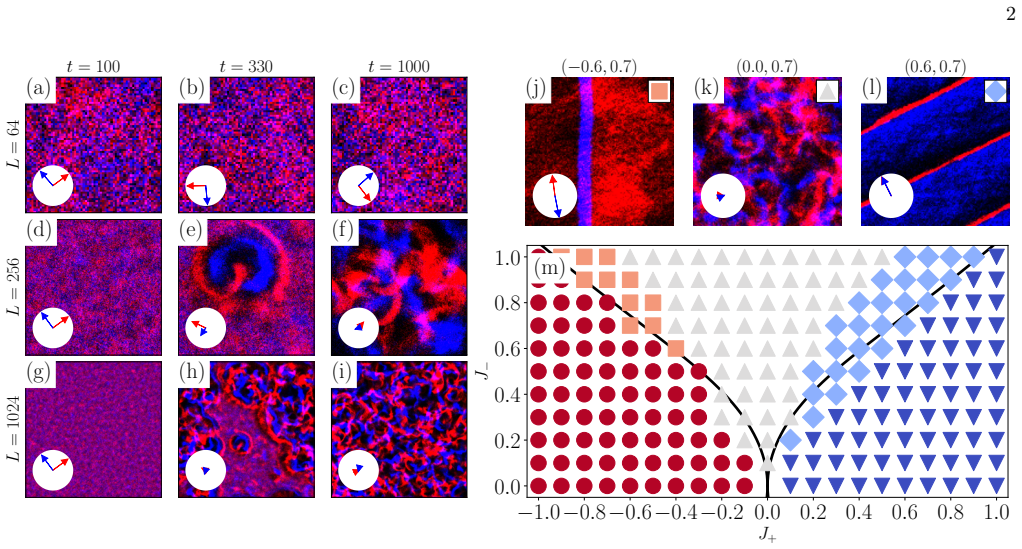
In the two-species Vicsek model, chiral order in small flocks gives way to extensive spatiotemporal chaos in large flocks separated by a finite-wavelength instability set by the chiral orbit radius.
A machine-rendered reading of the paper's core claim, the machinery that carries it, and where it could break.
Core claim
In the two-species Vicsek model these two states coexist: chiral order for small flocks, and extensive spatiotemporal chaos for large flocks, both separated by a finite wavelength instability whose scale is set by the rotation radius of the chiral orbits. For system sizes larger than this length scale extensive spatiotemporal chaos unfolds, as manifested by an extensive number of Floquet exponents for the unstable chiral state, a positive Lyapunov exponent, a finite correlation and chaotic length and a broad energy spectrum.
What carries the argument
The finite-wavelength instability of the chiral state, whose wavelength is fixed by the radius of the circular orbits that particles follow under non-reciprocal alignment.
If this is right
- Chiral order remains stable only below the instability wavelength set by the orbit radius.
- The number of unstable Floquet exponents grows extensively with system size once the threshold is crossed.
- The chaotic state maintains a positive Lyapunov exponent and a broad energy spectrum at all larger scales.
- Correlation and chaotic lengths stay finite, indicating persistent disorder rather than long-range order.
Where Pith is reading between the lines
- The same size-dependent switch to chaos may occur in other active-matter systems that lack intrinsic chirality but possess non-reciprocal couplings.
- Experiments with asymmetric alignment rules in colloidal or robotic flocks could test whether the orbit-radius threshold controls the appearance of turbulence.
- Field theories of active matter with broken reciprocity might exhibit analogous instabilities when coarse-grained to large scales.
Load-bearing premise
The instability wavelength is strictly fixed by the chiral orbit radius and any larger system must develop extensive chaos rather than other forms of disorder or finite-size effects.
What would settle it
A simulation or experiment in which the onset size for chaos does not match the measured chiral orbit radius, or in which the number of unstable Floquet exponents stops growing with system area.
Figures


read the original abstract
Non-reciprocal interactions in active matter gives rise to a multitude of fascinating phenomena among which are collective oscillatory states without intrinsic particle chirality and active turbulence. Here we show that in a paradigmatic model for non-reciprocal flocking, the two species Vicsek model, these two states coexist: chiral order for small flocks, and extensive spatiotemporal chaos for large flocks, both separated by a finite wavelength instability whose scale is set by the rotation radius of the chiral orbits. For system sizes larger than this length scale extensive spatiotemporal chaos unfolds, as manifested by an extensive number of Floquet exponents for the unstable chiral state, a positive Lyapunov exponent, a finite correlation and chaotic length and a broad energy spectrum. Our results suggest that complex, turbulent behavior is a generic possibility in any system where particles or fields interact asymmetrically and may have significant implications for understanding how non-reciprocal interactions could drive chaotic, fluid-like behavior in active matter.
Editorial analysis
A structured set of objections, weighed in public.
Referee Report
Summary. The paper examines the two-species Vicsek model with non-reciprocal interactions and reports that chiral ordered states coexist with extensive spatiotemporal chaos: the former for small flocks and the latter for large flocks. These regimes are separated by a finite-wavelength instability whose characteristic scale is set by the rotation radius of the chiral orbits. For system sizes exceeding this scale, the unstable chiral state exhibits an extensive number of Floquet exponents, a positive Lyapunov exponent, finite correlation and chaotic lengths, and a broad energy spectrum.
Significance. If the central claims are confirmed, the work establishes a concrete mechanism by which non-reciprocal interactions produce size-dependent transitions from ordered to chaotic collective motion in active-matter models. The explicit connection between the chiral-orbit radius and the instability wavelength, together with the reported extensivity diagnostics, would strengthen the case that asymmetric interactions generically enable turbulent states without requiring intrinsic particle chirality.
major comments (3)
- [Linear stability analysis] The statement that the finite-wavelength instability scale 'is set by' the rotation radius of the chiral orbits (abstract and the linear-stability section) requires an explicit derivation or scaling argument showing why the most unstable wavevector k* satisfies 2π/k* ≈ R_orbit; numerical coincidence for the chosen parameters cannot be excluded without this step.
- [Floquet and Lyapunov analysis] The claim of extensivity rests on an 'extensive number of Floquet exponents' and a size-independent positive Lyapunov exponent; the manuscript should present the number of unstable multipliers versus system size L (with data collapse or linear scaling) and the largest Lyapunov exponent versus L to confirm saturation rather than slow growth or localization.
- [Correlation functions and energy spectra] The finite correlation length and chaotic length are asserted to saturate for L larger than the instability scale; quantitative plots of these lengths versus L, including error bars from multiple realizations, are needed to rule out continued growth or finite-size artifacts.
minor comments (2)
- [Model definition] Notation for the two species and the non-reciprocal coupling strength should be introduced once and used consistently; occasional switches between symbols obscure the parameter dependence.
- [Energy spectra] The energy spectrum is described as 'broad'; a quantitative measure (e.g., power-law exponent or width) and comparison to a reference spectrum would improve clarity.
Simulated Author's Rebuttal
We thank the referee for the careful reading and constructive suggestions. We agree that additional derivations and quantitative plots will strengthen the manuscript and will revise accordingly to address all points.
read point-by-point responses
-
Referee: The statement that the finite-wavelength instability scale 'is set by' the rotation radius of the chiral orbits (abstract and the linear-stability section) requires an explicit derivation or scaling argument showing why the most unstable wavevector k* satisfies 2π/k* ≈ R_orbit; numerical coincidence for the chosen parameters cannot be excluded without this step.
Authors: We agree that an explicit scaling argument is needed. In the revised manuscript we will add a derivation in the linear-stability section. Starting from the linearized two-species Vicsek equations with non-reciprocal alignment, the dispersion relation yields a most-unstable wavevector satisfying k* R_orbit ≈ 2π, where R_orbit = v_0 / ω_eff and ω_eff is the rotation frequency set by the antisymmetric interaction strength. This follows from the competition between self-propulsion and the chiral torque induced by non-reciprocity, independent of the specific parameter values chosen for illustration. revision: yes
-
Referee: The claim of extensivity rests on an 'extensive number of Floquet exponents' and a size-independent positive Lyapunov exponent; the manuscript should present the number of unstable multipliers versus system size L (with data collapse or linear scaling) and the largest Lyapunov exponent versus L to confirm saturation rather than slow growth or localization.
Authors: We thank the referee for this request. The current text already states linear scaling of the number of unstable Floquet multipliers, but we will add explicit figures: (i) number of positive multipliers versus L, demonstrating linear growth with system size, and (ii) the largest Lyapunov exponent versus L, showing convergence to a constant positive value once L exceeds the instability scale. These plots will confirm extensivity and exclude slow growth or localization. revision: yes
-
Referee: The finite correlation length and chaotic length are asserted to saturate for L larger than the instability scale; quantitative plots of these lengths versus L, including error bars from multiple realizations, are needed to rule out continued growth or finite-size artifacts.
Authors: We agree that explicit quantitative plots with error bars are required. In the revision we will include figures showing both the correlation length and the chaotic length as functions of L, each averaged over at least five independent realizations with error bars given by the standard deviation. The data will demonstrate saturation for L larger than the orbit-radius scale, consistent with the finite-wavelength instability. revision: yes
Circularity Check
No significant circularity; central claims rest on direct numerical simulations of the two-species Vicsek model
full rationale
The paper reports numerical observations of chiral order for small flocks and extensive spatiotemporal chaos for large flocks in the non-reciprocal Vicsek model, separated by a finite-wavelength instability. The scale of this instability is identified from simulations as matching the chiral orbit radius, with extensivity diagnosed via computed Floquet exponents, Lyapunov exponents, correlation lengths, and spectra. No analytical derivation chain is presented that reduces any prediction to a fitted input or self-citation by construction. The results are grounded in explicit model simulations for varying system sizes, without self-definitional loops, renamed known results, or load-bearing self-citations that substitute for independent verification. This is the expected non-circular outcome for a simulation-driven study of active-matter phenomenology.
Axiom & Free-Parameter Ledger
axioms (1)
- domain assumption Particles align with neighbors according to the Vicsek rule with non-reciprocal inter-species interactions.
Forward citations
Cited by 2 Pith papers
-
Nonreciprocal surface tension: anisotropy-induced defect motility and organization
Nonreciprocal surface tension in the Nonreciprocal Cahn-Hilliard model induces defect motility and organization into target patterns and mosaic-waves whose large-scale dynamics belong to the anisotropic Kardar-Parisi-...
-
Stability and breakdown of chiral motion in non-reciprocal flocking
Chiral motion in the non-reciprocal two-species Vicsek model is stable only inside a narrow window of high density, very low speed, small system size, and dominant aligning couplings; imbalances or strong anti-alignme...
Reference graph
Works this paper leans on
-
[1]
of the chiral state, but decays to zero for larger values ofL
Different marker shapes indicate different values ofJ−; the full marker legend is provided in [39]. of the chiral state, but decays to zero for larger values ofL. The survival probability curve converges to a step function sitting at finiteτ∞. This behavior is incompati- ble with a picture of instability due to spatially indepen- dent Poisson nucleation e...
work page 2000
-
[2]
Frisch,Turbulence: the legacy of A
U. Frisch,Turbulence: the legacy of A. N. Kolmogorov (Cambridge University Press, 2010)
work page 2010
-
[3]
M. C. Cross and P. C. Hohenberg, Pattern formation outside of equilibrium, Reviews of Modern Physics65, 851 (1993)
work page 1993
-
[4]
H. H. Wensink, J. Dunkel, S. Heidenreich, K. Drescher, R. E. Goldstein, H. Löwen, and J. M. Yeomans, Meso- scale turbulence in living fluids, Proceedings of the Na- tional Academy of Sciences109, 14308 (2012)
work page 2012
- [5]
- [6]
-
[7]
V. Bratanov, F. Jenko, and E. Frey, New class of tur- bulence in active fluids, Proceedings of the National Academy of Sciences112, 15048 (2015)
work page 2015
-
[8]
D. Ruelle, Large volume limit of the distribution of char- acteristic exponents in turbulence, Communications in Mathematical Physics87, 287 (1982)
work page 1982
-
[9]
H.-W. Xi, R. Toral, J. D. Gunton, and M. I. Tribelsky, Extensive chaos in the nikolaevskii model, Physical Re- view E62, R17 (2000)
work page 2000
-
[10]
S. Tajima and H. S. Greenside, Microextensive chaos of a spatially extended system, Physical Review E66, 017205 (2002)
work page 2002
-
[11]
D. A. Egolf, I. V. Melnikov, W. Pesch, and R. E. Ecke, Mechanisms of extensive spatiotemporal chaos in rayleigh–bénard convection, Nature404, 733 (2000)
work page 2000
-
[12]
Y. Kuramoto, Diffusion-induced chaos in reaction sys- tems, Progress of Theoretical Physics Supplement64, 346 (1978)
work page 1978
-
[13]
G. Hu, Y. Zhang, H. A. Cerdeira, and S. Chen, From low-dimensional synchronous chaos to high-dimensional desynchronous spatiotemporal chaos in coupled systems, Physical Review Letters85, 3377 (2000)
work page 2000
-
[14]
I. S. Aranson and L. Kramer, The world of the complex ginzburg–landau equation, Reviews of Modern Physics 74, 99 (2002)
work page 2002
-
[15]
Kurmaoto,Chemical Oscillations, Waves, and Turbu- lence(Springer, 1984)
Y. Kurmaoto,Chemical Oscillations, Waves, and Turbu- lence(Springer, 1984)
work page 1984
-
[16]
D. T. Papageorgiou and Y. S. Smyrlis, The route to chaos for the kuramoto–sivashinsky equation, Theoretical and Computational Fluid Dynamics3, 15 (1991)
work page 1991
-
[17]
R. W. Wittenberg and P. Holmes, Scale and space local- ization in the kuramoto–sivashinsky equation, Chaos9, 452 (1999)
work page 1999
-
[18]
M. C. Marchetti, J.-F. Joanny, S. Ramaswamy, T. B. Liverpool, J. Prost, M. Rao, and R. A. Simha, Hydrody- namics of soft active matter, Reviews of Modern Physics 85, 1143 (2013)
work page 2013
-
[19]
C. Bechinger, R. Di Leonardo, H. Löwen, C. Reichhardt, G. Volpe, and G. Volpe, Active particles in complex and crowded environments, Reviews of Modern Physics88, 045006 (2016)
work page 2016
-
[20]
M. R. Shaebani, A. Wysocki, R. G. Winkler, G. Gomp- per,andH.Rieger,Computationalmodelsforactivemat- ter, Nat. Rev. Phys.2, 181 (2020)
work page 2020
-
[21]
M. te Vrugt and R. Wittkowski, Metareview: a survey of active matter reviews, The European Physical Journal E 48, 12 (2025)
work page 2025
-
[22]
A. Dinelli, J. O’Byrne, A. Curatolo, Y. Zhao, P. Sollich, and J. Tailleur, Non-reciprocity across scales in active mixtures, Nature Communications14, 7035 (2023)
work page 2023
-
[23]
Y. Duan, J. Agudo-Canalejo, R. Golestanian, and B. Mahault, Dynamical pattern formation without self- attraction in quorum-sensing active matter: The inter- play between nonreciprocity and motility, Physical Re- view Letters131, 148301 (2023)
work page 2023
-
[24]
Y. Duan, J. Agudo-Canalejo, R. Golestanian, and B. Mahault, Phase coexistence in nonreciprocal quorum- sensing active matter, Physical Review Research7, 013234 (2025)
work page 2025
-
[25]
F. Brauns and M. C. Marchetti, Nonreciprocal pattern formation of conserved fields, Physical Review X14, 6 021014 (2024)
work page 2024
-
[26]
S. Saha and R. Golestanian, Effervescence in a binary mixture with nonlinear non-reciprocal interactions, Na- ture Communications16, 7310 (2025)
work page 2025
-
[27]
D.Martin, D.Seara, Y.Avni, M.Fruchart,andV.Vitelli, Transition to collective motion in nonreciprocal active matter: Coarse graining agent-based models into fluc- tuating hydrodynamics, Physical Review X15, 041015 (2025)
work page 2025
-
[28]
K. L. Kreienkamp and S. H. Klapp, Nonreciprocal align- ment induces asymmetric clustering in active mixtures, Physical Review Letters133, 258303 (2024)
work page 2024
-
[29]
C. Myin and B. Mahault, Flocking in weakly non- reciprocal mixtures, arXiv preprint arXiv:2510.25377 10.48550/arXiv.2510.25377 (2025)
- [30]
- [31]
-
[32]
M. Fruchart, R. Hanai, P. B. Littlewood, and V. Vitelli, Non-reciprocal phase transitions, Nature592, 363 (2021)
work page 2021
-
[33]
B. Liebchen and D. Levis, Chiral active matter, Euro- physics Letters139, 67001 (2022)
work page 2022
- [34]
- [35]
- [36]
-
[37]
K. Han, G. Kokot, O. Tovkach, A. Glatz, I. S. Aranson, and A. Snezhko, Emergence of self-organized multivor- tex states in flocks of active rollers, Proceedings of the National Academy of Sciences117, 9706 (2020)
work page 2020
-
[38]
H. Wioland, F. G. Woodhouse, J. Dunkel, J. O. Kessler, and R. E. Goldstein, Confinement stabilizes a bacterial suspension into a spiral vortex, Physical Review Letters 110, 268102 (2013)
work page 2013
- [39]
-
[40]
See Supplemental Material
-
[41]
B. Benvegnen, O. Granek, S. Ro, R. Yaacoby, H. Chaté, Y.Kafri, D.Mukamel, A.Solon,andJ.Tailleur,Metasta- bility of discrete-symmetry flocks, Physical review letters 131, 218301 (2023)
work page 2023
- [42]
- [43]
- [44]
-
[45]
D. Barkley and R. D. Henderson, Three-dimensional flo- quet stability analysis of the wake of a circular cylinder, Journal of Fluid Mechanics322, 215 (1996)
work page 1996
-
[46]
L. Kocarev, Z. Tasev, and U. Parlitz, Synchronizing spa- tiotemporal chaos of partial differential equations, Phys- ical Review Letters79, 51 (1997)
work page 1997
-
[47]
C. C. Lalescu, C. Meneveau, and G. L. Eyink, Synchro- nization of chaos in fully developed turbulence, Physical Review Letters110, 084102 (2013)
work page 2013
-
[48]
A. Karimi and M. R. Paul, Length scale of a chaotic element in rayleigh-bénard convection, Physical Review E—Statistical, Nonlinear, and Soft Matter Physics86, 066212 (2012)
work page 2012
-
[49]
Notably, non-reciprocity due to small symmetric phase- shifts in the alignment interactions between multiple species does exhibit quasi-long-range chiral order [?]
-
[50]
K. Binder, Finite size effects on phase transitions, Ferroelectrics73, 43 (1987), https://doi.org/10.1080/00150198708227908
-
[51]
L. Chen, C. F. Lee, and J. Toner, Only the ambidextrous can flock: Two-dimensional chiral malthusian flocks, time cholesterics, and the kpz equation, arXiv preprint arXiv:2506.03488 10.48550/arXiv.2506.03488 (2025)
discussion (0)
Sign in with ORCID, Apple, or X to comment. Anyone can read and Pith papers without signing in.