Stability and breakdown of chiral motion in non-reciprocal flocking
Pith reviewed 2026-05-10 03:41 UTC · model grok-4.3
The pith
Chiral collective motion in a two-species non-reciprocal Vicsek model exists only within a narrow window of high density, low speed, and small system size.
A machine-rendered reading of the paper's core claim, the machinery that carries it, and where it could break.
Core claim
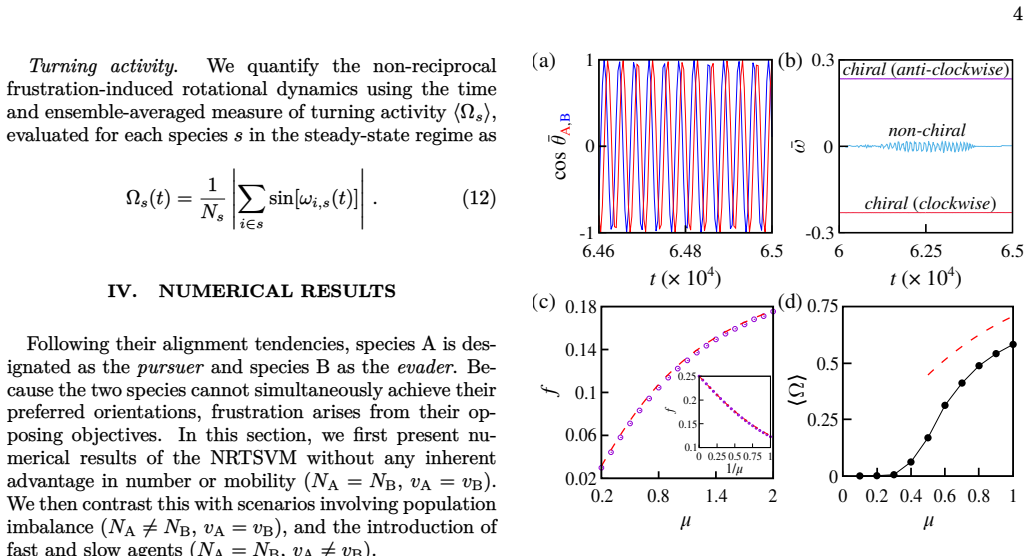
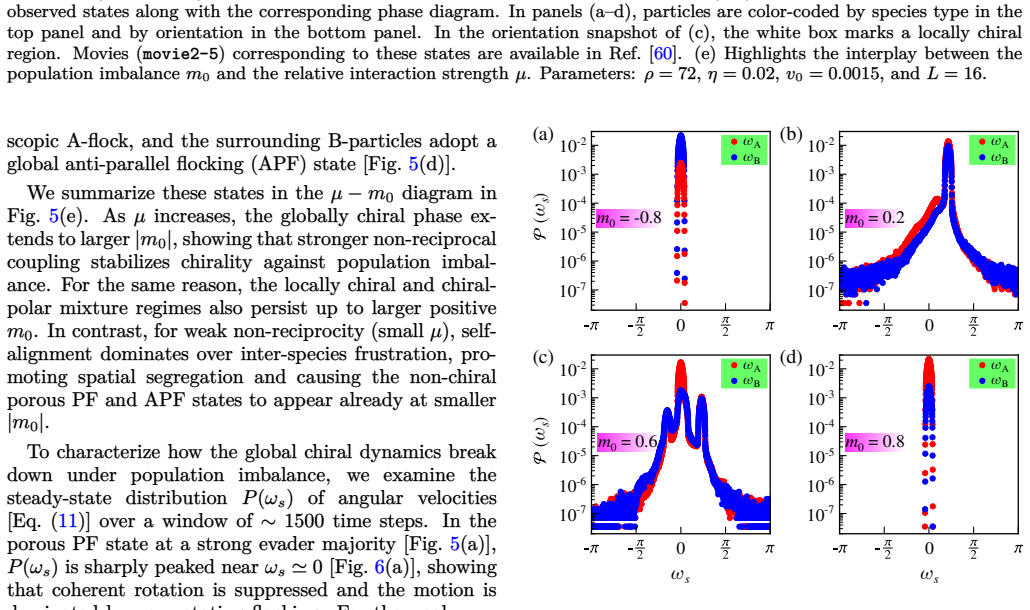
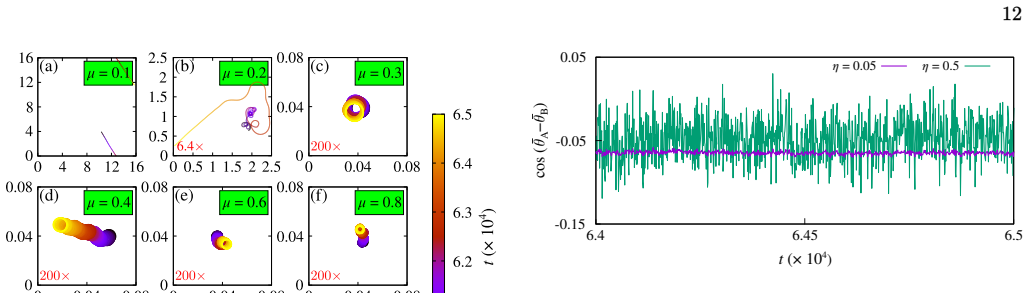
For equal populations and motilities, a globally coherent chiral motion state exists only within a restricted window characterized by high density, very low self-propulsion speed, and small system size relative to the interaction range. Within this window, chirality appears primarily when aligning interactions dominate over anti-alignment, whereas stronger anti-alignment leads to species segregation and suppresses chirality. Introducing species asymmetry through population imbalance drives transitions from chiral states to porous parallel-flocking or anti-parallel-flocking liquids; motility imbalance induces asynchronous oscillations and, in extreme cases, leads to segregation into moving 0.
What carries the argument
the discrete-time metric two-species Vicsek model with intra-species alignment and asymmetric inter-species couplings (one species aligns while the other anti-aligns)
If this is right
- Stronger anti-alignment than alignment produces species segregation and eliminates chirality.
- Population imbalance replaces the chiral state with porous parallel or anti-parallel flocking liquids.
- Motility imbalance produces asynchronous oscillations or segregation of faster particles into moving clusters.
- The chiral state remains stable only inside the window of high density, low speed, and small system size.
Where Pith is reading between the lines
- The explicit dependence on small system size relative to interaction range implies the chiral state may disappear in the thermodynamic limit of infinite system size.
- Non-reciprocal interactions alone do not guarantee chiral order; the additional requirements on density and speed indicate that chirality is a special rather than generic outcome.
- The transitions seen under population or motility imbalance suggest that balanced parameters are necessary to prevent segregation from overtaking collective rotation.
Load-bearing premise
The discrete-time metric Vicsek rules with the chosen interaction range and periodic boundaries faithfully capture the large-scale hydrodynamic behavior without finite-size artifacts dominating the observed chiral window.
What would settle it
A simulation at the same high density and low speed but with system size much larger than the interaction range that fails to sustain a stable chiral state would show the reported window is an artifact of small-system effects.
Figures






read the original abstract
We study a two-species Vicsek model with intra-species alignment and asymmetric inter-species couplings, where one species aligns with the other while the latter anti-aligns. Motivated by recent results showing that globally coherent chiral motion is not a generic large-scale state of finite-range non-reciprocal flocking, we ask whether a chiral state can nevertheless be stabilized in the discrete-time, metric, non-reciprocal two-species Vicsek model, and if so, under what conditions. For equal populations and motilities, we show that such a state exists only within a restricted window characterized by high density, very low self-propulsion speed, and small system size relative to the interaction range. Within this window, we also find that chirality appears primarily when aligning interactions dominate over anti-alignment, whereas stronger anti-alignment leads to species segregation and suppresses chirality. Conversely, introducing species asymmetry through population imbalance drives transitions from chiral states to porous parallel-flocking or anti-parallel-flocking liquids; motility imbalance induces asynchronous oscillations and, in extreme cases, leads to segregation into moving clusters of the faster species within a more dispersed background of slower particles. Overall, these results indicate that chirality in the non-reciprocal two-species Vicsek model arises within a restricted regime set by density, motility, inter-species coupling, and system size, rather than being a generic outcome of non-reciprocal interactions.
Editorial analysis
A structured set of objections, weighed in public.
Referee Report
Summary. The manuscript studies a two-species metric Vicsek model with intra-species alignment and asymmetric inter-species couplings (one species aligns, the other anti-aligns). Using discrete-time simulations with periodic boundaries, it reports that globally coherent chiral motion for equal populations and motilities exists only inside a narrow window of high density, very low self-propulsion speed, and small system size relative to the interaction range, with chirality favored when alignment dominates anti-alignment. Population or motility imbalance instead produces segregation, porous parallel/anti-parallel flocks, or asynchronous oscillations.
Significance. If the restricted chiral window survives finite-size extrapolation and statistical validation, the work would usefully demonstrate that non-reciprocal flocking does not generically produce large-scale chirality, supplying concrete parameter boundaries that can guide hydrodynamic modeling and experiments. The numerical mapping of density, motility, and coupling effects is a concrete contribution, though the purely observational character and absence of analytic derivations limit its reach beyond the specific discrete model.
major comments (2)
- [Abstract and Results] Abstract and main results: the claim that chiral motion exists only for small system size relative to interaction range (L/ξ) is load-bearing for the restricted-window conclusion, yet no finite-size scaling study, L→∞ extrapolation, or comparison with continuum hydrodynamic limits is presented; the observed chirality could therefore be an artifact of the chosen discrete-time metric rules and periodic boundaries rather than an intrinsic feature.
- [Methods and Results] Simulation protocol: the reported phase boundaries and chiral states lack error bars, details on the number of independent runs, time-averaging windows, or convergence tests with respect to integration timestep and noise realization, making it impossible to assess the statistical robustness of the narrow window.
minor comments (1)
- [Abstract] The abstract would be clearer if it briefly stated the precise form of the inter-species coupling terms and the metric interaction rule used.
Simulated Author's Rebuttal
We thank the referee for the careful reading and constructive comments. We agree that additional statistical details and finite-size analysis would strengthen the manuscript and will revise accordingly to address the major points below.
read point-by-point responses
-
Referee: [Abstract and Results] Abstract and main results: the claim that chiral motion exists only for small system size relative to interaction range (L/ξ) is load-bearing for the restricted-window conclusion, yet no finite-size scaling study, L→∞ extrapolation, or comparison with continuum hydrodynamic limits is presented; the observed chirality could therefore be an artifact of the chosen discrete-time metric rules and periodic boundaries rather than an intrinsic feature.
Authors: We acknowledge that the manuscript does not include a systematic finite-size scaling analysis or L→∞ extrapolation, nor a direct comparison to continuum hydrodynamics. Our simulations for equal populations and motilities show that global chirality is stable only when L/ξ remains small (typically L/ξ ≲ 10 for the parameters studied), with larger systems exhibiting segregation or parallel flocking instead; this trend is visible in the data we have, but we did not quantify the scaling of the chiral window boundary with L. We will add a dedicated subsection on finite-size effects, including new simulation runs at larger L/ξ to illustrate the breakdown, and will explicitly note the absence of thermodynamic-limit extrapolation as a limitation of the present discrete-time study. This revision will make the restricted-window claim more precise without overstating its generality. revision: yes
-
Referee: [Methods and Results] Simulation protocol: the reported phase boundaries and chiral states lack error bars, details on the number of independent runs, time-averaging windows, or convergence tests with respect to integration timestep and noise realization, making it impossible to assess the statistical robustness of the narrow window.
Authors: We agree that the current manuscript omits these statistical details. In the revised version we will add error bars on all phase-boundary and order-parameter plots, specify the number of independent runs (typically 10–20 per parameter set), describe the time-averaging windows used after equilibration, and report convergence checks with respect to timestep and noise realizations. These additions will allow readers to evaluate the robustness of the narrow chiral window. revision: yes
Circularity Check
No circularity: results are direct numerical observations from model simulations
full rationale
The paper presents findings exclusively from discrete-time metric Vicsek simulations with specified interaction rules, periodic boundaries, and parameter sweeps. No analytical derivation, fitted functional form, or self-referential equation chain is used to obtain the restricted chiral window; the claims follow directly from running the model and observing outcomes under varying density, speed, system size, and coupling strengths. Self-citations appear only as motivation for the question and do not bear the load of the central results. The derivation chain is therefore self-contained empirical observation rather than any reduction to inputs by construction.
Axiom & Free-Parameter Ledger
free parameters (4)
- particle density
- self-propulsion speed
- system size relative to interaction range
- inter-species coupling asymmetry
axioms (2)
- domain assumption Intra-species alignment follows the standard Vicsek rule
- domain assumption Inter-species couplings are strictly asymmetric (align vs anti-align)
Reference graph
Works this paper leans on
-
[1]
R. Hanai, “Nonreciprocal frustration: Time crystalline order-by-disorder phenomenon and a spin-glass-like state,” Phys. Rev. X14, 011029 (2024)
work page 2024
-
[2]
Statistical mechanics where newton’s third law is broken,
A. V. Ivlev, J. Bartnick, M. Heinen, C-R Du, V. Nosenko, and H. Löwen, “Statistical mechanics where newton’s third law is broken,” Phys. Rev. X5, 011035 (2015)
work page 2015
-
[3]
Symmetry, thermodynamics, and topology in active matter,
M. J. Bowick, N. Fakhri, M. C. Marchetti, and S. Ra- maswamy, “Symmetry, thermodynamics, and topology in active matter,” Phys. Rev. X12, 010501 (2022)
work page 2022
-
[4]
M. Fruchart and V. Vitelli, “Nonreciprocal many-body physics,” arXiv preprint arXiv:2602.11111 (2026)
-
[5]
Flower-like patterns in multi-species bacterial colonies,
L. Xiong, Y. Cao, R. Cooper, W-J Rappel, J. Hasty, and L. Tsimring, “Flower-like patterns in multi-species bacterial colonies,” elife9, e48885 (2020)
work page 2020
-
[6]
Chase-and-run between adjacent cell populations promotes directional collective migration,
E. Theveneau, B. Steventon, E. Scarpa, S. Garcia, X. Trepat, A. Streit, and R. Mayor, “Chase-and-run between adjacent cell populations promotes directional collective migration,” Nat. Cell Biol.15, 763–772 (2013)
work page 2013
-
[7]
Predator–prey interactions between droplets driven by non-reciprocal oil exchange,
C. H. Meredith, P. G. Moerman, J. Groenewold, Y-J Chiu, W. K. Kegel, A. van Blaaderen, and L. D. Zarzar, “Predator–prey interactions between droplets driven by non-reciprocal oil exchange,” Nat. Chem.12, 1136–1142 (2020)
work page 2020
-
[8]
Struc- ture formation induced by non-reciprocal cell–cell inter- actions in a multicellular system,
B. Bhattacherjee, M. Hayakawa, and T. Shibata, “Struc- ture formation induced by non-reciprocal cell–cell inter- actions in a multicellular system,” Soft Matter20, 2739– 2749 (2024)
work page 2024
-
[9]
Non-reciprocity across scales in active mixtures,
A. Dinelli, J. O’Byrne, A. Curatolo, Y. Zhao, P. Sollich, and J. Tailleur, “Non-reciprocity across scales in active mixtures,” Nat. Commun.14, 7035 (2023)
work page 2023
-
[10]
S. Xie, R. Ye, X. Li, Z. Huang, S. Cao, W. Lv, H. He, P. Zhang, Z. Fang, J. Zhang,et al., “Nonreciprocal in- teractions in crowd dynamics: Investigating the impact of moving threats on pedestrian speed preferences,” Transp. Res. Part C162, 104586 (2024)
work page 2024
-
[11]
Nonreciprocal field theory for decision-making in multi-agent control systems,
A. Lama, M. Di Be., and S. H. L. Klapp, “Nonreciprocal field theory for decision-making in multi-agent control systems,” Nat. Commun.16, 8450 (2025)
work page 2025
-
[12]
Irreversibility, heat and information flows induced by non-reciprocal interac- tions,
S. A. M. Loos and S. H. L. Klapp, “Irreversibility, heat and information flows induced by non-reciprocal interac- tions,” New J. Phys.22, 123051 (2020)
work page 2020
-
[13]
Y. Avni, M. Fruchart, D. Martin, D. Seara, and V. Vitelli, “Nonreciprocal ising model,” Phys. Rev. Lett. 134, 117103 (2025)
work page 2025
-
[14]
Dynamical phase transitions in the nonre- ciprocal ising model,
Y. Avni, M. Fruchart, D. Martin, D. Seara, and V. Vitelli, “Dynamical phase transitions in the nonre- ciprocal ising model,” Phys. Rev. E111, 034124 (2025)
work page 2025
-
[15]
S. A. M. Loos, S. H. L. Klapp, and T. Martynec, “Long- range order and directional defect propagation in the nonreciprocal xy model with vision cone interactions,” Phys. Rev. Lett.130, 198301 (2023)
work page 2023
-
[16]
The xy model with vision cone: non- reciprocal vs. reciprocal interactions,
G. Bandini, D. Venturelli, S. A. M. Loos, A. Jelic, and A. Gambassi, “The xy model with vision cone: non- reciprocal vs. reciprocal interactions,” J. Stat. Mech.: Theory Exp.2025, 053205 (2025)
work page 2025
-
[17]
In- escapable anisotropy of nonreciprocal xy models,
D. Dopierala, H. Chaté, X. Shi, and A. Solon, “In- escapable anisotropy of nonreciprocal xy models,” Phys. Rev. Lett.135, 088302 (2025)
work page 2025
-
[18]
Ordering and defect cloaking in nonreciprocal lattice xy models,
P. Popli, A. Maitra, and S. Ramaswamy, “Ordering and defect cloaking in nonreciprocal lattice xy models,” Phys. Rev. Lett.135, 088303 (2025)
work page 2025
-
[19]
Nonmutual torques and the unimpor- tance of motility for long-range order in two-dimensional flocks,
L.P.Dadhichi, J.Kethapelli, R.Chajwa, S.Ramaswamy, and A. Maitra, “Nonmutual torques and the unimpor- tance of motility for long-range order in two-dimensional flocks,” Phys. Rev. E101, 052601 (2020)
work page 2020
-
[20]
Nonreciprocal spin-glass transition and ag- ing,
G. G. Lorenzana, A. Altieri, G. Biroli, M. Fruchart, and V. Vitelli, “Nonreciprocal spin-glass transition and ag- ing,” Phys. Rev. Lett.135, 187402 (2025)
work page 2025
-
[21]
Nonre- ciprocity as a generic route to traveling states,
Z. You, A. Baskaran, and M. C. Marchetti, “Nonre- ciprocity as a generic route to traveling states,” Proc. Natl. Acad. Sci.117, 19767 (2020)
work page 2020
-
[22]
Nonreciprocal pattern formation of conserved fields,
F. Brauns and M. C. Marchetti, “Nonreciprocal pattern formation of conserved fields,” Phys. Rev. X14, 021014 (2024)
work page 2024
-
[23]
Scalar active mixtures: The nonreciprocal cahn-hilliard model,
S. Saha, J. Agudo-Canalejo, and R. Golestanian, “Scalar active mixtures: The nonreciprocal cahn-hilliard model,” Phys. Rev. X10, 041009 (2020)
work page 2020
-
[24]
Y. Duan, J. Agudo-Canalejo, R. Golestanian, and B. Mahault, “Dynamical pattern formation without self- attraction in quorum-sensing active matter: the interplay between nonreciprocity and motility,” Phys. Rev. Lett. 131, 148301 (2023)
work page 2023
-
[25]
Phase coexistence in nonreciprocal quorum-sensing active matter,
Y. Duan, J. Agudo-Canalejo, R. Golestanian, and B. Mahault, “Phase coexistence in nonreciprocal quorum-sensing active matter,” Phys. Rev. Res.7, 013234 (2025)
work page 2025
-
[26]
Non-reciprocal phase transitions,
M. Fruchart, R. Hanai, P. B. Littlewood, and V. Vitelli, “Non-reciprocal phase transitions,” Nature592, 363 (2021)
work page 2021
-
[27]
Clustering and flocking of repulsive chiral active particles with non- reciprocal couplings,
K. L. Kreienkamp and S.H.L. Klapp, “Clustering and flocking of repulsive chiral active particles with non- reciprocal couplings,” New J. Phys.24, 123009 (2022)
work page 2022
-
[28]
Nonreciprocal alignment induces asymmetric clustering in active mix- tures,
K. L. Kreienkamp and S.H.L. Klapp, “Nonreciprocal alignment induces asymmetric clustering in active mix- tures,” Phys. Rev. Lett.133, 258303 (2024)
work page 2024
-
[29]
Dynamical struc- tures in phase-separating nonreciprocal polar active mix- tures,
K. L. Kreienkamp and S.H.L. Klapp, “Dynamical struc- tures in phase-separating nonreciprocal polar active mix- tures,” Phys. Rev. E110, 064135 (2024)
work page 2024
-
[30]
Synchronization and exceptional points in nonreciprocal active polar mix- tures,
K. L. Kreienkamp and S. H. L. Klapp, “Synchronization and exceptional points in nonreciprocal active polar mix- tures,” Commun. Phys.8, 307 (2025)
work page 2025
-
[31]
Entropy pro- duction in the nonreciprocal cahn-hilliard model,
T. Suchanek, K. Kroy, and S. A. M. Loos, “Entropy pro- duction in the nonreciprocal cahn-hilliard model,” Phys. Rev. E108, 064610 (2023)
work page 2023
-
[32]
Irreversibil- ity across a nonreciprocal pt-symmetry-breaking phase transition,
H. Alston, L. Cocconi, and T. Bertrand, “Irreversibil- ity across a nonreciprocal pt-symmetry-breaking phase transition,” Phys. Rev. Lett.131, 258301 (2023)
work page 2023
-
[33]
Stochasticthermodynamics ofnon-reciprocallyinteractingparticlesandfields,
A.T.MohiteandH.Rieger,“Stochasticthermodynamics ofnon-reciprocallyinteractingparticlesandfields,”arXiv preprint arXiv:2504.10515 (2025)
-
[34]
Universal scaling in one-dimensional non-reciprocal matter,
S. Liu, P. B. Littlewood, and R. Hanai, “Universal scaling in one-dimensional non-reciprocal matter,” arXiv preprint arXiv:2503.14384 (2025). 15
-
[35]
Entropy pro- duction in non-reciprocal polar active mixtures,
K. L. Kreienkamp and S. H. L. Klapp, “Entropy pro- duction in non-reciprocal polar active mixtures,” New J. Phys.28, 024601 (2026)
work page 2026
-
[36]
Collective mo- tion of active particles exhibiting non-reciprocal orienta- tional interactions,
M. Knežević, T. Welker, and H. Stark, “Collective mo- tion of active particles exhibiting non-reciprocal orienta- tional interactions,” Sci. Rep.12, 19437 (2022)
work page 2022
-
[37]
Emergent collective behavior of cohesive, aligning particles,
J. Shea and H. Stark, “Emergent collective behavior of cohesive, aligning particles,” Eur. Phys. J. E48, 22 (2025)
work page 2025
-
[38]
R. S. Negi, R. G. Winkler, and G. Gompper, “Collec- tive behavior of self-steering active particles with veloc- ity alignment and visual perception,” Phys. Rev. Res.6, 013118 (2024)
work page 2024
-
[39]
Active pattern formation emer- gent from single-species nonreciprocity,
Z-F Huang, M. te Vrugt, J. M. Martins, R. Wit- tkowski, and H. Löwen, “Active pattern formation emer- gent from single-species nonreciprocity,” arXiv preprint arXiv:2404.10093 (2024)
-
[40]
Self-trapping of active par- ticles with nonreciprocal interactions in disordered me- dia,
R. Saavedra and F. Peruani, “Self-trapping of active par- ticles with nonreciprocal interactions in disordered me- dia,” Phys. Rev. E110, 064602 (2024)
work page 2024
-
[41]
Collective be- havior of non-reciprocal swarmalators,
Z. Yu, H. Zhang, F. Jiang, and H. Zhang, “Collective be- havior of non-reciprocal swarmalators,” Chaos, Solitons Fract.197, 116461 (2025)
work page 2025
-
[42]
Zoology of collective pat- terns modulated by non-reciprocal, long-range interac- tions,
E. Brigatti and F. Peruani, “Zoology of collective pat- terns modulated by non-reciprocal, long-range interac- tions,” Soft Matter (2026)
work page 2026
-
[43]
Reentrant phase behav- ior in binary topological flocks with nonreciprocal align- ment,
T. Tang, Y. Duan, and Y. Ma, “Reentrant phase behav- ior in binary topological flocks with nonreciprocal align- ment,” Phys. Rev. Res.7, 023008 (2025)
work page 2025
-
[44]
C. Myin and B. Mahault, “Flocking in weakly nonrecip- rocalmixtures,”arXivpreprintarXiv:2510.25377 (2025)
-
[45]
Emergent chirality and hyperuniformity in an active mixture with nonreciprocal interactions,
J. Chen, X. Lei, Y. Xiang, M. Duan, X. Peng, and H.P. Zhang, “Emergent chirality and hyperuniformity in an active mixture with nonreciprocal interactions,” Phys. Rev. Lett.132, 118301 (2024)
work page 2024
-
[46]
D. Martin, D. Seara, Y. Avni, M. Fruchart, and V. Vitelli, “Transition to collective motion in nonrecip- rocal active matter: Coarse graining agent-based mod- els into fluctuating hydrodynamics,” Phys. Rev. X15, 041015 (2025)
work page 2025
-
[47]
M. Mangeat, S. Chatterjee, J. D. Noh, and H. Rieger, “Emergent complex phases in a discrete flocking model with reciprocal and non-reciprocal interactions,” Com- mun. Phys.8, 186 (2025)
work page 2025
-
[48]
Flocking with random nonreciprocal interactions,
J. Choi, J. D. Noh, and H. Rieger, “Flocking with random nonreciprocal interactions,” Phys. Rev. Res.7, L042059 (2025)
work page 2025
-
[49]
C-U Woo, H. Rieger, and J. D. Noh, “Nonrecipro- cal yet symmetric multi-species active matter: Emer- gence of chirality and species separation,” arXiv preprint arXiv:2512.18749 (2025)
-
[50]
Generalized non-reciprocal phase transitions in multipopulation systems,
C. Weis and R. Hanai, “Generalized non-reciprocal phase transitions in multipopulation systems,” arXiv preprint arXiv:2507.16763 (2025)
-
[51]
Kinetic theory of pattern formation in a generalized multi-species vicsek model,
E. Lardet, L. Chen, and T. Bertrand, “Kinetic theory of pattern formation in a generalized multi-species vicsek model,” arXiv preprint arXiv:2512.19393 (2025)
- [52]
-
[53]
Collective behavior in the nonreciprocal multi-species vicsek model,
C-U Woo, H. Rieger, and J. D. Noh, “Collective behavior in the nonreciprocal multi-species vicsek model,” arXiv preprint arXiv:2512.18756 (2025)
-
[54]
Flocking of two unfriendly species: The two- species vicsek model,
S. Chatterjee, M. Mangeat, C-U Woo, H. Rieger, and J. D. Noh, “Flocking of two unfriendly species: The two- species vicsek model,” Phys. Rev. E107, 024607 (2023)
work page 2023
-
[55]
A. K. Dutta, M. Mangeat, H. Rieger, R. Paul, and S. Chatterjee, “Stability of flocking in the reciprocal two-species vicsek model: Effects of relative population, motility, and noise,” Phys. Rev. E112, 024137 (2025)
work page 2025
-
[56]
Extensive Spatio-Temporal Chaos in Non-reciprocal Flocking
C-U Woo, J. D. Noh, and H. Rieger, “Extensive spatio-temporal chaos in non-reciprocal flocking,” arXiv preprint arXiv:2604.06462 (2026)
work page internal anchor Pith review Pith/arXiv arXiv 2026
-
[57]
Novel type of phase transition in a system of self-driven particles,
T. Vicsek, A. Czirók, E. Ben-Jacob, I. Cohen, and O. Shochet, “Novel type of phase transition in a system of self-driven particles,” Phys. Rev. Lett.75, 1226 (1995)
work page 1995
-
[58]
Col- lective motion of self-propelled particles interacting with- out cohesion,
H. Chaté, F. Ginelli, G. Grégoire, and F. Raynaud, “Col- lective motion of self-propelled particles interacting with- out cohesion,” Phys. Rev. E77, 046113 (2008)
work page 2008
-
[59]
A. P. Solon, H. Chaté, and J. Tailleur, “From phase to microphase separation in flocking models: The essen- tial role of nonequilibrium fluctuations,” Phys. Rev. Lett. 114, 068101 (2015)
work page 2015
-
[60]
Supplementary movies forStability and breakdown of chiral motion in the non-reciprocal flocking,
A. K. Dutta, S. Chatterjee, M. Mangeat, and R. Paul, “Supplementary movies forStability and breakdown of chiral motion in the non-reciprocal flocking,” Zenodo (2026), 10.5281/zenodo.19388130
-
[61]
Polar flocks with discretized directions: The active clock model ap- proaching the vicsek model,
S. Chatterjee, M. Mangeat, and H. Rieger, “Polar flocks with discretized directions: The active clock model ap- proaching the vicsek model,” Europhys. Lett.138, 41001 (2022)
work page 2022
-
[62]
Collective motion of binary chi- ral particle mixtures with environmental complex noise,
J. Huang and Z. Shao, “Collective motion of binary chi- ral particle mixtures with environmental complex noise,” Phys. Rev. E110, 034135 (2024)
work page 2024
discussion (0)
Sign in with ORCID, Apple, or X to comment. Anyone can read and Pith papers without signing in.