Uncertainty Propagation in Stochastic Hybrid Systems with Dimension-Varying Resets
Pith reviewed 2026-05-10 18:08 UTC · model grok-4.3
The pith
A weak-formulation using pushforward of probability flux models uncertainty propagation in stochastic hybrid systems where resets change state dimension.
A machine-rendered reading of the paper's core claim, the machinery that carries it, and where it could break.
Core claim
The central claim is that reset-induced probability transfer in dimension-varying stochastic hybrid systems can be captured by the pushforward of probability flux across the guard set in a weak formulation. This yields a unified description where dimension reduction appears as an interior source density and dimension increase as a singular source on a lower-dimensional subset.
What carries the argument
The pushforward of probability flux across the guard, which represents reset-induced transfer in the weak form.
If this is right
- When the reset decreases dimension, transferred probability appears as an interior source density.
- When the reset increases dimension, it appears as a singular source supported on a lower-dimensional subset.
- The framework provides a unified description beyond classical boundary-condition-based formulations for such systems.
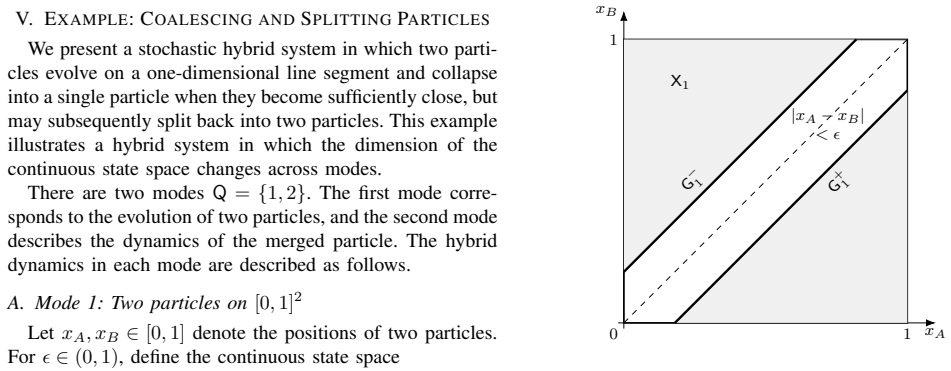
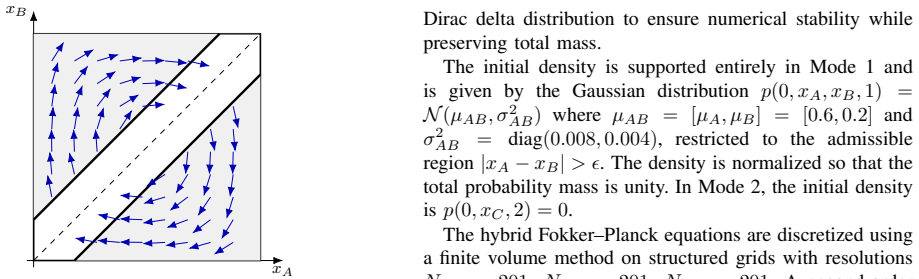
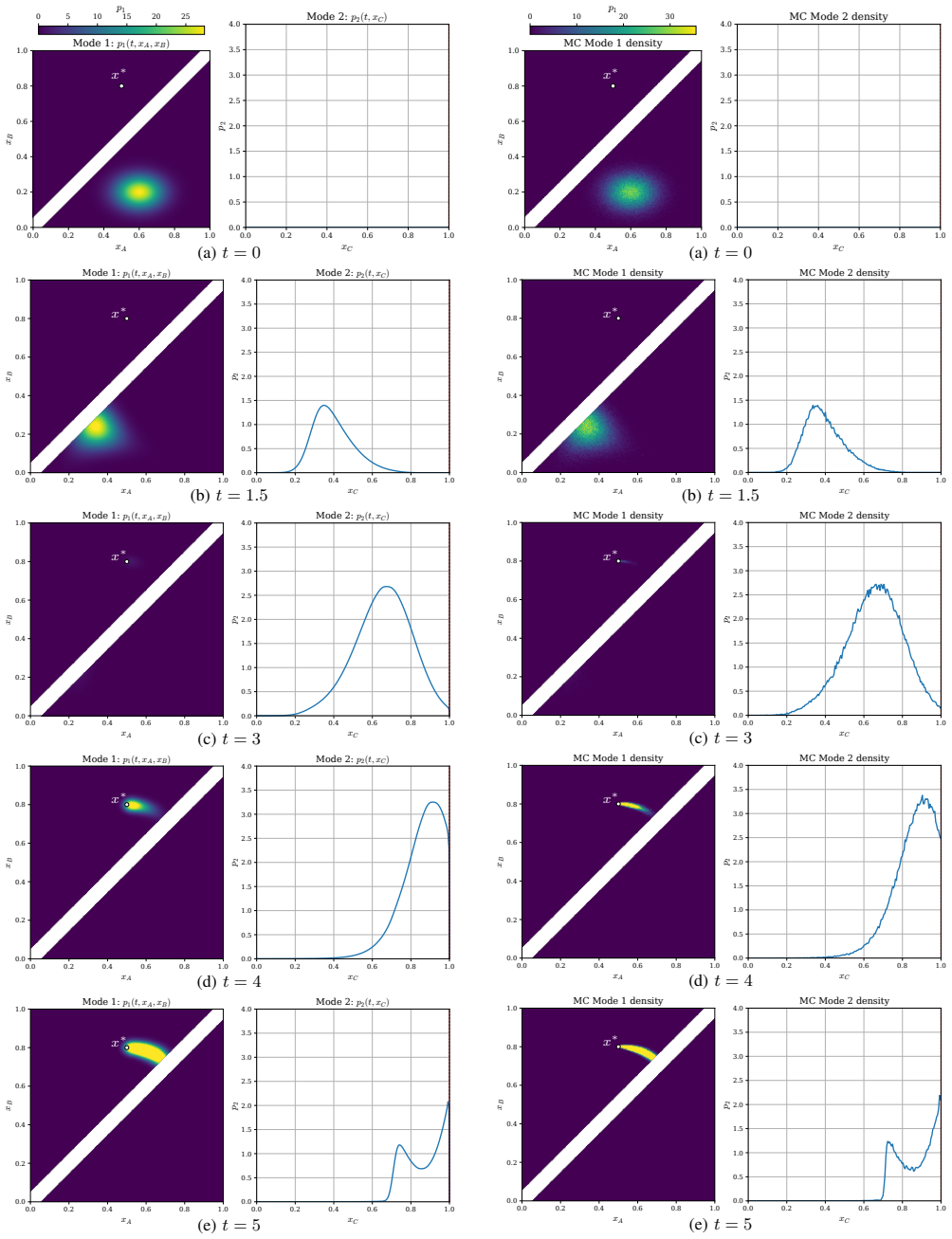
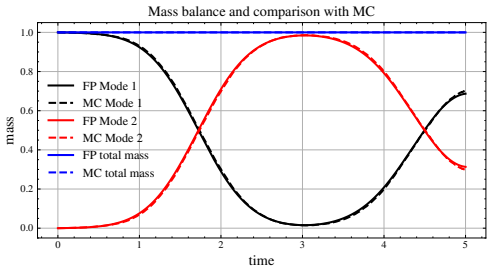
- The approach is demonstrated on a stochastic hybrid model of two particles merging into one and later splitting back into two.
Where Pith is reading between the lines
- Numerical schemes solving the resulting weak equations could be developed to propagate uncertainty in merging or splitting dynamics.
- The same flux-pushforward idea might apply to other hybrid systems where probability mass concentrates on lower-dimensional sets.
- Verification on the merge-split example would show where boundary-condition methods miss the generated source terms.
Load-bearing premise
The reset maps must be sufficiently regular for the pushforward of the probability flux to be well-defined, and the system must admit a probability density without unmodeled singularities.
What would settle it
Compute the probability density evolution for the two-particle merge-and-split model using both the proposed weak formulation and standard boundary conditions, then check whether the densities differ in the presence of dimension-changing resets.
Figures
read the original abstract
This paper studies probability density evolution for stochastic hybrid systems with reset maps that change the dimension of the continuous state across modes. Existing Frobenius--Perron formulations typically represent reset-induced probability transfer through boundary conditions, which is insufficient when resets map guard sets into the interior or onto lower-dimensional subsets of another mode. We develop a weak-form formulation in which reset-induced transfer is represented by the pushforward of probability flux across the guard, yielding a unified description for such systems. The proposed framework naturally captures both cases: when the reset decreases dimension, the transferred probability appears as an interior source density, whereas when the reset increases dimension, it generally appears as a singular source supported on a lower-dimensional subset. The approach is illustrated using a stochastic hybrid model in which two particles merge into one and later split back into two, demonstrating how dimension-changing resets lead to source terms beyond classical boundary-condition-based formulations.
Editorial analysis
A structured set of objections, weighed in public.
Referee Report
Summary. The paper develops a weak-form formulation for probability density evolution in stochastic hybrid systems with reset maps that change the dimension of the continuous state. Reset-induced transfer is represented via pushforward of probability flux across guards, providing a unified description that captures dimension-decreasing resets as interior source densities and dimension-increasing resets as singular sources on lower-dimensional subsets. This is positioned as an improvement over traditional Frobenius-Perron or boundary-condition approaches, and demonstrated on a stochastic hybrid model of two particles merging into one and later splitting back into two.
Significance. If rigorously supported, the framework would extend uncertainty propagation tools to a broader class of hybrid systems involving coalescence or fission, where state dimension varies. This could enable more accurate modeling in applications such as multi-agent coordination or biological processes, by handling probability transfers that existing fixed-dimension methods cannot represent without ad-hoc adjustments. The particle example highlights the practical distinction from classical formulations.
major comments (2)
- [Abstract and weak-formulation section] Abstract and weak-formulation section: The central claim that the pushforward yields a 'unified description' for dimension-increasing resets (appearing as singular sources) is load-bearing, yet the formulation is framed around evolution of a probability density. When the image of the guard is supported on a lower-dimensional subset, the overall measure is no longer absolutely continuous w.r.t. Lebesgue measure on the target space; the weak form tested against smooth compactly supported functions on the full-dimensional domain therefore requires an explicit decomposition into absolutely continuous plus singular parts, or the source term remains incompletely specified.
- [Particle merge-split example] Particle merge-split example: The illustration demonstrates dimension-changing resets but supplies no explicit equations for the resulting source terms, no error bounds, and no verification (e.g., against particle simulations or Monte Carlo) that the weak formulation correctly reproduces the probability transfer after the first dimension-increasing reset. This leaves the practical advantage over boundary-condition methods unquantified.
minor comments (2)
- The abstract would benefit from a concise statement of the regularity assumptions on the reset maps and guard sets that ensure the pushforward of probability flux is well-defined.
- Notation for the probability flux and its pushforward should be introduced with a clear reference to the underlying measure-theoretic construction to aid readability.
Simulated Author's Rebuttal
We thank the referee for the constructive and detailed comments. We address each major point below and will revise the manuscript accordingly to strengthen the presentation of the weak formulation and the illustrative example.
read point-by-point responses
-
Referee: [Abstract and weak-formulation section] Abstract and weak-formulation section: The central claim that the pushforward yields a 'unified description' for dimension-increasing resets (appearing as singular sources) is load-bearing, yet the formulation is framed around evolution of a probability density. When the image of the guard is supported on a lower-dimensional subset, the overall measure is no longer absolutely continuous w.r.t. Lebesgue measure on the target space; the weak form tested against smooth compactly supported functions on the full-dimensional domain therefore requires an explicit decomposition into absolutely continuous plus singular parts, or the source term remains incompletely specified.
Authors: We appreciate the referee's observation on the measure-theoretic requirements. The weak formulation is developed for general probability measures (not restricted to densities), with the evolution equation understood in the distributional sense. The pushforward of the probability flux across the guard defines the source as a Radon measure that may be singular. In the revised manuscript, we will explicitly introduce the decomposition of the probability measure into absolutely continuous and singular parts and clarify how the weak form, tested against C^∞_c test functions, incorporates the singular source via the pushforward. This makes the unified description complete and rigorous. revision: yes
-
Referee: [Particle merge-split example] Particle merge-split example: The illustration demonstrates dimension-changing resets but supplies no explicit equations for the resulting source terms, no error bounds, and no verification (e.g., against particle simulations or Monte Carlo) that the weak formulation correctly reproduces the probability transfer after the first dimension-increasing reset. This leaves the practical advantage over boundary-condition methods unquantified.
Authors: We agree that explicit equations for the source terms would enhance the example. In the revision, we will derive and include the explicit expression for the singular source term generated by the dimension-increasing split reset, obtained directly from the pushforward of the incoming probability flux. The example is primarily illustrative of the conceptual distinction from boundary-condition approaches. We will add a brief discussion of how numerical verification could be performed via Monte Carlo simulation of the hybrid process, but we do not include quantitative error bounds or full verification in this theoretical paper, as that would constitute a separate computational study. The practical advantage is demonstrated by the framework's ability to represent singular sources without ad-hoc adjustments. revision: partial
Circularity Check
No significant circularity; derivation is self-contained from measure-theoretic pushforward
full rationale
The paper derives a weak-form evolution equation for probability densities in stochastic hybrid systems by representing reset transfers via the pushforward of probability flux across guards. This construction follows directly from standard measure theory and the definition of the pushforward operator on measures, without any reduction to fitted parameters, self-definitional loops, or load-bearing self-citations. The abstract and description explicitly distinguish interior sources (dimension decrease) from singular sources (dimension increase) as consequences of the pushforward, not as inputs that define the framework. The example of merging/splitting particles serves as illustration rather than a tautological fit. No steps match the enumerated circularity patterns.
Axiom & Free-Parameter Ledger
axioms (2)
- domain assumption Existence of a probability density for the continuous state in each mode of the hybrid system.
- domain assumption Reset maps admit a well-defined pushforward operation on probability measures or fluxes.
Lean theorems connected to this paper
-
IndisputableMonolith/Foundation/RealityFromDistinction.leanreality_from_one_distinction unclear?
unclearRelation between the paper passage and the cited Recognition theorem.
weak-form formulation in which reset-induced transfer is represented by the pushforward of probability flux across the guard... singular source supported on a lower-dimensional subset
-
IndisputableMonolith/Cost/FunctionalEquation.leanwashburn_uniqueness_aczel unclear?
unclearRelation between the paper passage and the cited Recognition theorem.
ηq(t) = sum Φ∗((Yr · Nr)dSr)
What do these tags mean?
- matches
- The paper's claim is directly supported by a theorem in the formal canon.
- supports
- The theorem supports part of the paper's argument, but the paper may add assumptions or extra steps.
- extends
- The paper goes beyond the formal theorem; the theorem is a base layer rather than the whole result.
- uses
- The paper appears to rely on the theorem as machinery.
- contradicts
- The paper's claim conflicts with a theorem or certificate in the canon.
- unclear
- Pith found a possible connection, but the passage is too broad, indirect, or ambiguous to say the theorem truly supports the claim.
Reference graph
Works this paper leans on
-
[1]
Toward a general theory of stochastic hybrid systems,
M. L. Bujorianu and J. Lygeros, “Toward a general theory of stochastic hybrid systems,” inStochastic hybrid systems. Springer, 2006, pp. 3–30
work page 2006
-
[2]
Rare event estimation for a large-scale stochastic hybrid system with air traffic application,
H. A. Blom, G. Bakker, and J. Krystul, “Rare event estimation for a large-scale stochastic hybrid system with air traffic application,”Rare event simulation using Monte Carlo methods, pp. 193–214, 2009
work page 2009
-
[3]
Fluid limit theorems for stochastic hybrid systems with application to neuron models,
K. Pakdaman, M. Thieullen, and G. Wainrib, “Fluid limit theorems for stochastic hybrid systems with application to neuron models,” Advances in Applied Probability, vol. 42, no. 3, pp. 761–794, 2010
work page 2010
-
[4]
Stochastic hybrid systems: Application to commu- nication networks,
J. P. Hespanha, “Stochastic hybrid systems: Application to commu- nication networks,” inInternational Workshop on Hybrid Systems: Computation and Control. Springer, 2004, pp. 387–401
work page 2004
-
[5]
M. Oprea, A. Shaw, R. Huq, K. Iwasaki, D. Kassabova, and W. Clark, “A study of the long-term behavior of hybrid systems with symmetries via reduction and the Frobenius–Perron operator,”SIAM Journal on Applied Dynamical Systems, vol. 23, no. 4, pp. 2899–2938, 2024
work page 2024
-
[6]
Spectral Bayesian estimation for general stochastic hybrid systems,
W. Wang and T. Lee, “Spectral Bayesian estimation for general stochastic hybrid systems,”Automatica, vol. 117, Jul. 2020
work page 2020
-
[7]
Uncertainty propagation for general stochastic hybrid systems on compact Lie groups,
——, “Uncertainty propagation for general stochastic hybrid systems on compact Lie groups,”SIAM Journal on Applied Dynamical Systems, vol. 21, no. 3, pp. 2215–2240, Jun. 2022
work page 2022
-
[8]
Uncertainty propagation of stochastic hybrid systems: a case study for types of jump,
T. C, W. Clark, and T. Lee, “Uncertainty propagation of stochastic hybrid systems: a case study for types of jump,” inProceedings of the IFAC Symposium on Nonlinear Control Systems, Jul. 2025
work page 2025
-
[9]
Øksendal,Stochastic differential equations
B. Øksendal,Stochastic differential equations. Springer, 2003
work page 2003
-
[10]
V . I. Bogachev and M. A. S. Ruas,Measure theory. Springer, 2007, vol. 1, no. 1
work page 2007
-
[11]
R. J. LeVeque,Finite volume methods for hyperbolic problems. Cambridge university press, 2002, vol. 31
work page 2002
discussion (0)
Sign in with ORCID, Apple, or X to comment. Anyone can read and Pith papers without signing in.