Recognition: 2 theorem links
· Lean TheoremLearning to Search: A Decision-Based Agent for Knowledge-Based Visual Question Answering
Pith reviewed 2026-05-10 17:49 UTC · model grok-4.3
The pith
A search agent learns to choose retrieval or answer actions step by step to solve knowledge-based visual questions more adaptively than fixed pipelines.
A machine-rendered reading of the paper's core claim, the machinery that carries it, and where it could break.
Core claim
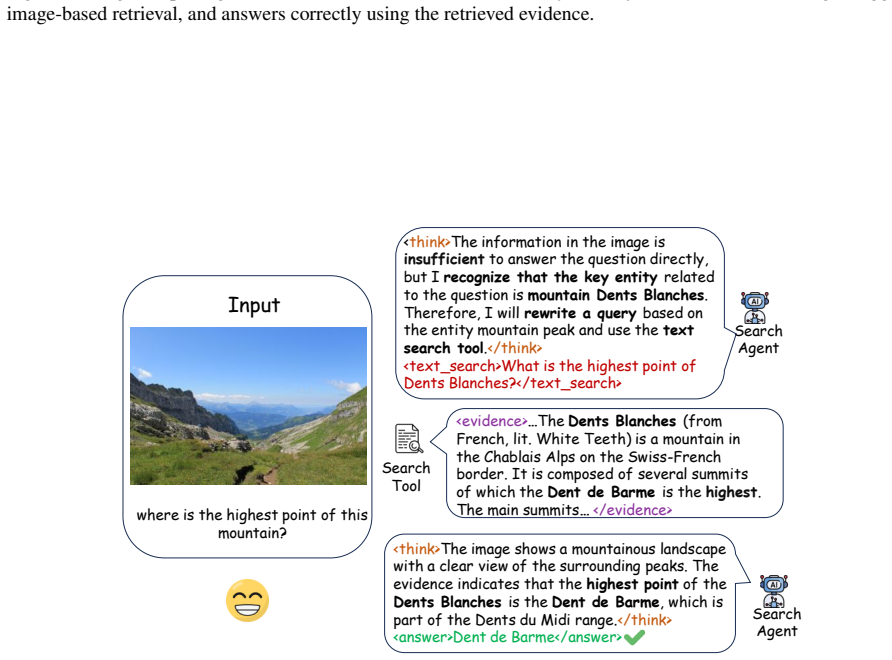
We reformulate KB-VQA as a search-agent problem and model the solving process as a multi-step decision-making procedure. At each step, the agent selects one of four actions-Answer, Image Retrieval, Text Retrieval, and Caption-based on its current information state. We further design an automated pipeline to collect multi-step trajectories that record the agent's reasoning process, tool usage, and intermediate decisions. These trajectories are then used as supervision for fine-tuning.
What carries the argument
The multi-step decision agent that selects among Answer, Image Retrieval, Text Retrieval, and Caption actions according to its current information state, trained on trajectories collected by an automated pipeline.
Load-bearing premise
The automated pipeline reliably produces high-quality trajectories that give effective, unbiased supervision for learning good decision policies.
What would settle it
Running the trained agent on the InfoSeek or E-VQA test sets and measuring no gain in accuracy over standard fixed retrieval-augmented baselines would falsify the claimed advantage.
Figures




read the original abstract
Knowledge-based visual question answering (KB-VQA) requires vision-language models to understand images and use external knowledge, especially for rare entities and long-tail facts. Most existing retrieval-augmented generation (RAG) methods adopt a fixed pipeline that sequentially retrieves information, filters it, and then produces an answer. Such a design makes it difficult to adapt to diverse question types. Moreover, it separates retrieval from reasoning, making it hard for the model to decide when to search, how to refine queries, or when to stop. As a result, the retrieved evidence is often poorly aligned with the question. To address these limitations, we reformulate KB-VQA as a search-agent problem and model the solving process as a multi-step decision-making procedure. At each step, the agent selects one of four actions-Answer, Image Retrieval, Text Retrieval, and Caption-based on its current information state. We further design an automated pipeline to collect multi-step trajectories that record the agent's reasoning process, tool usage, and intermediate decisions. These trajectories are then used as supervision for fine-tuning. Experiments on InfoSeek and E-VQA demonstrate that our method achieves state-of-the-art performance, consistently outperforming prior baselines and confirming the effectiveness of our framework.
Editorial analysis
A structured set of objections, weighed in public.
Referee Report
Summary. The paper proposes reformulating KB-VQA as a search-agent problem modeled as a multi-step decision-making procedure. The agent selects one of four actions—Answer, Image Retrieval, Text Retrieval, or Caption—at each step based on its current information state. An automated pipeline collects multi-step trajectories that record reasoning, tool usage, and decisions for use as supervision to fine-tune the model. Experiments on the InfoSeek and E-VQA datasets are claimed to demonstrate state-of-the-art performance, outperforming prior baselines.
Significance. Should the empirical claims prove robust upon detailed verification, this work has the potential to improve KB-VQA systems by integrating retrieval and reasoning through learned adaptive policies rather than rigid sequential pipelines. This could lead to better handling of diverse question types and improved alignment of retrieved evidence with questions involving rare or long-tail knowledge.
major comments (2)
- [Method section (trajectory collection)] The automated pipeline used to collect multi-step trajectories for supervision is described only at a high level. No specifics are given on the heuristics for action selection, prevention of loops or suboptimal paths, or validation that the trajectories provide high-quality, unbiased supervision. This is a load-bearing component for the claim that the decision framework yields superior policies, as the gains could stem from imitating the pipeline rather than learning optimal decisions.
- [Experiments section] The manuscript asserts state-of-the-art results on InfoSeek and E-VQA but supplies no experimental details, baselines, metrics, error analysis, or ablation studies in the provided text. This absence prevents assessment of whether the performance improvements are attributable to the proposed agent framework.
minor comments (1)
- The abstract refers to a 'Caption-based' action without clarifying whether this involves generating or retrieving captions; this should be defined precisely in the method for clarity.
Simulated Author's Rebuttal
We thank the referee for the constructive feedback. The comments identify key areas where additional clarity and detail will strengthen the manuscript. We address each major comment below and commit to a revised version that incorporates the requested expansions.
read point-by-point responses
-
Referee: [Method section (trajectory collection)] The automated pipeline used to collect multi-step trajectories for supervision is described only at a high level. No specifics are given on the heuristics for action selection, prevention of loops or suboptimal paths, or validation that the trajectories provide high-quality, unbiased supervision. This is a load-bearing component for the claim that the decision framework yields superior policies, as the gains could stem from imitating the pipeline rather than learning optimal decisions.
Authors: We agree that the current description of the automated pipeline is high-level and that more specifics are needed to substantiate the quality of the supervision. In the revised manuscript we will expand the Methods section with concrete details on the heuristics for action selection (including the exact rules and thresholds used to decide between Answer, Image Retrieval, Text Retrieval, and Caption), mechanisms to detect and prevent loops (such as state hashing and maximum-step caps), and validation procedures (including sampling rates for manual review, quantitative checks for path diversity, and bias metrics comparing trajectory distributions to the original datasets). These additions will clarify how the collected trajectories support learning of adaptive policies rather than simple imitation. revision: yes
-
Referee: [Experiments section] The manuscript asserts state-of-the-art results on InfoSeek and E-VQA but supplies no experimental details, baselines, metrics, error analysis, or ablation studies in the provided text. This absence prevents assessment of whether the performance improvements are attributable to the proposed agent framework.
Authors: The full manuscript contains an Experiments section reporting results on InfoSeek and E-VQA, but we acknowledge that the version reviewed may have presented these results too concisely. In the revision we will expand this section to include complete experimental details: full descriptions of all baselines (prior KB-VQA and RAG methods), the exact evaluation metrics, comprehensive error analysis broken down by question type and knowledge rarity, and ablation studies isolating the contribution of the learned decision policy versus fixed pipelines. Additional tables and figures will be added to make the attribution of gains to the agent framework explicit and verifiable. revision: yes
Circularity Check
No significant circularity; empirical agent framework evaluated on external benchmarks
full rationale
The paper reformulates KB-VQA as a four-action search agent, collects trajectories via an automated pipeline for fine-tuning supervision, and reports SOTA results on InfoSeek and E-VQA. No equations, fitted parameters renamed as predictions, self-citations, or uniqueness theorems appear in the provided text. The central claim rests on empirical performance against external benchmarks rather than any derivation that reduces to its inputs by construction. This is a standard self-contained empirical setup with no load-bearing self-referential steps.
Axiom & Free-Parameter Ledger
axioms (2)
- domain assumption The four actions (Answer, Image Retrieval, Text Retrieval, Caption) are sufficient to solve KB-VQA tasks
- domain assumption Automatically collected trajectories can serve as effective supervision for fine-tuning the agent's policy
Lean theorems connected to this paper
-
IndisputableMonolith/Cost/FunctionalEquation.leanwashburn_uniqueness_aczel unclear?
unclearRelation between the paper passage and the cited Recognition theorem.
We further design an automated pipeline to collect multi-step trajectories that record the agent's reasoning process, tool usage, and intermediate decisions.
What do these tags mean?
- matches
- The paper's claim is directly supported by a theorem in the formal canon.
- supports
- The theorem supports part of the paper's argument, but the paper may add assumptions or extra steps.
- extends
- The paper goes beyond the formal theorem; the theorem is a base layer rather than the whole result.
- uses
- The paper appears to rely on the theorem as machinery.
- contradicts
- The paper's claim conflicts with a theorem or certificate in the canon.
- unclear
- Pith found a possible connection, but the passage is too broad, indirect, or ambiguous to say the theorem truly supports the claim.
Reference graph
Works this paper leans on
-
[1]
Can pre-trained vision and language models answer visual information-seeking questions?ArXiv, abs/2302.11713. Zhuo Chen, Zhengxian Wu, Zirui Liao, Shenao Jiang, Hangrui Xu, Yang Chen, Chaokui Su, Xiaoyu Liu, and Haoqian Wang. 2026. R3g: A reasoning- retrieval-reranking framework for vision-centric an- swer generation.ArXiv, abs/2602.00104. Changin Choi, W...
-
[2]
ReSeek: A Self-Correcting Framework for Search Agents with Instructive Rewards
Cross-modal retrieval for knowledge-based visual question answering. InEuropean Conference on Information Retrieval. Shiyu Li, Yang Tang, Yifan Wang, Peiming Li, and Xi Chen. 2025. Reseek: A self-correcting framework for search agents with instructive rewards.ArXiv, abs/2510.00568. Yangning Li, Yinghui Li, Xinyu Wang, Yong Jiang, Zhen Zhang, Xinran Zheng,...
work page internal anchor Pith review arXiv 2025
-
[3]
arXiv preprint arXiv:2410.08876 (2024),https://arxiv.org/abs/2410.08876
Rora-vlm: Robust retrieval-augmented vision language models.ArXiv, abs/2410.08876. Xin Su, Man Luo, Kris W Pan, Tien Pei Chou, Vasudev Lal, and Phillip Howard. 2024. Sk-vqa: Synthetic knowledge generation at scale for training context- augmented multimodal llms.ArXiv, abs/2406.19593. Michael Sullivan, Mareike Hartmann, and Alexander Koller. 2025. Procedur...
-
[4]
PORTool: Importance-Aware Policy Optimization with Rewarded Tree for Multi-Tool-Integrated Reasoning
Portool: Tool-use llm training with rewarded tree.ArXiv, abs/2510.26020. Zhengxian Wu, Kai Shi, Chuanrui Zhang, Zirui Liao, Jun Yang, Ni Yang, Qiuying Peng, Luyuan Zhang, Hangrui Xu, Tianhuang Su, Zhenyu Yang, Haonan Lu, and Haoqian Wang. 2026. When models judge themselves: Unsupervised self-evolution for multi- modal reasoning. Junbin Xiao, Nanxin Huang,...
work page internal anchor Pith review Pith/arXiv arXiv 2026
-
[5]
ground truth
Fine-grained knowledge structuring and re- trieval for visual question answering. Yuxiang Zheng, Dayuan Fu, Xiangkun Hu, Xiaojie Cai, Lyumanshan Ye, Pengrui Lu, and Pengfei Liu. 2025. Deepresearcher: Scaling deep research via reinforce- ment learning in real-world environments. InCon- ference on Empirical Methods in Natural Language Processing. A Datasets...
2025
discussion (0)
Sign in with ORCID, Apple, or X to comment. Anyone can read and Pith papers without signing in.