Recognition: unknown
Interaction-Mediated Non-Reciprocal Dynamics in Open Quantum Systems: From an Exactly Solvable Model to Generic Behavior
Pith reviewed 2026-05-10 16:58 UTC · model grok-4.3
The pith
Density-density interactions transfer bath-induced non-reciprocity to uncoupled degrees of freedom in open quantum systems.
A machine-rendered reading of the paper's core claim, the machinery that carries it, and where it could break.
Core claim
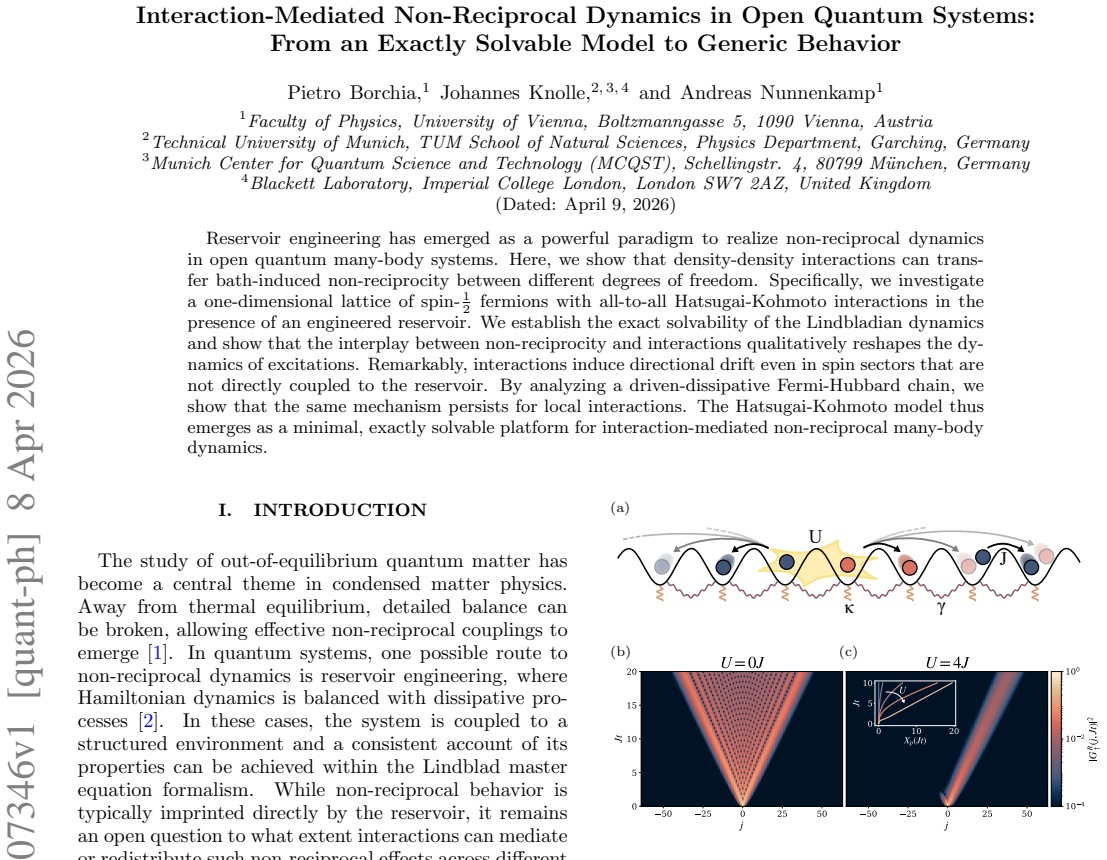
The central claim is that density-density interactions mediate the transfer of non-reciprocity between different degrees of freedom. In the exactly solvable Hatsugai-Kohmoto model the interplay between reservoir-induced non-reciprocity and interactions qualitatively reshapes excitation dynamics and induces directional drift even in spin sectors that are not directly coupled to the reservoir. The mechanism persists for local interactions in the driven-dissipative Fermi-Hubbard chain, establishing the Hatsugai-Kohmoto model as a minimal exactly solvable platform for interaction-mediated non-reciprocal many-body dynamics.
What carries the argument
All-to-all Hatsugai-Kohmoto density-density interactions, which render the Lindbladian exactly solvable and mediate non-reciprocity transfer to uncoupled spin sectors.
If this is right
- The dynamics of excitations is qualitatively altered by the combined action of non-reciprocity and interactions.
- Directional drift appears in spin sectors that lack direct reservoir coupling.
- The transfer effect survives when interactions are restricted to local density-density form in the Fermi-Hubbard chain.
- The Hatsugai-Kohmoto model supplies an exactly solvable minimal setting for studying such many-body open-system dynamics.
Where Pith is reading between the lines
- Choosing interaction forms that commute with the reservoir coupling could allow non-reciprocity to be routed into chosen subspaces without additional engineering.
- The same mediation principle might be tested in higher dimensions or with different reservoir types to see how far the directional-drift effect generalizes.
- Quantum simulators could exploit this route to realize controlled non-reciprocal transport without needing site-by-site bath engineering.
Load-bearing premise
The transfer mechanism depends on the specific all-to-all form of the Hatsugai-Kohmoto interactions together with the chosen engineered reservoir, and the claim of generic behavior rests on the separate analysis of the driven-dissipative Fermi-Hubbard chain.
What would settle it
A numerical or experimental check that finds no directional drift in the uncoupled spin sectors of the Hatsugai-Kohmoto model under the stated reservoir coupling would falsify the interaction-mediated transfer.
Figures


read the original abstract
Reservoir engineering has emerged as a powerful paradigm to realize non-reciprocal dynamics in open quantum many-body systems. Here, we show that density-density interactions can transfer bath-induced non-reciprocity between different degrees of freedom. Specifically, we investigate a one-dimensional lattice of spin-$\frac{1}{2}$ fermions with all-to-all Hatsugai-Kohmoto interactions in the presence of an engineered reservoir. We establish the exact solvability of the Lindbladian dynamics and show that the interplay between non-reciprocity and interactions qualitatively reshapes the dynamics of excitations. Remarkably, interactions induce directional drift even in spin sectors that are not directly coupled to the reservoir. By analyzing a driven-dissipative Fermi-Hubbard chain, we show that the same mechanism persists for local interactions. The Hatsugai-Kohmoto model thus emerges as a minimal, exactly solvable platform for interaction-mediated non-reciprocal many-body dynamics.
Editorial analysis
A structured set of objections, weighed in public.
Referee Report
Summary. The paper claims that density-density interactions can transfer bath-induced non-reciprocity between degrees of freedom in open quantum systems. It establishes exact solvability of the Lindbladian for a 1D lattice of spin-1/2 fermions with all-to-all Hatsugai-Kohmoto interactions under an engineered reservoir, showing that interactions induce directional drift of excitations even in spin sectors not directly coupled to the reservoir. The same mechanism is argued to hold for local interactions via analysis of a driven-dissipative Fermi-Hubbard chain, positioning the Hatsugai-Kohmoto model as a minimal exactly solvable platform.
Significance. If the central claims hold, this provides a valuable exactly solvable model for interaction-mediated non-reciprocal dynamics in open many-body systems. The exact solvability of the Lindbladian for the Hatsugai-Kohmoto case is a notable strength, enabling clean, parameter-free derivations of the directional drift effect and serving as a benchmark for numerical or approximate treatments of more generic models.
major comments (1)
- [Fermi-Hubbard chain analysis] The section analyzing the driven-dissipative Fermi-Hubbard chain is load-bearing for the genericity claim. The manuscript must specify the solution method (numerical integration of the Lindblad equation, perturbative expansion, mean-field, or exact diagonalization) and the parameter regime in which directional drift is demonstrated for spin sectors not directly coupled to the reservoir. Without these details it remains unclear whether the qualitative reshaping survives for local interactions independently of the all-to-all Hatsugai-Kohmoto solvability.
minor comments (2)
- [Abstract] The abstract could briefly identify the observable (e.g., excitation current or density profile) used to demonstrate directional drift.
- [Notation and model definitions] Notation for reservoir coupling strengths and jump operators should be checked for consistency between the Hatsugai-Kohmoto and Fermi-Hubbard sections.
Simulated Author's Rebuttal
We thank the referee for their careful reading of our manuscript and for the constructive feedback. We appreciate the positive assessment of the significance of the exact solvability result for the Hatsugai-Kohmoto model. Below we address the major comment and commit to revisions that will strengthen the presentation of the genericity claim.
read point-by-point responses
-
Referee: [Fermi-Hubbard chain analysis] The section analyzing the driven-dissipative Fermi-Hubbard chain is load-bearing for the genericity claim. The manuscript must specify the solution method (numerical integration of the Lindblad equation, perturbative expansion, mean-field, or exact diagonalization) and the parameter regime in which directional drift is demonstrated for spin sectors not directly coupled to the reservoir. Without these details it remains unclear whether the qualitative reshaping survives for local interactions independently of the all-to-all Hatsugai-Kohmoto solvability.
Authors: We agree that the Fermi-Hubbard analysis requires explicit methodological and parametric details to support the claim that interaction-mediated non-reciprocity persists for local interactions. In the revised manuscript we will add a dedicated paragraph (or subsection) stating that the results were obtained by direct numerical integration of the Lindblad master equation on small lattices (L=4 and L=6 sites) using a fourth-order Runge-Kutta integrator with a time step dt=0.01/t. The parameter regime explored is U/t=1.5, driving amplitude Ω/t=0.8, and engineered dissipation rate γ/t=0.2, with the reservoir coupled only to the spin-up sector. In this window we observe a clear directional drift of the spin-down density profile (quantified by the first moment of the density distribution shifting at a constant velocity v≈0.15 t a, where a is the lattice spacing) that is absent when U=0. These parameters are chosen to be deep in the regime where the interaction-induced transfer of non-reciprocity dominates over direct bath effects on the uncoupled sector. We will also include a brief statement that the qualitative drift survives under moderate variations of U/t and γ/t, thereby establishing independence from the all-to-all solvability. revision: yes
Circularity Check
No circularity: exact solvability derived for specific model; generic claim rests on independent analysis of second model.
full rationale
The derivation begins with the definition of the all-to-all Hatsugai-Kohmoto Lindbladian, for which the paper states it establishes exact solvability via direct solution of the master equation. The directional-drift result in uncoupled sectors follows from that explicit solution. The extension to local interactions is performed on a separate driven-dissipative Fermi-Hubbard chain whose dynamics are analyzed independently (numerically or otherwise). No step equates a prediction to a fitted parameter by construction, renames a known result, or relies on a self-citation whose content is itself unverified. The central claims therefore remain self-contained against the paper's own equations and the additional model study.
Axiom & Free-Parameter Ledger
axioms (2)
- standard math The dynamics of the open system are governed by a Lindblad master equation
- domain assumption The Hatsugai-Kohmoto interaction allows exact solvability of the many-body Lindbladian
Forward citations
Cited by 1 Pith paper
-
Exact steady states of interacting driven dissipative fermionic systems with hidden time-reversal symmetry
Exact steady states are derived for interacting dissipative fermionic systems with hidden time-reversal symmetry, revealing a first-order particle density phase transition that survives finite dissipation.
Reference graph
Works this paper leans on
-
[1]
M. Fruchart and V. Vitelli, Nonreciprocal many-body physics (2026), arXiv:2602.11111
-
[2]
Metelmann and A
A. Metelmann and A. A. Clerk, Nonreciprocal photon transmission and amplification via reservoir engineering, Phys. Rev. X5, 021025 (2015)
2015
-
[3]
F. Song, S. Yao, and Z. Wang, Non-hermitian skin effect and chiral damping in open quantum systems, Phys. Rev. Lett.123, 170401 (2019)
2019
-
[4]
T. Haga, M. Nakagawa, R. Hamazaki, and M. Ueda, Liouvillian skin effect: Slowing down of relaxation pro- cesses without gap closing, Phys. Rev. Lett.127, 070402 (2021)
2021
-
[5]
G. Lee, A. McDonald, and A. Clerk, Anomalously large relaxation times in dissipative lattice models beyond the non-hermitian skin effect, Phys. Rev. B108, 064311 (2023)
2023
-
[6]
McDonald, R
A. McDonald, R. Hanai, and A. A. Clerk, Nonequilib- rium stationary states of quantum non-hermitian lattice models, Phys. Rev. B105, 064302 (2022)
2022
-
[7]
Porras and S
D. Porras and S. Fern´ andez-Lorenzo, Topological amplifi- cation in photonic lattices, Phys. Rev. Lett.122, 143901 (2019)
2019
-
[8]
C. C. Wanjura, M. Brunelli, and A. Nunnenkamp, Topo- logical framework for directional amplification in driven- dissipative cavity arrays, Nature Communications11 (2020)
2020
-
[9]
Belyansky, C
R. Belyansky, C. Weis, R. Hanai, P. B. Littlewood, and A. A. Clerk, Phase transitions in nonreciprocal driven- dissipative condensates, Phys. Rev. Lett.135, 123401 (2025)
2025
- [10]
-
[11]
P. Brighi and A. Nunnenkamp, Pairing-induced phase transition in the non-reciprocal kitaev chain (2025), arXiv:2510.24851
-
[12]
Yoshida, S.-B
T. Yoshida, S.-B. Zhang, T. Neupert, and N. Kawakami, Non-hermitian mott skin effect, Phys. Rev. Lett.133, 076502 (2024)
2024
-
[13]
Hamazaki, K
R. Hamazaki, K. Kawabata, and M. Ueda, Non- hermitian many-body localization, Phys. Rev. Lett.123, 090603 (2019)
2019
-
[14]
Kawabata, K
K. Kawabata, K. Shiozaki, and S. Ryu, Many-body topology of non-hermitian systems, Phys. Rev. B105, 165137 (2022)
2022
-
[15]
Many Manda, R
B. Many Manda, R. Carretero-Gonz´ alez, P. G. Kevrekidis, and V. Achilleos, Skin modes in a nonlinear hatano-nelson model, Phys. Rev. B109, 094308 (2024)
2024
-
[16]
Ashida, Z
Y. Ashida, Z. Gong, and M. Ueda, Non-hermitian physics, Advances in Physics69, 249 (2020)
2020
-
[17]
Brighi and A
P. Brighi and A. Nunnenkamp, Nonreciprocal dynamics and the non-hermitian skin effect of repulsively bound 9 pairs, Phys. Rev. A110, L020201 (2024)
2024
-
[18]
S. E. Begg and R. Hanai, Quantum criticality in open quantum spin chains with nonreciprocity, Phys. Rev. Lett.132, 120401 (2024)
2024
-
[19]
Hatsugai and M
Y. Hatsugai and M. Kohmoto, Exactly solvable model of correlated lattice electrons in any dimensions, Journal of the Physical Society of Japan61, 2056 (1992)
2056
-
[20]
P. W. Phillips, L. Yeo, and E. W. Huang, Exact theory for superconductivity in a doped mott insulator, Nature Physics16, 1175 (2020)
2020
-
[21]
Zhong, Solvable periodic anderson model with infinite- range hatsugai-kohmoto interaction: Ground-states and beyond, Physical Review B106, 155119 (2022)
Y. Zhong, Solvable periodic anderson model with infinite- range hatsugai-kohmoto interaction: Ground-states and beyond, Physical Review B106, 155119 (2022)
2022
-
[22]
Leeb and J
V. Leeb and J. Knolle, Quantum oscillations in a doped mott insulator beyond onsager’s relation, Physical Re- view B108, 085106 (2023)
2023
-
[23]
Meng and J
T. Meng and J. C. Budich, Unpaired weyl nodes from long-ranged interactions: Fate of quantum anomalies, Physical Review Letters122, 046402 (2019)
2019
-
[24]
J. Zhao, P. Mai, B. Bradlyn, and P. Phillips, Failure of topological invariants in strongly correlated matter, Physical Review Letters131, 106601 (2023)
2023
-
[26]
Schwarz, M
F. Schwarz, M. Goldstein, A. Dorda, E. Arrigoni, A. We- ichselbaum, and J. von Delft, Lindblad-driven discretized leads for nonequilibrium steady-state transport in quan- tum impurity models: Recovering the continuum limit, Phys. Rev. B94, 155142 (2016)
2016
-
[27]
See Supplemental Material
-
[28]
J. Zhao, N. A. Hackner, and D. Kush, Twisting the hubbard model into the momentum-mixing hat- sugai–kohmoto model, Nature Physics (2025)
2025
-
[29]
Y. Bai and P. W. Phillips, Proof that momentum mix- ing hatsugai–kohmoto equals the twisted hubbard model (2025), arXiv:2512.03148
-
[30]
Interaction-Mediated Non-Reciprocal Dynamics in Open Quantum Systems: From an Exactly Solvable Model to Generic Behavior
D. Manning-Coe and B. Bradlyn, Ground state stability, symmetry, and degeneracy in mott insulators with long- range interactions, Phys. Rev. B108, 165136 (2023). Supplemental Material for “Interaction-Mediated Non-Reciprocal Dynamics in Open Quantum Systems: From an Exactly Solvable Model to Generic Behavior” Pietro Borchia, 1 Johannes Knolle, 2, 3, 4 and...
2023
-
[31]
+i Γ¯σ 2 +i √ ∆ 2i √ ∆ (42) Z2 = U(n ss ¯σ − 1
-
[32]
+i Γ¯σ 2 −i √ ∆ −2i √ ∆ (43) Therefore we can compactly write Z1,2 = 1 2 1± U(2n ss ¯σ −1) +iΓ ¯σ i √ ∆ (44) III. BEYOND THE EXACTL Y SOL V ABLE MODEL As a preliminary investigation of the generality of interaction-induced non-reciprocal dynamics, we consider a 1D spin- 1 2 Fermi-Hubbard chain with incoherent dissipation and drive. The Hubbard interaction...
-
[33]
Equation of motion forc k↑ The Heisenberg equation reads ∂tO=i[H, O] + X m ξ L† mOLm − 1 2 {L† mLm, O} ,(49) withξ=−1 for odd fermionic operators. Since the jump operators act only on the↓-sector, the dissipator does not contribute directly toc k↑, and ∂tck↑ =−iε kck↑ +i[H int, ck↑].(50) 6 Using [ρq↑, ck↑] = X p [c† p↑cp+q,↑, ck↑] =−c k+q,↑,(51) we obtain...
-
[34]
First order inUis trivial At first order one would replace ck+q,↑ρ−q,↓ →c k+q,↑ ⟨ρ−q,↓⟩.(56) For the translationally invariant non-interacting steady state of the↓-fermions, ⟨ρ−q,↓⟩=δ q,0 ⟨N↓⟩.(57) Thus one only gets the Hartree shift ∂tck↑ =−i εk + U L ⟨N↓⟩ ck↑.(58) This renormalizes the energy but contains no information about the momentum dependence an...
-
[35]
Equation of motion forg kqp To extend the hierarchy of equations of motions for the first moment to second order inU, we now have to compute the time evolution of the higher-order operatorg kqp. The free Hamiltonian gives i[H0, gkqp] =−i(ε k+q −ε p +ε p−q)gkqp.(59) Since the jump operators act only on the↓-sector, D(gkqp) =c k+q,↑ D(c† p↓cp−q,↓).(60) Forq...
-
[36]
Gardiner and P
C. Gardiner and P. Zoller,Quantum Noise(Springer, Berlin, 2000)
2000
-
[37]
Schwarz, M
F. Schwarz, M. Goldstein, A. Dorda, E. Arrigoni, A. Weichselbaum, and J. von Delft, Lindblad-driven discretized leads for nonequilibrium steady-state transport in quantum impurity models: Recovering the continuum limit, Phys. Rev. B94, 155142 (2016)
2016
-
[38]
Bruus and K
H. Bruus and K. Flensberg,Many–Body Quantum Theory in Condensed Matter Physics: An Introduction(Oxford University Press, 2004)
2004
discussion (0)
Sign in with ORCID, Apple, or X to comment. Anyone can read and Pith papers without signing in.