Recognition: 2 theorem links
· Lean TheoremTunneling-Augmented Simulated Annealing for Short-Block LDPC Code Construction
Pith reviewed 2026-05-13 21:23 UTC · model grok-4.3
The pith
Tunneling-augmented simulated annealing designs short-block LDPC codes that achieve up to 1.3 dB SNR gains over random constructions.
A machine-rendered reading of the paper's core claim, the machinery that carries it, and where it could break.
Core claim
A global discrete optimization framework formulates short-block linear code construction as a constrained binary problem on the parity-check matrix and solves it with tunneling-augmented simulated annealing plus classical local refinement, yielding matrices whose finite-length decoding performance on the AWGN channel exceeds that of random LDPC codes by 0.1–1.3 dB (average 0.45 dB) while staying within 0.6 dB of Progressive Edge Growth.
What carries the argument
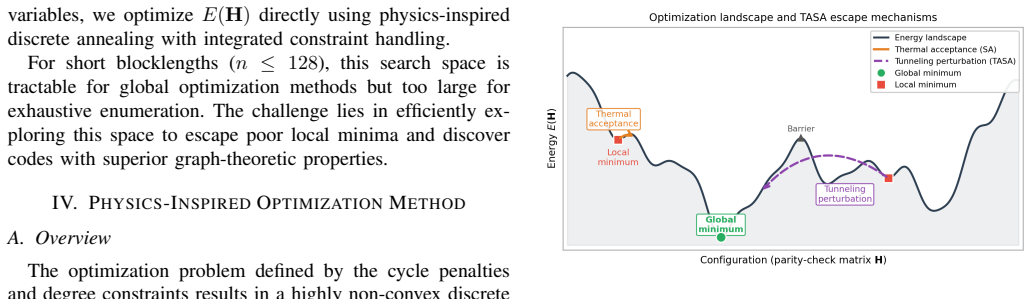
Tunneling-augmented simulated annealing (TASA) driven by additive penalties for short cycles, trapping-set-correlated substructures, and degree violations, which enables escape from local minima in the non-convex space of parity-check matrices.
If this is right
- In constrained design regimes, multiple objectives can be balanced directly inside the objective function rather than through sequential greedy choices.
- Eliminating large numbers of trapping-set patterns (for example, 1906) can produce only marginal decoding improvement (0.08 dB), showing that structural metrics are imperfect proxies.
- The method acts as a complementary tool to greedy constructions such as Progressive Edge Growth when application-specific trade-offs are required.
- Retuning the penalty weights allows the same search procedure to target different channels or latency constraints without redesigning the optimizer.
Where Pith is reading between the lines
- Extending the penalty set to include additional harmful subgraphs could narrow the remaining gap to capacity-approaching performance at short lengths.
- The hybrid global-local search strategy may transfer to constructing other linear code families, such as algebraic or polar codes, at comparable block lengths.
- Directly embedding full decoder simulations inside the objective function, instead of relying on proxy penalties, offers a route to larger observed gains.
- For block lengths below 200 the approach suggests that guided annealing can make near-exhaustive exploration of small matrix spaces practical.
Load-bearing premise
Penalties for short cycles, trapping-set substructures, and degree violations sufficiently predict actual decoding performance to steer the optimizer toward effective matrices.
What would settle it
Run Monte Carlo bit-error-rate simulations of the optimized parity-check matrices over the AWGN channel at block lengths 64–128; if the measured SNR gains fall below 0.1 dB on average relative to random codes, the framework does not reliably improve performance.
Figures



read the original abstract
Designing high-performance error-correcting codes at short blocklengths is critical for low-latency communication systems, where decoding is governed by finite-length and graph-structural effects rather than asymptotic properties. This paper presents a global discrete optimization framework for constructing short-block linear codes by directly optimizing parity-check matrices. Code design is formulated as a constrained binary optimization problem with penalties for short cycles, trapping-set-correlated substructures, and degree violations. We employ a hybrid strategy combining tunneling-augmented simulated annealing (TASA) with classical local refinement to explore the resulting non-convex space. Experiments at blocklengths 64-128 over the AWGN channel show 0.1-1.3 dB SNR gains over random LDPC codes (average 0.45 dB) and performance within 0.6 dB of Progressive Edge Growth. In constrained regimes, the method enables design tradeoffs unavailable to greedy approaches. However, structural improvements do not always yield decoding gains: eliminating 1906 trapping set patterns yields only +0.08 dB improvement. These results position annealing-based global optimization as a complementary tool for application-specific code design under multi-objective constraints.
Editorial analysis
A structured set of objections, weighed in public.
Referee Report
Summary. The manuscript presents a tunneling-augmented simulated annealing (TASA) framework for constructing short-block LDPC codes by casting parity-check matrix design as a constrained binary optimization problem with additive penalties for short cycles, trapping-set-correlated substructures, and degree violations. A hybrid TASA-plus-local-refinement strategy is used to search the non-convex space. Experiments at block lengths 64–128 over AWGN report SNR gains of 0.1–1.3 dB (average 0.45 dB) versus random LDPC codes and performance within 0.6 dB of Progressive Edge Growth, while noting that removal of 1906 trapping-set patterns produces only +0.08 dB improvement.
Significance. If the empirical gains are reproducible and the optimization objectives can be shown to align with decoding performance, the work supplies a global-search complement to greedy constructions such as PEG, enabling explicit multi-objective trade-offs in short-block regimes. The direct side-by-side comparisons to random and PEG baselines constitute a clear, falsifiable benchmark.
major comments (2)
- [Abstract] Abstract: the claim that the penalty-driven optimization targets decoding-relevant structures is undermined by the explicit observation that eliminating 1906 trapping-set patterns yields only +0.08 dB; this discrepancy is load-bearing because it indicates the chosen penalties may not reliably predict AWGN frame-error-rate improvement.
- [Experiments] Experiments section: no error bars, confidence intervals, or details on the number of Monte-Carlo trials are supplied for the reported 0.1–1.3 dB SNR gains, preventing assessment of whether the improvements exceed simulation noise.
minor comments (1)
- [Method] Notation for the penalty coefficients and the precise definition of “trapping-set-correlated substructures” should be collected in a single table or subsection for reproducibility.
Simulated Author's Rebuttal
We thank the referee for the detailed and constructive review. The comments highlight important aspects of clarity and statistical rigor that we address below. We have prepared revisions to the manuscript to strengthen the presentation of our results.
read point-by-point responses
-
Referee: [Abstract] Abstract: the claim that the penalty-driven optimization targets decoding-relevant structures is undermined by the explicit observation that eliminating 1906 trapping-set patterns yields only +0.08 dB; this discrepancy is load-bearing because it indicates the chosen penalties may not reliably predict AWGN frame-error-rate improvement.
Authors: We appreciate this observation. The abstract already states that structural improvements do not always translate to decoding gains and explicitly reports the +0.08 dB result for the trapping-set removal experiment. The optimization penalties address a combination of short cycles, degree distributions, and trapping-set substructures; the modest gain from removing only the 1906 patterns illustrates that cycle and degree penalties contribute substantially to the observed 0.45 dB average improvement. To avoid any potential misinterpretation, we will revise the abstract to more explicitly separate the multi-objective penalty design from the empirical FER outcomes and to emphasize that the framework enables explicit trade-offs rather than claiming direct one-to-one prediction of FER improvement. revision: yes
-
Referee: [Experiments] Experiments section: no error bars, confidence intervals, or details on the number of Monte-Carlo trials are supplied for the reported 0.1–1.3 dB SNR gains, preventing assessment of whether the improvements exceed simulation noise.
Authors: We agree that statistical details are necessary for assessing the reliability of the reported gains. In the revised manuscript we will add error bars (computed as the standard deviation over 10 independent simulation runs) to all FER curves and will state the Monte-Carlo stopping criterion (minimum 100 frame errors or 10^7 frames per SNR point, whichever occurs first). These additions will allow readers to evaluate whether the 0.1–1.3 dB improvements exceed simulation variability. revision: yes
Circularity Check
No circularity in optimization-based construction
full rationale
The paper formulates short-block LDPC design as a constrained binary optimization problem whose objective is a sum of explicit penalties on cycles, trapping-set substructures, and degree violations. It then applies the established TASA algorithm plus local refinement to search this space and reports direct Monte-Carlo simulation results on the AWGN channel. No equation or claim equates a derived performance metric to a fitted parameter, renames an input as a prediction, or rests on a self-citation chain whose validity is presupposed by the present work. The reported 0.1–1.3 dB gains are empirical outcomes, not quantities forced by construction from the penalty terms themselves.
Axiom & Free-Parameter Ledger
free parameters (1)
- Penalty coefficients for cycles and trapping sets
axioms (1)
- domain assumption The non-convex optimization landscape for parity-check matrices can be effectively explored by tunneling-augmented simulated annealing.
Lean theorems connected to this paper
-
IndisputableMonolith/Cost/FunctionalEquation.leanwashburn_uniqueness_aczel unclear?
unclearRelation between the paper passage and the cited Recognition theorem.
Code design is formulated as a constrained binary optimization problem with penalties for short cycles, trapping-set-correlated substructures, and degree violations. We employ a hybrid strategy combining tunneling-augmented simulated annealing (TASA) with classical local refinement
-
IndisputableMonolith/Foundation/BranchSelection.leanbranch_selection unclear?
unclearRelation between the paper passage and the cited Recognition theorem.
eliminating 1906 trapping set patterns yields only +0.08 dB improvement
What do these tags mean?
- matches
- The paper's claim is directly supported by a theorem in the formal canon.
- supports
- The theorem supports part of the paper's argument, but the paper may add assumptions or extra steps.
- extends
- The paper goes beyond the formal theorem; the theorem is a base layer rather than the whole result.
- uses
- The paper appears to rely on the theorem as machinery.
- contradicts
- The paper's claim conflicts with a theorem or certificate in the canon.
- unclear
- Pith found a possible connection, but the passage is too broad, indirect, or ambiguous to say the theorem truly supports the claim.
Reference graph
Works this paper leans on
-
[1]
Optimization by simulated annealing,
S. Kirkpatrick, C. D. Gelatt, and M. P. Vecchi, “Optimization by simulated annealing,”Science, vol. 220, no. 4598, pp. 671–680, 1983
work page 1983
-
[2]
Quantum annealing in the transverse ising model,
T. Kadowaki and H. Nishimori, “Quantum annealing in the transverse ising model,”Physical Review E, vol. 58, no. 5, pp. 5355–5363, 1998
work page 1998
-
[3]
Quantum annealing by the path-integral monte carlo method: The two-dimensional random ising model,
R. Marto ˇn´ak, G. E. Santoro, and E. Tosatti, “Quantum annealing by the path-integral monte carlo method: The two-dimensional random ising model,”Physical Review B, vol. 66, no. 9, p. 094203, 2002
work page 2002
-
[4]
Low-density parity-check codes,
R. G. Gallager, “Low-density parity-check codes,”IRE Transactions on Information Theory, vol. 8, no. 1, pp. 21–28, 1962
work page 1962
-
[5]
Good error-correcting codes based on very sparse matrices,
D. J. C. MacKay, “Good error-correcting codes based on very sparse matrices,”IEEE Transactions on Information Theory, vol. 45, no. 2, pp. 399–431, 1999
work page 1999
-
[6]
T. Richardson and R. Urbanke,Modern Coding Theory. Cambridge: Cambridge University Press, 2008
work page 2008
-
[7]
Regular and irregular progressive edge-growth tanner graphs,
X. Hu, E. Eleftheriou, and D. M. Arnold, “Regular and irregular progressive edge-growth tanner graphs,”IEEE Transactions on Information Theory, vol. 51, no. 1, pp. 386–398, 2005
work page 2005
-
[8]
R. Li and W. E. Ryan, “Decoder-optimized progressive edge growth algorithms for the construction of LDPC codes with low error floors,” IEEE Communications Letters, vol. 11, no. 8, pp. 644–646, 2007
work page 2007
-
[9]
Z. He, K. Cai, and H. Chen, “Improved construction of irregular progressive edge-growth tanner graphs for low-density parity-check codes,”IET Communications, vol. 1, no. 6, pp. 1246–1251, 2007
work page 2007
-
[10]
Construction of short block length irregular low-density parity-check codes,
A. Ramamoorthy and R. D. Wesel, “Construction of short block length irregular low-density parity-check codes,” inProceedings of the IEEE International Conference on Communications (ICC), 2004, pp. 772–776
work page 2004
-
[11]
High performance short-block binary regular LDPC codes,
L. Mostari and A. Taleb-Ahmed, “High performance short-block binary regular LDPC codes,”Alexandria Engineering Journal, vol. 57, no. 4, pp. 2633–2639, 2018
work page 2018
-
[12]
Finite-length analysis of low-density parity-check codes on the binary erasure channel,
C. Di, D. Proietti, I ¸. Telatar, T. J. Richardson, and R. L. Urbanke, “Finite-length analysis of low-density parity-check codes on the binary erasure channel,”IEEE Transactions on Information Theory, vol. 48, no. 6, pp. 1570–1579, 2002
work page 2002
-
[13]
Analysis of absorbing sets and fully absorbing sets of array-based LDPC codes,
L. Dolecek, Z. Zhang, V . Anantharam, J. G. Proakis, and M. J. Wainwright, “Analysis of absorbing sets and fully absorbing sets of array-based LDPC codes,”IEEE Transactions on Information Theory, vol. 56, no. 1, pp. 181–201, 2010
work page 2010
-
[14]
T. J. Richardson, “Error floors of LDPC codes,” inProceedings of the 41st Annual Allerton Conference on Communication, Control, and Computing, 2003, pp. 1426–1435
work page 2003
-
[15]
Constructing LDPC codes with any desired girth,
J. Wang, Q. Zhu, E. Li, and L. Song, “Constructing LDPC codes with any desired girth,”Entropy, vol. 23, no. 3, p. 330, 2021
work page 2021
-
[16]
Construction of short LDPC codes by integer programming,
A. Venkiah, M. Pischella, and F. Alberge, “Construction of short LDPC codes by integer programming,”Electronics Letters, vol. 43, no. 21, pp. 1146–1148, 2007
work page 2007
-
[17]
Optimal design of LDPC codes using differential evolution,
R. Campello de Souza, R. M. Costa, and R. Palazzo, “Optimal design of LDPC codes using differential evolution,”IET Communications, vol. 1, no. 2, pp. 287–292, 2007
work page 2007
-
[18]
Design of efficiently encodable moderate-length high-rate irregular LDPC codes,
M. Yang, W. E. Ryan, and Y . Li, “Design of efficiently encodable moderate-length high-rate irregular LDPC codes,”IEEE Transactions on Communications, vol. 52, no. 4, pp. 564–571, 2004
work page 2004
-
[19]
A quantum approximate optimization algorithm,
E. Farhi, J. Goldstone, and S. Gutmann, “A quantum approximate optimization algorithm,”arXiv preprint, 2014
work page 2014
-
[20]
Ising formulations of many NP problems,
A. Lucas, “Ising formulations of many NP problems,”Frontiers in Physics, vol. 2, p. 5, 2014
work page 2014
-
[21]
Towards quantum belief propagation for LDPC decoding in wireless networks,
S. Kasi and K. Jamieson, “Towards quantum belief propagation for LDPC decoding in wireless networks,” inProceedings of the 26th Annual International Conference on Mobile Computing and Networking (MobiCom), 2020, pp. 1–14
work page 2020
-
[22]
Quantum computing in the RAN with Qu4Fec,
G. Luisier, N. Bastianello, W. B. Tan, N. Apostolakiset al., “Quantum computing in the RAN with Qu4Fec,” inProceedings of ACM SIGMETRICS, 2025, to appear
work page 2025
-
[23]
5g wireless network slicing for eMBB, URLLC, and mMTC: A communication-theoretic view,
P. Popovski, K. F. Trillingsgaard, O. Simeone, and G. Durisi, “5g wireless network slicing for eMBB, URLLC, and mMTC: A communication-theoretic view,”IEEE Access, vol. 6, pp. 55 765– 55 779, 2018
work page 2018
-
[24]
Toward massive, ultra- reliable, and low-latency wireless communication with short packets,
G. Durisi, T. Koch, and P. Popovski, “Toward massive, ultra- reliable, and low-latency wireless communication with short packets,” Proceedings of the IEEE, vol. 104, no. 9, pp. 1711–1726, 2016
work page 2016
-
[25]
Satellite communications supporting internet of remote things,
M. De Sanctis, E. Cianca, G. Araniti, I. Bisio, and R. Prasad, “Satellite communications supporting internet of remote things,”IEEE Internet of Things Journal, vol. 3, no. 1, pp. 113–123, 2016
work page 2016
discussion (0)
Sign in with ORCID, Apple, or X to comment. Anyone can read and Pith papers without signing in.