Classification of magnon thermal Hall systems based on U(1) to non-Abelian gauge fields
Pith reviewed 2026-05-10 18:15 UTC · model grok-4.3
The pith
Antiferromagnets with multiple magnetic sublattices generate non-Abelian SU(N) gauge fields for magnons that produce a thermal Hall effect.
A machine-rendered reading of the paper's core claim, the machinery that carries it, and where it could break.
Core claim
In ferromagnets the magnon thermal Hall effect comes from U(1) gauge fields produced by Dzyaloshinskii-Moriya interactions or spin textures, yet these fields frequently cancel in many lattices. Antiferromagnets with multiple sublattices instead support non-Abelian SU(N) gauge fields whose noncommutativity blocks Berry-curvature cancellation and ensures a finite thermal Hall conductivity. A coplanar 120° antiferromagnet with Dzyaloshinskii-Moriya interactions provides the simplest SU(3) realization. The paper supplies a table that assigns gauge-field type to known two-dimensional lattices and magnetic structures, offering a practical map for locating materials, including antiferromagnets and
What carries the argument
non-Abelian SU(N) gauge fields experienced by magnons in multi-sublattice antiferromagnets, whose noncommutativity prevents Berry-curvature cancellation
If this is right
- The noncommutativity of SU(N) gauge fields guarantees a nonvanishing magnon thermal Hall conductivity.
- A coplanar 120° antiferromagnet with Dzyaloshinskii-Moriya interactions forms a minimal canonical SU(3) platform.
- Two-dimensional lattices and magnetic structures can be classified by whether they support U(1) or non-Abelian gauge fields.
- Altermagnets fall within the same classification scheme and can host the thermal Hall response.
Where Pith is reading between the lines
- The same non-Abelian mechanism may appear in three-dimensional antiferromagnets or in other bosonic excitations such as phonons.
- Targeted experiments on layered van-der-Waals antiferromagnets could directly test whether the predicted finite thermal Hall signal appears once the lattice and spin structure match the SU(N) criteria.
- The classification suggests that symmetry-protected cancellations in topological transport are more easily avoided once the number of magnetic sublattices increases.
Load-bearing premise
That the emergent gauge fields felt by magnons in multi-sublattice antiferromagnets are genuinely non-Abelian and that their noncommutativity directly produces a non-vanishing thermal Hall conductivity without further cancellations from other symmetries or interactions.
What would settle it
A first-principles calculation or measurement of the thermal Hall conductivity in a coplanar 120° antiferromagnet with Dzyaloshinskii-Moriya interactions that finds exact cancellation of all Berry-curvature contributions would falsify the claim that non-Abelian noncommutativity guarantees a nonzero response.
Figures



read the original abstract
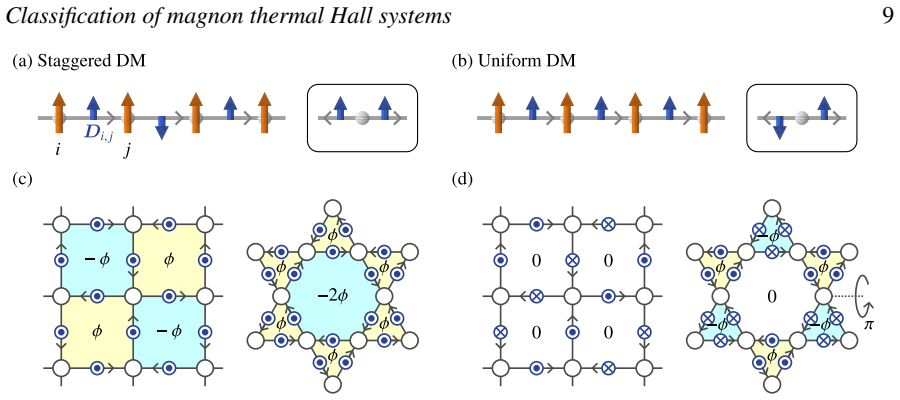
Magnon thermal Hall effect in insulating magnets is the manifestation of Berry curvature in magnon bands, which is formulated using the emergent gauge fields that act on magnons as a fictitious magnetic field. In ferromagnets, it is commonly accepted as the outcome of U(1) gauge fields generated by Dzyaloshinskii-Moriya interactions and spin textures, but this mechanism is often suppressed by symmetry-enforced cancellations in many lattice geometries, known as a no-go rule. As a result, antiferromagnetic insulators have long been considered as unfavorable platforms for the effect. We show that antiferromagnets with multiple magnetic sublattices naturally host non-Abelian SU(N) gauge fields in magnon band structures, providing a robust rule-to-go mechanism. The noncommutativity of these gauge fields prevents Berry-curvature cancellation and guarantees a nonvanishing thermal Hall response. As a minimal realization, we demonstrate that a coplanar 120$^{\circ}$ antiferromagnet with Dzyaloshinskii-Moriya interactions constitutes a canonical SU(3) platform for the magnon thermal Hall effect. We provide a table of so-far-known two-dimensional lattice geometries and variants of magnetic structures, along with the corresponding gauge fields, providing a unified guideline for identifying magnetic materials, including antiferromagnets and altermagnets, that host thermal Hall transport.
Editorial analysis
A structured set of objections, weighed in public.
Referee Report
Summary. The paper claims that multi-sublattice antiferromagnets host emergent non-Abelian SU(N) gauge fields for magnons (arising via linear spin-wave theory from the spin Hamiltonian), whose noncommutativity prevents the Berry-curvature cancellations that suppress the magnon thermal Hall effect under U(1) gauge fields in ferromagnets. It presents the coplanar 120° antiferromagnet with Dzyaloshinskii-Moriya interactions as a minimal SU(3) realization that exhibits a nonvanishing thermal Hall response, and supplies a classification table of 2D lattices and magnetic structures with their associated gauge fields as a guideline for material identification, including altermagnets.
Significance. If the central claim is substantiated, the work supplies a concrete rule-to-go mechanism that enlarges the set of platforms for magnon thermal Hall transport beyond ferromagnets, where symmetry cancellations often forbid the effect. The classification table is a useful organizing tool that could guide experimental searches in antiferromagnetic and altermagnetic insulators.
major comments (2)
- [demonstration for the 120° coplanar AFM] The abstract and the section introducing the non-Abelian mechanism assert that SU(N) noncommutativity 'prevents Berry-curvature cancellation and guarantees a nonvanishing thermal Hall response.' However, the thermal Hall conductivity is an integral of the trace of the Berry curvature (weighted by the Bose function) over the Brillouin zone; even with non-Abelian gauge fields, additional lattice symmetries or band degeneracies could still enforce pairwise cancellation. The manuscript must explicitly demonstrate, for the 120° AFM example, that the integrated trace remains finite after all symmetries are imposed, rather than relying on noncommutativity alone.
- [classification table] In the classification table of lattice geometries and magnetic structures, several entries are listed as hosting non-Abelian gauge fields. For each such entry the paper should verify that the emergent gauge field is indeed SU(N) with N>1 (i.e., that the holonomy matrices do not commute) and that this noncommutativity is what lifts the cancellation, rather than a model-specific feature of the spin-wave Hamiltonian.
minor comments (2)
- [introduction] Notation for the matrix-valued Berry curvature and its trace should be introduced once and used consistently; currently the transition from U(1) to SU(N) curvature is described in two different paragraphs with slightly different symbols.
- [introduction] The manuscript cites several prior works on magnon thermal Hall in ferromagnets but omits recent experimental reports on antiferromagnetic candidates; adding one or two such references would strengthen the motivation.
Simulated Author's Rebuttal
We thank the referee for the careful reading and constructive comments on our manuscript. We address each major comment below and have revised the manuscript to incorporate the requested clarifications and verifications.
read point-by-point responses
-
Referee: [demonstration for the 120° coplanar AFM] The abstract and the section introducing the non-Abelian mechanism assert that SU(N) noncommutativity 'prevents Berry-curvature cancellation and guarantees a nonvanishing thermal Hall response.' However, the thermal Hall conductivity is an integral of the trace of the Berry curvature (weighted by the Bose function) over the Brillouin zone; even with non-Abelian gauge fields, additional lattice symmetries or band degeneracies could still enforce pairwise cancellation. The manuscript must explicitly demonstrate, for the 120° AFM example, that the integrated trace remains finite after all symmetries are imposed, rather than relying on noncommutativity alone.
Authors: We agree that an explicit demonstration of the non-cancellation in the integrated thermal Hall conductivity is essential for rigor. Although the manuscript already computes the magnon bands and Berry curvature for the 120° coplanar AFM with DM interactions and states that the response is nonvanishing, we acknowledge that the symmetry-imposed cancellation argument could be shown more transparently. In the revised manuscript we have added a dedicated subsection with (i) an explicit symmetry analysis under the C3 rotational symmetry of the lattice, (ii) the computed distribution of the trace of the non-Abelian Berry curvature, and (iii) numerical integration confirming a finite thermal Hall conductivity at finite temperature. This calculation demonstrates that the noncommutativity of the SU(3) holonomy matrices prevents the pairwise cancellation that would occur for U(1) fields. revision: yes
-
Referee: [classification table] In the classification table of lattice geometries and magnetic structures, several entries are listed as hosting non-Abelian gauge fields. For each such entry the paper should verify that the emergent gauge field is indeed SU(N) with N>1 (i.e., that the holonomy matrices do not commute) and that this noncommutativity is what lifts the cancellation, rather than a model-specific feature of the spin-wave Hamiltonian.
Authors: We concur that systematic verification of noncommutativity for every non-Abelian entry strengthens the classification. The original table was intended as a guideline based on the multi-sublattice structure, but we did not provide explicit holonomy matrices for all cases. In the revised version we have expanded the table caption and added an appendix that lists the holonomy matrices (or their generators) for each non-Abelian entry. For representative lattices we explicitly show that the matrices fail to commute, and we argue that this noncommutativity originates from the SU(N) structure tied to the number of sublattices rather than from details of the particular spin-wave Hamiltonian. This addresses the concern that the effect might be model-specific. revision: yes
Circularity Check
No significant circularity in the derivation of non-Abelian gauge fields and thermal Hall response.
full rationale
The paper derives emergent SU(N) gauge fields directly from the multi-sublattice spin Hamiltonian via linear spin-wave theory, then invokes noncommutativity of the resulting matrix-valued Berry curvature as the mechanism preventing cancellation. This chain relies on standard magnon band-structure calculations and explicit demonstration for the 120° AFM case rather than self-definitional loops, fitted inputs renamed as predictions, or load-bearing self-citations whose validity reduces to the present work. The classification table and rule-to-go argument are presented as consequences of the gauge-field structure, remaining self-contained against external benchmarks such as symmetry analysis and explicit curvature integrals.
Axiom & Free-Parameter Ledger
axioms (2)
- standard math Magnon thermal Hall conductivity is determined by the integral of Berry curvature over occupied bands.
- domain assumption Dzyaloshinskii-Moriya interactions and spin textures generate emergent gauge fields acting on magnons.
invented entities (1)
-
non-Abelian SU(N) gauge fields for magnons in antiferromagnets
no independent evidence
Reference graph
Works this paper leans on
- [1]
- [2]
- [3]
- [4]
- [5]
-
[6]
M. Hirschberger, R. Chisnell, Y . S. Lee, and N. P. Ong, Phys. Rev. Lett.115, 106603 (2015)
work page 2015
-
[7]
A. Mook, J. Henk, and I. Mertig, Phys. Rev. B90, 024412 (2014)
work page 2014
-
[8]
A. Mook, J. Henk, and I. Mertig, Phys. Rev. B89, 134409 (2014)
work page 2014
-
[9]
A. Mook, J. Henk, and I. Mertig, Phys. Rev. B94, 174444 (2016)
work page 2016
-
[10]
S. A. Owerre, Phys. Rev. B95, 014422 (2017)
work page 2017
-
[11]
S. A. Owerre, Phys. Rev. B97, 094412 (2018)
work page 2018
- [12]
- [13]
- [14]
- [15]
- [16]
- [17]
-
[18]
K.-S. Kim, K. H. Lee, S. B. Chung, and J.-G. Park, Phys. Rev. B100, 064412 (2019)
work page 2019
-
[19]
H.-L. Kim, T. Saito, H. Yang, H. Ishizuka, M. J. Coak, J. H. Lee, H. Sim, Y . S. Oh, N. Nagaosa, and J.-G. Park, Nat. Commun.15, 243 (2024)
work page 2024
-
[20]
N. Nagaosa, J. Sinova, S. Onoda, A. H. MacDonald, and N. P. Ong, Rev. Mod. Phys. 82, 1539 (2010)
work page 2010
-
[21]
H. Chen, Q. Niu, and A. H. MacDonald, Phys. Rev. Lett.112, 017205 (2014)
work page 2014
- [22]
-
[23]
A. K. Nayak, J. E. Fischer, Y . Sun, B. Yan, J. Karel, A. C. Komarek, C. Shekhar, N. Kumar, W. Schnelle, J. K¨ubler, C. Felser, and S. S. P. Parkin, Sci. Adv.2, 1501870 (2016). REFERENCES29
work page 2016
-
[24]
N. Kiyohara, T. Tomita, and S. Nakatsuji, Phys. Rev. Appl.5, 064009 (2016)
work page 2016
-
[25]
Z. H. Liu, Y . J. Zhang, G. D. Liu, B. Ding, E. K. Liu, H. M. Jafri, Z. P. Hou, W. H. Wang, X. Q. Ma, and G. H. Wu, Sci. Rep.7, 515 (2017)
work page 2017
- [26]
- [27]
- [28]
- [29]
- [30]
-
[31]
A. V . Chumak, V . I. Vasyuchka, A. A. Serga, and B. Hillebrands, Nat. Phys.11, 453 (2015)
work page 2015
- [32]
-
[33]
(), Although a thermal Hall signal has been reported in the noncoplanar antiferromagnet in the distorted triangular lattice YMnO3, it is attributed to topological spin fluctuations and phonon-related effects, rather than to a magnon thermal Hall effect
- [34]
- [35]
-
[36]
K. A. van Hoogdalem, Y . Tserkovnyak, and D. Loss, Phys. Rev. B87, 024402 (2013)
work page 2013
- [37]
- [38]
-
[39]
Y .-T. Oh, H. Lee, J.-H. Park, and J. H. Han, Phys. Rev. B91, 104435 (2015)
work page 2015
-
[40]
A. Rold ´an-Molina, A. S. Nunez, and J. Fern ´andez-Rossier, New J. Phys.18, 045015 (2016)
work page 2016
-
[41]
A. Mook, B. G ¨obel, J. Henk, and I. Mertig, Phys. Rev. B95, 020401 (2017)
work page 2017
-
[42]
S. K. Kim, K. Nakata, D. Loss, and Y . Tserkovnyak, Phys. Rev. Lett.122, 057204 (2019)
work page 2019
- [43]
-
[44]
M. Akazawa, H.-Y . Lee, H. Takeda, Y . Fujima, Y . Tokunaga, T.-h. Arima, J. H. Han, and M. Yamashita, Phys. Rev. Res.4, 043085 (2022)
work page 2022
-
[45]
S. A. Owerre, J. Appl. Phys.120, 043903 (2016)
work page 2016
- [46]
- [47]
-
[48]
P. A. McClarty, X.-Y . Dong, M. Gohlke, J. G. Rau, F. Pollmann, R. Moessner, and K. Penc, Phys. Rev. B98, 060404 (2018)
work page 2018
-
[49]
E. Z. Zhang, L. E. Chern, and Y . B. Kim, Phys. Rev. B103, 174402 (2021). REFERENCES30
work page 2021
-
[50]
L. E. Chern, E. Z. Zhang, and Y . B. Kim, Phys. Rev. Lett.126, 147201 (2021)
work page 2021
-
[51]
R. R. Neumann, A. Mook, J. Henk, and I. Mertig, Phys. Rev. Lett.128, 117201 (2022)
work page 2022
- [52]
- [53]
-
[54]
L. E. Chern, R. Kaneko, H.-Y . Lee, and Y . B. Kim, Phys. Rev. Res.2, 013014 (2020)
work page 2020
-
[55]
L. E. Chern, F. L. Buessen, and Y . B. Kim, npj Quantum Materials6, 33 (2021)
work page 2021
- [56]
-
[57]
X. Cao, K. Chen, and D. He, J. Phys: Condens. Matter27, 166003 (2015)
work page 2015
-
[58]
S. A. Owerre, J. Phys.: Cond. Matt29, 03LT01 (2016)
work page 2016
- [59]
-
[60]
J. Romh ´anyi, K. Penc, and R. Ganesh, Nat. Commun.6, 10.1038/ncomms7805 (2015)
- [61]
-
[62]
S. Suetsugu, T. Yokoi, K. Totsuka, T. Ono, I. Tanaka, S. Kasahara, Y . Kasahara, Z. Chengchao, H. Kageyama, and Y . Matsuda, Phys. Rev. B105, 024415 (2022)
work page 2022
-
[63]
L. S. Buzo and R. L. Doretto, Phys. Rev. B109, 134405 (2024)
work page 2024
- [64]
- [65]
- [66]
- [67]
- [68]
-
[69]
R. Matsumoto, R. Shindou, and S. Murakami, Phys. Rev. B89, 054420 (2014)
work page 2014
- [70]
- [71]
-
[72]
V . Fritsch, J. Hemberger, N. B¨uttgen, E.-W. Scheidt, H.-A. Krug von Nidda, A. Loidl, and V . Tsurkan, Phys. Rev. Lett.92, 116401 (2004)
work page 2004
-
[73]
S. Gao, O. Zaharko, V . Tsurkan, Y . Su, J. White, G. Tucker, B. Roessli, F. Bourdarot, R. Sibille, D. Chernyshov, T. Fennell, A. Loidl, D.C., and C. R ¨uegg, Nature Phys.13, 157 (2017)
work page 2017
-
[74]
S. Gao, H. D. Rosales, F. A. G. Albarracin, G. K. Tsurkan, T. Fennell, P. Steffens, M. Boehm, P. Cermak, A. Schneldewind, E. Ressouche, D. Cabra, C. R ¨uegg, and O. Zaharko, Nature586, 37 (2020)
work page 2020
-
[75]
C. L. Kane and E. J. Mele, Phys. Rev. Lett.95, 226801 (2005)
work page 2005
-
[76]
C. L. Kane and E. J. Mele, Phys. Rev. Lett.95, 146802 (2005)
work page 2005
- [77]
- [78]
-
[79]
L. ˇSmejkal, J. Sinova, and T. Jungwirth, Phys. Rev. X12, 031042 (2022). REFERENCES31
work page 2022
- [80]
discussion (0)
Sign in with ORCID, Apple, or X to comment. Anyone can read and Pith papers without signing in.