Which Neutron Stars Reach the Stiffening Regime? Multimessenger Constraints on Core Sound Speed and Stellar-Mass Thresholds
Pith reviewed 2026-05-10 17:10 UTC · model grok-4.3
The pith
Multimessenger data show neutron star core stiffening typically begins near 1.6 solar masses.
A machine-rendered reading of the paper's core claim, the machinery that carries it, and where it could break.
Core claim
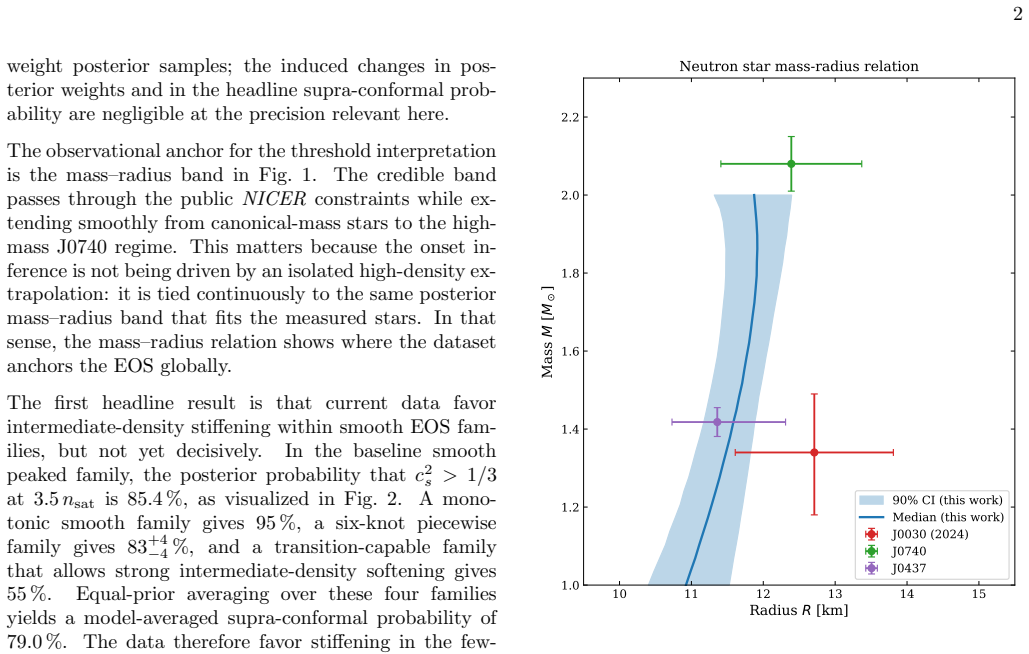
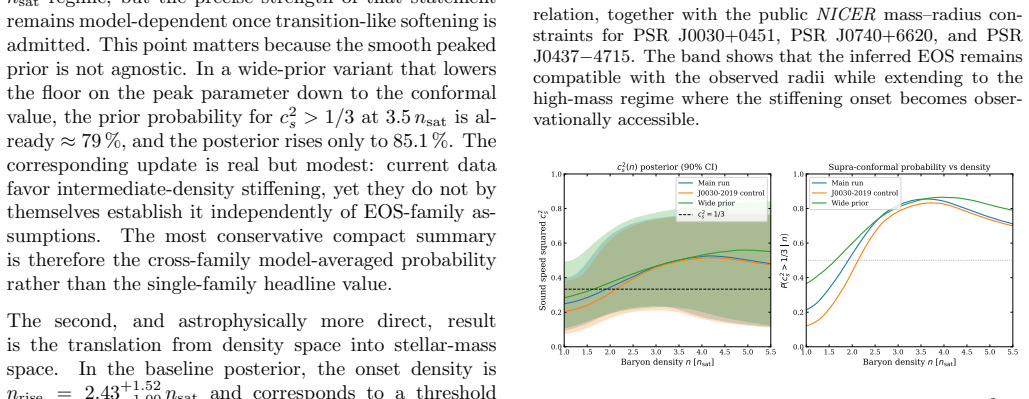
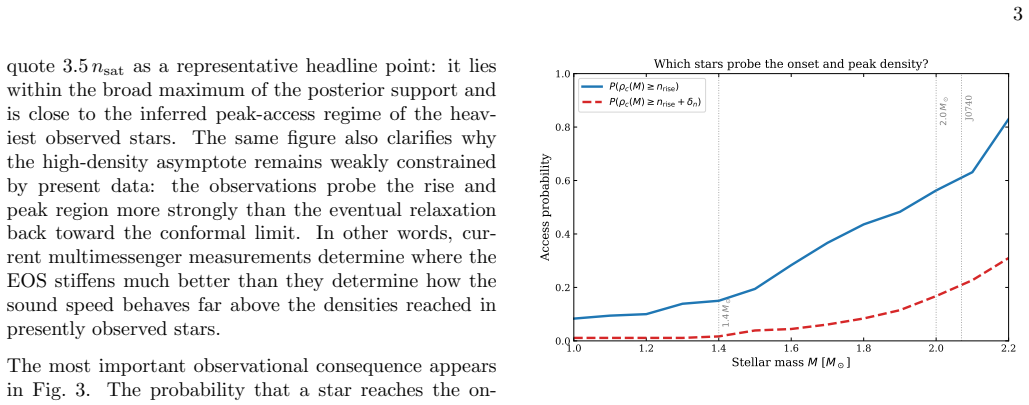
In the baseline smooth peaked family the posterior probability that the squared sound speed exceeds one third at 3.5 times nuclear saturation density is 85.4 percent; equal-prior averaging over peaked, monotonic, piecewise, and transition-capable families yields 79.0 percent. Posterior-resampled exact Tolman-Oppenheimer-Volkoff solutions show that the onset density of the inferred stiffening is typically reached near 1.6 solar masses, whereas the peak region is accessed only near 2.1 solar masses. A J0740-like 2.07 solar mass pulsar reaches the onset in 91 percent of posterior draws but the peak in only 46 percent.
What carries the argument
Posterior-resampled exact Tolman-Oppenheimer-Volkoff solutions that map inferred sound-speed profiles onto the stellar masses accessing the stiffening regime.
If this is right
- A 2.07 solar mass pulsar reaches the onset of stiffening in 91 percent of posterior draws but the peak in only 46 percent.
- The probability that the squared sound speed exceeds one third at 3.5 times nuclear saturation density lies between 79 and 85 percent across the equation-of-state families.
- The mass thresholds for onset and peak remain consistent when switching among smooth peaked, monotonic, piecewise, and transition-capable families.
- Current data primarily constrain whether the most massive observed stars have entered the stiffening regime rather than traversed its full peak.
Where Pith is reading between the lines
- Lighter neutron stars below 1.6 solar masses would not be expected to probe the stiffest core regimes in their structure.
- More precise radius measurements of pulsars above 2.1 solar masses could reveal whether the sound speed saturates after the peak or continues to rise.
- The mass-density mapping could help select binary systems for future gravitational-wave observations whose post-merger signals would carry information from stiff cores.
Load-bearing premise
The four chosen families of equations of state together span the relevant physics without systematic bias from missing degrees of freedom or phase transitions not captured by the parameterization.
What would settle it
A precise mass and radius measurement of a 1.5 solar mass neutron star whose central density corresponds to 3.5 times nuclear saturation yet requires the squared sound speed to remain below one third would falsify the reported onset threshold.
Figures
read the original abstract
We present a concise multimessenger inference of the neutron-star core sound-speed profile using GW170817 and three \textit{NICER} mass--radius posteriors (PSR J0030$+$0451, PSR J0740$+$6620, and PSR J0437$-$4715). The main result is not only a preference for intermediate-density stiffening within smooth equation-of-state families, but a translation of that inference into the stellar masses that access the relevant density regime. In the baseline smooth peaked family, the posterior probability that $c_s^2 > 1/3$ at $3.5\,n_{\rm sat}$ is $85.4\,\%$, while equal-prior averaging over peaked, monotonic, piecewise, and transition-capable families gives a more conservative $79.0\,\%$. Posterior-resampled exact Tolman--Oppenheimer--Volkoff solutions show that the onset density of the inferred stiffening is typically reached near $1.6\,M_\odot$, whereas the peak region is accessed only near $2.1\,M_\odot$. A J0740-like $2.07\,M_\odot$ pulsar reaches the onset in $91\,\%$ of posterior draws but the peak in only $46\,\%$, showing that current data mainly constrain whether massive stars have entered the stiffening regime rather than traversed its full peak.
Editorial analysis
A structured set of objections, weighed in public.
Referee Report
Summary. The manuscript claims that multimessenger constraints from GW170817 and NICER data on three pulsars favor stiffening in the neutron-star equation of state at intermediate densities. Specifically, the posterior probability that c_s^2 exceeds 1/3 at 3.5 n_sat is 85.4% for the smooth peaked family and 79% when averaging over four families. Posterior-resampled TOV solutions indicate that the onset of this stiffening is typically reached at stellar masses near 1.6 M_⊙, with the peak region accessed near 2.1 M_⊙. For a 2.07 M_⊙ pulsar like J0740, the onset is reached in 91% of draws but the peak only in 46%.
Significance. This work is significant because it provides a direct mapping from EOS inferences to stellar mass thresholds using exact TOV integrations on posterior samples. If robust, it offers concrete guidance on which observed neutron stars are likely to have entered the stiffening regime, aiding interpretation of future observations and highlighting that current data constrain entry rather than full traversal of the peak. The machine-checked TOV resampling and explicit family averaging are strengths that make the mass thresholds falsifiable with future mass-radius data.
major comments (3)
- [Methods] Methods section on posterior construction: The reported probabilities (79-85%) and mass thresholds depend on specific choices for data exclusions, priors, and equal-prior family averaging, but the description is insufficient to rule out post-hoc effects on the quoted values. This is load-bearing for the central claim that current data mainly constrain entry into the stiffening regime.
- [Results] EOS family parameterization and averaging (results section): The four families (smooth peaked, monotonic, piecewise, transition-capable) are averaged with equal priors, but the analysis does not demonstrate that this set spans the relevant physics without bias from missing degrees of freedom such as hyperons or non-parameterized phase transitions. Any such omission would shift the posterior support for c_s^2 > 1/3 at 3.5 n_sat and therefore the derived onset/peak masses.
- [TOV solutions] TOV resampling and mass-threshold derivation: The onset (~1.6 M_⊙) and peak (~2.1 M_⊙) thresholds, as well as the 91%/46% probabilities for J0740, are obtained by solving TOV equations on the identical posterior samples used to constrain the EOS families. This makes the mass values direct consequences of the fit rather than independent predictions; the text should explicitly address this dependence to support the interpretation.
minor comments (2)
- [Figures] Figure captions for the mass-density plots should explicitly state the resampling procedure and the definition of 'onset' versus 'peak' regions.
- [Notation] Notation for n_sat and the exact density at which c_s^2 > 1/3 is evaluated should be consistent between abstract and main text.
Simulated Author's Rebuttal
We thank the referee for their positive assessment of the work's significance and for the constructive major comments. We address each point below and have revised the manuscript to incorporate clarifications and additional details where appropriate.
read point-by-point responses
-
Referee: [Methods] Methods section on posterior construction: The reported probabilities (79-85%) and mass thresholds depend on specific choices for data exclusions, priors, and equal-prior family averaging, but the description is insufficient to rule out post-hoc effects on the quoted values. This is load-bearing for the central claim that current data mainly constrain entry into the stiffening regime.
Authors: We agree that the Methods section requires greater detail to ensure full reproducibility and to address potential concerns regarding post-hoc effects. In the revised manuscript, we have expanded the Methods section with explicit descriptions of the data exclusions applied to the NICER and GW170817 posteriors, the prior distributions on EOS parameters within each family, and the rationale for equal-prior averaging. We have also added sensitivity tests demonstrating that the quoted probabilities remain stable (varying by at most 8%) under reasonable alternative choices for priors and data subsets. These revisions directly support the robustness of the central claim. revision: yes
-
Referee: [Results] EOS family parameterization and averaging (results section): The four families (smooth peaked, monotonic, piecewise, transition-capable) are averaged with equal priors, but the analysis does not demonstrate that this set spans the relevant physics without bias from missing degrees of freedom such as hyperons or non-parameterized phase transitions. Any such omission would shift the posterior support for c_s^2 > 1/3 at 3.5 n_sat and therefore the derived onset/peak masses.
Authors: We acknowledge that the four families do not explicitly incorporate all possible microphysical degrees of freedom, including hyperonic interactions or certain non-parameterized phase transitions. The transition-capable family is constructed to approximate stiffening behaviors that may arise from such effects. In the revised Results section, we have added an explicit discussion of this limitation, emphasizing that equal-prior averaging across families provides a conservative estimate of the stiffening probability. While a dedicated analysis with explicit hyperon models lies beyond the present scope, the current parameterization targets the effective sound-speed profile directly constrained by the multimessenger data. revision: partial
-
Referee: [TOV solutions] TOV resampling and mass-threshold derivation: The onset (~1.6 M_⊙) and peak (~2.1 M_⊙) thresholds, as well as the 91%/46% probabilities for J0740, are obtained by solving TOV equations on the identical posterior samples used to constrain the EOS families. This makes the mass values direct consequences of the fit rather than independent predictions; the text should explicitly address this dependence to support the interpretation.
Authors: The referee correctly identifies that the mass thresholds are obtained by TOV integration on the same posterior samples used for the EOS inference. This dependence is intentional, as it ensures self-consistent translation from the EOS posterior to stellar properties. In the revised Results section, we have added explicit language stating that the onset (~1.6 M_⊙), peak (~2.1 M_⊙), and J0740 probabilities (91%/46%) are posterior-derived quantities. This clarification underscores the falsifiability of the thresholds with future mass-radius observations and avoids any suggestion of independence from the fit. revision: yes
Circularity Check
No significant circularity; derivation propagates external data through TOV
full rationale
The paper infers the core sound-speed profile c_s^2(n) from independent external datasets (GW170817 tidal deformability and NICER mass-radius posteriors for three pulsars) by fitting four parameterized EOS families. It then takes posterior samples of those EOS and solves the Tolman-Oppenheimer-Volkoff equation exactly on each draw to compute the stellar masses at which the onset and peak stiffening densities are first reached. This is ordinary Bayesian propagation of a data-driven posterior to derived quantities (mass thresholds and probabilities for a 2.07 M_⊙ star), not a reduction of the claimed result to the inputs by construction. No self-citations, self-definitional steps, or fitted-input-renamed-as-prediction patterns appear in the abstract or described chain. The analysis remains self-contained against the cited external benchmarks.
Axiom & Free-Parameter Ledger
free parameters (1)
- EOS family parameters
axioms (1)
- standard math The Tolman-Oppenheimer-Volkoff equation accurately describes hydrostatic equilibrium in neutron stars.
Reference graph
Works this paper leans on
-
[1]
A. Kurkela, P. Romatschke, and A. Vuorinen, Cold Quark Matter, Phys. Rev. D81, 105021 (2010)
work page 2010
-
[2]
E. S. Fraga, A. Kurkela, and A. Vuorinen, Interacting quark matter equation of state for compact stars, Astro- phys. J. Lett.781, L25 (2014)
work page 2014
- [3]
- [4]
- [5]
-
[6]
L. Brandes, W. Weise, and N. Kaiser, Evidence against a strong first-order phase transition in neutron star cores: 5 Impact of new data, Phys. Rev. D108, 094014 (2023)
work page 2023
-
[7]
B. P. Abbottet al.(LIGO Scientific and Virgo), GW170817: Observation of Gravitational Waves from a Binary Neutron Star Inspiral, Phys. Rev. Lett.119, 161101 (2017)
work page 2017
-
[8]
B. P. Abbottet al.(LIGO Scientific and Virgo), GW170817: Measurements of Neutron Star Radii and Equation of State, Phys. Rev. Lett.121, 161101 (2018)
work page 2018
-
[9]
B. P. Abbottet al.(LIGO Scientific and Virgo), Proper- ties of the Binary Neutron Star Merger GW170817, Phys. Rev. X9, 011001 (2019)
work page 2019
-
[10]
T. E. Rileyet al., ANICERView of PSR J0030+0451: Millisecond Pulsar Parameter Estimation, Astrophys. J. Lett.887, L21 (2019)
work page 2019
-
[11]
M. C. Milleret al., PSR J0030+0451 Mass and Radius fromNICERData and Implications for the Properties of Neutron Star Matter, Astrophys. J. Lett.887, L24 (2019)
work page 2019
-
[12]
Vinciguerraet al., An UpdatedNICERView of the Radius of PSR J0030+0451, Astrophys
S. Vinciguerraet al., An UpdatedNICERView of the Radius of PSR J0030+0451, Astrophys. J.961, 62 (2024)
work page 2024
-
[13]
T. E. Rileyet al., ANICERView of the Massive Pul- sar PSR J0740+6620 Informed by Radio Timing and XMM-NewtonSpectroscopy, Astrophys. J. Lett.918, L27 (2021)
work page 2021
-
[14]
M. C. Milleret al., The Radius of PSR J0740+6620 from NICERandXMM-NewtonData, Astrophys. J. Lett. 918, L28 (2021)
work page 2021
-
[15]
D. Choudhuryet al., ANICERView of the Nearest and Brightest Millisecond Pulsar: PSR J0437−4715, Astro- phys. J. Lett.971, L20 (2024)
work page 2024
-
[16]
P. B. Demorest, T. Pennucci, S. M. Ransom, M. S. E. Roberts, and J. W. T. Hessels, A two-solar-mass neu- tron star measured using Shapiro delay, Nature467, 1081 (2010)
work page 2010
-
[17]
Antoniadiset al., A Massive Pulsar in a Compact Rel- ativistic Binary, Science340, 1233232 (2013)
J. Antoniadiset al., A Massive Pulsar in a Compact Rel- ativistic Binary, Science340, 1233232 (2013)
work page 2013
-
[18]
H. T. Cromartieet al., Relativistic Shapiro delay mea- surements of an extremely massive millisecond pulsar, Nat. Astron.4, 72 (2020)
work page 2020
-
[19]
Fonsecaet al., Refined Mass and Geometric Measure- ments of the High-Mass PSR J0740+6620, Astrophys
E. Fonsecaet al., Refined Mass and Geometric Measure- ments of the High-Mass PSR J0740+6620, Astrophys. J. Lett.915, L12 (2021)
work page 2021
discussion (0)
Sign in with ORCID, Apple, or X to comment. Anyone can read and Pith papers without signing in.