Recognition: no theorem link
On the Global Photometric Alignment for Low-Level Vision
Pith reviewed 2026-05-10 17:51 UTC · model grok-4.3
The pith
Photometric and structural residuals are orthogonal under least squares, so a closed-form affine alignment removes nuisance color shifts from low-level vision losses.
A machine-rendered reading of the paper's core claim, the machinery that carries it, and where it could break.
Core claim
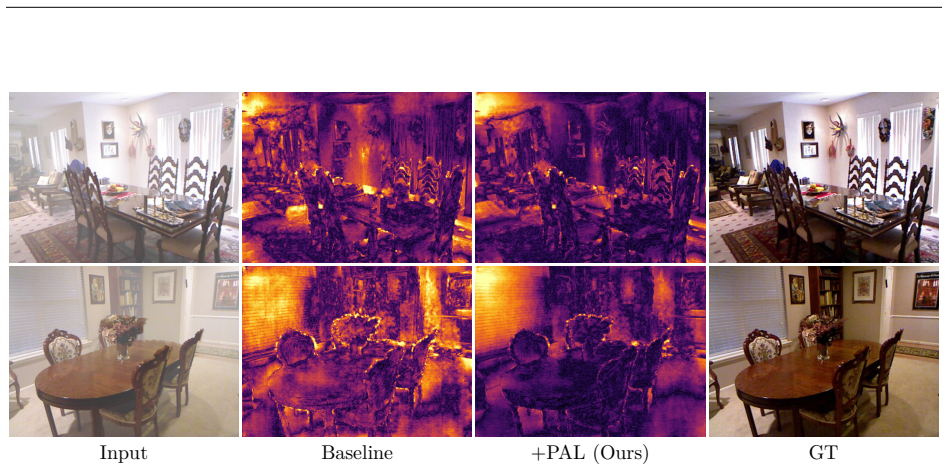
Under least-squares decomposition, the photometric and structural components of the prediction-target residual are orthogonal, and the spatially dense photometric component dominates the gradient energy. This analysis motivates Photometric Alignment Loss, which discounts nuisance photometric discrepancy via closed-form affine color alignment while preserving restoration-relevant supervision.
What carries the argument
Photometric Alignment Loss (PAL), which computes a global affine color transform from covariance statistics of prediction and target, applies the alignment, and then evaluates the usual reconstruction loss on the aligned pair.
If this is right
- Standard reconstruction losses allocate disproportionate gradient budget to conflicting per-pair photometric targets.
- PAL requires only covariance statistics and a tiny matrix inversion, adding negligible overhead.
- The alignment improves metrics and generalization across 6 tasks, 16 datasets, and 16 architectures.
- Task-intrinsic photometric transfer and unintended acquisition shifts are both addressed by the same global correction step.
Where Pith is reading between the lines
- The same orthogonality argument could be used to design scale- or offset-invariant losses in other dense regression problems where input and target are recorded under mismatched conditions.
- Replacing the global affine with a spatially varying but still closed-form alignment might extend the approach to non-uniform illumination without changing the core decomposition.
- If the dominance result holds, any paired regression benchmark that reports only final metrics may be underestimating how much of its reported gain is actually photometric rather than structural.
Load-bearing premise
Photometric inconsistencies between paired images are well approximated by a global affine color transform that can be removed without discarding task-relevant information or introducing new artifacts.
What would settle it
Compute the fraction of total gradient energy attributable to the mean-color photometric component versus the residual structural component on a collection of real paired datasets; if the photometric share is not dominant, the central motivation for alignment does not hold.
Figures




read the original abstract
Supervised low-level vision models rely on pixel-wise losses against paired references, yet paired training sets exhibit per-pair photometric inconsistency, say, different image pairs demand different global brightness, color, or white-balance mappings. This inconsistency enters through task-intrinsic photometric transfer (e.g., low-light enhancement) or unintended acquisition shifts (e.g., de-raining), and in either case causes an optimization pathology. Standard reconstruction losses allocate disproportionate gradient budget to conflicting per-pair photometric targets, crowding out content restoration. In this paper, we investigate this issue and prove that, under least-squares decomposition, the photometric and structural components of the prediction-target residual are orthogonal, and that the spatially dense photometric component dominates the gradient energy. Motivated by this analysis, we propose Photometric Alignment Loss (PAL). This flexible supervision objective discounts nuisance photometric discrepancy via closed-form affine color alignment while preserving restoration-relevant supervision, requiring only covariance statistics and tiny matrix inversion with negligible overhead. Across 6 tasks, 16 datasets, and 16 architectures, PAL consistently improves metrics and generalization. The implementation is in the appendix.
Editorial analysis
A structured set of objections, weighed in public.
Referee Report
Summary. The paper claims that photometric inconsistencies in paired low-level vision training data cause optimization pathologies by dominating gradients under standard losses. It proves that, via least-squares decomposition, the photometric (global affine) and structural components of the prediction-target residual are orthogonal, with the dense photometric term dominating gradient energy. Motivated by this, it proposes Photometric Alignment Loss (PAL), a closed-form affine color alignment that discounts nuisance photometric discrepancy while preserving restoration supervision, requiring only covariance statistics and small matrix inversion. PAL yields consistent metric and generalization gains across 6 tasks, 16 datasets, and 16 architectures.
Significance. If the global-affine approximation is valid and the dominance result holds on real data, PAL provides a simple, efficient, parameter-free supervision objective that directly addresses a common training issue in low-level vision without altering architectures. The closed-form solution with negligible overhead and the broad empirical coverage across tasks and models are strengths; the work could influence training practices for restoration, enhancement, and related tasks if the assumption is shown to hold sufficiently.
major comments (2)
- [§3] §3 (Mathematical Analysis, around the least-squares decomposition): The orthogonality of photometric and structural residuals follows by construction from the projection onto the 6-dimensional per-channel affine subspace, but the claim that the photometric component dominates gradient energy is only guaranteed when per-pair discrepancies lie exactly (or predominantly) in that subspace. No analysis quantifies the captured photometric variance or residual error after projection on the 16 datasets.
- [Experiments] Experiments (results tables and ablations): Consistent gains are reported, yet the manuscript contains no controlled experiment that isolates global affine photometric mismatch from spatially varying or non-linear shifts (common in de-raining, low-light, or cross-camera pairs). Without such a test, it is unclear whether improvements arise from the claimed mechanism or from incidental regularization effects.
minor comments (2)
- [§4] The closed-form solution for the affine parameters (via covariance) is described but would benefit from an explicit equation or pseudocode block showing the 6-parameter computation and the subsequent loss evaluation.
- [§3] Notation for the photometric alignment matrix and the resulting aligned target could be introduced earlier and used consistently in the gradient analysis to improve readability.
Simulated Author's Rebuttal
We thank the referee for the constructive and detailed feedback. We address each major comment below and will revise the manuscript accordingly to strengthen the presentation of the analysis and empirical validation.
read point-by-point responses
-
Referee: [§3] §3 (Mathematical Analysis, around the least-squares decomposition): The orthogonality of photometric and structural residuals follows by construction from the projection onto the 6-dimensional per-channel affine subspace, but the claim that the photometric component dominates gradient energy is only guaranteed when per-pair discrepancies lie exactly (or predominantly) in that subspace. No analysis quantifies the captured photometric variance or residual error after projection on the 16 datasets.
Authors: We agree that while orthogonality holds by construction of the projection, the dominance claim on real data would be more convincing with explicit quantification. In the revised manuscript we will add an analysis (new figure and table in §3) that, for representative pairs from all 16 datasets, reports the fraction of total residual energy captured by the photometric affine component after the closed-form least-squares projection, together with the residual error norm. This directly quantifies how well the 6-dimensional subspace approximates the observed photometric discrepancies. revision: yes
-
Referee: [Experiments] Experiments (results tables and ablations): Consistent gains are reported, yet the manuscript contains no controlled experiment that isolates global affine photometric mismatch from spatially varying or non-linear shifts (common in de-raining, low-light, or cross-camera pairs). Without such a test, it is unclear whether improvements arise from the claimed mechanism or from incidental regularization effects.
Authors: We concur that a controlled isolation experiment would provide stronger causal evidence for the proposed mechanism. In the revision we will add a new ablation subsection that applies only synthetic global affine photometric transformations (brightness, contrast, and color shifts drawn from the same range observed in the real datasets) to otherwise perfectly matched pairs, then trains identical models with and without PAL. This isolates the effect of global affine mismatch from spatially varying or non-linear discrepancies while keeping all other factors fixed. revision: yes
Circularity Check
No circularity; derivation relies on standard least-squares projection identities and closed-form covariance solution
full rationale
The paper's core analysis decomposes the residual into photometric (global affine) and structural parts under least-squares, noting their orthogonality by the definition of orthogonal projection onto the 6-dimensional affine subspace per channel. The claim that the dense photometric term dominates gradient energy follows from the spatial coherence of a global transform versus potential cancellation in local structural residuals, which is a direct mathematical consequence rather than a fitted prediction or self-referential result. PAL is then constructed explicitly as the closed-form affine alignment (via covariance and matrix inversion) that removes this photometric component while retaining the orthogonal structural supervision. No parameters are fitted to data subsets and then renamed as predictions, no self-citations bear load on uniqueness or ansatzes, and the derivation does not reduce any claimed output to its own inputs by construction. The approach is self-contained against external least-squares theory.
Axiom & Free-Parameter Ledger
axioms (2)
- standard math Least-squares residuals between prediction and target decompose into orthogonal photometric and structural components.
- domain assumption Photometric discrepancies between paired images are adequately captured by a global affine color mapping.
Reference graph
Works this paper leans on
-
[1]
Learningadeepsingleimagecontrastenhancerfrommulti-exposure images.IEEE TIP, 27(4):2049–2062,
JianruiCai, ShuhangGu, andLeiZhang. Learningadeepsingleimagecontrastenhancerfrommulti-exposure images.IEEE TIP, 27(4):2049–2062,
2049
-
[2]
Boyi Li, Wenqi Ren, Dengpan Fu, Dacheng Tao, Dan Feng, Wenjun Zeng, and Zhangyang Wang. Bench- marking single-image dehazing and beyond.IEEE transactions on image processing, 28(1):492–505, 2018a. Chongyi Li, Jichang Guo, and Chunle Guo. Emerging from water: Underwater image color correction based on weakly supervised color transfer.IEEE Signal Processing...
-
[3]
Vision transformers for single image dehazing.IEEE TIP, 32:1927–1941,
15 Yuda Song, Zhuqing He, Hui Qian, and Xin Du. Vision transformers for single image dehazing.IEEE TIP, 32:1927–1941,
1927
-
[4]
Q-Align: Teaching LMMs for Visual Scoring via Discrete Text-Defined Levels
Haoning Wu, Zicheng Zhang, Weixia Zhang, Chaofeng Chen, Liang Liao, Chunyi Li, Yixuan Gao, Annan Wang, Erli Zhang, Wenxiu Sun, et al. Q-align: Teaching lmms for visual scoring via discrete text-defined levels.arXiv preprint arXiv:2312.17090,
work page internal anchor Pith review arXiv
-
[5]
Sparse gradient regularized deep retinex network for robust low-light image enhancement.IEEE TIP, 30:2072–2086,
Wenhan Yang, Wenjing Wang, Haofeng Huang, Shiqi Wang, and Jiaying Liu. Sparse gradient regularized deep retinex network for robust low-light image enhancement.IEEE TIP, 30:2072–2086,
2072
-
[6]
17 A Limitations and Future Work PAL models the photometric discrepancy as a global affine color transformation (CˆI+b, 12 parameters), which cannot explicitly capture spatially varying photometric effects such as local illumination. However, this is a deliberate design choice: a global model avoids absorbing spatially localized content (textures, edges) ...
2016
-
[7]
20.57 0.769 0.254 2.9141.85521.74 0.877 0.138 2.650 2.023 21.28 0.791 0.3552.256 1.377 +GT-Mean Loss 20.79 0.7870.2332.892 1.728 21.920.8880.1182.8402.08421.770.8000.365 2.2851.331 +PAL (Ours)21.01 0.791 0.228 2.9231.729 22.13 0.890 0.117 2.870 2.091 22.32 0.816 0.348 2.535 1.469 Uformer (Wang et al.,
-
[8]
18.85 0.751 0.288 2.7511.66121.50 0.884 0.120 2.919 2.058 19.80 0.714 0.346 2.135 1.387 +GT-Mean Loss 19.01 0.7590.2792.728 1.558 21.620.894 0.107 2.996 2.10419.920.7290.3312.1541.416 +PAL (Ours)19.31 0.767 0.247 2.858 1.666 21.790.890 0.1122.9522.06320.12 0.738 0.327 2.780 1.649 Retinexformer (Cai et al.,
-
[9]
23.40 0.822 0.269 3.148 1.980 25.48 0.930 0.1012.404 2.096 21.69 0.846 0.276 3.163 1.962 +GT-Mean Loss 24.03 0.8420.2403.4122.09425.870.9400.083 2.438 2.18921.870.8490.2533.3982.057 +PAL (Ours)24.53 0.847 0.239 3.533 2.122 26.01 0.941 0.0832.4352.16222.73 0.8640.2653.499 2.077 CID-Net (Yan et al.,
-
[10]
Best and second-best results are inboldand underlined
23.970.8490.1043.791 2.071 25.44 0.935 0.0473.299 2.171 23.19 0.857 0.136 3.699 2.042 +GT-Mean Loss 23.72 0.838 0.1053.993 2.13325.53 0.9360.045 3.410 2.19823.390.8630.1203.9172.089 +PAL (Ours)24.13 0.854 0.0993.923 2.10425.84 0.937 0.0453.3732.18523.95 0.870 0.112 3.938 2.103 Table 9: Direct comparison of Baseline, GT-Mean Loss (Liao et al., 2025), and P...
discussion (0)
Sign in with ORCID, Apple, or X to comment. Anyone can read and Pith papers without signing in.