Recognition: 2 theorem links
· Lean TheoremHow many VHE gamma-ray binaries with young pulsars can be observed?
Pith reviewed 2026-05-10 18:38 UTC · model grok-4.3
The pith
Stellar and pulsar wind collisions in binaries accelerate particles to PeV energies in some orbital phases, with anisotropy shaping how many systems are visible as VHE gamma-ray sources.
A machine-rendered reading of the paper's core claim, the machinery that carries it, and where it could break.
Core claim
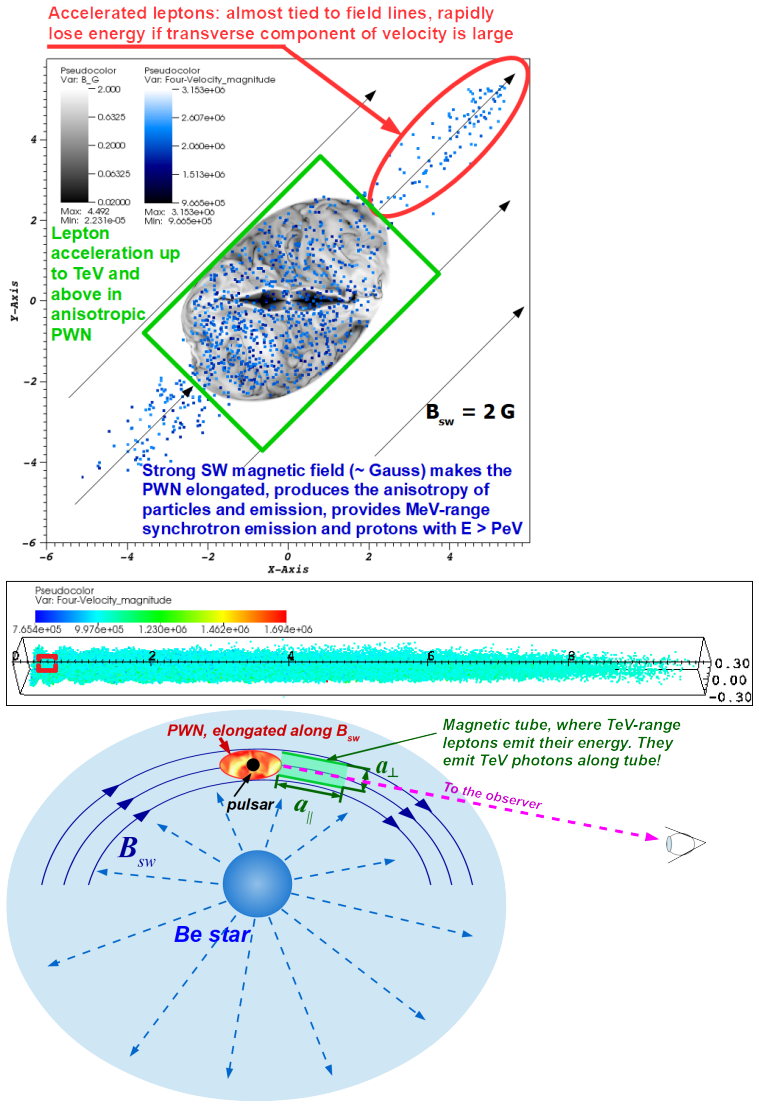
The stellar winds with strong (~ Gauss) magnetic fields at ~ AU distances colliding with powerful pulsar outflows are capable of accelerating particles up to PeV energies at some orbital configurations and phases. The strong magnetic field in the interaction region produces a highly anisotropic structure of the particle accelerator and emitter in the pulsar outflow. The anisotropic radiation pattern may affect the gamma-ray photon absorption and the number of the observed gamma-ray loud systems.
What carries the argument
The anisotropic structure of the interaction zone between the relativistic pulsar wind and the strongly magnetized massive star's wind, which enables PeV particle acceleration and directional emission.
If this is right
- Certain orbital periods and eccentricities allow particle acceleration to PeV energies during specific phases of the orbit.
- Anisotropy in the emission and absorption reduces the fraction of systems that appear as gamma-ray loud to a distant observer.
- The synthesis yields an estimate for the total number of potentially observable VHE gamma-ray binaries in the Galaxy.
- Multi-wavelength data on known binaries can test the modeled conditions for acceleration and visibility.
Where Pith is reading between the lines
- Targeted observations at predicted orbital phases could raise detection rates of new VHE sources beyond current blind surveys.
- The same wind-collision physics could apply to black-hole companions, broadening the census of gamma-ray binaries.
- PeV acceleration in these systems offers a possible contribution to the high-energy end of the Galactic cosmic-ray spectrum.
Load-bearing premise
The assumed distributions of binary eccentricities, orbital periods, Be-disk inclinations, and pulsar braking energy losses, together with the modeled conditions for VHE particle acceleration and anisotropic emission in the wind-interaction zone, correctly capture the physics that determines observability.
What would settle it
A statistical mismatch between the predicted number and phase-dependent detectability of VHE gamma-ray binaries and the actual count or variability patterns found in observations of known pulsar systems would falsify the central claim.
Figures


read the original abstract
A population of Galactic gamma-ray binaries is currently emerging due to ever increasing sensitivity of gamma-ray observatories. The detection of very high energy (VHE) photons with energies well above 10 TeV from a dozen of sources and the estimated power of those sources make them potentially interesting cosmic ray accelerators. Multi-wavelength observations of gamma-ray binaries revealed that most of them include a young massive star in pair with a relativistic companion, either a black hole or energetic pulsar. Fast stellar winds interacting with powerful relativistic outflows from pulsars or the black hole jets in microquasars are favorable sites for VHE particle acceleration. To estimate the expected number of gamma-ray binaries, we present results of population synthesis calculations of Galactic binaries in which a young massive OB- or Be-star is accompanied by a pulsar capable of producing a powerful relativistic outflow. The distributions over the binary eccentricities, orbital periods, Be-disk inclinations, and the pulsar braking energy losses are taken into account. Conditions for a binary to accelerate VHE particles, radiate and absorb the non-thermal photons that may reach the observer are discussed. We model the anisotropic structure of the zone of interaction of the relativistic pulsar wind with the strongly magnetized massive star's wind. The stellar winds with strong ($\sim$ Gauss) magnetic fields at $\sim$ AU distances colliding with powerful pulsar outflows are capable of accelerating particles up to PeV energies at some orbital configurations and phases. The strong magnetic field in the interaction region produces a highly anisotropic structure of the particle accelerator and emitter in the pulsar outflow. The anisotropic radiation pattern may affect the gamma-ray photon absorption and the number of the observed gamma-ray loud systems.
Editorial analysis
A structured set of objections, weighed in public.
Referee Report
Summary. The manuscript performs population synthesis calculations for Galactic binaries consisting of a young massive OB- or Be-star paired with a pulsar to estimate the number of observable VHE gamma-ray binaries. It incorporates distributions over binary eccentricities, orbital periods, Be-disk inclinations, and pulsar braking energy losses, models the anisotropic interaction zone between the relativistic pulsar wind and the strongly magnetized stellar wind, and argues that ~Gauss magnetic fields at ~AU distances enable particle acceleration to PeV energies at certain orbital phases, with anisotropy affecting gamma-ray absorption and the count of detectable systems.
Significance. If the quantitative results hold, the work would supply a falsifiable prediction for the size of the VHE gamma-ray binary population detectable by current and future instruments (H.E.S.S., MAGIC, VERITAS, CTA), directly informing the interpretation of the dozen known sources and the role of wind-collision zones as cosmic-ray accelerators. The explicit treatment of anisotropic particle acceleration and emission is a strength that could be tested against multi-wavelength data.
major comments (2)
- Abstract: the central population estimate (the expected number of observable VHE gamma-ray binaries) is not reported, nor are any numerical outcomes, uncertainties, or direct comparisons to the dozen known sources supplied; without these the synthesis calculation cannot be verified or assessed for robustness.
- The modeling of VHE acceleration and anisotropic emission relies on the assumed distributions for eccentricity, orbital period, Be-disk inclination, and pulsar braking losses (listed as free parameters); no justification, observational priors, or sensitivity tests for these choices are visible in the provided text, which directly affects the reliability of the observability prediction.
minor comments (2)
- The abstract refers to 'a dozen of sources' without citing specific objects or references; adding a brief list or reference would improve context.
- Clarify the precise functional forms or parameter ranges used for the magnetic field strength at AU scales and the conditions for PeV acceleration in the interaction zone.
Simulated Author's Rebuttal
We thank the referee for the careful reading of our manuscript and the constructive comments. We address each major comment below and have revised the manuscript to improve clarity and completeness.
read point-by-point responses
-
Referee: Abstract: the central population estimate (the expected number of observable VHE gamma-ray binaries) is not reported, nor are any numerical outcomes, uncertainties, or direct comparisons to the dozen known sources supplied; without these the synthesis calculation cannot be verified or assessed for robustness.
Authors: We agree that the abstract should report the key quantitative outcome. In the revised manuscript we have updated the abstract to state the estimated number of observable VHE gamma-ray binaries, the associated uncertainties, and a direct comparison with the dozen known sources. revision: yes
-
Referee: The modeling of VHE acceleration and anisotropic emission relies on the assumed distributions for eccentricity, orbital period, Be-disk inclination, and pulsar braking losses (listed as free parameters); no justification, observational priors, or sensitivity tests for these choices are visible in the provided text, which directly affects the reliability of the observability prediction.
Authors: The referee is correct that explicit justifications and sensitivity tests were not detailed in the submitted text. We have added a dedicated subsection describing the observational priors for each distribution (drawn from pulsar binary surveys and Be-star studies) with appropriate references, and we have included sensitivity tests that vary the parameters within observationally motivated ranges to show the robustness of the predicted count. revision: yes
Circularity Check
No significant circularity in derivation chain
full rationale
The paper conducts population synthesis of Galactic binaries using externally supplied input distributions for eccentricities, orbital periods, Be-disk inclinations, and pulsar braking losses, combined with a standard model of anisotropic particle acceleration and photon absorption in the pulsar-wind/stellar-wind interaction zone. No equations, fitted parameters, or results are presented that reduce the predicted number of observable VHE systems to a self-defined quantity, a renamed fit, or a load-bearing self-citation chain. The central estimate therefore rests on independent assumptions and external physics rather than internal redefinition or circular closure.
Axiom & Free-Parameter Ledger
free parameters (4)
- binary eccentricity distribution
- orbital period distribution
- Be-disk inclination distribution
- pulsar braking energy losses distribution
axioms (2)
- domain assumption Stellar winds with strong magnetic fields at AU distances can accelerate particles to PeV energies when colliding with pulsar outflows
- domain assumption The anisotropic structure of the wind-interaction zone governs gamma-ray absorption and observability
Reference graph
Works this paper leans on
-
[2]
V . Bosch-Ramon, D. Khangulyan, Under- standing the V ery-High Emission from Micro- quasars, International Journal of Modern Physics D 18 (2009) 347–387. doi: 10.1142/ S0218271809014601. arXiv:0805.4123
-
[3]
LHAASO Collaboration, Ultrahigh-Energy Gamma-ray Emission Associated with Black Hole-Jet Systems, arXiv e-prints (2024) arXiv:2410.08988. doi: 10.48550/arXiv.2410. 08988. arXiv:2410.08988
-
[4]
Dubus, Gamma-ray binaries: pul- sars in disguise?, A&A 456 (2006) 801–
G. Dubus, Gamma-ray binaries: pul- sars in disguise?, A&A 456 (2006) 801–
2006
-
[5]
doi: 10.1051/0004-6361:20054779. arXiv:astro-ph/0605287
-
[6]
Dubus, Gamma-ray binaries and re- lated systems, Astron
G. Dubus, Gamma-ray binaries and re- lated systems, Astron. Astroph. Reviews 21 (2013) 64. doi: 10.1007/s00159-013-0064-5 . arXiv:1307.7083
-
[7]
G. E. Romero, M. Boettcher, S. Marko ff, F. Tavec- chio, Relativistic Jets in Active Galactic Nuclei and Microquasars, Space Sci. Rev. 207 (2017) 5–61. doi: 10.1007/s11214-016-0328-2 . arXiv:1611.09507
- [9]
-
[10]
Lhaaso Collaboration, Z. Cao, F. Aharonian, Q. An, Axikegu, L. X. Bai, Y . X. Bai, Y . W. Bao, D. Bastieri, X. J. Bi, Y . J. Bi, H. Cai, J. T. Cai, 21 Z. Cao, J. Chang, J. F. Chang, B. M. Chen, E. S. Chen, J. Chen, L. Chen, L. Chen, L. Chen, M. J. Chen, M. L. Chen, Q. H. Chen, S. H. Chen, S. Z. Chen, T. L. Chen, X. L. Chen, Y . Chen, N. Cheng, Y . D. Chen...
-
[11]
E. Amato, B. Olmi, The Crab Pulsar and Nebula as Seen in Gamma-Rays, Universe 7 (2021) 448. doi: 10.3390/universe7110448. arXiv:2111.07712
-
[12]
J. Aleksi ´c, S. Ansoldi, L. A. Antonelli, P . An- toranz, A. Babic, P . Bangale, J. A. Barrio, J. Becerra González, W. Bednarek, E. Bernardini, B. Biasuzzi, A. Biland, O. Blanch, S. Bonnefoy, G. Bonnoli, F. Borracci, T. Bretz, E. Carmona, A. Carosi, P . Colin, E. Colombo, J. L. Contreras, J. Cortina, S. Covino, P . Da V ela, F. Dazzi, A. De Angelis, G. D...
-
[13]
A. M. Bykov, A. E. Petrov, M. E. Kalyashova, S. V . Troitsky, PeV Photon and Neutrino Flares from Galactic Gamma-Ray Binaries, ApJ 921 (2021) L10. doi: 10.3847/2041-8213/ac2f3d. arXiv:2110.11189
-
[14]
Arons, Pulsar Wind Nebulae as Cosmic Pevatrons: A Current Sheet’s Tale, Space Sci
J. Arons, Pulsar Wind Nebulae as Cosmic Pevatrons: A Current Sheet’s Tale, Space Sci. Rev. 173 (2012) 341–367. doi: 10.1007/ s11214-012-9885-1 . arXiv:1208.5787. 22
-
[15]
E. de Oña Wilhelmi, R. López-Coto, E. Amato, F. Aharonian, On the Potential of Bright, Y oung Pulsars to Power Ultrahigh Gamma-Ray Sources, ApJ 930 (2022) L2. doi: 10.3847/2041-8213/ ac66cf. arXiv:2204.09440
-
[16]
T. Rivinius, A. C. Carciofi, C. Martayan, Clas- sical Be stars. Rapidly rotating B stars with vis- cous Keplerian decretion disks, Astron. As- troph. Reviews 21 (2013) 69. doi: 10.1007/ s00159-013-0069-0 . arXiv:1310.3962
-
[17]
F. C. Michel, Rotating Magnetospheres: an Ex- act 3-D Solution, ApJ 180 (1973) L133. doi: 10. 1086/181169
1973
-
[18]
S. V . Bogovalov, On the physics of cold MHD winds from oblique rota- tors, A&A 349 (1999) 1017–1026. doi:10.48550/arXiv.astro-ph/9907051. arXiv:astro-ph/9907051
-
[19]
A. M. Bykov, A. E. Petrov, G. A. Ponomaryov, K. P . Levenfish, M. Falanga, PeV proton acceler- ation in gamma-ray binaries, Advances in Space Research 74 (2024) 4276–4289. doi: 10.1016/j. asr.2024.01.021. arXiv:2401.06271
work page doi:10.1016/j 2024
-
[20]
A. M. Bykov, A. E. Petrov, K. P . Levenfish, Rela- tivistic Astrospheres of Pulsars and Gamma-Ray Binaries: Modeling of Non-thermal Processes, Fluid Dynamics 59 (2024) 2377–2391. doi: 10. 1134/S0015462824605059
2024
-
[21]
M. Lemoine, E. Waxman, Anisotropy vs chemi- cal composition at ultra-high energies, JCAP 2009 (2009) 009. doi: 10.1088/1475-7516/2009/11/
- [22]
-
[24]
S.-S. Weng, L. Qian, B.-J. Wang, D. F. Tor- res, A. Papitto, P . Jiang, R. Xu, J. Li, J.-Z. Y an, Q.-Z. Liu, M.-Y . Ge, Q.-R. Y uan, Ra- dio pulsations from a neutron star within the gamma-ray binary LS I +61° 303, Nature Astronomy 6 (2022) 698–702. doi: 10.1038/ s41550-022-01630-1 . arXiv:2203.09423
-
[25]
V . Zabalza, J. M. Paredes, V . Bosch-Ramon, On the origin of correlated X-ray /VHE emission from LS I +61 303, A&A 527 (2011) A9. doi:10.1051/ 0004-6361/201015373. arXiv:1011.4489
-
[26]
H. Y oneda, K. Makishima, T. Enoto, D. Khangulyan, T. Matsumoto, T. Taka- hashi, Sign of Hard-X-Ray Pulsation from the γ -Ray Binary System LS 5039, Phys. Rev. Lett. 125 (2020) 111103. doi:10.1103/PhysRevLett.125.111103. arXiv:2009.02075
-
[28]
J. R. Hurley, O. R. Pols, C. A. Tout, Com- prehensive analytic formulae for stellar evolution as a function of mass and metal- licity, MNRAS 315 (2000) 543–569. doi:10.1046/j.1365-8711.2000.03426.x. arXiv:astro-ph/0001295
-
[29]
J. R. Hurley, C. A. Tout, O. R. Pols, Evolu- tion of binary stars and the e ffect of tides on binary populations, MNRAS 329 (2002) 897–
2002
-
[30]
doi: 10.1046/j.1365-8711.2002.05038. x. arXiv:astro-ph/0201220
-
[31]
L. Chomiuk, M. S. Povich, Toward a Uni- fication of Star Formation Rate Determinations in the Milky Way and Other Galaxies, AJ 142 (2011) 197. doi: 10.1088/0004-6256/142/ 6/197. arXiv:1110.4105
- [32]
-
[33]
H. Sana, S. E. de Mink, A. de Koter, N. Langer, C. J. Evans, M. Gieles, E. Gosset, R. G. Izzard, J.- B. Le Bouquin, F. R. N. Schneider, Binary Inter- action Dominates the Evolution of Massive Stars, Science 337 (2012) 444. doi: 10.1126/science. 1223344. arXiv:1207.6397. 23
- [35]
-
[36]
R. F. Webbink, Double white dwarfs as progeni- tors of R Coronae Borealis stars and Type I super- novae, ApJ 277 (1984) 355–360. doi: 10.1086/ 161701
1984
-
[37]
Iben, Jr., A
I. Iben, Jr., A. V . Tutukov, Supernovae of type I as end products of the evolution of binaries with com- ponents of moderate initial mass (M not greater than about 9 solar masses), ApJS 54 (1984) 335–
1984
- [38]
-
[40]
J. S. Vink, Winds from stripped low-mass helium stars and Wolf-Rayet stars, A&A 607 (2017) L8. doi: 10.1051/0004-6361/201731902. arXiv:1710.02010
-
[41]
G. Hobbs, D. R. Lorimer, A. G. Lyne, M. Kramer, A statistical study of 233 pulsar proper motions, MNRAS 360 (2005) 974–992. doi:10.1111/j.1365-2966.2005.09087.x. arXiv:astro-ph/0504584
-
[43]
Miyaji, K
S. Miyaji, K. Nomoto, K. Y okoi, D. Sugimoto, Su- pernova triggered by electron captures., PASJ 32 (1980) 303–329
1980
-
[44]
A. G. Kuranov, S. B. Popov, K. A. Postnov, Pulsar spin-velocity alignment from single and binary neutron star progenitors, MNRAS 395 (2009) 2087–2094. doi: 10.1111/j.1365-2966. 2009.14595.x. arXiv:0901.1055
-
[45]
V . M. Lipunov, K. A. Postnov, M. E. Prokhorov, The Scenario Machine: restrictions on key param- eters of binary evolution., A&A 310 (1996) 489– 507
1996
-
[46]
V . M. Lipunov, K. A. Postnov, M. E. Prokhorov, A. I. Bogomazov, Description of the “Sce- nario Machine”, Astronomy Reports 53 (2009) 915–940. doi: 10.1134/S1063772909100047. arXiv:0704.1387
-
[47]
M., 2006, @doi [ ] 10.1086/501516 , https://ui.adsabs.harvard.edu/abs/2006ApJ...643..332F 643, 332
C.-A. Faucher-Giguère, V . M. Kaspi, Birth and Evolution of Isolated Radio Pulsars, ApJ 643 (2006) 332–355. doi: 10.1086/501516. arXiv:astro-ph/0512585
-
[48]
A. P . Igoshev, S. B. Popov, Indication of rapid magnetic field decay in X-ray dim iso- lated neutron star RX J0720.4-3125, MNRAS 535 (2024) L54–L57. doi: 10.1093/mnrasl/ slae094. arXiv:2409.03573
-
[49]
T. M. Tauris, E. P . J. van den Heuvel, Physics of Binary Star Evolution. From Stars to X-ray Binaries and Gravitational Wave Sources, 2023. doi:10.48550/arXiv.2305.09388
-
[50]
B. Paczynski, A Polytropic Model of an Accre- tion Disk, a Boundary Layer, and a Star, ApJ 370 (1991) 597. doi: 10.1086/169846
-
[51]
R. Popham, R. Narayan, Does Accretion Cease When a Star Approaches Breakup?, ApJ 370 (1991) 604. doi: 10.1086/169847
-
[52]
G. S. Bisnovatyi-Kogan, A self-consistent solution for an accretion disc structure around a rapidly ro- tating non-magnetized star, A&A 274 (1993) 796
1993
-
[53]
W. C. G. Ho, C. Y . Ng, A. G. Lyne, B. W. Stappers, M. J. Coe, J. P . Halpern, T. J. John- son, I. A. Steele, Multiwavelength monitoring and X-ray brightening of Be X-ray binary PSR J2032+4127/MT91 213 on its approach to peri- astron, MNRAS 464 (2017) 1211–1219. doi: 10. 1093/mnras/stw2420. arXiv:1609.06328
-
[55]
N. Matchett, B. van Soelen, New insight into the orbital parameters of the gamma-ray binary HESS J0632 + 057, MNRAS 536 (2025) 166–173. doi:10.1093/mnras/stae2597. arXiv:2411.12499
-
[56]
J. Casares, M. Ribó, I. Ribas, J. M. Pare- des, J. Martí, A. Herrero, A possible black hole in the γ-ray microquasar LS 5039, MNRAS 364 (2005) 899–908. doi:10.1111/j.1365-2966.2005.09617.x. arXiv:astro-ph/0507549
-
[57]
The origin of the formalism intrinsic degeneracies and their influence on H 0
B. van Soelen, S. Mc Keague, D. Malyshev, M. Chernyakova, N. Komin, N. Matchett, I. M. Monageng, Improved binary solution for the gamma-ray binary 1FGL J1018.6-5856, MNRAS 515 (2022) 1078–1085. doi: 10.1093/mnras/ stac1754. arXiv:2206.11647
-
[58]
B. van Soelen, N. Komin, A. Kniazev, P . Väisä- nen, The orbital parameters of the gamma- ray binary LMC P3†, MNRAS 484 (2019) 4347–4351. doi:10.1093/mnras/stz289. arXiv:1901.08911
-
[61]
D. D. Dzhappuev, Y . Z. Afashokov, I. M. Dza- parova, T. A. Dzhatdoev, E. A. Gorbacheva, I. S. Karpikov, M. M. Khadzhiev, N. F. Klimenko, A. U. Kudzhaev, A. N. Kurenya, A. S. Lidvansky, O. I. Mikhailova, V . B. Petkov, E. I. Podlesnyi, V . S. Romanenko, G. I. Rubtsov, S. V . Troitsky, I. B. Unatlokov, I. A. V aiman, A. F. Y anin, Y . V . Zhezher, K. V . Z...
-
[62]
J. H. Grunhut, G. A. Wade, C. Neiner, M. E. Oksala, V . Petit, E. Alecian, D. A. Bohlen- der, J. C. Bouret, H. F. Henrichs, G. A. J. Hussain, O. Kochukhov, MiMeS Collaboration, The MiMeS survey of Magnetism in Massive Stars: magnetic analysis of the O-type stars, MNRAS 465 (2017) 2432–2470. doi: 10.1093/ mnras/stw2743. arXiv:1610.07895
-
[63]
M. E. Shultz, G. A. Wade, T. Rivinius, E. Ale- cian, C. Neiner, V . Petit, S. Owocki, A. ud- Doula, O. Kochukhov, D. Bohlender, Z. Keszthe- lyi, MiMeS Collaboration, BinaMIcS Collab- oration, The magnetic early B-type stars - III. A main-sequence magnetic, rotational, and magnetospheric biography, MNRAS 490 (2019) 274–295. doi: 10.1093/mnras/stz2551. arXi...
- [64]
-
[65]
F. Aharonian, A. G. Akhperjanian, A. R. Bazer- Bachi, M. Beilicke, W. Benbow, D. Berge, K. Bernlöhr, C. Boisson, O. Bolz, V . Bor- rel, I. Braun, A. M. Brown, R. Bühler, I. Büsching, S. Carrigan, P . M. Chadwick, L. M. Chounet, R. Cornils, L. Costamante, B. Degrange, H. J. Dickinson, A. Djannati-Ataï, L. O’C. Drury, G. Dubus, K. Egberts, D. Em- manoulopou...
- [66]
- [67]
-
[68]
Cognitive Science36(5), 757–798 (2012).https://doi.org/10.1111/j
M. Chernyakova, A. Neronov, F. Aharonian, Y . Uchiyama, T. Takahashi, X-ray observations of PSR B1259-63 near the 2007 periastron passage, MNRAS 397 (2009) 2123–2132. doi: 10.1111/j. 1365-2966.2009.15116.x
work page doi:10.1111/j 2007
-
[69]
M. Chernyakova, A. A. Abdo, A. Neronov, M. V . McSwain, J. Moldón, M. Ribó, J. M. Paredes, I. Sushch, M. de Naurois, U. Schwanke, Y . Uchiyama, K. Wood, S. Johnston, S. Chaty, A. Coleiro, D. Malyshev, I. Babyk, Multi- wavelength observations of the binary sys- tem PSR B1259-63 /LS 2883 around the 2010-2011 periastron passage, MNRAS 439 (2014) 432–445. doi...
-
[70]
M. Chernyakova, D. Malyshev, B. van Soelen, A. Finn Gallagher, N. Matchett, T. D. Russell, J. van den Eijnden, M. E. Lower, S. Johnston, S. Tsygankov, A. Salganik, I. Shebalkova, Mul- tiwavelength coverage of the 2024 periastron pas- sage of PSR B1259-63 /LS 2883, MNRAS 536 (2025) 247–253. doi:10.1093/mnras/stae2621. arXiv:2411.02128
-
[71]
H. E. S. S. Collaboration, F. Aharonian, F. Ait Benkhali, J. Aschersleben, H. Ashkar, M. Backes, V . Barbosa Martins, R. Batzofin, Y . Becherini, D. Berge, K. Bernlöhr, M. Böttcher, C. Boisson, J. Bolmont, M. de Bony de Lavergne, J. Borowska, M. Bouyahiaoui, R. Brose, A. Brown, F. Brun, B. Bruno, T. Bulik, C. Burger-Scheidlin, S. Caro ff, S. Casanova, J. Ce...
-
[72]
Bosch-Ramon, Properties of a hypothetical cold pulsar wind in LS 5039, A&A 645 (2021) A86
V . Bosch-Ramon, Properties of a hypothetical cold pulsar wind in LS 5039, A&A 645 (2021) A86. doi: 10.1051/0004-6361/202039666. arXiv:2012.11578
-
[73]
2007, The Astrophysical Journal Supplement Series, 170, 228–242, doi: 10.1086/513316
A. Mignone, G. Bodo, S. Massaglia, T. Matsakos, O. Tesileanu, C. Zanni, A. Ferrari, PLUTO: A Numerical Code for Computational Astrophysics, ApJS 170 (2007) 228–242. doi: 10.1086/513316. arXiv:astro-ph/0701854. 26
-
[74]
A. Mignone, G. Bodo, B. V aidya, G. Mat- tia, A Particle Module for the PLUTO Code. I. An Implementation of the MHD-PIC Equations, ApJ 859 (2018) 13. doi: 10.3847/1538-4357/ aabccd. arXiv:1804.01946
-
[75]
R. Klement, A. C. Carciofi, T. Rivinius, L. D. Matthews, R. G. Vieira, R. Ignace, J. E. Bjorkman, B. C. Mota, D. M. Faes, A. D. Bratcher, M. Curé, S. Štefl, Revealing the structure of the outer disks of Be stars, A&A 601 (2017) A74. doi: 10.1051/ 0004-6361/201629932. arXiv:1703.07321
-
[76]
Nikishov, Absorption of high-energy photons in the Universe, Sov
A. Nikishov, Absorption of high-energy photons in the Universe, Sov. Phys. JETP 14 (1962) 393
1962
- [77]
-
[78]
A. Neronov, M. Ribordy, Neutrino signal from γ- ray-loud binaries powered by high energy protons, Phys. Rev. D 79 (2009) 043013. doi: 10.1103/ PhysRevD.79.043013. arXiv:0812.0306
-
[79]
J. Takata, P . H. T. Tam, C. W. Ng, K. L. Li, A. K. H. Kong, C. Y . Hui, K. S. Cheng, High- energy Emissions from the Pulsar /Be Binary Sys- tem PSR J2032 +4127/MT91 213, ApJ 836 (2017) 241. doi: 10.3847/1538-4357/aa5c80. arXiv:1702.04446
- [80]
-
[81]
M. Chernyakova, D. Malyshev, S. Mc Keague, B. van Soelen, J. P . Marais, A. Martin-Carrillo, D. Murphy, New insight into the origin of the GeV flare in the binary system PSR B1259-63 /LS 2883 from the 2017 periastron passage, MNRAS 497 (2020) 648–655. doi:10.1093/mnras/staa1876. arXiv:2005.14060
-
[82]
M. Chernyakova, D. Malyshev, B. van Soelen, S. O’Sullivan, C. Sobey, S. Tsygankov, S. Mc Keague, J. Green, M. Kirwan, A. Santangelo, G. Pühlhofer, I. M. Monageng, Multi-Wavelength Properties of the 2021 Periastron Passage of PSR B1259-63, Universe 7 (2021) 242. doi: 10.3390/ universe7070242. arXiv:2106.03759
-
[83]
Hubrig, A
S. Hubrig, A. F. Kholtygin, L. Sidoli, M. Schöller, S. P . Järvinen, Studying the presence of mag- netic fields in a sample of high-mass X-ray bi- naries, in: L. M. Oskinova, E. Bozzo, T. Bu- lik, D. R. Gies (Eds.), High-mass X-ray Bina- ries: Illuminating the Passage from Massive Bina- ries to Merging Compact Objects, volume 346 of IAU Symposium, 2019, pp...
2019
-
[84]
Hubrig, M
S. Hubrig, M. Schöller, Magnetic Fields in O, B, and A Stars, IOP ebooks, 2021. doi: 10.1088/ 2514-3433/abefcc
2021
-
[87]
S. del Palacio, V . Bosch-Ramon, G. E. Romero, Gamma-ray binaries beyond one-zone mod- els: an application to LS 5039, A&A 575 (2015) A112. doi: 10.1051/0004-6361/ 201424713. arXiv:1412.8167
- [88]
-
[89]
The LHAASO Collaboration, Z. Cao, F. Aharo- nian, Y . X. Bai, Y . W. Bao, D. Bastieri, X. J. Bi, Y . J. Bi, W. Bian, A. V . Bukevich, C. M. Cai, W. Y . Cao, Z. Cao, J. Chang, J. F. Chang, A. M. Chen, E. S. Chen, G. H. Chen, H. X. Chen, L. Chen, L. Chen, M. J. Chen, M. L. Chen, Q. H. Chen, S. Chen, S. H. Chen, S. Z. Chen, T. L. Chen, X. B. Chen, X. J. Chen...
work page internal anchor Pith review doi:10.48550/arxiv 2025
-
[90]
Z. Cao, F. Aharonian, Q. An, B. Axikegu, Y . X., Y . W. Bao, D. Bastieri, X. J. Bi, Y . J. Bi, J. T. Cai, Q. Cao, W. Y . Cao, Z. Cao, J. Chang, J. F. Chang, A. M. Chen, E. S. Chen, L. Chen, L. Chen, L. Chen, M. J. Chen, M. L. Chen, Q. H. Chen, S. H. Chen, S. Z. Chen, T. L. Chen, Y . Chen, N. Cheng, Y . D. Cheng, M. Y . Cui, S. W. Cui, X. H. Cui, Y . D. Cu...
- [91]
discussion (0)
Sign in with ORCID, Apple, or X to comment. Anyone can read and Pith papers without signing in.