Exact Generalized Langevin Dynamics of Pair Coordinates in Elastic Networks
Pith reviewed 2026-05-10 17:38 UTC · model grok-4.3
The pith
An exact generalized Langevin equation governs the relative coordinate of two beads in any elastic network.
A machine-rendered reading of the paper's core claim, the machinery that carries it, and where it could break.
Core claim
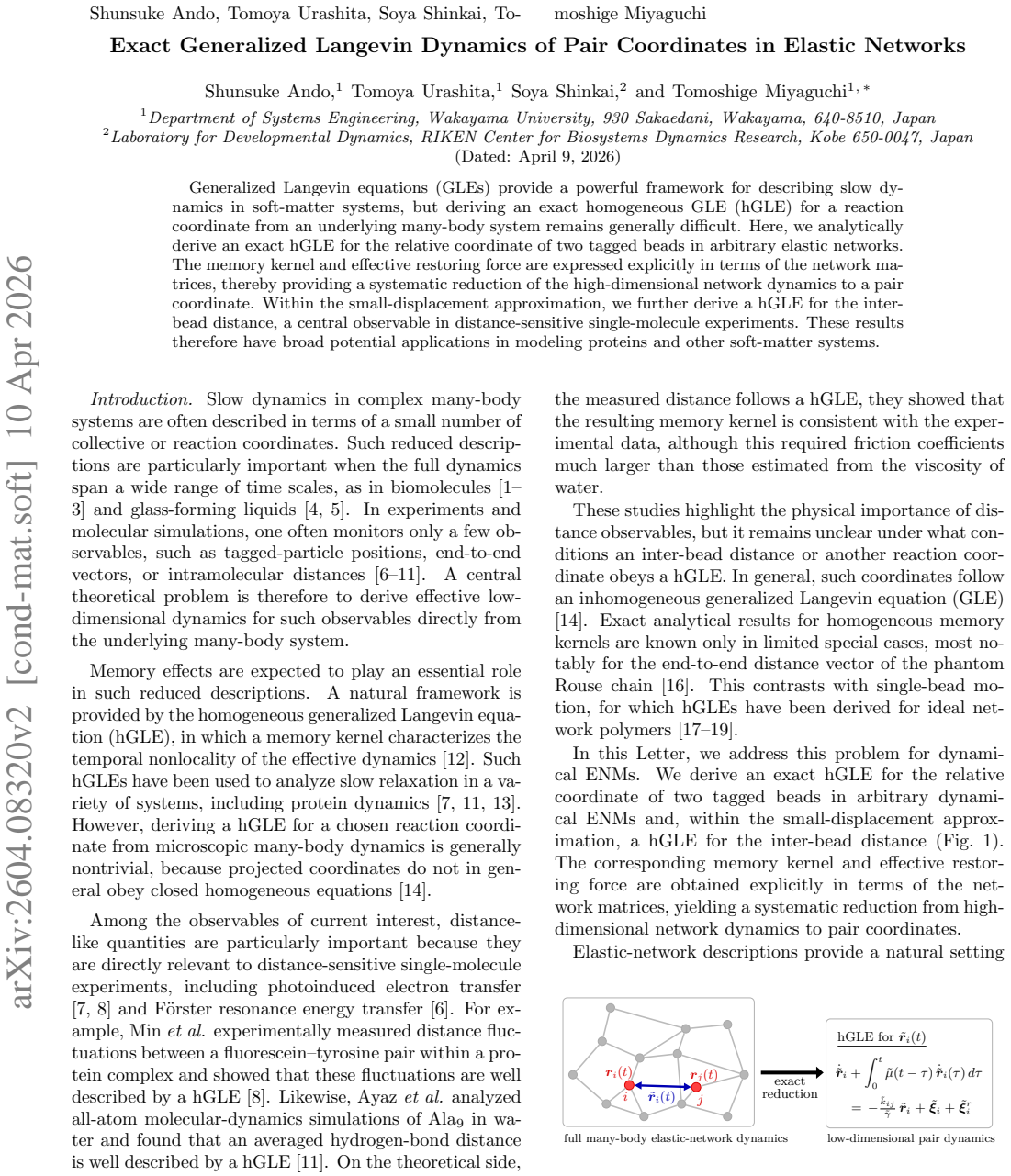
We analytically derive an exact hGLE for the relative coordinate of two tagged beads in arbitrary elastic networks. The memory kernel and effective restoring force are expressed explicitly in terms of the network matrices, thereby providing a systematic reduction of the high-dimensional network dynamics to a pair coordinate. Within the small-displacement approximation, we further derive a hGLE for the inter-bead distance, a central observable in distance-sensitive single-molecule experiments.
What carries the argument
The homogeneous generalized Langevin equation (hGLE) for the pair relative coordinate, with memory kernel and restoring force derived explicitly from the elastic network matrices.
If this is right
- The full many-body elastic dynamics reduces exactly to an equation involving only the chosen pair.
- Explicit expressions allow direct computation of memory effects and forces from the network structure.
- The reduction applies to arbitrary networks rather than only regular or periodic ones.
- Under the small-displacement approximation the same framework supplies an equation for the scalar inter-bead distance.
Where Pith is reading between the lines
- Exact projections of this form could be used to benchmark approximate coarse-graining methods in large-scale protein simulations.
- The matrix expressions might be generalized to include additional interactions such as hydrodynamic coupling.
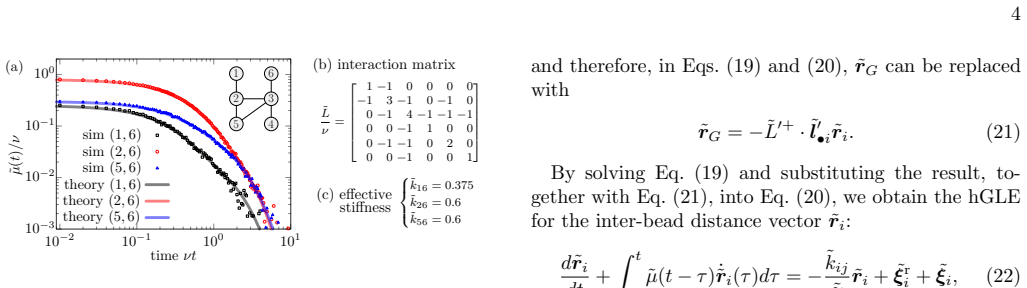
- Numerical tests on small networks would quickly confirm whether the derived memory kernel reproduces the correct long-time decay.
Load-bearing premise
The derivation assumes a network of linear Hookean springs together with the small-displacement approximation when treating the inter-bead distance.
What would settle it
Direct numerical integration of the full bead equations for a small elastic network followed by comparison of the resulting pair-coordinate statistics against the predictions of the derived hGLE; systematic discrepancy would falsify the exactness of the reduction.
Figures
read the original abstract
Generalized Langevin equations (GLEs) provide a powerful framework for describing slow dynamics in soft-matter systems, but deriving an exact homogeneous GLE (hGLE) for a reaction coordinate from an underlying many-body system remains generally difficult. Here, we analytically derive an exact hGLE for the relative coordinate of two tagged beads in arbitrary elastic networks. The memory kernel and effective restoring force are expressed explicitly in terms of the network matrices, thereby providing a systematic reduction of the high-dimensional network dynamics to a pair coordinate. Within the small-displacement approximation, we further derive a hGLE for the inter-bead distance, a central observable in distance-sensitive single-molecule experiments. These results therefore have broad potential applications in modeling proteins and other soft-matter systems.
Editorial analysis
A structured set of objections, weighed in public.
Referee Report
Summary. The manuscript analytically derives an exact homogeneous Generalized Langevin Equation (hGLE) for the relative vector coordinate of two tagged beads in arbitrary linear elastic networks, expressing the memory kernel and effective restoring force directly via the network mass and connectivity matrices. It further obtains a hGLE for the scalar inter-bead distance under an additional small-displacement approximation.
Significance. If the central derivation holds, the work supplies a parameter-free, closed-form reduction of high-dimensional harmonic network dynamics to effective pair dynamics. The explicit matrix expressions constitute a reproducible strength that enables direct numerical implementation without auxiliary fitting, with potential utility for interpreting distance-sensitive experiments on proteins and other soft-matter systems.
major comments (1)
- [Abstract] Abstract and the section deriving the scalar-distance equation: the small-displacement approximation is invoked without an error bound or quantified validity range (e.g., relative to typical thermal fluctuation amplitudes in the network), which limits assessment of applicability to real proteins even though the vector-coordinate result does not require it.
minor comments (1)
- Define all matrix symbols (e.g., the connectivity and mass matrices) explicitly at first appearance and ensure consistent notation between the vector and scalar derivations.
Simulated Author's Rebuttal
We thank the referee for their careful reading, positive assessment of the work's significance, and recommendation for minor revision. We address the major comment below.
read point-by-point responses
-
Referee: [Abstract] Abstract and the section deriving the scalar-distance equation: the small-displacement approximation is invoked without an error bound or quantified validity range (e.g., relative to typical thermal fluctuation amplitudes in the network), which limits assessment of applicability to real proteins even though the vector-coordinate result does not require it.
Authors: We agree that an explicit error bound or validity range for the small-displacement approximation would improve the manuscript, especially for judging applicability to proteins where fluctuation sizes depend on local stiffness. The vector-coordinate hGLE is exact, but the scalar-distance version linearizes the distance observable around the equilibrium separation, neglecting higher-order displacement terms. In the revised version we will add a concise discussion in the scalar-distance section that quantifies the regime of validity. Using the harmonic network structure we will relate the neglected terms to the mean-square fluctuations obtained from the inverse of the connectivity matrix (via equipartition), yielding a practical criterion such as sqrt(<delta r_perp^2>) << equilibrium distance. This estimate will be expressed in terms of network eigenvalues, temperature, and bead separation, directly addressing the referee's concern. We will also note the approximation's regime briefly in the abstract if the length limit permits. revision: yes
Circularity Check
No significant circularity; direct analytical reduction from linear equations
full rationale
The paper derives an exact hGLE for the relative coordinate by projecting the many-body linear harmonic dynamics onto the pair coordinate, expressing the memory kernel and effective force explicitly via the network connectivity and mass matrices. This is a direct analytical reduction (Mori-Zwanzig or equivalent elimination) that remains exact for the vector relative coordinate because the underlying equations are linear; no fitted parameters, self-definitional steps, or load-bearing self-citations are required. The small-displacement approximation applies only to the subsequent scalar inter-bead distance equation and is not needed for the primary vector result. The derivation is therefore self-contained against the stated equations of motion.
Axiom & Free-Parameter Ledger
axioms (2)
- domain assumption The underlying many-body system obeys linear elastic forces (Hooke's law) between connected beads.
- domain assumption The projection onto the pair coordinate preserves the exact memory structure without additional approximations beyond linearity.
Reference graph
Works this paper leans on
-
[1]
H. Yang, G. Luo, P. Karnchanaphanurach, T.-M. Louie, I. Rech, S. Cova, L. Xun, and X. S. Xie, Protein con- formational dynamics probed by single-molecule electron transfer, Science302, 262 (2003)
work page 2003
-
[2]
W. Ye, M. G¨ otz, S. Celiksoy, L. T¨ uting, C. Ratzke, J. Prasad, J. Ricken, S. V. Wegner, R. Ahijado-Guzm´ an, T. Hugel, and S. Carsten, Conformational dynamics of a single protein monitored for 24 h at video rate, Nano Lett.18, 6633 (2018)
work page 2018
-
[3]
J. Li, J. Xie, A. Godec, K. R. Weninger, C. Liu, J. C. Smith, and L. Hong, Non-ergodicity of a globular protein extending beyond its functional timescale, Chem. Sci.13, 9668 (2022)
work page 2022
- [4]
-
[5]
R. Yamamoto and A. Onuki, Dynamics of highly super- cooled liquids: Heterogeneity, rheology, and diffusion, Phys. Rev. E58, 3515 (1998)
work page 1998
-
[6]
E. V. Kuzmenkina, C. D. Heyes, and G. U. Nienhaus, Single-molecule f¨ orster resonance energy transfer study of protein dynamics under denaturing conditions, Proc. Natl. Acad. Sci. U.S.A102, 15471 (2005)
work page 2005
-
[7]
S. C. Kou and X. S. Xie, Generalized Langevin equation with fractional gaussian noise: Subdiffusion within a sin- gle protein molecule, Phys. Rev. Lett.93, 180603 (2004)
work page 2004
-
[8]
W. Min, G. Luo, B. J. Cherayil, S. C. Kou, and X. S. Xie, Observation of a power-law memory kernel for fluctua- tions within a single protein molecule, Phys. Rev. Lett. 94, 198302 (2005)
work page 2005
-
[9]
X. Hu, L. Hong, M. Dean Smith, T. Neusius, X. Cheng, and J. C. Smith, The dynamics of single protein molecules is non-equilibrium and self-similar over thir- teen decades in time, Nat. Phys.12, 171 (2016)
work page 2016
-
[10]
E. Yamamoto, T. Akimoto, A. Mitsutake, and R. Met- zler, Universal relation between instantaneous diffusivity and radius of gyration of proteins in aqueous solution, Phys. Rev. Lett.126, 128101 (2021)
work page 2021
-
[11]
C. Ayaz, L. Tepper, F. N. Br¨ unig, J. Kappler, J. O. Dal- drop, and R. R. Netz, Non-markovian modeling of protein folding, Proc. Natl. Acad. Sci. U.S.A118, e2023856118 (2021)
work page 2021
-
[12]
M. Shimizu, T. Miyaguchi, E. Yamamoto, and T. Aki- moto, Memory-induced slow relaxation in the generalized langevin equation, J. Chem. Phys.163, 094108 (2025)
work page 2025
-
[13]
B. A. Dalton and R. R. Netz, ph modulates friction memory effects in protein folding, Phys. Rev. Lett.133, 188401 (2024)
work page 2024
-
[14]
H. Vroylandt and P. Monmarch´ e, Position-dependent memory kernel in generalized langevin equations: Theory and numerical estimation, J. Chem. Phys.156, 244105 (2022)
work page 2022
-
[15]
J. Xing and K. S. Kim, Protein fluctuations and break- down of time-scale separation in rate theories, Phys. Rev. E74, 061911 (2006)
work page 2006
-
[16]
X. Tian, X. Xu, Y. Chen, J. Chen, and W.-S. Xu, Ex- plicit analytical form for memory kernel in the general- ized Langevin equation for end-to-end vector of Rouse chains, J. Chem. Phys.157, 224901 (2022)
work page 2022
- [17]
-
[18]
S. Shinkai, S. Onami, and T. Miyaguchi, Generalized Langevin dynamics for single beads in linear elastic net- works, Phys. Rev. E110, 044136 (2024)
work page 2024
- [19]
-
[20]
M. M. Tirion, Large amplitude elastic motions in pro- teins from a single-parameter, atomic analysis, Phys. Rev. Lett.77, 1905 (1996)
work page 1905
- [21]
-
[22]
S. Ciliberti, P. De Los Rios, and F. Piazza, Glasslike structure of globular proteins and the boson peak, Phys. Rev. Lett.96, 198103 (2006)
work page 2006
-
[23]
E. Caballero-Manrique, J. K. Bray, W. A. Deutschman, F. W. Dahlquist, and M. G. Guenza, A theory of pro- 6 tein dynamics to predict NMR relaxation, Biophys. J. 93, 4128 (2007)
work page 2007
-
[24]
S. Reuveni, R. Granek, and J. Klafter, Anomalies in the vibrational dynamics of proteins are a consequence of fractal-like structure, Proc. Natl. Acad. Sci. U.S.A107, 13696 (2010)
work page 2010
-
[25]
J. Copperman and M. G. Guenza, Predicting protein dy- namics from structural ensembles, J. Chem. Phys.143, 243131 (2015)
work page 2015
-
[26]
Y. Togashi and H. Flechsig, Coarse-grained protein dy- namics studies using elastic network models, Int. J. Mol. Sci.19, 3899 (2018)
work page 2018
-
[27]
A. Lapolla, M. Vossel, and A. Godec, Time- and ensemble-average statistical mechanics of the gaussian network model, J. Phys. A54, 355601 (2021)
work page 2021
-
[28]
F. Cecconi, G. Costantini, C. Guardiani, M. Baldovin, and A. Vulpiani, Correlation, response and entropy ap- proaches to allosteric behaviors: a critical comparison on the ubiquitin case, Phys. Biol.20, 056002 (2023)
work page 2023
-
[29]
J. H. Lam, A. Nakano, and V. Katritch, Scalable compu- tation of anisotropic vibrations for large macromolecular assemblies, Nat. Commun.15, 3479 (2024)
work page 2024
-
[30]
G. Costantini, L. Caprini, U. M. B. Marconi, and F. Cec- coni, Active gaussian network model: a non-equilibrium description of protein fluctuations and allosteric behav- ior, Phys. Biol.22, 056005 (2025)
work page 2025
-
[31]
S. Shinkai, M. Nakagawa, T. Sugawara, Y. Togashi, H. Ochiai, R. Nakato, Y. Taniguchi, and S. Onami, PHi- C: deciphering Hi-C data into polymer dynamics, NAR Genomics Bioinforma2, lqaa020 (2020)
work page 2020
-
[32]
T. Yuan, H. Yan, M. L. P. Bailey, J. F. Williams, I. Surovtsev, M. C. King, and S. G. J. Mochrie, Effect of loops on the mean-square displacement of Rouse-model chromatin, Phys. Rev. E109, 044502 (2024)
work page 2024
-
[33]
A. A. Gurtovenko and Y. Y. Gotlib, Intra-and inter- chain relaxation processes in meshlike polymer networks, Macromolecules31, 5756 (1998)
work page 1998
- [34]
-
[35]
C. De Bacco, F. Baldovin, E. Orlandini, and K. Seki- moto, Nonequilibrium statistical mechanics of the heat bath for two brownian particles, Phys. Rev. Lett.112, 180605 (2014)
work page 2014
-
[36]
C. Lim and J.-H. Jeon, Anomalous diffusion in coupled viscoelastic media: A fractional langevin equation ap- proach, Phys. Rev. Res.7, 043356 (2025)
work page 2025
-
[37]
R. Kubo, M. Toda, and N. Hashitume,Statisti- cal Physics II. Nonequilibrium Statistical Mechanics (Springer-Verlag, 1991)
work page 1991
-
[38]
, N), thenH=γ −1 0 IN and henceLis symmetric
If the friction is homogeneous,γ m =γ 0 (m= 1, . . . , N), thenH=γ −1 0 IN and henceLis symmetric. In this case, the subsequent analysis becomes much simpler because there is no need to distinguish between row and column vectors
-
[39]
Zwanzig,Nonequilibrium statistical mechanics(Ox- ford university press, 2001)
R. Zwanzig,Nonequilibrium statistical mechanics(Ox- ford university press, 2001)
work page 2001
-
[40]
See Supplemental Material at [URL will be inserted by publisher] for details on methods and results for the Rouse model and ring polymer
-
[41]
J. F. Allemand, S. Cocco, N. Douarche, and G. Lia, Loops in DNA: an overview of experimental and theoretical ap- proaches, Euro. Phys. J. E19, 293 (2006)
work page 2006
-
[42]
Goychuk, Viscoelastic subdiffusion in a random gaus- sian environment, Phys
I. Goychuk, Viscoelastic subdiffusion in a random gaus- sian environment, Phys. Chem. Chem. Phys.20, 24140 (2018)
work page 2018
-
[43]
Miyaguchi, Generalized langevin equation with fluc- tuating diffusivity, Phys
T. Miyaguchi, Generalized langevin equation with fluc- tuating diffusivity, Phys. Rev. Res.4, 043062 (2022)
work page 2022
discussion (0)
Sign in with ORCID, Apple, or X to comment. Anyone can read and Pith papers without signing in.