Harmonic morphisms and dynamical invariants in network renormalization
Pith reviewed 2026-05-10 17:10 UTC · model grok-4.3
The pith
Discrete harmonic morphisms are the minimal maps under which random walks on a fine network project exactly onto its coarse-grained version via a random time change.
A machine-rendered reading of the paper's core claim, the machinery that carries it, and where it could break.
Core claim
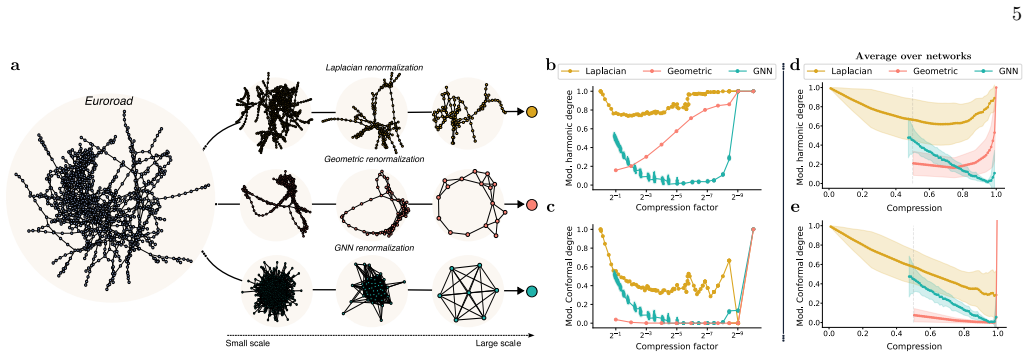
Discrete harmonic morphisms—surjective maps that send harmonic functions to harmonic functions—supply the weakest condition under which the transition structure of a random walk on a fine-grained network projects exactly onto the random walk on the coarse-grained network after an appropriate random time change. This is diagnosed by the harmonic degree, which measures deviation from the morphism property. Laplacian renormalization spontaneously realizes exact morphisms on several real-world networks, yielding exact preservation of first-exit transition probabilities at specific scales.
What carries the argument
The discrete harmonic morphism, a surjective node map that preserves the property that a function is harmonic (its value at each node equals the average over neighbors), which carries the exact projection of random-walk paths under time rescaling.
If this is right
- Laplacian renormalization produces exact harmonic morphisms and exact first-exit preservation at identifiable scales in multiple real networks.
- Geometric, Laplacian, and GNN-based coarse-graining each imprint a distinct dynamical fingerprint tied to their physical assumptions.
- The harmonic degree supplies a quantitative test for evaluating or designing multi-scale network reductions.
- The construction supplies a discrete counterpart to diffusion-preserving conformal maps on irregular topologies.
Where Pith is reading between the lines
- Renormalization algorithms could be redesigned to enforce the harmonic-morphism condition directly rather than optimizing other objectives.
- The same morphism test may apply to other Markovian processes on networks beyond simple random walks.
- Exact morphisms at particular scales could mark the natural resolution levels at which a network's dynamics become self-similar.
- The framework offers a way to compare renormalization schemes across different network domains by their dynamical fidelity rather than by structural similarity alone.
Load-bearing premise
That any coarse-graining can be expressed as a surjective map on the set of nodes that sends harmonic functions to harmonic functions.
What would settle it
A counter-example network in which a coarse-graining that is not a harmonic morphism still produces exact projection of random-walk first-exit probabilities without any time adjustment, or a harmonic morphism that fails to produce such a projection.
Figures



read the original abstract
Renormalization of complex networks requires principled criteria for assessing whether a coarse-graining preserves dynamical content. We prove that discrete harmonic morphisms -- surjective maps preserving harmonic functions -- provide the minimal condition under which random walks on a fine-grained network project exactly onto random walks on its coarse-grained image, through an appropriate random time change. We formalize this via the harmonic degree, a diagnostic quantifying how closely any network coarse-graining approximates a harmonic morphism. Applying this framework to geometric, Laplacian, and GNN-based renormalization across real-world networks, we find that each method produces a distinct dynamical fingerprint encoding its underlying physical assumptions. Most strikingly, Laplacian renormalization spontaneously yields exact harmonic morphisms in several networks, achieving exact preservation of first-exit random-walk transition structure at specific scales, a property that entropic susceptibility fails to detect. Our results identify a discrete analog of diffusion-preserving conformal maps for irregular network topologies and provide quantitative tools for designing and evaluating multi-scale network descriptions.
Editorial analysis
A structured set of objections, weighed in public.
Referee Report
Summary. The paper proves that discrete harmonic morphisms—defined as surjective maps on graphs that preserve harmonic functions—provide the minimal condition under which random walks on a fine-grained network project exactly onto random walks on its coarse-grained image via an appropriate random time change. It introduces the harmonic degree as a quantitative diagnostic for how closely any coarse-graining approximates a harmonic morphism. The framework is applied to geometric, Laplacian, and GNN-based renormalization schemes on real-world networks, revealing distinct dynamical fingerprints for each method and showing that Laplacian renormalization can spontaneously produce exact harmonic morphisms at specific scales, thereby preserving first-exit random-walk transition structure in a manner not detected by entropic susceptibility.
Significance. If the central theorem holds, the work supplies a rigorous mathematical criterion for dynamical preservation under network coarse-graining, establishing a discrete counterpart to diffusion-preserving conformal maps on irregular topologies. The harmonic degree offers a practical, falsifiable tool for evaluating and designing multi-scale network representations. The empirical observation that Laplacian renormalization yields exact morphisms on several networks is a concrete, testable finding with implications for statistical mechanics of complex systems.
minor comments (3)
- The abstract introduces the harmonic degree without a one-sentence definition; adding a brief parenthetical gloss would improve immediate readability for readers outside graph theory.
- Figure captions for the network renormalization examples should explicitly state the network sizes, the specific scales at which exact morphisms appear, and the random-walk observables being compared.
- Notation for the random time change (presumably introduced in the main theorem) should be cross-referenced to the earlier definition of the harmonic morphism to avoid any ambiguity in the projection argument.
Simulated Author's Rebuttal
We thank the referee for their accurate and positive summary of the manuscript, which correctly identifies the central theorem on discrete harmonic morphisms as the minimal condition for exact random-walk projection, the role of the harmonic degree, and the empirical observation that Laplacian renormalization can yield exact morphisms. We appreciate the recommendation for minor revision and the recognition of the work's implications for dynamical preservation under coarse-graining.
Circularity Check
No significant circularity; derivation is a self-contained mathematical proof
full rationale
The central claim is a theorem proving that discrete harmonic morphisms (defined as surjective maps preserving harmonic functions on graphs) are the minimal condition for exact projection of random walks onto a coarse-grained image via random time change. This rests on standard graph-theoretic definitions of harmonic functions and introduces the harmonic degree as a diagnostic tool. No load-bearing step reduces by construction to a fitted parameter, self-citation chain, or renamed input; the proof is conditioned precisely on the stated assumption about the coarse-graining map, with applications to real networks serving as empirical illustration rather than circular validation. The framework is externally falsifiable via direct verification of the morphism property on any given graph.
Axiom & Free-Parameter Ledger
axioms (2)
- domain assumption The networks are undirected graphs on which harmonic functions are well-defined
- domain assumption Coarse-graining corresponds to a surjective node map
invented entities (1)
-
harmonic degree
no independent evidence
Reference graph
Works this paper leans on
-
[1]
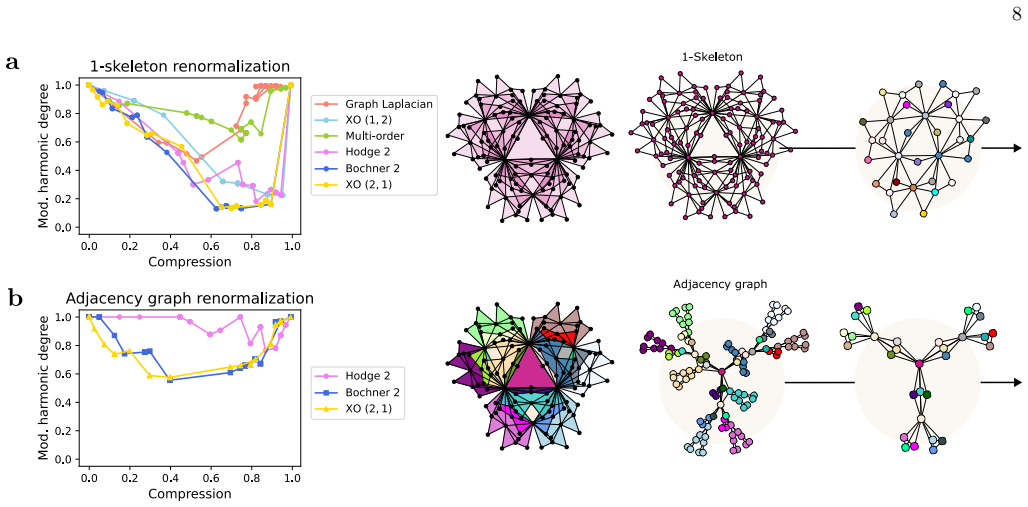
Modified harmonic degree:To prevent large macro-sets from dominating, we average harmonic- ity within each macro-set: Hmod = 1 |V| X y∈V |H(φ −1(y))| |φ−1(y)| .(6) This is our primary metric for renormalization anal- ysis
-
[2]
Harmonic deviation:which provides a continuous measure of multiplicity imbalance across macro-sets: HDev = 1 |V| X x∈V std({ky′(x) :y ′ ∼φ(x)}).(7) We define analogous conformal degree metrics (CF mean, CFmod, CFDev) based on Definition 4; explicit definitions appear in the Supplementary Material S2 and S2). In the following, we define thecompression η of...
-
[3]
L. P. Kadanoff, Physics Physique Fizika2, 263 (1966)
work page 1966
-
[4]
K. G. Wilson, Rev. Mod. Phys.47, 773 (1975)
work page 1975
-
[6]
R. Blumenhagen and E. Plauschinn,Introduction to Con- formal Field Theory: With Applications to String Theory, Lecture Notes in Physics, Vol. 779 (Springer, 2009)
work page 2009
-
[7]
C. Song, S. Havlin, and H. A. Makse, Nature433, 392–395 (2005)
work page 2005
-
[8]
K.-I. Goh, G. Salvi, B. Kahng, and D. Kim, Phys. Rev. Lett.96, 018701 (2006)
work page 2006
-
[9]
G. Garc´ ıa-P´ erez, M. Bogu˜ n´ a, and M. A. Serrano, Nature Physics14, 583–589 (2018)
work page 2018
-
[10]
E. Garuccio, M. Lalli, and D. Garlaschelli, Physical Review Research5, 10.1103/physrevresearch.5.043101 (2023)
-
[11]
P. Villegas, T. Gili, G. Caldarelli, and A. Gabrielli, Nature Physics19, 445–450 (2023)
work page 2023
- [14]
-
[15]
F. Battiston, E. Amico, A. Barrat, G. Bianconi, G. Ferraz de Arruda, B. Franceschiello, I. Iacopini, S. K´ efi, V. La- tora, Y. Moreno, M. M. Murray, T. P. Peixoto, F. Vac- carino, and G. Petri, Nature Physics17, 1093 (2021)
work page 2021
- [16]
-
[18]
M. Schmidt, F. Caccioli, and T. Aste, Physical Review E 112, 034303 (2025)
work page 2025
-
[19]
C. H. Kim and B. Kahng, Chaos, Solitons & Fractals201, 117398 (2025)
work page 2025
-
[20]
Urakawa, Glasgow Mathematical Journal42, 319 (2000)
H. Urakawa, Glasgow Mathematical Journal42, 319 (2000)
work page 2000
-
[21]
G. F. Lawler,Intersections of Random Walks, Probability and Its Applications (Birkh¨ auser, 1991)
work page 1991
-
[22]
Barahudcov´ a, Lattice models — master extended, ac- cessed: 2025-05-10
B. Barahudcov´ a, Lattice models — master extended, ac- cessed: 2025-05-10
work page 2025
-
[23]
Fuglede, Annales de l’Institut Fourier28, 107 (1978)
B. Fuglede, Annales de l’Institut Fourier28, 107 (1978)
work page 1978
-
[24]
Ishihara, Journal of Mathematics of Kyoto University 19, 215 (1979)
T. Ishihara, Journal of Mathematics of Kyoto University 19, 215 (1979)
work page 1979
- [25]
-
[26]
N. O’Clery, Y. Yuan, G.-B. Stan, and M. Barahona, Phys. Rev. E88, 042805 (2013)
work page 2013
- [27]
-
[28]
G. Garc´ ıa-P´ erez, A. Allard, M. ´A. Serrano, and M. Bogu˜ n´ a, New J. Phys.21, 123033 (2019)
work page 2019
-
[29]
R. Jankowski, A. Allard, M. Bogu˜ n´ a, and M.´A. Serrano, Nat. Commun.14, 7585 (2023)
work page 2023
-
[30]
D. Krioukov, F. Papadopoulos, M. Kitsak, A. Vahdat, and M. Bogu˜ n´ a, Phys. Rev. E82, 036106 (2010)
work page 2010
- [31]
-
[32]
L. Barjuan, M. Zheng, and M. A. Serrano, PLoS Compu- tational Biology21, e1012848 (2025)
work page 2025
-
[33]
A. L. Traud, P. J. Mucha, and M. A. Porter, Physica A 391, 4165 (2012)
work page 2012
-
[34]
G. Bianconi,Higher-Order Networks: An Introduction to Simplicial Complexes(Cambridge University Press, 2021)
work page 2021
-
[35]
Eckmann, Commentarii Mathematici Helvetici17, 240 (1944)
B. Eckmann, Commentarii Mathematici Helvetici17, 240 (1944)
work page 1944
-
[37]
M. T. Schaub, A. R. Benson, P. Horn, G. Lippner, and A. Jadbabaie, SIAM Review62, 353 (2020)
work page 2020
-
[39]
S. N. Dorogovtsev, A. V. Goltsev, and J. F. F. Mendes, Physical Review E65, 066122 (2002)
work page 2002
-
[40]
G. F. Lawler,Conformally Invariant Processes in the Plane, Mathematical Surveys and Monographs, Vol. 114 (American Mathematical Society, 2005)
work page 2005
- [41]
-
[43]
A. I. Bobenko, U. Pinkall, and B. A. Springborn, Geome- try & Topology19, 2155–2215 (2015)
work page 2015
-
[45]
M. Baker and S. Norine, Harmonic morphisms and hy- perelliptic graphs (2007), arXiv:0707.1309 [math.CO]
-
[46]
Caporaso, inAlgebraic and Complex Geometry, edited by A
L. Caporaso, inAlgebraic and Complex Geometry, edited by A. Fr¨ uhbis-Kr¨ uger, R. N. Kloosterman, and M. Sch¨ utt (Springer International Publishing, Cham, 2014) pp. 77– 108. 1 Supplementary Material S1. Proofs Throughout this section, we use the notation established in the main text: G = (V, E) and G = (V,E ) are two graphs, φ : V→ V is surjective, Gy i...
work page 2014
-
[47]
Construct induced graph.Given partition φ−1(y) for each y∈ V , create G with edge y∼y ′ whenever ∃x∈φ −1(y), z∈φ −1(y′) withx∼zinG. 2.For each nodex∈V: •Determiney=φ(x) •For each neighboring macro-nodey ′ ∼y, countk y′(x) =|{z∈φ −1(y′) :z∼x}| •Check if allk y′(x) are equal (harmonic node) •Computeσ x = std({ky′(x)}) •For conformality: include ˜ky(x) =|{z∈...
-
[48]
decomposee j =e (h) j +e (r) j into harmonic and residual components by projecting onto the orthogonal complement of the kernel
-
[49]
S5: GNN-based renormalization of theWeaversocial network
diffuse the residual part:ϱ ·,j =e −tLe(r) j ; 11 (a) (c) (b) FIG. S5: GNN-based renormalization of theWeaversocial network. (a) Difference in partition functions as a function of the number of macronodes, showing that the sampled partitions rapidly converge toward the same coarse-graining statistics as resolution increases. (b) Harmonicity measures acros...
-
[50]
merge nodes i and j if (|ϱij| + |ϱji|)/2 ≥min (|ϱii|,|ϱ jj |), where absolute values account for possible sign changes in non-symmetric operators. This procedure commutes with the heat kernel (since L and e−tL share eigenvectors), and reduces to standard Laplacian renormalization for the graph Laplacian and cross-order Laplacians, whose kernels are spanne...
-
[51]
J. Leskovec and A. Krevl, SNAP Datasets: Stanford large network dataset collection, http://snap.stanford.edu/data (2014)
work page 2014
- [52]
-
[53]
R. A. Rossi and N. K. Ahmed, inAAAI(2015)
work page 2015
- [54]
-
[55]
U. N. Raghavan, R. Albert, and S. Kumara, Physical Review E76, 10.1103/physreve.76.036106 (2007)
-
[56]
M. E. J. Newman, Proceedings of the National Academy of Sciences103, 8577–8582 (2006)
work page 2006
-
[57]
V. D. Blondel, J.-L. Guillaume, R. Lambiotte, and E. Lefebvre, Journal of Statistical Mechanics: Theory and Experiment 2008, P10008 (2008)
work page 2008
- [58]
-
[59]
M. Rosvall and C. T. Bergstrom, Proceedings of the National Academy of Sciences105, 1118–1123 (2008)
work page 2008
-
[60]
T. P. Peixoto, Bayesian stochastic blockmodeling (2019)
work page 2019
-
[61]
A. L. Traud, P. J. Mucha, and M. A. Porter, Physica A391, 4165 (2012)
work page 2012
- [62]
- [63]
-
[64]
D. A. Bader, H. Meyerhenke, P. Sanders, and D. Wagner, in10th DIMACS Implementation Challenge, Contemporary Mathematics, Vol. 588 (AMS, 2013)
work page 2013
-
[65]
I. S. Duff, R. G. Grimes, and J. G. Lewis, ACM Trans. Math. Softw.15, 1 (1989)
work page 1989
-
[66]
M. E. J. Newman, Phys. Rev. E74, 036104 (2006)
work page 2006
- [67]
- [68]
- [69]
-
[70]
A. Muhammad and M. Egerstedt, inControl Using Higher Order Laplacians in Network Topologies(2006)
work page 2006
-
[71]
M. Nurisso, M. Morandini, M. Lucas, F. Vaccarino, T. Gili, and G. Petri, Nature Physics21, 661 (2025)
work page 2025
-
[72]
M. Lucas, G. Cencetti, and F. Battiston, Physical Review Research2, 10.1103/physrevresearch.2.033410 (2020)
-
[73]
Forman, Discrete & Computational Geometry29, 323 (2003)
R. Forman, Discrete & Computational Geometry29, 323 (2003)
work page 2003
-
[74]
I. Iacopini, G. Petri, A. Barrat, and V. Latora, Nature Communications10, 2485 (2019)
work page 2019
-
[75]
Caporaso, inAlgebraic and Complex Geometry, edited by A
L. Caporaso, inAlgebraic and Complex Geometry, edited by A. Fr¨ uhbis-Kr¨ uger, R. N. Kloosterman, and M. Sch¨ utt (Springer International Publishing, Cham, 2014) pp. 77–108
work page 2014
-
[76]
C. G. Melles and D. Joyner, inCombinatorics, Graph Theory and Computing, Springer Proceedings in Mathematics & Statistics, Vol. 462, edited by S. Heuss, R. Low, and J. C. Wierman (Springer, Cham, 2024) pp. 243–274
work page 2024
- [77]
-
[78]
R. Blumenhagen and E. Plauschinn,Introduction to Conformal Field Theory: With Applications to String Theory, Lecture Notes in Physics, Vol. 779 (Springer, 2009)
work page 2009
-
[79]
H. Duminil-Copin and S. Smirnov, Conformal invariance of lattice models (2012), arXiv:1109.1549 [math.PR]
-
[80]
Smirnov, Discrete complex analysis and probability (2010), arXiv:1009.6077 [math-ph]
S. Smirnov, Discrete complex analysis and probability (2010), arXiv:1009.6077 [math-ph]
-
[81]
D. Jakobson, T. Ng, M. Stevenson, and M. Suzuki, Conformally covariant operators and conformal invariants on weighted graphs (2014), arXiv:1404.5690 [math.CO]
-
[82]
A. I. Bobenko, U. Pinkall, and B. A. Springborn, Geometry & Topology19, 2155–2215 (2015)
work page 2015
-
[83]
N. Irges and S. Kastrinakis, Graph theoretical approach to conformal correlators: The conformal squid (2024), arXiv:2402.08449 [hep-th]
discussion (0)
Sign in with ORCID, Apple, or X to comment. Anyone can read and Pith papers without signing in.