Bulk-dissociated topological bands without spin-orbit coupling in hetero-dimensional superconducting metamaterials
Pith reviewed 2026-05-10 16:49 UTC · model grok-4.3
The pith
Spin-polarized magnetic adatoms on a superconducting square network produce weak topological superconductivity without spin-orbit coupling.
A machine-rendered reading of the paper's core claim, the machinery that carries it, and where it could break.
Core claim
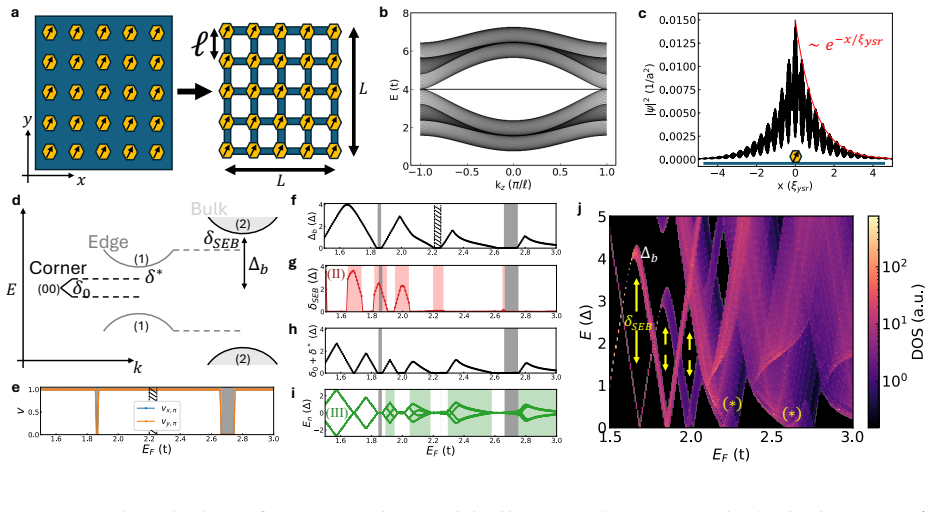
In a square superconducting network decorated with spin-polarized magnetic adatoms, the localized Yu-Shiba-Rusinov bound states collectively form a weak topological superconducting phase without spin-orbit coupling. Tuning the Fermi energy of the network induces a transition to a bulk-dissociated topological superconducting phase in which the edge state bands separate from the bulk, resulting in nodal lines and the coexistence of bulk-dissociated edge and corner modes. This demonstrates that hetero-dimensional superconducting metamaterials can control the coupling between electronic degrees of freedom of different dimensionalities.
What carries the argument
Collective topological bands formed by Yu-Shiba-Rusinov states at magnetic adatom sites within a hetero-dimensional superconducting metamaterial.
If this is right
- Fermi energy tuning drives a transition from weak topological superconducting phase to bulk-dissociated phase.
- Edge state bands detach from the bulk, producing nodal lines in the spectrum.
- Bulk-dissociated edge and corner modes coexist in the tuned phase.
- Hetero-dimensional geometry controls coupling and dissociation of states across dimensionalities without spin-orbit coupling.
Where Pith is reading between the lines
- Networks of this type could be built with standard superconducting thin-film techniques to test the Fermi-energy-driven transition experimentally.
- Bulk dissociation offers a geometric handle for isolating topological edge modes that might otherwise hybridize with bulk states.
- The same design principle could extend to other hybrid platforms where geometry replaces material-specific interactions for topology.
Load-bearing premise
The model assumes that magnetic adatoms remain fully spin-polarized and that the superconducting proximity effect generates protected topological bands without spin-orbit coupling.
What would settle it
Fabricate the square superconducting network with magnetic adatoms and measure the band structure while tuning Fermi energy; the predicted detachment of edge bands from the bulk continuum and appearance of nodal lines would confirm the transition, while their absence would falsify it.
Figures


read the original abstract
Topological superconductors (TSCs) in superconducting hybrid heterostructures, which integrate superconducting and non-superconducting materials, have been intensely investigated with the hope of discovering exotic non-Abelian anyons for fault-tolerant quantum computing. In this effort, a challenge for hybrid superconducting systems is controlling hybridization, which is often a balance between enhancing the superconducting proximity effect at the cost of suppressing desirable electronic properties such as strong spin-orbit interactions. Hence, discovering hybrid superconducting systems with topological properties controlled and enhanced by material geometry design without spin-orbit interactions would be intriguing to explore. In this work, we theoretically study a square superconducting network decorated with spin-polarized magnetic adatoms. We find that localized Yu-Shiba-Rusinov bound states at magnetic adatom sites collectively form a weak topological superconducting phase despite the absence of spin-orbit interactions. We then demonstrate that by tuning the Fermi energy of the network, the system can transition from a weak TSC phase to a bulk-dissociated TSC phase where the edge state bands separate from the bulk, giving rise to unexpected features such as nodal lines and co-existing bulk-dissociated edge and corner modes. Moreover, our findings highlight how hetero-dimensional superconducting metamaterials can serve as a useful template for controlling the coupling and dissociation between electronic degrees of freedom of different dimensionalities.
Editorial analysis
A structured set of objections, weighed in public.
Referee Report
Summary. The manuscript examines a square superconducting network decorated with spin-polarized magnetic adatoms. It claims that the resulting Yu-Shiba-Rusinov bound states form a weak topological superconducting phase in the absence of spin-orbit coupling, and that tuning the Fermi energy drives a transition to a bulk-dissociated TSC phase featuring separated edge bands, nodal lines, and co-existing corner modes within a hetero-dimensional metamaterial geometry.
Significance. If the topological classification and phase robustness hold, the work offers a geometry-driven route to topological superconductivity that circumvents the usual need for strong spin-orbit coupling in hybrid systems. This could inform the design of metamaterial platforms for protected edge and corner states, with potential relevance to fault-tolerant quantum information.
major comments (3)
- [Model and effective Hamiltonian section] The effective tight-binding Hamiltonian for the YSR lattice (including hopping and pairing amplitudes between adatom sites) is not derived explicitly from the microscopic proximity model; without the parameter expressions or numerical values, the band structures and claimed weak topological phase cannot be reproduced or verified.
- [Results on band structure and phase diagram] No explicit evaluation of the topological invariant (e.g., weak Z2 index or winding number in class D) is reported for the effective 2D YSR lattice either in the uniform phase or across the Fermi-energy-tuned transition; band-structure plots alone do not establish whether the bulk-dissociated edge states are topologically protected or accidental.
- [Discussion of bulk-dissociated TSC phase] The transition to the bulk-dissociated phase with nodal lines and corner modes is asserted upon Fermi-energy tuning, but the manuscript provides no calculation confirming that the edge-band separation persists under weak disorder or open-boundary perturbations, which is required to substantiate protection in the absence of SOC.
minor comments (2)
- [Abstract] The abstract refers to 'unexpected features such as nodal lines' without indicating their topological origin or location in the Brillouin zone; a short clarification would improve readability.
- [Figures] Figure captions for the band-structure plots should explicitly label the Fermi-energy values corresponding to the weak TSC and bulk-dissociated regimes.
Simulated Author's Rebuttal
We thank the referee for their thoughtful and detailed review of our manuscript. Their comments highlight important aspects for strengthening the presentation and verifiability of our results on the hetero-dimensional superconducting metamaterial. We address each major comment below and will incorporate revisions to improve clarity and rigor.
read point-by-point responses
-
Referee: [Model and effective Hamiltonian section] The effective tight-binding Hamiltonian for the YSR lattice (including hopping and pairing amplitudes between adatom sites) is not derived explicitly from the microscopic proximity model; without the parameter expressions or numerical values, the band structures and claimed weak topological phase cannot be reproduced or verified.
Authors: We agree that explicit derivation from the microscopic model would aid reproducibility. The effective Hamiltonian in the manuscript is constructed from the standard Yu-Shiba-Rusinov formalism for spin-polarized adatoms on a superconducting substrate, with hopping and pairing amplitudes obtained via second-order perturbation in the exchange coupling. In the revised version, we will add an appendix providing the full microscopic derivation, including analytic expressions for the inter-adatom hopping t(r) and pairing amplitude Δ(r) in terms of the superconducting gap Δ_sc, Fermi wavevector k_F, and adatom-substrate coupling J, along with the specific numerical values used for the band-structure calculations. revision: yes
-
Referee: [Results on band structure and phase diagram] No explicit evaluation of the topological invariant (e.g., weak Z2 index or winding number in class D) is reported for the effective 2D YSR lattice either in the uniform phase or across the Fermi-energy-tuned transition; band-structure plots alone do not establish whether the bulk-dissociated edge states are topologically protected or accidental.
Authors: We acknowledge that explicit computation of the topological invariant strengthens the claim. While the band structures, gap closings/reopenings, and emergence of edge modes are consistent with a weak topological superconductor in class D, we did not report the invariant. In the revision, we will evaluate and present the weak Z2 index (via the Pfaffian parity at time-reversal invariant momenta) for the uniform phase and the Fermi-energy-tuned transition, as well as the winding number along high-symmetry lines, to rigorously confirm the topological nature of the edge states and the bulk-dissociated phase. revision: yes
-
Referee: [Discussion of bulk-dissociated TSC phase] The transition to the bulk-dissociated phase with nodal lines and corner modes is asserted upon Fermi-energy tuning, but the manuscript provides no calculation confirming that the edge-band separation persists under weak disorder or open-boundary perturbations, which is required to substantiate protection in the absence of SOC.
Authors: The referee correctly notes that robustness checks are important for claims of protection without SOC. Our open-boundary calculations in the clean limit demonstrate the separation of edge bands, nodal lines, and coexisting corner modes in the hetero-dimensional geometry. To address this, we will add supplementary calculations showing that the bulk-dissociated edge states and corner modes persist under weak random on-site disorder (e.g., disorder strength up to 5-10% of the hopping amplitude), with the separation from the bulk continuum remaining intact. This will provide evidence for the geometric protection in the metamaterial setup. revision: yes
Circularity Check
No circularity in derivation; model and phase claims rest on explicit YSR lattice construction without self-referential reduction
full rationale
The paper constructs an effective lattice model from localized YSR states on a square network of superconducting wires with magnetic adatoms, then tunes Fermi energy to induce a transition between weak TSC and bulk-dissociated phases. No equations or steps reduce the topological invariant, band separation, or nodal features to fitted parameters or prior self-citations by construction. The absence of SOC is an explicit modeling choice rather than a hidden assumption smuggled in, and the claims are presented as numerical or analytical outcomes of the hetero-dimensional geometry. This is the common case of a self-contained theoretical proposal whose validity can be checked against independent benchmarks or code.
Axiom & Free-Parameter Ledger
Reference graph
Works this paper leans on
-
[1]
M. Z. Hasan and C. L. Kane, Colloquium: Topological insulators, Rev. Mod. Phys.82, 3045 (2010)
work page 2010
-
[2]
X.-L. Qi and S.-C. Zhang, Topological insulators and superconductors, Rev. Mod. Phys.83, 1057 (2011)
work page 2011
-
[3]
A. Y. Kitaev, Unpaired majorana fermions in quantum wires, Physics-Uspekhi44, 131 (2001)
work page 2001
-
[4]
A. Y. Kitaev, Fault-tolerant quantum computation by anyons, Annals of Physics303, 2 (2003)
work page 2003
-
[5]
C. Nayak, S. H. Simon, A. Stern, M. Freedman, and S. Das Sarma, Non-Abelian anyons and topological quantum computation, Reviews of Modern Physics 10.1103/RevModPhys.80.1083 (2008), arXiv:0707.1889
-
[6]
J. Alicea, New directions in the pursuit of majorana fermions in solid state systems, Reports on Progress in Physics75, 076501 (2012)
work page 2012
-
[7]
R. M. Lutchyn, J. D. Sau, and S. Das Sarma, Majorana fermions and a topological phase transition in semiconductor-superconductor heterostructures, Phys. Rev. Lett.105, 077001 (2010)
work page 2010
-
[8]
Y. Oreg, G. Refael, and F. von Oppen, Helical liquids and majorana bound states in quantum wires, Phys. Rev. Lett.105, 177002 (2010)
work page 2010
-
[9]
J. D. Sau, R. M. Lutchyn, S. Tewari, and S. Das Sarma, Generic new platform for topological quantum computation using semiconductor heterostructures, Phys. Rev. Lett.104, 040502 (2010)
work page 2010
-
[10]
W. F. Schiela, P. Yu, and J. Shabani, Progress in superconductor-semiconductor topological josephson junctions, PRX Quantum5, 030102 (2024)
work page 2024
-
[11]
O. Lesser, A. Saydjari, M. Wesson, A. Yacoby, and Y. Oreg, Phase-induced topological su- perconductivity in a planar heterostructure, Proceedings of the National Academy of Sciences 118, e2107377118 (2021), https://www.pnas.org/doi/pdf/10.1073/pnas.2107377118
-
[12]
S. Nadj-Perge, I. K. Drozdov, B. A. Bernevig, and A. Yazdani, Proposal for realizing majorana fermions in chains of magnetic atoms on a superconductor, Phys. Rev. B88, 020407 (2013)
work page 2013
-
[13]
S. Nadj-Perge, I. K. Drozdov, J. Li, H. Chen, S. Jeon, J. Seo, A. H. MacDonald, B. A. Bernevig, and A. Yazdani, Observation of majorana fermions in ferromagnetic atomic chains on a superconductor, Science346, 602 (2014), doi: 10.1126/science.1259327. 19
-
[14]
J. R¨ ontynen and T. Ojanen, Topological superconductivity and high chern numbers in 2d ferromagnetic shiba lattices, Phys. Rev. Lett.114, 236803 (2015)
work page 2015
-
[15]
J. Li, T. Neupert, Z. Wang, A. H. MacDonald, A. Yazdani, and B. A. Bernevig, Two- dimensional chiral topological superconductivity in shiba lattices, Nature Communications 7, 12297 (2016)
work page 2016
-
[16]
M. O. Soldini, F. K¨ uster, G. Wagner, S. Das, A. Aldarawsheh, R. Thomale, S. Lounis, S. S. P. Parkin, P. Sessi, and T. Neupert, Two-dimensional shiba lattices as a possible platform for crystalline topological superconductivity, Nature Physics19, 1848 (2023)
work page 2023
-
[17]
R. Lo Conte, J. Wiebe, S. Rachel, D. K. Morr, and R. Wiesendanger, Magnet-superconductor hybrid quantum systems: a materials platform for topological superconductivity, La Rivista del Nuovo Cimento47, 453 (2024)
work page 2024
-
[18]
R. Br¨ uning, J. Bedow, R. Lo Conte, K. von Bergmann, D. K. Morr, and R. Wiesendanger, The noncollinear path to two-dimensional topological superconductivity, ACS Nano19, 36215 (2025)
work page 2025
-
[19]
M. Rodriguez-Vega, T. A. Loring, and A. Cerjan, Dimensional crossover of class d real-space topological invariants, Communications Physics8, 480 (2025)
work page 2025
-
[20]
R. Lo Conte, M. Bazarnik, K. Palot´ as, L. R´ ozsa, L. Szunyogh, A. Kubetzka, K. von Bergmann, and R. Wiesendanger, Coexistence of antiferromagnetism and superconductivity in mn/nb(110), Phys. Rev. B105, L100406 (2022)
work page 2022
-
[21]
M. Bazarnik, R. Lo Conte, E. Mascot, K. von Bergmann, D. K. Morr, and R. Wiesendan- ger, Antiferromagnetism-driven two-dimensional topological nodal-point superconductivity, Nature Communications14, 614 (2023)
work page 2023
-
[22]
E. J. H. Lee, X. Jiang, R. Aguado, G. Katsaros, C. M. Lieber, and S. De Franceschi, Zero- bias anomaly in a nanowire quantum dot coupled to superconductors, Phys. Rev. Lett.109, 186802 (2012)
work page 2012
- [23]
-
[24]
C. Reeg, O. Dmytruk, D. Chevallier, D. Loss, and J. Klinovaja, Zero-energy andreev bound states from quantum dots in proximitized rashba nanowires, Phys. Rev. B98, 245407 (2018)
work page 2018
-
[25]
A. Vuik, B. Nijholt, A. R. Akhmerov, and M. Wimmer, Reproducing topological properties 20 with quasi-Majorana states, SciPost Phys.7, 061 (2019)
work page 2019
-
[26]
C.-X. Liu, J. D. Sau, T. D. Stanescu, and S. Das Sarma, Conductance smearing and anisotropic suppression of induced superconductivity in a majorana nanowire, Phys. Rev. B99, 024510 (2019)
work page 2019
-
[27]
J. Chen, B. D. Woods, P. Yu, M. Hocevar, D. Car, S. R. Plissard, E. P. A. M. Bakkers, T. D. Stanescu, and S. M. Frolov, Ubiquitous non-majorana zero-bias conductance peaks in nanowire devices, Phys. Rev. Lett.123, 107703 (2019)
work page 2019
-
[28]
O. A. Awoga, J. Cayao, and A. M. Black-Schaffer, Supercurrent detection of topologically trivial zero-energy states in nanowire junctions, Phys. Rev. Lett.123, 117001 (2019)
work page 2019
-
[29]
B. D. Woods, J. Chen, S. M. Frolov, and T. D. Stanescu, Zero-energy pinning of topologically trivial bound states in multiband semiconductor-superconductor nanowires, Phys. Rev. B100, 125407 (2019)
work page 2019
-
[30]
Nontopological zero-bias peaks in full-shell nanowires induced by flux-tunable andreev states,
M. Valentini, F. Pe˜ naranda, A. Hofmann, M. Brauns, R. Hauschild, P. Krogstrup, P. San-Jose, E. Prada, R. Aguado, and G. Katsaros, Nontopological zero-bias peaks in full-shell nanowires induced by flux-tunable andreev states, Science373, 82 (2021), https://www.science.org/doi/pdf/10.1126/science.abf1513
-
[31]
R. Hess, H. F. Legg, D. Loss, and J. Klinovaja, Local and nonlocal quantum transport due to andreev bound states in finite rashba nanowires with superconducting and normal sections, Phys. Rev. B104, 075405 (2021)
work page 2021
-
[32]
M. Aghaee, A. Akkala, Z. Alam, R. Ali, A. Alcaraz Ramirez, M. Andrzejczuk, A. E. An- tipov, P. Aseev, M. Astafev, B. Bauer, J. Becker, S. Boddapati, F. Boekhout, J. Bommer, T. Bosma, L. Bourdet, S. Boutin, P. Caroff, L. Casparis, M. Cassidy, S. Chatoor, A. W. Chris- tensen, N. Clay, W. S. Cole, F. Corsetti, A. Cui, P. Dalampiras, A. Dokania, G. de Lange, ...
work page 2023
-
[33]
M. Aghaee, A. Alcaraz Ramirez, Z. Alam, R. Ali, M. Andrzejczuk, A. Antipov, M. Astafev, A. Barzegar, B. Bauer, J. Becker, U. K. Bhaskar, A. Bocharov, S. Boddapati, D. Bohn, J. Bommer, L. Bourdet, A. Bousquet, S. Boutin, L. Casparis, B. J. Chapman, S. Chatoor, A. W. Christensen, C. Chua, P. Codd, W. Cole, P. Cooper, F. Corsetti, A. Cui, P. Dal- passo, J. P...
work page 2025
-
[34]
A. Altland, P. W. Brouwer, J. Dieplinger, M. S. Foster, M. Moreno-Gonzalez, and L. Tri- funovic, Fragility of surface states in non-wigner-dyson topological insulators, Phys. Rev. X 14, 011057 (2024)
work page 2024
-
[35]
A. V. Balatsky, I. Vekhter, and J.-X. Zhu, Impurity-induced states in conventional and un- conventional superconductors, Rev. Mod. Phys.78, 373 (2006)
work page 2006
- [36]
-
[37]
I. Seroussi, E. Berg, and Y. Oreg, Topological superconducting phases of weakly coupled quantum wires, Phys. Rev. B89, 104523 (2014)
work page 2014
-
[38]
J. M. Lee, C. Geng, J. W. Park, M. Oshikawa, S.-S. Lee, H. W. Yeom, and G. Y. Cho, Stable flatbands, topology, and superconductivity of magic honeycomb networks, Phys. Rev. Lett. 124, 137002 (2020)
work page 2020
-
[39]
R. B. Laughlin, Quantized hall conductivity in two dimensions, Phys. Rev. B23, 5632 (1981)
work page 1981
-
[40]
D. Nakamura, K. Shiozaki, K. Shimomura, M. Sato, and K. Kawabata, Non-hermitian origin of detachable boundary states in topological insulators, Phys. Rev. Lett.135, 096601 (2025)
work page 2025
-
[41]
C. W. Peterson, W. A. Benalcazar, T. L. Hughes, and G. Bahl, A quantized microwave quadrupole insulator with topologically protected corner states, Nature555, 346 (2018)
work page 2018
-
[42]
W. DeGottardi, D. Sen, and S. Vishveshwara, Topological phases, majorana modes and quench dynamics in a spin ladder system, New Journal of Physics13, 065028 (2011)
work page 2011
-
[43]
W. DeGottardi, M. Thakurathi, S. Vishveshwara, and D. Sen, Majorana fermions in supercon- ducting wires: Effects of long-range hopping, broken time-reversal symmetry, and potential landscapes, Phys. Rev. B88, 165111 (2013)
work page 2013
-
[44]
W. DeGottardi, D. Sen, and S. Vishveshwara, Majorana fermions in superconducting 1d sys- tems having periodic, quasiperiodic, and disordered potentials, Phys. Rev. Lett.110, 146404 (2013)
work page 2013
-
[45]
S. S. Hegde and S. Vishveshwara, Majorana wave-function oscillations, fermion parity switches, and disorder in kitaev chains, Phys. Rev. B94, 115166 (2016)
work page 2016
-
[46]
S. Das Sarma, J. D. Sau, and T. D. Stanescu, Splitting of the zero-bias conductance peak as smoking gun evidence for the existence of the majorana mode in a superconductor- semiconductor nanowire, Phys. Rev. B86, 220506 (2012)
work page 2012
-
[47]
R. Verresen, R. Thorngren, N. G. Jones, and F. Pollmann, Gapless topological phases and symmetry-enriched quantum criticality, Phys. Rev. X11, 041059 (2021)
work page 2021
-
[48]
F. K¨ uster, S. Brinker, R. Hess, D. Loss, S. S. P. Parkin, J. Klinovaja, S. Lou- nis, and P. Sessi, Non-majorana modes in diluted spin chains proximitized to a super- conductor, Proceedings of the National Academy of Sciences119, e2210589119 (2022), https://www.pnas.org/doi/pdf/10.1073/pnas.2210589119
-
[49]
R. Hess, H. F. Legg, D. Loss, and J. Klinovaja, Trivial andreev band mimicking topological bulk gap reopening in the nonlocal conductance of long rashba nanowires, Phys. Rev. Lett. 23 130, 207001 (2023)
work page 2023
-
[50]
K. H. Wong, M. R. Hirsbrunner, J. Gliozzi, A. Malik, B. Bradlyn, T. L. Hughes, and D. K. Morr, Higher order topological superconductivity in magnet-superconductor hybrid systems, npj Quantum Materials8, 31 (2023)
work page 2023
-
[51]
Y.-Y. Li and S.-B. Zhang, Floating edge bands in the bernevig-hughes-zhang model with altermagnetism, Phys. Rev. B111, 045106 (2025)
work page 2025
-
[52]
K. Shiozaki, D. Nakamura, K. Shimomura, M. Sato, and K. Kawabata,k-theory classification of wannier localizability and detachable topological boundary states, Phys. Rev. B112, 075152 (2025)
work page 2025
-
[53]
B. Lapierre, L. Trifunovic, T. Neupert, and P. W. Brouwer, Topology of ultralocalized insu- lators and superconductors, Phys. Rev. Lett.136, 066601 (2026)
work page 2026
-
[54]
J. J. Cuozzo, W. Yu, P. Davids, T. M. Nenoff, D. B. Soh, W. Pan, and E. Rossi, Leggett modes in a dirac semimetal, Nature Physics20, 1118 (2024)
work page 2024
-
[55]
X.-X. Zhang and N. Nagaosa, Surface spectroscopy and surface–bulk hybridization of weyl semimetals, Proceedings of the National Academy of Sciences121, e2313488121 (2024), https://www.pnas.org/doi/pdf/10.1073/pnas.2313488121
-
[56]
W. Yu, J. J. Cuozzo, K. Sapkota, E. Rossi, D. X. Rademacher, T. M. Nenoff, and W. Pan, Time reversal symmetry breaking and zero magnetic field josephson diode effect in dirac semimetal Cd3As2 mediated asymmetric squids, Phys. Rev. B110, 104510 (2024)
work page 2024
-
[57]
Y. Guo, C. Jiang, J. Song, K. Zhang, D. Qiu, C. Yang, Y. Wang, H. Wang, Y. Li, X. Zhang, and P. Li, Decoupling surface and bulk states via third-order electrical nonlinearity in cen- trosymmetric crystal, Nano Letters25, 16621 (2025)
work page 2025
-
[58]
S. Kyatskaya, J. Gal´ an Mascar´ os, L. Bogani, F. Hennrich, M. Kappes, W. Wernsdorfer, and M. Ruben, Anchoring of rare-earth-based single-molecule magnets on single-walled carbon nanotubes, Journal of the American Chemical Society131, 15143 (2009)
work page 2009
-
[59]
L. Bogani, C. Danieli, E. Biavardi, N. Bendiab, A.-L. Barra, E. Dal- canale, W. Wernsdorfer, and A. Cornia, Single-molecule-magnet carbon- nanotube hybrids, Angewandte Chemie International Edition48, 746 (2009), https://onlinelibrary.wiley.com/doi/pdf/10.1002/anie.200804967
-
[60]
M. Urdampilleta, S. Klyatskaya, J.-P. Cleuziou, M. Ruben, and W. Wernsdorfer, Supramolec- ular spin valves, Nature Materials10, 502 (2011). 24
work page 2011
-
[61]
A. Skurativska, S. S. Tsirkin, F. D. Natterer, T. Neupert, and M. H. Fischer, Flat bands with fragile topology through superlattice engineering on single-layer graphene, Phys. Rev. Res.3, L032003 (2021)
work page 2021
-
[62]
C. W. Groth, M. Wimmer, A. R. Akhmerov, and X. Waintal, Kwant: A software pack- age for quantum transport, New Journal of Physics 10.1088/1367-2630/16/6/063065 (2014), arXiv:1309.2926. ACKNOWLEDGMENTS J.J.C. thanks A. Cerjan for helpful discussions. The work at Sandia is supported by a LDRD project. S.A.A.G. was supported by the U.S. Department of Energy,...
discussion (0)
Sign in with ORCID, Apple, or X to comment. Anyone can read and Pith papers without signing in.