Frequency resolved optical gating using parametric amplification for characterizing ultrafast temporally multimode squeezed states
Pith reviewed 2026-05-10 16:43 UTC · model grok-4.3
The pith
Frequency-resolved optical gating with an optical parametric amplifier recovers complex temporal mode shapes and quadrature variances of ultrafast multimode squeezed states.
A machine-rendered reading of the paper's core claim, the machinery that carries it, and where it could break.
Core claim
The authors claim that frequency resolved optical gating using an optical parametric amplifier can simultaneously recover the complex temporal mode shapes and quadrature variances of ultrafast multimode squeezed states, with numerical simulations demonstrating successful recovery of the mode shapes and the levels of squeezing and anti-squeezing.
What carries the argument
Frequency resolved optical gating (FROG) that uses an optical parametric amplifier as the nonlinear process; the amplifier boosts weak quantum signals to detectable intensities while aiming to preserve squeezing levels and temporal mode structure.
If this is right
- The method recovers both mode shapes and quadrature variances in one measurement.
- It supports characterization of arbitrary temporal modes without prior assumptions on the state.
- It enables practical experiments on large-scale multimode ultrafast Gaussian quantum states.
- The high temporal resolution of FROG is retained while gaining quantum-state sensitivity.
Where Pith is reading between the lines
- The scheme could be tested on states with more than a few modes to check scalability.
- If noise remains low, the same hardware might characterize non-Gaussian ultrafast states by adding higher-order correlation measurements.
- Integration into existing ultrafast laser setups could lower the barrier for groups already using FROG for classical pulse characterization.
Load-bearing premise
The optical parametric amplifier amplifies the weak quantum states without adding prohibitive noise or distorting the squeezing and mode information.
What would settle it
An input state with known mode shapes and squeezing levels is sent through the proposed FROG-OPA setup, and the reconstructed modes or quadrature variances deviate beyond the simulated error bars.
Figures
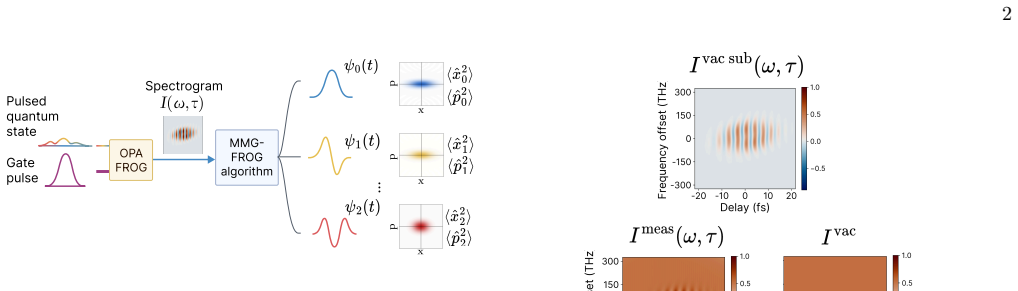


read the original abstract
Temporally multimode squeezed states have been a topic of recent interest due to their applications in quantum communication, information processing, and sensing. Characterizing the mode shapes is crucial for effectively manipulating these states, but current mode shape and state characterization techniques necessitate constraining assumptions and complicated experimental setups. Here, we propose a characterization technique that simultaneously recovers the complex temporal mode shapes and quadrature variances of ultrafast multimode squeezed states based on frequency resolved optical gating (FROG) using an optical parametric amplifier (OPA). FROG is a promising tool for quantum state characterization due to its flexibility of implementation and high temporal resolution. Using an OPA as the nonlinear process in FROG has the benefit of amplifying weak quantum states to a detectable level while preserving quantum information. Numerical simulations demonstrate the recovery of the mode shapes and levels of squeezing and anti-squeezing of ultrafast multimode squeezed states. This scheme offers a practical experimental approach to measuring arbitrary temporal mode shapes and characterizing large-scale multimode ultrafast Gaussian quantum states.
Editorial analysis
A structured set of objections, weighed in public.
Referee Report
Summary. The manuscript proposes a characterization technique for ultrafast temporally multimode squeezed states that uses frequency-resolved optical gating (FROG) with an optical parametric amplifier (OPA) as the nonlinear medium. The central claim is that this approach simultaneously recovers the complex temporal mode shapes and the quadrature variances (squeezing and anti-squeezing levels) of such states, as shown by numerical simulations, while amplifying weak quantum states to detectable levels without loss of quantum information.
Significance. If the simulations accurately capture the relevant physics, the method would offer a practical, flexible route to full characterization of large-scale multimode Gaussian states in the ultrafast regime. It combines the high temporal resolution of FROG with the gain of an OPA, potentially reducing the need for mode-selective homodyne detection or other constraining assumptions that limit current techniques, thereby supporting applications in quantum communication, information processing, and sensing.
major comments (2)
- [Numerical Simulations] Numerical Simulations section: the recovery of mode shapes and squeezing levels is demonstrated solely through simulations, yet no specific values are provided for OPA gain, pump temporal profile, input state parameters (e.g., number of modes or squeezing levels), or the precise algorithm used to invert the FROG trace. This omission prevents verification that the claimed recovery holds under the conditions stated in the abstract.
- [OPA implementation in FROG] OPA implementation in FROG section: the assertion that the OPA amplifies the weak quantum state while exactly preserving mode structure and quadrature statistics is not supported by any modeling of vacuum noise injection, pump fluctuations, or phase-matching imperfections. These effects are load-bearing for the central claim, as even small excess noise or mode coupling would distort the recovered squeezing levels and shapes.
minor comments (2)
- [Abstract] The abstract refers to 'large-scale multimode' states without defining the scale or providing an example with a concrete number of modes; a brief clarification would help readers assess the scope.
- Figure captions for the recovered modes and FROG traces should explicitly state the input parameters and any noise levels used in the simulation to improve reproducibility.
Simulated Author's Rebuttal
We thank the referee for their thorough review and constructive feedback on our manuscript. We address each major comment below and will revise the manuscript to improve clarity and support for our claims.
read point-by-point responses
-
Referee: [Numerical Simulations] Numerical Simulations section: the recovery of mode shapes and squeezing levels is demonstrated solely through simulations, yet no specific values are provided for OPA gain, pump temporal profile, input state parameters (e.g., number of modes or squeezing levels), or the precise algorithm used to invert the FROG trace. This omission prevents verification that the claimed recovery holds under the conditions stated in the abstract.
Authors: We agree that the omission of specific simulation parameters limits independent verification. In the revised manuscript, we will expand the Numerical Simulations section to explicitly state the OPA gain, the temporal profile of the pump pulse, the number of temporal modes and squeezing levels of the input states, and a step-by-step description of the inversion algorithm applied to the FROG trace. These parameters were used in our existing simulations and will be documented to allow readers to confirm the recovery of mode shapes and quadrature variances under the conditions relevant to the abstract. revision: yes
-
Referee: [OPA implementation in FROG] OPA implementation in FROG section: the assertion that the OPA amplifies the weak quantum state while exactly preserving mode structure and quadrature statistics is not supported by any modeling of vacuum noise injection, pump fluctuations, or phase-matching imperfections. These effects are load-bearing for the central claim, as even small excess noise or mode coupling would distort the recovered squeezing levels and shapes.
Authors: The referee correctly identifies that our discussion of the OPA assumes ideal conditions without explicit modeling of non-ideal effects. While the underlying physics of parametric amplification in the low-gain regime supports preservation of mode structure and quadrature statistics when phase-matching is perfect and the pump is stable, we acknowledge that vacuum noise, pump fluctuations, and phase-matching imperfections require attention. In the revision, we will add a dedicated paragraph in the OPA implementation in FROG section that qualitatively discusses these effects, provides order-of-magnitude estimates based on standard OPA theory, and includes a brief robustness check via additional simulations under small perturbations. This will qualify the central claim and demonstrate that the method remains viable for realistic experimental parameters. revision: yes
Circularity Check
No significant circularity detected
full rationale
The paper proposes a FROG technique with OPA for recovering temporal mode shapes and quadrature variances of multimode squeezed states, supported by numerical simulations as validation. No load-bearing steps reduce claimed recoveries to fitted inputs, self-definitions, or self-citation chains by construction. The abstract and method description treat simulations as independent feasibility checks on an established nonlinear process, without renaming known results or smuggling ansatzes. The derivation chain remains self-contained against external benchmarks.
Axiom & Free-Parameter Ledger
axioms (1)
- domain assumption An optical parametric amplifier can amplify weak quantum states while preserving their squeezing and temporal mode structure.
Reference graph
Works this paper leans on
-
[1]
and broadband nature [20], and their phase-sensitive ∗ marandi@caltech.edu amplification which allows for quadrature-selective mea- surement while preserving some quantum information [21, 22]. Because of their broad bandwidth [23], many temporal modes can exist in an ultrashort multimode squeezed pulse generated by an OPA. Mode-selective squeezing measure...
work page internal anchor Pith review Pith/arXiv arXiv 2026
-
[2]
J. L. O’Brien, Optical quantum computing, Science318, 1567 (2007)
work page 2007
-
[3]
W. Asavanant, Y. Shiozawa, S. Yokoyama, B. Charoen- sombutamon, H. Emura, R. N. Alexander, S. Takeda, J.-i. Yoshikawa, N. C. Menicucci, H. Yonezawa, and A. Furusawa, Generation of time-domain-multiplexed two-dimensional cluster state, Science366, 373 (2019)
work page 2019
-
[4]
M. V. Larsen, X. Guo, C. R. Breum, J. S. Neergaard- Nielsen, and U. L. Andersen, Deterministic generation of a two-dimensional cluster state, Science366, 369 (2019)
work page 2019
-
[5]
H.-S. Zhong, H. Wang, Y.-H. Deng, M.-C. Chen, L.-C. Peng, Y.-H. Luo, J. Qin, D. Wu, X. Ding, Y. Hu, P. Hu, X.-Y. Yang, W.-J. Zhang, H. Li, Y. Li, X. Jiang, L. Gan, G. Yang, L. You, Z. Wang, L. Li, N.-L. Liu, C.-Y. Lu, and J.-W. Pan, Quantum computational advantage using photons, Science370, 1460 (2020)
work page 2020
-
[6]
S. Pirandola, U. L. Andersen, L. Banchi, M. Berta, D. Bunandar, R. Colbeck, D. Englund, T. Gehring, 7 C. Lupo, C. Ottaviani, J. L. Pereira, M. Razavi, J. S. Shaari, M. Tomamichel, V. C. Usenko, G. Vallone, P. Vil- loresi, and P. Wallden, Advances in quantum cryptogra- phy, Advances in Optics and Photonics12, 1012 (2020)
work page 2020
-
[7]
M. V. Larsen, J. E. Bourassa, S. Kocsis, J. F. Tasker, R. S. Chadwick, C. Gonz´ alez-Arciniegas, J. Hastrup, C. E. Lopetegui-Gonz´ alez, F. M. Miatto, A. Motamedi, R. Noro, G. Roeland, R. Baby, H. Chen, P. Contu, I. Di Luch, C. Drago, M. Giesbrecht, T. Grainge, I. Krasnokutska, M. Menotti, B. Morrison, C. Puviraj, K. Rezaei Shad, B. Hussain, J. McMahon, J...
work page 2025
- [8]
-
[10]
L. Cruz-Rodriguez, D. Dey, A. Freibert, and P. Stam- mer, Quantum phenomena in attosecond science, Nature Reviews Physics6, 691 (2024)
work page 2024
- [11]
- [12]
-
[13]
N. C. Menicucci, P. Van Loock, M. Gu, C. Weedbrook, T. C. Ralph, and M. A. Nielsen, Universal quantum com- putation with continuous-variable cluster states, Physical Review Letters97, 110501 (2006)
work page 2006
-
[14]
N. C. Menicucci, Fault-tolerant measurement-based quantum computing with continuous-variable cluster states, Physical Review Letters112, 120504 (2014)
work page 2014
-
[15]
T. C. Ralph, Continuous variable quantum cryptography, Physical Review A61, 010303 (1999)
work page 1999
-
[16]
A. Leverrier and P. Grangier, Unconditional security proof of long-distance continuous-variable quantum key distribution with discrete modulation, Physical Review Letters102, 180504 (2009)
work page 2009
-
[17]
J. Williams, E. Sendonaris, R. Nehra, R. M. Gray, R. Sekine, L. Ledezma, and A. Marandi, Ultrafast all- optical measurement of squeezed vacuum in a lithium niobate nanophotonic circuit, Physical Review Research 7, 043006 (2025)
work page 2025
-
[18]
I. Barakat, M. Kalash, D. Scharwald, P. Sharapova, N. Lindlein, and M. Chekhova, Simultaneous measure- ment of multimode squeezing through multimode phase- sensitive amplification, Optica Quantum3, 36 (2025)
work page 2025
-
[19]
M. Kalash, U.-N. Han, Y.-S. Ra, and M. V. Chekhova, Efficient detection of spectrally multimode squeezed light through optical parametric amplification (2025), 2508.04502 [quant-ph]
-
[20]
W. Wasilewski, A. I. Lvovsky, K. Banaszek, and C. Radzewicz, Pulsed squeezed light: Simultaneous squeezing of multiple modes, Physical Review A73, 063819 (2006)
work page 2006
- [21]
- [22]
-
[23]
M. Kalash and M. V. Chekhova, Wigner function tomog- raphy via optical parametric amplification, Optica10, 1142 (2023)
work page 2023
-
[24]
L. Ledezma, R. Sekine, Q. Guo, R. Nehra, S. Jahani, and A. Marandi, Intense optical parametric amplifica- tion in dispersion-engineered nanophotonic lithium nio- bate waveguides, Optica9, 303 (2022)
work page 2022
- [25]
-
[26]
Y. Cai, J. Roslund, G. Ferrini, F. Arzani, X. Xu, C. Fabre, and N. Treps, Multimode entanglement in re- configurable graph states using optical frequency combs, Nature Communications8, 15645 (2017)
work page 2017
-
[27]
C. Polycarpou, Adaptive detection of arbitrarily shaped ultrashort quantum light states, Physical Review Letters 109, 10.1103/PhysRevLett.109.053602 (2012)
-
[28]
A. Karnieli, P.-A. Mor, C. Roques-Carmes, E. Lustig, J. Sloan, J. Vuˇ ckovi´ c, D. A. B. Miller, and S. Fan, Vari- ational processing of multimode squeezed light (2025), 2509.16753 [quant-ph]
- [29]
- [30]
-
[31]
J. Gil-Lopez, Y. S. Teo, S. De, B. Brecht, H. Jeong, C. Silberhorn, and L. L. S´ anchez-Soto, Universal com- pressive tomography in the time-frequency domain, Op- tica8, 1296 (2021)
work page 2021
- [32]
- [33]
- [34]
-
[35]
C. Riek, P. Sulzer, M. Seeger, A. S. Moskalenko, G. Burkard, D. V. Seletskiy, and A. Leitenstorfer, Sub- cycle quantum electrodynamics, Nature541, 376 (2017)
work page 2017
- [36]
-
[37]
E. Hubenschmid, T. L. Guedes, and G. Burkard, Optical time-domain quantum state tomography on a subcycle scale, Physical Review X14, 041032 (2024)
work page 2024
-
[38]
E. Hubenschmid and G. Burkard, Time-domain field correlation measurements enable tomography of highly multimode quantum states of light (2025), 2506.10483 [quant-ph]
-
[39]
J. Roslund, R. M. de Ara´ ujo, S. Jiang, C. Fabre, and N. Treps, Wavelength-multiplexed quantum networks with ultrafast frequency combs, Nature Photonics8, 109 (2014)
work page 2014
-
[40]
R. Trebino,Frequency-Resolved Optical Gating: The Measurement of Ultrashort Laser Pulses(Springer US, 2000)
work page 2000
- [41]
-
[42]
J.-Y. Zhang, C.-K. Lee, J. Y. Huang, and C.-L. Pan, Sub femto-joule sensitive single-shot OPA-XFROG and its application in study of white-light supercontinuum generation, Optics Express12, 574 (2004)
work page 2004
-
[43]
T. Zacharias, R. Gray, R. Sekine, J. Williams, S. Zhou, and A. Marandi, Energy-efficient ultrashort-pulse charac- terization using nanophotonic parametric amplification, ACS Photonics12, 1316 (2025)
work page 2025
-
[44]
Y. Eto, M. Nuriya, and H. Kano, Quantum frequency- resolved optical gating measurement for ultranarrow temporal correlation of twin beams, Optica Quantum2, 468 (2024)
work page 2024
-
[45]
T. Zacharias, R. Gray, E. Sendonaris, J. Williams, M. Shen, S. Zhou, and A. Marandi, Temporal charac- terization of ultrashort-pulse squeezed vacuum using fre- quency resolved optical gating, in2025 Conference on Lasers and Electro-Optics (CLEO)(IEEE, 2025) pp. 1– 2
work page 2025
-
[46]
C. Fabre and N. Treps, Modes and states in quantum optics, Reviews of Modern Physics92, 035005 (2020)
work page 2020
-
[47]
C. Bourassin-Bouchet and M.-E. Couprie, Partially co- herent ultrafast spectrography, Nature Communications 6, 6465 (2015)
work page 2015
-
[48]
Z. Wang, E. Zeek, R. Trebino, and P. Kvam, Beyond er- ror bars: Understanding uncertainty in ultrashort-pulse frequency-resolved-optical-gating measurements in the presence of ambiguity, Optics Express11, 3518 (2003)
work page 2003
discussion (0)
Sign in with ORCID, Apple, or X to comment. Anyone can read and Pith papers without signing in.