Recognition: no theorem link
Think Less, Know More: State-Aware Reasoning Compression with Knowledge Guidance for Efficient Reasoning
Pith reviewed 2026-05-10 18:06 UTC · model grok-4.3
The pith
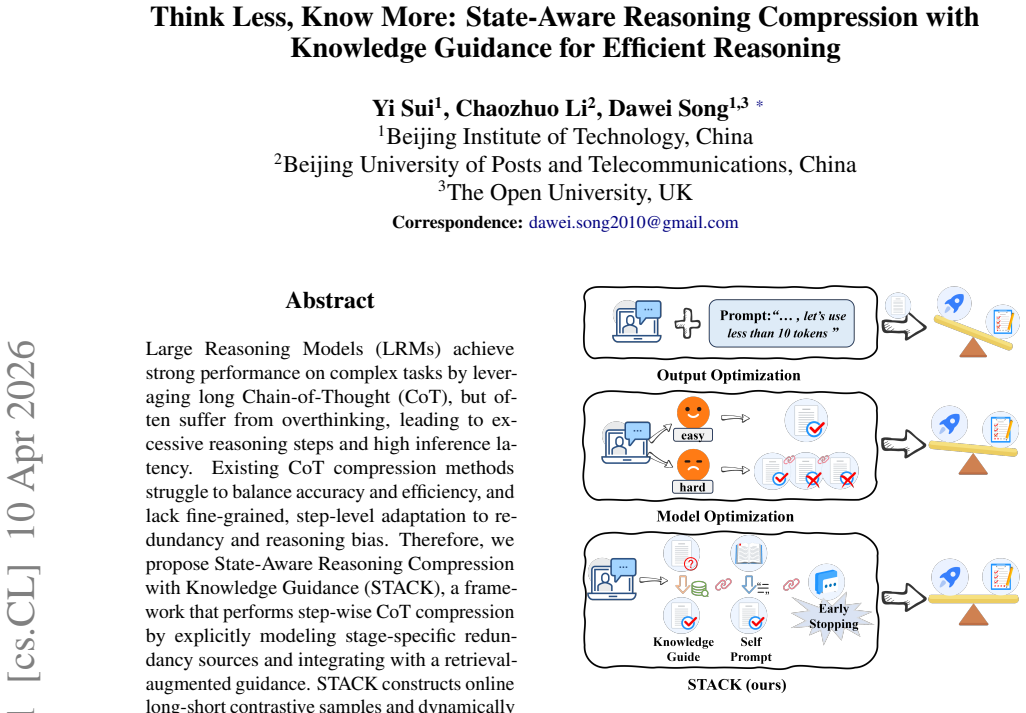
STACK compresses chain-of-thought reasoning by detecting states and applying knowledge-guided shortcuts, shortening responses by 59.9 percent while raising accuracy 4.8 points on math benchmarks.
A machine-rendered reading of the paper's core claim, the machinery that carries it, and where it could break.
Core claim
STACK performs step-wise CoT compression by explicitly modeling stage-specific redundancy sources and integrating retrieval-augmented guidance. It constructs online long-short contrastive samples, dynamically switches between knowledge-guided compression for uncertain or biased states and self-prompted compression for overly long but confident states, and adds answer-convergence-based early stopping to suppress redundant verification. A reward-difference-driven training strategy combining PPO and DPO enables the model to learn these state-conditioned strategies.
What carries the argument
The STACK framework, which builds online long-short contrastive samples and switches between knowledge-guided and self-prompted compression modes according to the detected reasoning state, augmented by answer-convergence early stopping.
If this is right
- Step-level adaptation to redundancy and bias becomes feasible without manual prompting.
- Early stopping based on answer convergence suppresses repeated verification loops.
- Combining PPO and DPO allows the model to internalize state-conditioned compression policies.
- The same compression logic can be applied at inference time to any long chain-of-thought trace.
Where Pith is reading between the lines
- The approach may extend to non-mathematical domains if state detection remains accurate outside math benchmarks.
- Lower inference latency from shorter chains could reduce energy consumption when deploying large reasoning models at scale.
- Future tests could measure whether the knowledge-retrieval component remains helpful when the external knowledge base contains noise or gaps.
Load-bearing premise
The online detector can reliably separate necessary verification steps from redundant ones and the retrieved knowledge supplies accurate guidance without introducing new errors.
What would settle it
Replacing the state detector with random mode switching on the same benchmarks and observing that accuracy drops below the uncompressed baseline or that length reduction disappears would falsify the claim.
Figures


read the original abstract
Large Reasoning Models (LRMs) achieve strong performance on complex tasks by leveraging long Chain-of-Thought (CoT), but often suffer from overthinking, leading to excessive reasoning steps and high inference latency. Existing CoT compression methods struggle to balance accuracy and efficiency, and lack fine-grained, step-level adaptation to redundancy and reasoning bias. Therefore, we propose State-Aware Reasoning Compression with Knowledge Guidance (STACK), a framework that performs step-wise CoT compression by explicitly modeling stage-specific redundancy sources and integrating with a retrieval-augmented guidance. STACK constructs online long-short contrastive samples and dynamically switches between knowledge-guided compression for uncertain or biased reasoning state and self-prompted compression for overly long but confident state, complemented by an answer-convergence-based early stopping mechanism to suppress redundant verification. We further propose a reward-difference-driven training strategy by combining Proximal Policy Optimization (PPO) and Direct Preference Optimization (DPO), enabling models to learn state-conditioned compression strategies. Experiments on three mathematical reasoning benchmarks show that STACK achieves a superior accuracy-efficiency balance, reducing average response length by 59.9% while improving accuracy by 4.8 points over existing methods.
Editorial analysis
A structured set of objections, weighed in public.
Referee Report
Summary. The manuscript proposes STACK, a framework for step-wise compression of Chain-of-Thought reasoning in Large Reasoning Models. It constructs online long-short contrastive samples to detect reasoning states (uncertain/biased vs. confident), dynamically switches between knowledge-guided compression and self-prompted compression, adds answer-convergence early stopping, and trains the policy with a combined PPO+DPO objective. On three mathematical reasoning benchmarks the abstract reports a 59.9% reduction in average response length together with a 4.8-point accuracy gain over prior compression methods.
Significance. If the empirical claims are substantiated with proper controls and component-level validation, the work would offer a practically useful advance in efficient inference for reasoning models. The state-conditioned switching and retrieval-augmented guidance constitute a concrete, testable mechanism for mitigating overthinking while preserving or improving accuracy, which is a load-bearing problem for current LRMs.
major comments (3)
- [Method] Method section (state detection and mode switching): the central claim that online long-short contrastive detection reliably distinguishes redundant steps from necessary verification is load-bearing for both the length reduction and the accuracy improvement, yet the manuscript provides no quantitative metrics (classification accuracy, false-positive rate on verification steps, or failure-case breakdown) on the three target benchmarks.
- [Experiments] Experiments section: the reported 4.8-point accuracy gain and 59.9% length reduction are presented without reference to the exact baselines, model backbones, number of runs, statistical significance tests, or error bars. This absence prevents assessment of whether the gains are robust or attributable to the proposed components rather than implementation differences.
- [Method] Knowledge-guidance component: no ablation or error analysis is supplied showing that the retrieval-augmented guidance does not introduce new factual or reasoning errors on the mathematical benchmarks; such analysis is required because hallucinated guidance would directly undermine the accuracy claim.
minor comments (1)
- [Abstract] Abstract: the phrase 'integrating with a retrieval-augmented guidance' is grammatically awkward and should be revised for clarity.
Simulated Author's Rebuttal
We thank the referee for the constructive and detailed feedback. We address each major comment below, indicating the specific revisions we will make to the manuscript.
read point-by-point responses
-
Referee: [Method] Method section (state detection and mode switching): the central claim that online long-short contrastive detection reliably distinguishes redundant steps from necessary verification is load-bearing for both the length reduction and the accuracy improvement, yet the manuscript provides no quantitative metrics (classification accuracy, false-positive rate on verification steps, or failure-case breakdown) on the three target benchmarks.
Authors: We agree that explicit quantitative validation of the state detection and mode-switching mechanism is needed to substantiate the central claims. The current manuscript emphasizes end-to-end performance but does not report standalone metrics for the contrastive detection. In the revised version we will add a dedicated analysis subsection reporting classification accuracy, false-positive rates on verification steps, and a failure-case breakdown across the three benchmarks. revision: yes
-
Referee: [Experiments] Experiments section: the reported 4.8-point accuracy gain and 59.9% length reduction are presented without reference to the exact baselines, model backbones, number of runs, statistical significance tests, or error bars. This absence prevents assessment of whether the gains are robust or attributable to the proposed components rather than implementation differences.
Authors: We acknowledge that greater experimental transparency is required. The manuscript reports aggregate improvements without full specification of the setup. We will expand the Experiments section to list the precise baselines and model backbones, report results over multiple runs with error bars, and include statistical significance tests to demonstrate robustness. revision: yes
-
Referee: [Method] Knowledge-guidance component: no ablation or error analysis is supplied showing that the retrieval-augmented guidance does not introduce new factual or reasoning errors on the mathematical benchmarks; such analysis is required because hallucinated guidance would directly undermine the accuracy claim.
Authors: We recognize that direct evidence is needed to confirm the guidance component does not introduce errors. While the observed accuracy gains provide indirect support, we will add an ablation isolating the knowledge-guidance module together with a qualitative error analysis of cases where guidance was applied, checking for introduced factual or reasoning inaccuracies. revision: yes
Circularity Check
No significant circularity detected
full rationale
The paper describes an empirical method (STACK) for CoT compression via online state detection, knowledge retrieval, early stopping, and a PPO+DPO training strategy. All performance claims (59.9% length reduction, +4.8 accuracy) are measured against external baselines on three public benchmarks rather than internal fitted parameters or self-referential definitions. No equations, uniqueness theorems, or ansatzes are presented that reduce the reported gains to quantities defined inside the paper. The derivation chain is therefore self-contained and externally validated.
Axiom & Free-Parameter Ledger
axioms (1)
- domain assumption Reasoning processes in LRMs can be segmented into identifiable states with distinct redundancy and bias patterns that are actionable for compression.
Reference graph
Works this paper leans on
-
[1]
DeepSeek-R1: Incentivizing Reasoning Capability in LLMs via Reinforcement Learning
Deepseek-r1: Incentivizing reasoning capability in llms via reinforcement learning.arXiv preprint arXiv:2501.12948. Qiguang Chen, Libo Qin, Jinhao Liu, Dengyun Peng, Jiannan Guan, Peng Wang, Mengkang Hu, Yuhang Zhou, Te Gao, and Wanxiang Che. 2025. Towards reasoning era: A survey of long chain-of-thought for reasoning large language models.arXiv preprint ...
work page internal anchor Pith review Pith/arXiv arXiv 2025
-
[2]
Let’s verify step by step. InThe Twelfth Inter- national Conference on Learning Representations. Aaron Jaech, Adam Kalai, Adam Lerer, Adam Richard- son, Ahmed El-Kishky, Aiden Low, Alec Helyar, Aleksander Madry, Alex Beutel, Alex Carney, and 1 others. 2024. Openai o1 system card.arXiv preprint arXiv:2412.16720. Xiang Lisa Li, Ari Holtzman, Daniel Fried, P...
work page internal anchor Pith review Pith/arXiv arXiv 2024
-
[3]
Auditing meta-cognitive hallucinations in reasoning large language models.arXiv preprint arXiv:2505.13143. Haotian Luo, Li Shen, Haiying He, Yibo Wang, Shi- wei Liu, Wei Li, Naiqiang Tan, Xiaochun Cao, and Dacheng Tao. 2025a. O1-pruner: Length- harmonizing fine-tuning for o1-like reasoning prun- ing.arXiv preprint arXiv:2501.12570. Michael Luo, Sijun Tan,...
-
[4]
Proximal Policy Optimization Algorithms
Direct preference optimization: Your language model is secretly a reward model.Advances in neural information processing systems, 36:53728–53741. John Schulman, Filip Wolski, Prafulla Dhariwal, Alec Radford, and Oleg Klimov. 2017. Proxi- mal policy optimization algorithms.arXiv preprint arXiv:1707.06347. Yi Shen, Jian Zhang, Jieyun Huang, Shuming Shi, Wen...
work page internal anchor Pith review Pith/arXiv arXiv 2017
-
[5]
Stop Overthinking: A Survey on Efficient Reasoning for Large Language Models
Stop overthinking: A survey on efficient rea- soning for large language models.arXiv preprint arXiv:2503.16419. Kimi Team, Angang Du, Bofei Gao, Bowei Xing, Changjiu Jiang, Cheng Chen, Cheng Li, Chenjun Xiao, Chenzhuang Du, Chonghua Liao, and 1 others
work page internal anchor Pith review arXiv
-
[6]
Kimi k1.5: Scaling Reinforcement Learning with LLMs
Kimi k1. 5: Scaling reinforcement learning with llms.arXiv preprint arXiv:2501.12599. SM Tonmoy, SM Zaman, Vinija Jain, Anku Rani, Vip- ula Rawte, Aman Chadha, and Amitava Das. 2024. A comprehensive survey of hallucination mitigation techniques in large language models.arXiv preprint arXiv:2401.01313. Shenzhi Wang, Le Yu, Chang Gao, Chujie Zheng, Shix- ua...
work page internal anchor Pith review Pith/arXiv arXiv 2024
-
[7]
Task-Specific Data (80%). To enable the model to acquire compressed reasoning pat- terns conditioned on retrieved knowledge, we construct pairs of the form (x, yteacher), where the input x= [Q, I] consists of the question and retrieval context, and the output yteacher is a high-quality, knowledge-integrated, com- pressed Chain of Thought generated by a te...
-
[8]
language competence safe- guard
General Regularization Data (20%). To pre- vent catastrophic forgetting caused by over- fitting to specific compression patterns, we incorporate general QA and reasoning data (e.g., standard CoT), preserving the model’s fundamental language and logical generaliza- tion capabilities. The primary objective of this phase is to con- struct a high-quality refe...
-
[9]
So, r is 3
That’s 3. So, r is 3. That makes sense because the point is 3 units above the origin on the y-axis, so its distance from the origin is indeed 3. Next, I need to find θ, the angle. The formula for θ is arctangent of y over x, so θ= arctan( y x). But wait, in this case, x is 0. So, arctan( 3 0). Hmm, I remember that dividing by zero is undefined, I need to ...
2086
-
[10]
Grouping the addition with 5: 144
-
[11]
Grouping the addition with 4 and 5: 126
-
[12]
Grouping the addition with 3,4,5: 122
-
[13]
So, that’s four different values
Grouping the addition with 2,3,4,5: 121. So, that’s four different values. Wait, but in the first grouping, when I grouped the addition with 5, I had 144, but when I grouped the addition with 4 and 5, I also got 144. So, that suggests that grouping the addition with 5 and grouping it with 4 and 5 both result in 144. So, it’s the same value. Similarly, gro...
-
[14]
So, to group 3 * (4 + 5), you have to change the order of operations, which is allowed by inserting parentheses
* 4) * 5). So, to group 3 * (4 + 5), you have to change the order of operations, which is allowed by inserting parentheses. Therefore, is 55 a valid result? Original Output for Case 2 Compute: 3 + 4 = 7, 5 + 1 = 6, 2 * 7 * 6 = 84. But in the original expression, it’s a linear chain, so grouping 3 + 4 and 5 + 1 is not allowed. Therefore, 84 is invalid. . ....
-
[15]
2·3·4·5 + 1 = 120 + 1 = 121
**Original Expression**: The expression is evaluated left to right without any parentheses. 2·3·4·5 + 1 = 120 + 1 = 121
-
[16]
2·3·(4·5) + 1 = 2·3·20 + 1 = 120 + 1 = 121 This gives the same result as the original expression
**Grouping the Addition with 5**: Insert parentheses around 4 and 5. 2·3·(4·5) + 1 = 2·3·20 + 1 = 120 + 1 = 121 This gives the same result as the original expression
-
[17]
2·(3·4·5) + 1 = 2·60 + 1 = 120 + 1 = 121 This also gives the same result as the original expression
**Grouping the Addition with 4 and 5**: Insert parentheses around 3, 4, and 5. 2·(3·4·5) + 1 = 2·60 + 1 = 120 + 1 = 121 This also gives the same result as the original expression
-
[18]
2·(3·(4·5)) + 1 = 2·60 + 1 = 120 + 1 = 121 This again gives the same result as the original expression
**Grouping the Addition with 3, 4, and 5**: Insert parentheses around 3, 4, and 5. 2·(3·(4·5)) + 1 = 2·60 + 1 = 120 + 1 = 121 This again gives the same result as the original expression
-
[19]
2·(3·(4 + 5)) + 1 = 2·27 + 1 = 54 + 1 = 55
**Grouping the Addition with 4 and 5**: Insert parentheses around 4 and 5. 2·(3·(4 + 5)) + 1 = 2·27 + 1 = 54 + 1 = 55
-
[20]
(2·3)·(4·5) + 1 = 6·20 + 1 = 120 + 1 = 121
**Grouping the Addition with 3, 4, and 5**: Insert parentheses around 3, 4, and 5. (2·3)·(4·5) + 1 = 6·20 + 1 = 120 + 1 = 121
-
[21]
(2·3·4)·(5 + 1) = 24·6 = 144
**Grouping theAddition with 5**: Insert parentheses around 5. (2·3·4)·(5 + 1) = 24·6 = 144
-
[22]
((2·3)·4)·(5 + 1) = 24·6 = 144 After evaluating all possible groupings, the different values obtained are 55, 121, 122, 126, and
**Grouping theAddition with 3, 4, and 5**: Insert parentheses around 3, 4, and 5. ((2·3)·4)·(5 + 1) = 24·6 = 144 After evaluating all possible groupings, the different values obtained are 55, 121, 122, 126, and
-
[23]
However, we can obtain values other than 121 for this expression if we are allowed to change it by inserting parentheses
Therefore, the number of different values is: 5 Ground Truth:4 [False] STACK’s Output for Case 2 Question:The expression 2·3·4·5 + 1 is equal to 121, since multiplication is carried out before addition. However, we can obtain values other than 121 for this expression if we are allowed to change it by inserting parentheses. For example, we can obtain 144 b...
-
[24]
**Default evaluation without parentheses:** 2·3·4·5 + 1 = 120 + 1 = 121
-
[25]
**Grouping the first two terms and the rest:** (2·3)·4·5 + 1 = 6·4·5 + 1 = 120 + 1 = 121 This does not change the result
-
[26]
**Grouping the first three terms and the last term:** (2·3·4)·5 + 1 = 24·5 + 1 = 120 + 1 = 121
-
[27]
**Grouping the last two terms first:** 2·3·(4·5) + 1 = 2·3·20 + 1 = 120 + 1 = 121 This does not change the result
-
[28]
**Grouping the middle terms first:** 2·(3·4)·(5 + 1) = 2·12·6 = 144
-
[29]
**Grouping the last term with the addition:** 2·(3·4·5 + 1) = 2·(60 + 1) = 2·61 = 122
-
[30]
Thus, the total number of distinct values is4
**Grouping the middle terms and then adding:** 2·(3·(4·5 + 1)) = 2·(3·21) = 2·63 = 126 By evaluating all possible groupings, we find the distinct values: 121, 144, 126, and 122. Thus, the total number of distinct values is4 . Ground Truth:4 [True]
discussion (0)
Sign in with ORCID, Apple, or X to comment. Anyone can read and Pith papers without signing in.