A Levinson's theorem for particle form factors
Pith reviewed 2026-05-10 17:52 UTC · model grok-4.3
The pith
Levinson's theorem links asymptotic phases of form factors to hadron electromagnetic properties.
A machine-rendered reading of the paper's core claim, the machinery that carries it, and where it could break.
Core claim
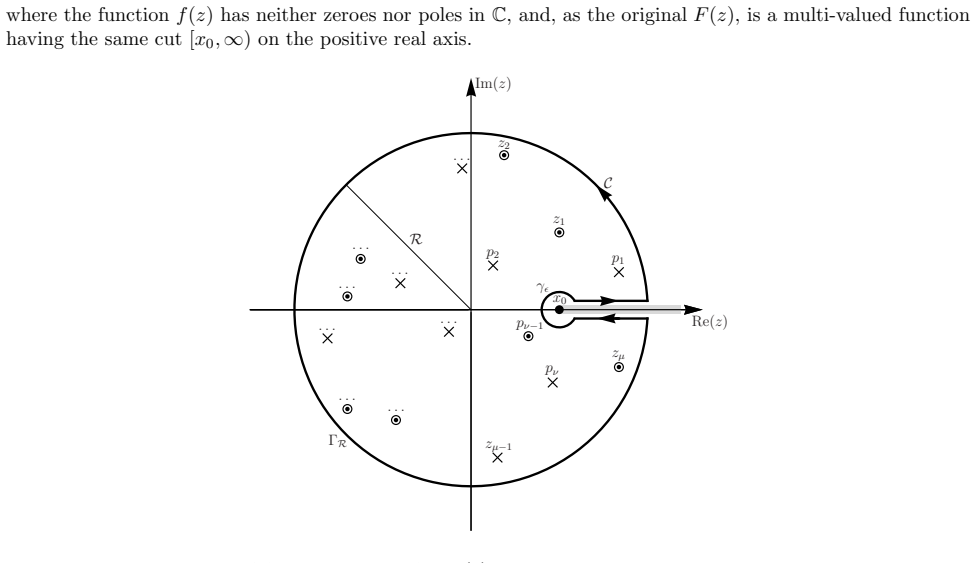
Levinson's theorem establishes a univocal relation between the integer multiples of pi to which form factor phases tend asymptotically and the properties of form factors related to the dynamics of the electromagnetic interaction of the corresponding hadrons. This follows from the requirement that form factors are multi-valued complex functions defined in the complex plane with a cut along the positive real axis, with phases on the upper edge tending to these multiples.
What carries the argument
Analyticity of form factors in the cut plane, which forces their time-like phases to approach integer multiples of pi whose specific values are fixed by electromagnetic dynamics via Levinson's theorem.
If this is right
- Form factor models must have phases that reach specific multiples of pi to remain consistent with analyticity and the theorem.
- The high-momentum phase behavior supplies a constraint on the electromagnetic couplings of hadrons without needing additional dynamical input.
- The same limiting phase applies across related processes that share the same electromagnetic structure.
- Dispersion relations for form factors can fix their asymptotic phase once the multiple is identified.
Where Pith is reading between the lines
- The result may extend to other analytic functions in quantum field theory whose phases are similarly constrained by cuts.
- High-energy data on time-like form factors from colliders could directly extract the integer multiple and thereby test the electromagnetic properties assumed in the theorem.
- Similar phase theorems might apply to transition form factors or other matrix elements with comparable analytic structure.
Load-bearing premise
The phases of form factors evaluated on the upper edge of the cut approach integer multiples of pi at large time-like momentum transfers.
What would settle it
A measured time-like form factor phase that fails to approach any integer multiple of pi at sufficiently high momentum transfer, or a mismatch between the observed multiple and the electromagnetic properties expected for that hadron.
Figures
read the original abstract
We present and demonstrate a version of Levinson's theorem especially dedicated to the asymptotic behavior of form factor phases. Indeed, as required by analyticity, form factors are multi-valued complex functions of a square four-momentum defined in the complex plane with a cut along the positive real axis. Their phases evaluated on the upper edge of this cut, i.e., on the time-like region, tend asymptotically to integer multiples of $\pi$ radians. The Levinson's theorem establishes a univocal relation between such multiples and properties of form factors related to the dynamics of the electromagnetic interaction of the corresponding hadrons.
Editorial analysis
A structured set of objections, weighed in public.
Referee Report
Summary. The manuscript proposes a version of Levinson's theorem tailored to the asymptotic phases of particle form factors. It asserts that analyticity in the complex s-plane (with a cut along the positive real axis) requires form factors to be multi-valued functions whose phases, evaluated on the upper edge of the cut in the time-like region, approach integer multiples of π asymptotically. The theorem is claimed to establish a univocal relation between these limiting multiples and dynamical properties of the electromagnetic interactions of the corresponding hadrons.
Significance. If the derivation is sound and the integer-multiple phase property is rigorously justified (either from analyticity plus additional QFT constraints or by direct proof), the result could provide a useful link between form-factor asymptotics and hadron dynamics, complementing dispersion relations and sum rules. The significance is currently limited by the absence of visible checks against known cases and the need to confirm that the phase condition follows from the stated assumptions rather than additional unstated restrictions.
major comments (1)
- [Abstract] Abstract: The claim that 'as required by analyticity, form factors are multi-valued complex functions ... phases ... tend asymptotically to integer multiples of π' is not generally true for functions analytic in the cut plane. Branches of s^α (non-integer α) or exp(−√s) (suitably normalized to be real for s<0) satisfy the cut structure and Schwarz reflection yet yield non-integer limiting phases on the upper cut. The Levinson relation between the limiting multiple and dynamical quantities (zeros, residues, electromagnetic couplings) therefore cannot be established until the integer-multiple property is independently proved; the abstract attributes it solely to analyticity.
minor comments (2)
- The manuscript would benefit from an explicit statement of the additional physical constraints (unitarity, crossing, or specific QFT properties) that might enforce the integer phase condition beyond pure analyticity.
- Explicit verification against at least one known form factor (e.g., the pion electromagnetic form factor) should be added to demonstrate that the derived relation reproduces established results.
Simulated Author's Rebuttal
We are grateful to the referee for their thorough review and valuable feedback on our manuscript. The main concern raised pertains to the justification of the asymptotic phase approaching integer multiples of π, which we address directly below. We agree that the original abstract wording requires clarification and will revise accordingly.
read point-by-point responses
-
Referee: The claim that 'as required by analyticity, form factors are multi-valued complex functions ... phases ... tend asymptotically to integer multiples of π' is not generally true for functions analytic in the cut plane. Branches of s^α (non-integer α) or exp(−√s) (suitably normalized to be real for s<0) satisfy the cut structure and Schwarz reflection yet yield non-integer limiting phases on the upper cut. The Levinson relation between the limiting multiple and dynamical quantities (zeros, residues, electromagnetic couplings) therefore cannot be established until the integer-multiple property is independently proved; the abstract attributes it solely to analyticity.
Authors: We thank the referee for highlighting this subtlety. Analyticity in the cut plane together with the Schwarz reflection principle is indeed insufficient by itself to enforce integer multiples of π for the asymptotic phase, as the cited counterexamples correctly demonstrate. However, electromagnetic form factors are not arbitrary analytic functions; they are matrix elements of the conserved electromagnetic current between hadron states. This imposes additional QFT constraints: (i) reality on the space-like axis (s < 0) from current hermiticity, (ii) a fixed normalization such as F(0) = 1, and (iii) power-law fall-off at large |s| from perturbative QCD or dispersion relations that force the imaginary part to vanish asymptotically in a manner compatible only with integer phase multiples. Our Levinson relation then connects these limiting integers to the number of zeros and pole residues, which carry the dynamical content. We acknowledge that the abstract phrasing is imprecise in attributing the integer property solely to analyticity. We will revise the abstract to state explicitly that the property follows from analyticity supplemented by the above QFT constraints, and we will add a short derivation in the text (or appendix) demonstrating why non-integer phases are excluded for physical form factors. revision: yes
Circularity Check
No circularity: derivation follows from stated analyticity assumptions
full rationale
The paper frames its Levinson variant as a direct consequence of the analytic properties of form factors (multi-valued functions in the cut plane with asymptotic phases on the cut edge). No steps reduce by construction to fitted inputs, self-definitions, or load-bearing self-citations; the central relation is presented as following from the cut-plane structure and phase behavior without tautological redefinition of the target quantities. This is the standard non-circular case for an analyticity-based theorem.
Axiom & Free-Parameter Ledger
axioms (1)
- domain assumption Form factors are multi-valued complex functions of square four-momentum defined in the complex plane with a cut along the positive real axis.
Reference graph
Works this paper leans on
-
[1]
Phase of the ele ctromagnetic form factor of the pion
Enrique Ruiz Arriola and Pablo Sanchez-Puertas. Phase of the ele ctromagnetic form factor of the pion. Phys. Rev. D , 110:054003, Sep 2024
work page 2024
-
[2]
Fir st exploration of the physical riemann surfaces of the ratio GΛ E/G Λ M
Alessio Mangoni, Simone Pacetti, and Egle Tomasi-Gustafsson. Fir st exploration of the physical riemann surfaces of the ratio GΛ E/G Λ M . Phys. Rev. D , 104:116016, Dec 2021
work page 2021
-
[3]
H. W. Hammer. Nucleon form factors in dispersion theory. The European Physical Journal A - Hadrons and Nuclei , 28(1):49–57, 2006
work page 2006
-
[4]
H.-W. Hammer, Ulf-G. Meißner, and D. Drechsel. Dispersion-theo retical analysis of the nucleon electro- magnetic form factors: Inclusion of time-like data. Physics Letters B , 385(1):343–347, 1996
work page 1996
-
[5]
E C Titchmarsh. The Theory of Functions . Oxford University Press, 1968
work page 1968
-
[6]
G P Lepage and S J Brodsky. Exclusive processes in quantum chro modynamics: The form factors of baryons at large momentum transfer. Phys. Rev. Lett.; (United States) , 43:8, 08 1979
work page 1979
-
[7]
Preliminary sketch of biquaternions
Clifford. Preliminary sketch of biquaternions. Proceedings of the London Mathematical Society, s1-4(1):381– 395, 1871
-
[8]
H. J. Ettlinger. Cauchy’s paper of 1814 on definite integrals. Annals of Mathematics , 23(3):255–270, 1922
work page 1922
-
[9]
V. A. Matveev, R. M. Muradian, and A. N. Tavkhelidze. Automode llism in the large - angle elastic scattering and structure of hadrons. Lett. Nuovo Cim. , 7:719–723, 1973
work page 1973
-
[10]
Stanley J. Brodsky and Glennys R. Farrar. Scaling laws at large t ransverse momentum. Phys. Rev. Lett. , 31:1153–1156, Oct 1973
work page 1973
-
[11]
B. V. Geshkenbein. Determination of the electromagnetic form factor in the space-like region from the value of its modulus in the time - like region. Yad. Fiz., 9:1232–1235, 1969. 8
work page 1969
discussion (0)
Sign in with ORCID, Apple, or X to comment. Anyone can read and Pith papers without signing in.