Nii-body: Bayesian Inference of Multiplanet Dynamics via N-body Simulations
Pith reviewed 2026-05-10 17:29 UTC · model grok-4.3
The pith
A Bayesian framework couples N-body simulations with MCMC to fit parameters of multiplanet exoplanetary systems.
A machine-rendered reading of the paper's core claim, the machinery that carries it, and where it could break.
Core claim
The authors present Nii-body, a code that integrates an adaptive Runge-Kutta-Fehlberg 7(8) solver with an automated parallel tempering MCMC algorithm, enabling Bayesian retrieval of multiplanet system parameters directly from N-body dynamics rather than Keplerian approximations.
What carries the argument
Nii-body code, which couples adaptive N-body integration via the RKF78 solver with parallel tempering MCMC to perform orbit retrieval from observations such as astrometry.
If this is right
- The N-body fitting workflow extends directly to radial velocity, transit timing variations, or combined datasets.
- The approach provides a versatile engine for high-precision orbital inference in multiplanet systems.
- Demonstrated efficiency on idealized two-planet models with synthetic astrometry supports scalability to more complex configurations.
Where Pith is reading between the lines
- This method could reduce systematic biases in mass and orbit estimates for planets in strong gravitational interactions compared to Keplerian models.
- Application to real data archives would enable joint constraints on system stability and architecture that current tools handle only approximately.
Load-bearing premise
The adaptive Runge-Kutta-Fehlberg 7(8) integrator remains accurate and stable over the relevant timescales, and the simplified synthetic astrometric observations adequately represent the noise and sampling of real data.
What would settle it
Applying Nii-body to a known multiplanet system with real astrometric or radial velocity data and obtaining parameter values that differ substantially from those derived by independent established methods would falsify the framework's reliability for practical use.
Figures


read the original abstract
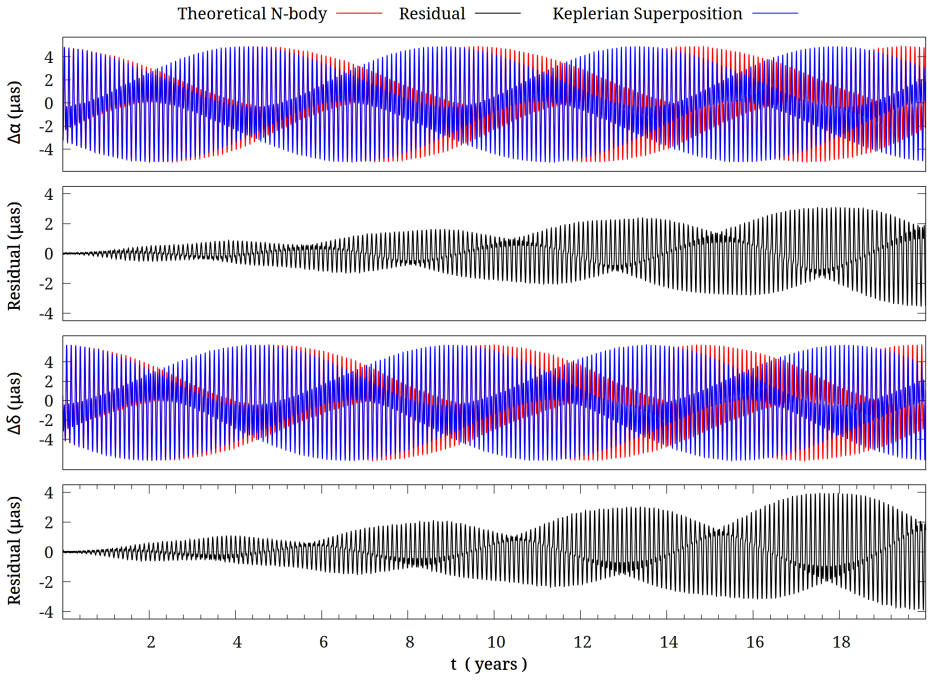
Many exoplanetary systems are multiplanet configurations whose long-term dynamics are governed by N-body gravitational interactions. Consequently, their detection signatures cannot be adequately described by Keplerian orbits. Accurately interpreting the observational data of these systems -- including radial velocity (RV), astrometry, and transit timing variations (TTVs) -- requires N-body integration. Motivated by this need, we developed a Bayesian fitting framework that couples N-body integration with Markov chain Monte Carlo (MCMC) to retrieve the system parameters of multiplanet systems. The code, named \texttt{Nii-body}, integrates an adaptive Runge--Kutta--Fehlberg 7(8) (RKF78) solver with an automated parallel tempering MCMC algorithm. Using simplified synthetic astrometric observations, we evaluated the efficiency and robustness of \texttt{Nii-body}'s N-body orbit retrieval on an idealized two-planet model, demonstrating its potential for future application to real observational data. The N-body fitting workflow can be readily extended to RV, TTVs, or combined datasets, providing a versatile engine for high-precision orbital inference in multiplanet systems.
Editorial analysis
A structured set of objections, weighed in public.
Referee Report
Summary. The manuscript introduces Nii-body, a Bayesian framework that couples an adaptive Runge-Kutta-Fehlberg 7(8) N-body integrator with parallel-tempering MCMC to infer orbital parameters of multiplanet systems from astrometric, RV, or TTV observations. The central demonstration consists of a parameter-recovery test on simplified synthetic astrometric data for an idealized two-planet model, with the authors noting that the workflow can be extended to real datasets.
Significance. A reliable open-source N-body+MCMC engine would be useful for exoplanet dynamics where mutual perturbations invalidate independent Keplerian fits. The paper correctly identifies the need for such a tool and its extensibility to combined datasets. However, the current evaluation on highly idealized synthetic data provides only qualitative evidence of success, limiting the immediate significance of the contribution.
major comments (2)
- [Synthetic recovery experiment (abstract and results)] The synthetic-data recovery experiment (described in the abstract and the results section) reports successful parameter retrieval but supplies no quantitative metrics: no posterior means or credible intervals, no bias or coverage statistics relative to the known inputs, no MCMC convergence diagnostics (e.g., Gelman-Rubin statistic or effective sample size), and no comparison to a Keplerian baseline. Without these numbers the claim that the framework “successfully retrieves” the system parameters cannot be evaluated.
- [Methods / synthetic data generation] The description of the synthetic astrometric observations states only that they are “simplified” and “idealized.” No explicit noise model, cadence, number of epochs, or astrometric precision is provided, nor is any test shown with correlated noise, uneven sampling, or stellar jitter. This omission directly affects the weakest assumption identified in the stress-test note and prevents assessment of robustness under realistic conditions.
minor comments (2)
- [Abstract and §1] The abstract and introduction would benefit from a brief statement of the specific orbital elements being fitted (e.g., whether masses, periods, eccentricities, or inclinations are free parameters) to clarify the dimensionality of the inference problem.
- [Methods] Notation for the integrator tolerances and MCMC tempering schedule should be defined once and used consistently; a short table summarizing the adopted numerical settings would improve reproducibility.
Simulated Author's Rebuttal
We thank the referee for their constructive comments, which highlight opportunities to strengthen the quantitative support for our claims and the transparency of our synthetic-data setup. We address each major point below and will incorporate the suggested improvements in the revised manuscript.
read point-by-point responses
-
Referee: [Synthetic recovery experiment (abstract and results)] The synthetic-data recovery experiment (described in the abstract and the results section) reports successful parameter retrieval but supplies no quantitative metrics: no posterior means or credible intervals, no bias or coverage statistics relative to the known inputs, no MCMC convergence diagnostics (e.g., Gelman-Rubin statistic or effective sample size), and no comparison to a Keplerian baseline. Without these numbers the claim that the framework “successfully retrieves” the system parameters cannot be evaluated.
Authors: We agree that the current presentation relies on qualitative demonstration and that explicit quantitative metrics are needed for readers to rigorously assess retrieval performance. In the revised manuscript we will add posterior means and 68%/95% credible intervals for all fitted parameters, Gelman-Rubin statistics and effective sample sizes for the MCMC chains, and a direct comparison of the N-body posterior to an independent Keplerian fit on the same synthetic data. These additions will allow quantitative evaluation of bias, coverage, and the necessity of the N-body treatment. revision: yes
-
Referee: [Methods / synthetic data generation] The description of the synthetic astrometric observations states only that they are “simplified” and “idealized.” No explicit noise model, cadence, number of epochs, or astrometric precision is provided, nor is any test shown with correlated noise, uneven sampling, or stellar jitter. This omission directly affects the weakest assumption identified in the stress-test note and prevents assessment of robustness under realistic conditions.
Authors: We acknowledge that the synthetic-data generation section is currently underspecified. We will expand the Methods section to provide the exact noise model (white Gaussian with specified standard deviation), observational cadence, total number of epochs, and astrometric precision adopted for the idealized two-planet test. We will also add a brief discussion of the assumptions and outline how the framework can be extended to correlated noise or jitter in future work, thereby clarifying the scope of the present demonstration. revision: yes
Circularity Check
No significant circularity; tool-development paper with independent synthetic validation
full rationale
The manuscript describes a software framework (Nii-body) that couples an adaptive RKF78 N-body integrator to parallel-tempering MCMC for orbital parameter retrieval. No theoretical derivation, uniqueness theorem, or predictive claim is advanced that reduces by construction to fitted quantities or self-citations. The only empirical demonstration uses freshly generated synthetic astrometric data whose noise model and sampling are stated to be simplified and independent of the fitting engine. All load-bearing steps (integrator choice, MCMC implementation, likelihood evaluation) are externally verifiable code-level operations rather than tautological redefinitions. This is a standard computational-methods contribution whose central claim does not collapse into its own inputs.
Axiom & Free-Parameter Ledger
Reference graph
Works this paper leans on
-
[1]
Winn, J. N., & Fabrycky, D. C. 2015. The Occurrence and Architecture of Exoplanetary Systems.Annual Review of Astronomy and Astrophysics,53, 409–447
work page 2015
-
[2]
Zhu, W., & Dong, S. 2021. Exoplanet Statistics and Theoretical Implications.Annual Review of Astronomy and Astrophysics,59, 291–336
work page 2021
- [3]
-
[4]
Prevalence of Earth-size planets orbiting Sun-like stars.Proceedings of the National Academy of Science, 110(48), 19273–19278
-
[5]
D., Pascucci, I., Apai, D., et al
Mulders, G. D., Pascucci, I., Apai, D., et al. 2018. The Exoplanet Population Observation Simulator. I. The Inner Edges of Planetary Systems.The Astronomical Journal,156(1), 24
work page 2018
-
[6]
Fang, J., & Margot, J.-L. 2012. Architecture of Planetary Systems Based on Kepler Data: Number of Planets and Coplanarity.The Astrophysical Journal,761(2), 92
work page 2012
- [7]
-
[8]
Architecture and Dynamics of Kepler’s Candidate Multiple Transiting Planet Systems.Astrophysical Journal, Supplement Series,197(1), 8
-
[9]
Muresan, A., Persson, C. M., & Fridlund, M. 2024. Diversities and similarities exhibited by multi-planetary systems and their architectures: I. Orbital spacings. Astronomy and Astrophysics,692, A122
work page 2024
-
[10]
Mishra, L., Alibert, Y., Udry, S., et al. 2023. Framework for the architecture of exoplanetary systems. I. Four classes of planetary system architecture.Astronomy and Astrophysics,670, A68
work page 2023
-
[11]
J., Koch, D., Basri, G., et al
Borucki, W. J., Koch, D., Basri, G., et al. 2010. Kepler Planet-Detection Mission: Introduction and First Results.Science,327(5968), 977
work page 2010
-
[12]
Batalha, N. M., Rowe, J. F., Bryson, S. T., et al. 2013. Planetary Candidates Observed by Kepler. III. Analysis of the First 16 Months of Data.Astrophysical Journal, Supplement Series,204(2), 24. [11]Fabrycky, D. C., Lissauer, J. J., Ragozzine, D., et al. 2014. Architecture of Kepler’s Multi-transiting Systems. II. New Investigations with Twice as Many Ca...
work page 2013
-
[13]
Pu, B., & Wu, Y. 2015. Spacing of Kepler Planets: Sculpting by Dynamical Instability.The Astrophysical Journal,807(1), 44
work page 2015
-
[14]
Smith, A. W., & Lissauer, J. J. 2009. Orbital stability of systems of closely-spaced planets.Icarus,201(1), 381– 394
work page 2009
-
[15]
Mayor, M., & Queloz, D. 1995. A Jupiter-mass compan- ion to a solar-type star.Nature,378(6555), 355–359
work page 1995
- [16]
-
[17]
Holman, M. J., & Murray, N. W. 2005. The Use of Transit Timing to Detect Terrestrial-Mass Extrasolar Planets.Science,307(5713), 1288–1291
work page 2005
-
[18]
Lithwick, Y., Xie, J., & Wu, Y. 2012. Extracting Planet Mass and Eccentricity from TTV Data.The Astrophysical Journal,761(2), 122
work page 2012
-
[19]
Sozzetti, A. 2005. Astrometric Methods and Instrumentation to Identify and Characterize Extrasolar Planets: A Review.Publications of Astronomical Society of the Pacific,117(836), 1021– 1048
work page 2005
- [20]
-
[21]
Astrometric Exoplanet Detection with Gaia.The Astrophysical Journal,797(1), 14
-
[22]
Lindegren, L., Hern´ andez, J., Bombrun, A., et al
-
[23]
Gaia Data Release 2. The astrometric solution. Astronomy and Astrophysics,616, A2. [21]Ji, J.-H., Li, H.-T., Zhang, J.-B., et al. 2022. CHES: A Space-borne Astrometric Mission for the Detection of Habitable Planets of the Nearby Solar-type Stars.Research in Astronomy and Astrophysics,22(7), 072003
work page 2022
-
[24]
Huang, X., Ji, J., Bao, C., et al. 2025. Closeby Habitable Exoplanet Survey (CHES). III. Retrieval of Planetary Masses in Binaries Using the N-body Model with Radial Velocity and Astrometry Synergy.The Astrophysical Journal,984(1), 82
work page 2025
-
[25]
Ford, E. B. 2005. Quantifying the Uncertainty in the Orbits of Extrasolar Planets.The Astronomical Journal,129(3), 1706–1717
work page 2005
-
[26]
Balan, S. T., & Lahav, O. 2009. EXOFIT: orbital parameters of extrasolar planets from radial velocities. Monthly Notices of the Royal Astronomical Society, 394(4), 1936–1944
work page 2009
-
[27]
Brandt, T. D., Dupuy, T. J., Li, Y., et al. 2021. orvara: An Efficient Code to Fit Orbits Using Radial Velocity, Absolute, and/or Relative Astrometry.The Astronomical Journal,162(5), 186
work page 2021
-
[28]
Laughlin, G., & Chambers, J. E. 2001. Short-Term Dynamical Interactions among Extrasolar Planets.The Astrophysical Journal Letters,551(1), L109–L113
work page 2001
-
[29]
Agol, E., Steffen, J., Sari, R., et al. 2005. On detecting terrestrial planets with timing of giant planet transits. Monthly Notices of the Royal Astronomical Society, 359(2), 567–579
work page 2005
-
[30]
Baluev, R. V. 2013. PlanetPack: A radial-velocity time-series analysis tool facilitating exoplanets de- tection, characterization, and dynamical simulations. Astronomy and Computing,2, 18–26
work page 2013
-
[31]
Baluev, R. V. 2018. PlanetPack3: A radial-velocity and transit analysis tool for exoplanets.Astronomy and 570www.ati.ac.cn Computing,25, 221–229
work page 2018
-
[32]
Trifonov, T. 2019, The Exo-Striker: Transit and radial velocity interactive fitting tool for orbital analysis and N-body simulations, Astrophysics Source Code Library, record ascl:1906.004, ,
work page 2019
-
[33]
Blunt, S., Wang, J. J., Angelo, I., et al. 2020. orbitize!: A Comprehensive Orbit-fitting Software Package for the High-contrast Imaging Community.The Astronomical Journal,159(3), 89
work page 2020
-
[34]
Rein, H., & Liu, S.-F. 2012. REBOUND: an open-source multi-purpose N-body code for collisional dynamics. Astronomy and Astrophysics,537, A128
work page 2012
-
[35]
Rein, H., & Spiegel, D. S. 2015. IAS15: a fast, adap- tive, high-order integrator for gravitational dynamics, accurate to machine precision over a billion orbits. Monthly Notices of the Royal Astronomical Society, 446(2), 1424–1437
work page 2015
-
[36]
Jin, S., Ding, X., Wang, S., et al. 2022. Nii: a Bayesian orbit retrieval code applied to differential astrometry. Monthly Notices of the Royal Astronomical Society, 509(3), 4608–4619
work page 2022
-
[37]
Jin, S., Jiang, W., & Wu, D.-H. 2024. Automatic Parallel Tempering Markov Chain Monte Carlo with Nii-C. Astrophysical Journal, Supplement Series,274(1), 10
work page 2024
-
[38]
Lammers, C., & Winn, J. N. 2026. On the Exoplanet Yield of Gaia Astrometry.The Astronomical Journal, 171(1), 18
work page 2026
-
[39]
Malbet, F., L´ eger, A., Anglada Escud´ e, G., et al. 2016. Microarcsecond astrometric observatory Theia: from dark matter to compact objects and nearby earths. In Society of Photo-Optical Instrumentation Engineers (SPIE) Conference Series. DOI:10.1117/12.2234425
-
[40]
The Theia Collaboration, Boehm, C., Krone-Martins, A., et al. 2017. Theia: Faint objects in motion or the new astrometry frontier.arXiv e-prints,
work page 2017
-
[41]
JI, J., & WANG, S. 2020. China’s Future Missions for Deep Space Exploration and Exoplanet Space Survey by 2030.Chinese Journal of Space Science,40(5), 729
work page 2020
-
[42]
Freudenthal, J., von Essen, C., Dreizler, S., et al. 2018. Kepler Object of Interest Network. II. Photodynamical modelling of Kepler-9 over 8 years of transit observa- tions.Astronomy and Astrophysics,618, A41
work page 2018
-
[43]
Fehlberg, E. 1968, Classical Fifth-, Sixth-, Seventh-, and Eighth-Order Runge-Kutta Formulas with Stepsize Control, NASA Technical Report NASA-TR-R-287, National Aeronautics and Space Administration, nTRS Document ID 19680027281
work page 1968
-
[44]
Dormand, J. R., & Prince, P. J. 1978. New Runge-Kutta Algorithms for Numerical Simulation in Dynamical Astronomy.Celestial Mechanics,18(3), 223–232. [43]Gelman, A., & Rubin, D. B. 1992. Inference from Iterative Simulation Using Multiple Sequences. Statistical Science,7, 457–472. Astronomical Techniques and Instruments,1(5), 560–566, 2024571
work page 1978
discussion (0)
Sign in with ORCID, Apple, or X to comment. Anyone can read and Pith papers without signing in.