Recognition: 2 theorem links
· Lean Theorem3D Multi-View Stylization with Pose-Free Correspondences Matching for Robust 3D Geometry Preservation
Pith reviewed 2026-05-15 07:42 UTC · model grok-4.3
The pith
Multi-view stylization preserves 3D geometry for SLAM and reconstruction by matching pose-free correspondences and depths during test-time optimization.
A machine-rendered reading of the paper's core claim, the machinery that carries it, and where it could break.
Core claim
A stylization network trained with per-scene test-time optimization under a composite objective can achieve multi-view artistic transfer while preserving 3D geometry without camera poses or an explicit 3D representation. Style transfer is driven by channel-wise moment matching from a frozen VGG-19 encoder. Structure is stabilized by a correspondence consistency loss that constrains SuperPoint descriptors extracted from stylized images to remain matched via SuperGlue to descriptors from the original multi-view set. Depth is preserved by a loss against MiDaS/DPT predictions after color alignment, with staged weighting of the geometry terms. On Tanks and Temples and Mip-NeRF 360 scenes, the ab-
What carries the argument
The correspondence-based consistency loss that uses SuperPoint and SuperGlue to enforce descriptor matches between stylized and original views, together with the depth-preservation loss against MiDaS predictions.
If this is right
- Correspondence and depth regularization together reduce structural distortion measured by Structure Distance.
- Stylized images produce more stable monocular SLAM trajectories than independent per-view stylization.
- Reconstructed point clouds show lower symmetric Chamfer distance while style adherence measured by Color Histogram Distance stays competitive.
- The staged weight schedule allows the network to first learn appearance then enforce geometry constraints without collapsing to the original images.
Where Pith is reading between the lines
- The same correspondence mechanism could be applied to video stylization by treating consecutive frames as additional views.
- If the method works without poses, it may simplify integration into existing capture pipelines that lack calibrated cameras.
- Extending the depth loss to use multiple monocular depth estimators could further reduce sensitivity to any single model's domain shift.
Load-bearing premise
Descriptor matching with SuperPoint and SuperGlue will still identify the same physical 3D points after stylization, so that the consistency loss does not lock in new mismatches.
What would settle it
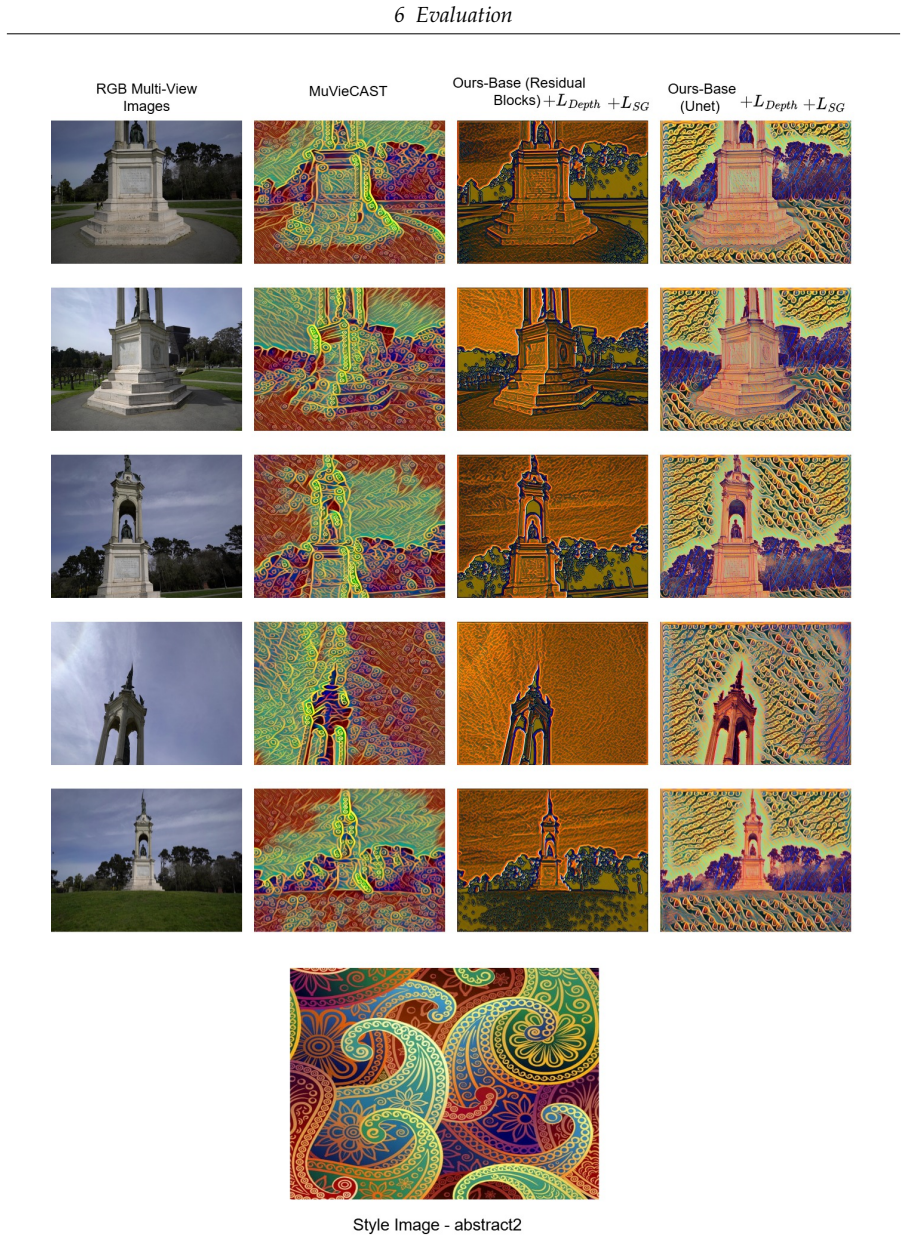
Running the method on a Tanks and Temples scene and finding that DROID-SLAM trajectories show larger drift or that symmetric Chamfer distance on back-projected point clouds increases relative to the MuVieCAST baseline would falsify the claim.
Figures









read the original abstract
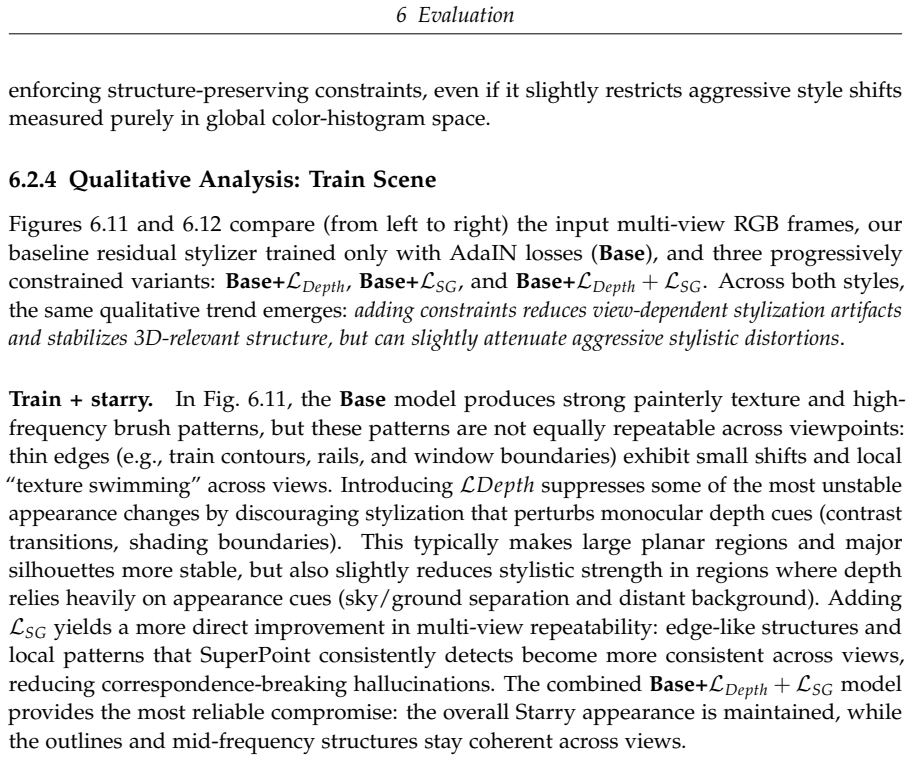
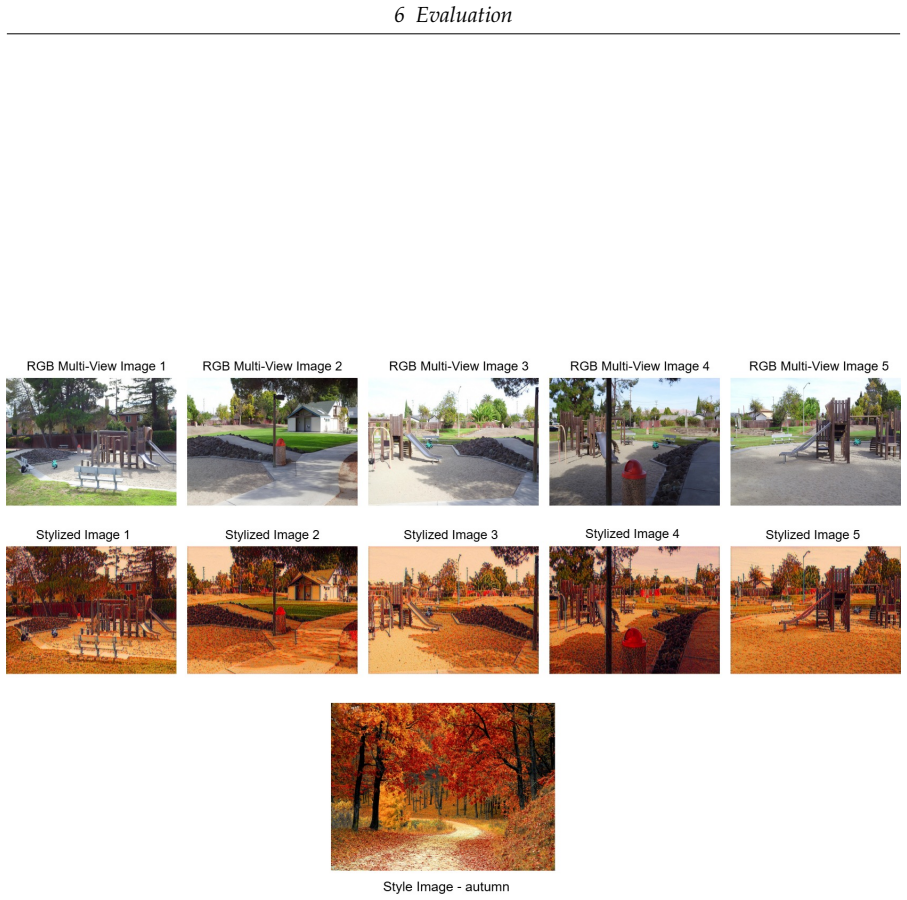
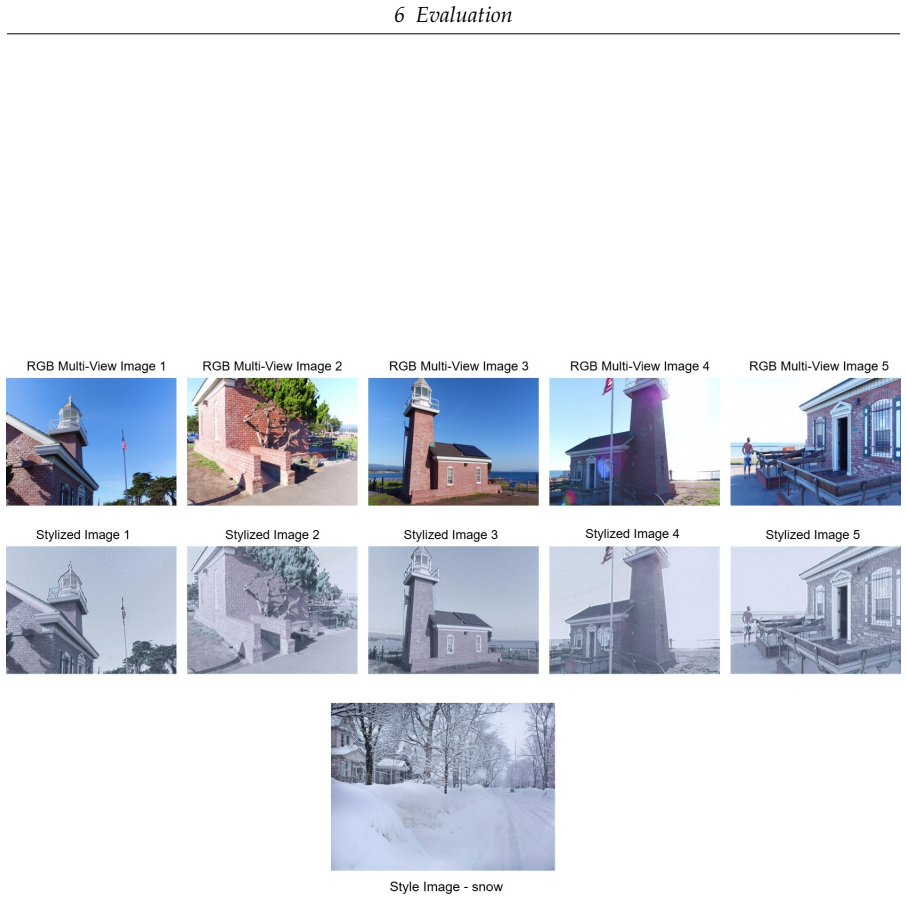
Artistic style transfer is well studied for images and videos, but extending it to multi-view 3D scenes remains difficult because stylization can disrupt correspondences needed by geometry-aware pipelines. Independent per-view stylization often causes texture drift, warped edges, and inconsistent shading, degrading SLAM, depth prediction, and multi-view reconstruction. This thesis addresses multi-view stylization that remains usable for downstream 3D tasks without assuming camera poses or an explicit 3D representation during training. We introduce a feed-forward stylization network trained with per-scene test-time optimization under a composite objective coupling appearance transfer with geometry preservation. Stylization is driven by an AdaIN-inspired loss from a frozen VGG-19 encoder, matching channel-wise moments to a style image. To stabilize structure across viewpoints, we propose a correspondence-based consistency loss using SuperPoint and SuperGlue, constraining descriptors from a stylized anchor view to remain consistent with matched descriptors from the original multi-view set. We also impose a depth-preservation loss using MiDaS/DPT and use global color alignment to reduce depth-model domain shift. A staged weight schedule introduces geometry and depth constraints. We evaluate on Tanks and Temples and Mip-NeRF 360 using image and reconstruction metrics. Style adherence and structure retention are measured by Color Histogram Distance (CHD) and Structure Distance (DSD). For 3D consistency, we use monocular DROID-SLAM trajectories and symmetric Chamfer distance on back-projected point clouds. Across ablations, correspondence and depth regularization reduce structural distortion and improve SLAM stability and reconstructed geometry; on scenes with MuVieCAST baselines, our method yields stronger trajectory and point-cloud consistency while maintaining competitive stylization.
Editorial analysis
A structured set of objections, weighed in public.
Referee Report
Summary. The manuscript proposes a feed-forward stylization network for multi-view 3D scenes that preserves geometry without camera poses or explicit 3D models. It uses an AdaIN-inspired appearance loss from frozen VGG-19, a correspondence consistency loss based on SuperPoint descriptors and SuperGlue matching between stylized anchors and original views, a depth-preservation loss from MiDaS/DPT with global color alignment, and a staged weight schedule. Evaluations on Tanks and Temples and Mip-NeRF 360 claim improved SLAM trajectory stability and point-cloud consistency (via DROID-SLAM and symmetric Chamfer distance) over MuVieCAST while maintaining competitive stylization quality via Color Histogram Distance (CHD) and Structure Distance (DSD).
Significance. If the correspondence matching assumption holds, the work provides a pragmatic, pose-free route to stylization that remains compatible with downstream geometry pipelines such as SLAM and multi-view reconstruction. The composite objective and use of off-the-shelf pre-trained networks constitute a clear engineering contribution; the staged schedule and explicit depth term are sensible safeguards against texture drift.
major comments (2)
- [Method (correspondence loss description)] The correspondence consistency loss (SuperPoint + SuperGlue between stylized anchors and original multi-view images) is load-bearing for the geometry-preservation claim. No inlier ratios, match-precision statistics, or failure-case analysis on stylized inputs are reported, so it remains unverified whether the loss enforces correct 3D-point constraints or erroneous ones induced by stylization-induced descriptor drift.
- [Experiments and results] The evaluation section provides no numerical tables, error bars, or per-scene quantitative values for CHD, DSD, trajectory RMSE, or Chamfer distance. Ablation claims of reduced structural distortion and improved SLAM stability therefore rest solely on qualitative descriptions, preventing assessment of effect size relative to MuVieCAST.
minor comments (1)
- [Method] The staged loss-weight schedule is referenced but the exact weight values, number of stages, and transition criteria are not tabulated; a supplementary table would improve reproducibility.
Simulated Author's Rebuttal
We thank the referee for the constructive comments and for recognizing the pragmatic engineering contributions of the composite objective and staged schedule. We will perform a major revision to strengthen the quantitative validation of the correspondence loss and to include full numerical results tables. Below we address each major comment in turn.
read point-by-point responses
-
Referee: [Method (correspondence loss description)] The correspondence consistency loss (SuperPoint + SuperGlue between stylized anchors and original multi-view images) is load-bearing for the geometry-preservation claim. No inlier ratios, match-precision statistics, or failure-case analysis on stylized inputs are reported, so it remains unverified whether the loss enforces correct 3D-point constraints or erroneous ones induced by stylization-induced descriptor drift.
Authors: We agree that explicit verification of the correspondence matching quality on stylized images is necessary to support the geometry-preservation claim. In the revised manuscript we will add a dedicated subsection reporting inlier ratios, match-precision statistics, and descriptor-distance histograms computed on both original and stylized views across all evaluated scenes. We will also include a short failure-case analysis highlighting scenes where stylization-induced drift is most pronounced and how the staged weight schedule and depth term limit propagation of erroneous matches. revision: yes
-
Referee: [Experiments and results] The evaluation section provides no numerical tables, error bars, or per-scene quantitative values for CHD, DSD, trajectory RMSE, or Chamfer distance. Ablation claims of reduced structural distortion and improved SLAM stability therefore rest solely on qualitative descriptions, preventing assessment of effect size relative to MuVieCAST.
Authors: We acknowledge that the absence of tabulated numerical results limits the ability to judge effect sizes. The revised version will contain complete tables reporting per-scene CHD, DSD, DROID-SLAM trajectory RMSE, and symmetric Chamfer distance values (with means and standard deviations) for all methods and ablations. These tables will directly compare our approach against MuVieCAST on the Tanks and Temples and Mip-NeRF 360 scenes, enabling quantitative assessment of the claimed improvements in SLAM stability and point-cloud consistency. revision: yes
Circularity Check
No circularity; derivation uses external pre-trained networks and explicit losses without self-referential reduction
full rationale
The paper presents a feed-forward stylization network trained via test-time optimization under a composite loss: AdaIN-style moment matching from a frozen VGG-19 encoder, a correspondence consistency term that matches SuperPoint descriptors via SuperGlue between stylized and original views, and a depth-preservation term from MiDaS/DPT. All components are drawn from independent, pre-trained external models rather than parameters fitted to the method's own outputs. Evaluation relies on separate metrics (Color Histogram Distance, Structure Distance, DROID-SLAM trajectories, symmetric Chamfer distance) that are not algebraically forced by the training losses. No equations, self-citations, or uniqueness claims are shown that would collapse the claimed geometry preservation back to the inputs by construction. The chain is therefore self-contained against external benchmarks.
Axiom & Free-Parameter Ledger
free parameters (1)
- staged loss weights
axioms (1)
- domain assumption Frozen VGG-19, SuperPoint/SuperGlue, and MiDaS/DPT models produce reliable style statistics, correspondences, and depths on stylized inputs.
Lean theorems connected to this paper
-
IndisputableMonolith/Cost/FunctionalEquation.leanwashburn_uniqueness_aczel unclear?
unclearRelation between the paper passage and the cited Recognition theorem.
correspondence-based geometric consistency loss using SuperPoint detections and SuperGlue matching: descriptors from a stylized anchor view are constrained to remain consistent with descriptors from the original multi-view set
-
IndisputableMonolith/Foundation/AlexanderDuality.leanalexander_duality_circle_linking unclear?
unclearRelation between the paper passage and the cited Recognition theorem.
depth-preservation loss using a frozen MiDaS/DPT teacher network
What do these tags mean?
- matches
- The paper's claim is directly supported by a theorem in the formal canon.
- supports
- The theorem supports part of the paper's argument, but the paper may add assumptions or extra steps.
- extends
- The paper goes beyond the formal theorem; the theorem is a base layer rather than the whole result.
- uses
- The paper appears to rely on the theorem as machinery.
- contradicts
- The paper's claim conflicts with a theorem or certificate in the canon.
- unclear
- Pith found a possible connection, but the passage is too broad, indirect, or ambiguous to say the theorem truly supports the claim.
Reference graph
Works this paper leans on
-
[1]
Mip-nerf: A multiscale representation for anti-aliasing neural radiance fields
J. T. Barron, B. Mildenhall, M. Tancik, P . Hedman, R. Martin-Brualla, and P . P . Srinivasan. “Mip-nerf: A multiscale representation for anti-aliasing neural radiance fields”. In: Proceedings of the IEEE/CVF international conference on computer vision. 2021, pp. 5855– 5864
work page 2021
-
[2]
Mip-nerf 360: Unbounded anti-aliased neural radiance fields
J. T. Barron, B. Mildenhall, D. Verbin, P . P . Srinivasan, and P . Hedman. “Mip-nerf 360: Unbounded anti-aliased neural radiance fields”. In:Proceedings of the IEEE/CVF conference on computer vision and pattern recognition. 2022, pp. 5470–5479
work page 2022
-
[3]
Kitov et al.style-transfer-dataset: A dataset of style images for neural style transfer
V . Kitov et al.style-transfer-dataset: A dataset of style images for neural style transfer. https: //github.com/victorkitov/style-transfer-dataset . GitHub repository. Accessed: 2026-01-10. 2024
work page 2026
-
[4]
Histogan: Controlling colors of gan- generated and real images via color histograms
M. Afifi, M. A. Brubaker, and M. S. Brown. “Histogan: Controlling colors of gan- generated and real images via color histograms”. In:Proceedings of the IEEE/CVF confer- ence on computer vision and pattern recognition. 2021, pp. 7941–7950
work page 2021
-
[5]
Splicing vit features for semantic appearance transfer
N. Tumanyan, O. Bar-Tal, S. Bagon, and T. Dekel. “Splicing vit features for semantic appearance transfer”. In:Proceedings of the IEEE/CVF Conference on Computer Vision and Pattern Recognition. 2022, pp. 10748–10757
work page 2022
-
[6]
Emerging properties in self-supervised vision transformers
M. Caron, H. Touvron, I. Misra, H. Jégou, J. Mairal, P . Bojanowski, and A. Joulin. “Emerging properties in self-supervised vision transformers”. In:Proceedings of the IEEE/CVF international conference on computer vision. 2021, pp. 9650–9660. 94
work page 2021
discussion (0)
Sign in with ORCID, Apple, or X to comment. Anyone can read and Pith papers without signing in.