Recognition: unknown
Relativistic figures of equilibrium in the Wald magnetosphere
Pith reviewed 2026-05-10 16:28 UTC · model grok-4.3
The pith
A rigidly rotating charged perfect fluid with vanishing conductivity can remain compatible with Wald's magnetosphere in non-vacuum spacetimes.
A machine-rendered reading of the paper's core claim, the machinery that carries it, and where it could break.
Core claim
In non-vacuum spacetimes, Wald's vacuum magnetic solution remains compatible with the electric current associated with a rotating charged perfect fluid of vanishing electric conductivity. For rigidly rotating fluids with constant energy density or a polytropic equation of state, the conservation of the energy-momentum tensor can be integrated, so the system is governed by nearly standard Einstein-Euler equations with a modification only in the Euler-Bernoulli equation.
What carries the argument
The Wald magnetosphere, an electromagnetic field constructed from two linearly independent Killing vectors in a stationary axisymmetric spacetime, which supplies the background magnetic field that matches the fluid current when conductivity vanishes.
If this is right
- The Einstein-Euler system for rigidly rotating fluids acquires only a single extra term in the Bernoulli integral when the Wald field is present.
- Numerical equilibria for constant-density and polytropic cases can be obtained by minor changes to an existing pseudospectral code.
- Self-gravitating, rigidly rotating charged fluids can be modeled without solving the full coupled Maxwell-Einstein system.
- The construction works for any stationary axisymmetric spacetime that admits the required Killing vectors.
Where Pith is reading between the lines
- The same integration trick may apply to other simple equations of state, allowing quick extension of the numerical models.
- Stability calculations for these magnetized configurations could reuse techniques already developed for unmagnetized rotating stars.
- The models supply initial data for dynamical simulations of rotating compact objects that carry a prescribed magnetic field.
Load-bearing premise
Wald's vacuum magnetic field remains consistent with the electric current of the rotating fluid once the spacetime is allowed to be non-vacuum.
What would settle it
A direct integration of Maxwell's equations with the four-current derived from the rotating charged fluid that yields an electromagnetic field differing from the Wald solution.
Figures


read the original abstract
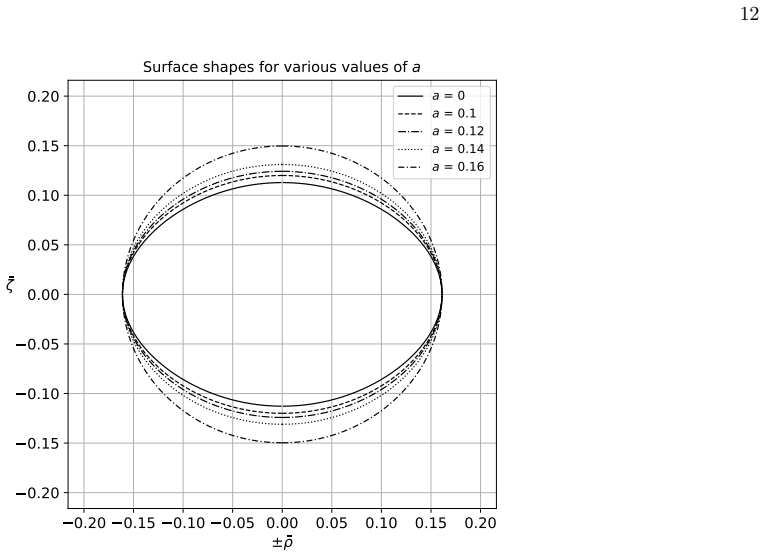
We consider a self-gravitating, rigidly rotating charged perfect fluid immersed in the Wald magnetosphere, constructed out of two linearly independent Killing vectors present in stationary and axially-symmetric spacetimes. We show that in non-vacuum spacetimes, Wald's solution can be compatible with the electric current associated with a rotating charged perfect fluid characterized by the vanishing electric conductivity. We prove that for rigidly rotating fluids with a constant energy density or described by the polytropic equation of state, the resulting equations expressing the conservation of the energy-momentum tensor can be integrated. Consequently, the system can be described by nearly standard Einstein-Euler equations known from the theory of general-relativistic rotating fluids, with modifications introduced in the Euler-Bernoulli equation. Numerical solutions of the Einstein-Euler equations are provided for these two cases by introducing suitable modifications in the pseudospectral code by Ansorg, Kleinw\"{a}chter, and Meinel.
Editorial analysis
A structured set of objections, weighed in public.
Referee Report
Summary. The paper considers self-gravitating, rigidly rotating charged perfect fluids immersed in the Wald magnetosphere constructed from the two Killing vectors of a stationary axisymmetric spacetime. It shows that Wald's vacuum electromagnetic field remains compatible with the fluid's electric current when electric conductivity vanishes, and proves that for constant energy density or polytropic equations of state the conservation of the energy-momentum tensor integrates to a modified Euler-Bernoulli relation. This reduces the system to the standard Einstein-Euler equations with only that relation altered, and the authors supply numerical equilibria by inserting the modified relation into an existing pseudospectral code.
Significance. If the integrability and numerical implementation hold, the work supplies a concrete, reproducible extension of the theory of relativistic rotating stars to include a Wald-type magnetic field while preserving the structure of the Einstein-Euler system for two standard equations of state. The reuse and modification of the established Ansorg-Kleinwächter-Meinel pseudospectral solver is a strength that supports direct comparison with non-magnetized equilibria.
major comments (2)
- [Numerical solutions] Numerical solutions section: the abstract and text assert that solutions exist for the two equations of state, yet no information is given on grid resolution, convergence tests, residual norms, or comparison against the non-magnetized limit (e.g., the known constant-density or polytropic sequences without the Wald field). This omission prevents assessment of whether the reported equilibria are accurate to the claimed precision.
- [Derivation of the integrated Euler-Bernoulli equation] The compatibility argument relies on the current four-vector being exactly parallel to the fluid four-velocity when conductivity vanishes; however, the manuscript does not explicitly verify that the resulting Maxwell equations remain satisfied once the fluid back-reacts on the metric (i.e., in the non-vacuum spacetime). A concrete check against the sourced Maxwell equations in the numerical solutions would strengthen the central claim.
minor comments (2)
- [Integration of the conservation laws] The notation for the modified Bernoulli integral should be introduced with an explicit equation number immediately after the integration step, rather than being referred to only descriptively.
- [Numerical implementation] A brief statement of the boundary conditions imposed at the stellar surface and at spatial infinity would clarify how the Wald field is matched to the interior solution.
Simulated Author's Rebuttal
We thank the referee for their thorough review and insightful comments on our manuscript. We address each major comment below and have prepared revisions to strengthen the presentation of our results.
read point-by-point responses
-
Referee: Numerical solutions section: the abstract and text assert that solutions exist for the two equations of state, yet no information is given on grid resolution, convergence tests, residual norms, or comparison against the non-magnetized limit (e.g., the known constant-density or polytropic sequences without the Wald field). This omission prevents assessment of whether the reported equilibria are accurate to the claimed precision.
Authors: We acknowledge that the numerical section would benefit from more detailed information on the computational parameters and validation. In the revised manuscript, we will include the grid resolutions employed in the pseudospectral code, results from convergence tests demonstrating the expected spectral accuracy, the norms of the residuals for the Einstein-Euler equations, and direct comparisons of key quantities (such as mass, angular momentum, and magnetic field strength) with the corresponding non-magnetized equilibria from the literature. These additions will allow readers to assess the accuracy of the reported solutions. revision: yes
-
Referee: The compatibility argument relies on the current four-vector being exactly parallel to the fluid four-velocity when conductivity vanishes; however, the manuscript does not explicitly verify that the resulting Maxwell equations remain satisfied once the fluid back-reacts on the metric (i.e., in the non-vacuum spacetime). A concrete check against the sourced Maxwell equations in the numerical solutions would strengthen the central claim.
Authors: The analytical derivation demonstrates that the Wald electromagnetic field, defined using the two Killing vectors, remains compatible with the fluid current (which is parallel to the four-velocity for vanishing conductivity) even in the presence of the fluid's energy-momentum tensor. This compatibility follows from the properties of the Killing vectors and the form of the Maxwell tensor, independent of the specific metric solution. Nevertheless, to address the referee's concern, we will add an explicit verification in the numerical solutions section, showing that the sourced Maxwell equations are satisfied to the level of the numerical truncation error in our computed equilibria. This will be done by computing the divergence of the electromagnetic field tensor and comparing it to the current four-vector. revision: yes
Circularity Check
No significant circularity; derivation self-contained from standard GR plus Wald construction
full rationale
The paper begins with the Einstein equations, the Wald electromagnetic field built from the two Killing vectors of a stationary axisymmetric spacetime, and the assumption of vanishing conductivity. It then demonstrates that the resulting current is parallel to the fluid four-velocity, shows that the electromagnetic term in the Euler equation becomes a gradient for constant-density and polytropic EOS, integrates to a modified Bernoulli relation, and solves the resulting system numerically by adapting an existing pseudospectral code. None of these steps reduces to a self-definition, a fitted parameter renamed as a prediction, or a load-bearing self-citation. The central compatibility and integrability results are direct mathematical consequences of the stated assumptions and do not presuppose the final equations.
Axiom & Free-Parameter Ledger
axioms (2)
- domain assumption Spacetime is stationary and axially symmetric, admitting two linearly independent Killing vectors
- ad hoc to paper Electric conductivity of the fluid vanishes
Reference graph
Works this paper leans on
-
[1]
They can be computed directly from Eq
= 1 (this corresponds top= 0). They can be computed directly from Eq. (44), or from the explicit solution (45). We set C= 1. a= 0,u t 0 = 1a= 0.1,u t 0 = 0.965166a= 0.2,u t 0 = 0.833049 H(0)(ut
-
[2]
1 0.991602 0.923646 H(2)(ut
-
[3]
0−0.0401569−0.102436 H(3)(ut
-
[4]
0 0.308907 1.4975 H(4)(ut
-
[5]
0−2.08438−13.8529 H(5)(ut
-
[6]
0 15.2849 136.129 H(6)(ut
-
[7]
0−125.617−1506.29 H(7)(ut
-
[8]
0 1158.14 18845.7 H(8)(ut
-
[9]
0−11906.4−264557. H(9)(ut
-
[10]
0 135467.4.12572×10 6 H(10)(ut
-
[11]
0−1.6931×10 6 −7.07924×10 7 and p ρ0 = p ε =h−1.(43) Inserting this into Eq. (41), we obtain the equation H′ − H 1 ut + 4a2(3H −2) 1 (ut)3 = 0,(44) which, upon integration, yields H(ut) =− 1 18a " √ 6πut erf √ 6a ut ! exp 6a2 (ut)2 −12a # +Cu t exp 6a2 (ut)2 ,(45) whereCis the integration constant. Using the property lim x→0(erf(x)/x) = 2/√π, it can be ch...
-
[12]
:=∂ nH(ut 0)/∂(ut)n, whereu t 0 satisfiesH(u t
-
[13]
This choice corresponds to the vanishing pressure,p= 0
= 1. This choice corresponds to the vanishing pressure,p= 0. In the examples collected in Tab. I, we setC= 1 and choose the values ofa= 0.1 anda= 0.2. In contrast to this behavior, fora= 0 one has the limitH(u t) =Cu t (Eq. (46)). In this caseH ′(ut) =C, and all higher derivatives vanish. B. Polytropic fluids For the polytropic equation of state,p=Kρ Γ 0 ...
-
[14]
0.98495 0.905376 0.983643 0.901805 H(2)(ut
-
[15]
0.00378691 0.116285 0.0122771 0.153011 H(3)(ut
-
[16]
0.0722495−0.0887735 0.0273865−0.326636 H(4)(ut 0)−0.648803−0.977188−0.382514 0.735717 H(5)(ut
-
[17]
5.20721 13.9595 3.38265 0.388689 H(6)(ut 0)−44.2599−161.221−29.9133−21.9982 H(7)(ut
-
[18]
411.595 1921.32 283.591 376.375 H(8)(ut 0)−4210.37−24781.9−2928.97−5436.9 H(9)(ut
1921
-
[19]
Support for Talented Doctoral Students at the Silesian University in Opava 2022
47268.1 349591.33021.2 79576.8 H(10)(ut 0)−579707−5.39059×10 6 −405334−1.23344×10 6 and consequently p ρ0 = Γ−1 Γ (h−1).(49) Therefore, condition (41) becomes H′ − H 1 ut + 4a2 H+ 2 Γ−1 Γ (H −1) 1 (ut)3 = 0.(50) The above equation can be integrated as H(ut) =− (Γ−1) √ 2πΓut erf a √ 2(3Γ−2)√ Γut exp 2a2(3Γ−2) Γ(ut)2 −4a √ 3Γ−2 2a(3Γ−2) 3/2 +Cu t exp 2a2(3Γ...
-
[20]
R. M. Wald, Black hole in a uniform magnetic field, Phys. Rev. D 10, 1680 (1974). doi: 10.1103/PhysRevD.10.1680. 19
-
[21]
J. Ben Achour, I. El Mellah, and E. Gourgoulhon, Jet launching from the Kerr black hole magnetosphere: An electrogeodesic approach, arXiv:2601.05048 (2026). doi: 10.48550/arXiv.2601.05048
-
[22]
R. Meinel, M. Ansorg, A. Kleinw¨ achter, G. Neugebauer, and D. Petroff, Relativistic Figures of Equilibrium, Cambridge University Press, Cambridge 2008. doi: 10.1017/CBO9780511535154
-
[23]
M. Ansorg, A. Kleinw¨ achter, and R. Meinel, Highly accurate calculation of rotating neutron stars: Detailed description of the numerical methods, Astron. Astrophys. 405, 711 (2003). doi: 10.1051/0004-6361:20030618
-
[24]
J. D. Bekenstein and E. Oron, New conservation laws in general-relativistic magnetohydrodynamics, Phys. Rev. D 18, 1809 (1978). doi: 10.1103/PhysRevD.18.1809
-
[25]
J. D. Bekenstein and E. Oron, Interior magnetohydrodynamic structure of a rotating relativistic star, Phys. Rev. D 19, 2827 (1979). doi: 10.1103/PhysRevD.19.2827
-
[26]
ROTATING NEUTRON STAR MODELS WITH MAGNETIC FIELD
M. Bocquet, S. Bonazzola, E. Gourgoulhon, and J. Novak, Rotating neutron star models with a magnetic field, Astron. Astrophys. 301, 757 (1995). doi: 10.48550/arXiv.gr-qc/9503044
work page internal anchor Pith review doi:10.48550/arxiv.gr-qc/9503044 1995
-
[27]
K. Konno, T. Obata, and Y. Kojima, Deformation of relativistic magnetized stars, Astron. Astrophys. 352, 211 (1999). doi: 10.48550/arXiv.gr-qc/9910038
-
[28]
Ch. Y. Cardall, M. Prakash, and J. M. Lattimer, Effects of strong magnetic fields on neutron star structure, Astrophys. J. 554, 322 (2001). doi: 10.1086/321370
-
[29]
Bonazzola, E
S. Bonazzola, E. Gourgoulhon, M. Salgado, and J. A. Marck, Axisymmetric rotating relativistic bodies: A new numerical approach for ‘exact’ solutions, Astron. Astrophys. 278, 421 (1993)
1993
-
[30]
2012, MNRAS, 427, 127, doi: 10.1111/j.1365-2966.2012.21948.x
J. Frieben and L. Rezzolla, Equilibrium models of relativistic magnetized neutron stars: Axisymmetric solutions with poloidal and toroidal magnetic fields, Mon. Not. R. Astron. Soc. 427, 3406 (2012). doi: 10.1111/j.1365-2966.2012.22027.x
-
[31]
K. Kiuchi and S. Yoshida, Relativistic stars with purely toroidal magnetic fields, Phys. Rev. D 78, 044045 (2008). doi: 10.1103/PhysRevD.78.044045
-
[32]
2010, MNRAS, 401, 1670, doi: 10.1111/j.1365-2966.2009.15794.x
R. Ciolfi, V. Ferrari, L. Gualtieri, and J. A. Pons, Relativistic models of magnetars: The twisted torus magnetic field configuration, Mon. Not. R. Astron. Soc. 397, 913 (2009). doi: 10.1111/j.1365-2966.2009.14990.x
-
[33]
R. Ciolfi and L. Rezzolla, Twisted-torus configurations with large toroidal magnetic fields in relativistic stars, Mon. Not. R. Astron. Soc. Lett. 435, L43 (2013). doi: 10.1093/mnrasl/slt092
-
[34]
K. Ioka and M. Sasaki, Relativistic stars with poloidal and toroidal magnetic fields and meridional flow, Astrophys. J. 600, 296 (2004). doi: 10.1086/379650
-
[35]
O. Zanotti and L. Rezzolla, General relativistic electromagnetic fields of a slowly rotating magnetized neutron star — II. Solution of the induction equations, Mon. Not. R. Astron. Soc. 331, 376 (2002). doi: 10.1046/j.1365-8711.2002.05196.x
-
[36]
K. Ioka and M. Sasaki, Grad–Shafranov equation in non-circular stationary axisymmetric spacetimes, Phys. Rev. D 67, 124026 (2003). doi: 10.1103/PhysRevD.67.124026
-
[37]
E. Gourgoulhon, Ch. Markakis, K. Uryu, and Y. Eriguchi, Magnetohydrodynamics in stationary and axisymmetric space- times: A fully covariant approach, Phys. Rev. D 83, 104007 (2011). doi: 10.1103/PhysRevD.83.104007
-
[38]
K. Uryu, E. Gourgoulhon, Ch. M. Markakis, K. Fujisawa, A. Tsokaros, and Y. Eriguchi, Equilibrium solutions of relativis- tic rotating stars with mixed poloidal and toroidal magnetic fields, Phys. Rev. D 90, 101501 (2014). doi: 10.1103/Phys- RevD.90.101501
-
[39]
2010, MNRAS, 401, 1670, doi: 10.1111/j.1365-2966.2009.15794.x
J. Otani, R. Takahashi, and Y. Eriguchi, Equilibrium states of magnetized toroid–central compact object systems, Mon. Not. R. Astron. Soc. 396, 2152 (2009). doi: 10.1111/j.1365-2966.2009.14842.x
-
[40]
O. Zanotti and D. Pugliese, Von Zeipel’s theorem for a magnetized circular flow around a compact object, Gen. Relativ. Gravit. 47, 44 (2015). doi: 10.1007/s10714-015-1886-4
-
[41]
P. Mach, S. Gimeno-Soler, J. A. Font, A. Odrzywo lek, and M. Pir´ og, Self-gravitating magnetized tori around black holes in general relativity, Phys. Rev. D 99, 104063 (2019). doi: 10.1103/PhysRevD.99.104063
-
[42]
W. Dyba, P. Mach, and M. Pietrzy´ nski, Toroidal magnetic fields in self-gravitating disks around black holes, Phys. Rev. D 104, 044058 (2021). doi: 10.1103/PhysRevD.104.044058
-
[43]
Shibata, Rotating black hole surrounded by self-gravitating torus in the puncture framework, Phys
M. Shibata, Rotating black hole surrounded by self-gravitating torus in the puncture framework, Phys. Rev. D 76, 064035 (2007). doi: 10.1103/PhysRevD.76.064035
-
[44]
J. Karkowski, W. Kulczycki, P. Mach, E. Malec, A. Odrzywo lek, and M. Pir´ og, General-relativistic rotation: Self-gravitating fluid tori in Keplerian motion around black holes, Phys. Rev. D 97, 104034 (2018). doi: 10.1103/PhysRevD.97.104034
-
[45]
J. Karkowski, W. Kulczycki, P. Mach, E. Malec, A. Odrzywo lek, and M. Pir´ og, Self-gravitating axially symmetric disks in general-relativistic rotation, Phys. Rev. D 97, 104017 (2018). doi: 10.1103/PhysRevD.97.104017
-
[46]
Ch. G. Tsagas, Electromagnetic fields in curved spacetimes, Class. Quantum Grav. 22, 393 (2005). doi: 10.1088/0264- 9381/22/2/011
-
[47]
J. Kov´ aˇ r, P. Slan´ y, Z. Stuchl´ ık, V. Karas, C. Cremaschini, and J. C. Miller, Role of electric charge in shaping equilibrium configurations of fluid tori encircling black holes, Phys. Rev. D 84, 084002 (2011). doi: 10.1103/PhysRevD.84.084002
-
[48]
A. Trova, Equilibrium of charged fluid around a Kerr black hole immersed in a magnetic field: Variation of angular momentum, Int. J. Mod. Phys. D 33, 2350112 (2024). doi: 10.1142/S0218271823501122
-
[49]
A. Trova, E. Hackmann, V. Karas, K. Schroven, J. Kov´ aˇ r, and P. Slan´ y, Influence of test charge and uniform magnetic field on charged fluid equilibrium structures, Phys. Rev. D 101, 083027 (2020). doi: 10.1103/PhysRevD.101.083027
-
[50]
L. I. Petrich, S. L. Shapiro, and S. A. Teukolsky, Accretion onto a moving black hole: An exact solution, Phys. Rev. Lett. 60, 1781 (1988). doi: 10.1103/PhysRevLett.60.1781
-
[51]
Straumann, General Relativity (2nd edition), Springer, Dordrecht 2013
N. Straumann, General Relativity (2nd edition), Springer, Dordrecht 2013. doi: 10.1007/978-94-007-5410-2
-
[52]
R. M. Wald, General Relativity, The University of Chicago Press, Chicago 1984. doi: 10.7208/chicago/9780226870373.001.0001. 20
-
[53]
M. Ansorg and D. Petroff, Black holes surrounded by uniformly rotating rings, Phys. Rev. D 72, 024019 (2005). doi: 10.1103/PhysRevD.72.024019
-
[54]
J. M. Bardeen and R. V. Wagoner, Relativistic disks. I. Uniform rotation, Astrophys. J. 167, 359 (1971). doi: 10.1086/151039
discussion (0)
Sign in with ORCID, Apple, or X to comment. Anyone can read and Pith papers without signing in.