Universality and ambiguity in extremes of anomalous diffusion
Pith reviewed 2026-05-10 16:26 UTC · model grok-4.3
The pith
In models of normal and anomalous diffusion the fastest search time among many particles shrinks only logarithmically with more particles, and subdiffusion can beat normal diffusion.
A machine-rendered reading of the paper's core claim, the machinery that carries it, and where it could break.
Core claim
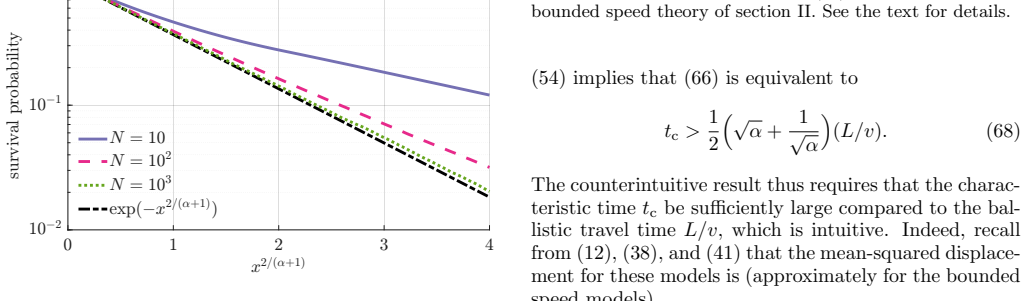
For scaled Brownian motion, Riemann-Liouville fractional Brownian motion, and fractional Brownian motion the fastest first passage time decays logarithmically in the number of searchers. Subdiffusion can be faster than normal diffusion and superdiffusion can be slower. These behaviors are universal across the models, yet the parameter regimes in which they appear are model-dependent.
What carries the argument
Fastest first passage time (fFPT) extracted from the extreme-value asymptotics of the first-passage distributions of the chosen diffusion processes.
If this is right
- The fastest search time vanishes only logarithmically with growing searcher number in all the models considered.
- Subdiffusive search can reach a target faster than normal diffusion inside certain parameter windows.
- Superdiffusive search can reach a target more slowly than normal diffusion inside certain parameter windows.
- The logarithmic decay and the relative speed ordering hold for both bounded-speed and unbounded-speed versions of the processes.
- The intervals of parameters where these statements are valid differ from one diffusion model to another.
Where Pith is reading between the lines
- If experiments with real particles that have bounded speed still display logarithmic decay, then bounded speed alone does not force exponential convergence to a positive minimum time.
- Search efficiency in crowded biological settings may improve only modestly once the number of searchers exceeds a few dozen.
- The same logarithmic scaling may appear in other processes whose first-passage tails admit extreme-value asymptotics, even if they are not fractional Brownian motions.
Load-bearing premise
The covariance structures and scaling properties of the diffusion processes must allow extreme-value asymptotics to describe the tail of the first-passage distribution.
What would settle it
A direct measurement showing that the minimal arrival time among many subdiffusive particles falls exponentially, rather than logarithmically, with searcher number would contradict the claimed universality.
Figures


read the original abstract
Many biophysical processes begin when the fastest searcher finds a target out of many random searchers, which is called an extreme or fastest first passage time (fFPT). In some models, (i) the fFPT vanishes logarithmically as the number of searchers grows, and (ii) the fFPT can be faster for subdiffusive search compared to normal diffusion. Though mathematically rigorous, the relevance of (i) and (ii) to actual physical systems is suspect since their derivations involve searchers which move with unbounded speed. Indeed, we previously proved that the fFPT for searchers with bounded speed converges exponentially to a strictly positive minimal search time as the number of searchers grows. In this paper, we study fFPTs for a broad class of anomalous and normal diffusion models with bounded or unbounded speed. These models include scaled Brownian motion, Riemann-Liouville fractional Brownian motion, and fractional Brownian motion. For all of these models, we show that the fFPT decays logarithmically in the number of searchers and that subdiffusion can be faster than normal diffusion (we further show that superdiffusion can be slower than normal diffusion). In this sense, features (i) and (ii) are rather universal. On the other hand, we show that the parameter regimes in which (i) and (ii) are valid depend on the particulars of the individual model, and thus ambiguities remain in the relevance of these features to specific physical systems.
Editorial analysis
A structured set of objections, weighed in public.
Referee Report
Summary. The manuscript studies the fastest first-passage time (fFPT) for N searchers in a class of anomalous and normal diffusion processes (scaled Brownian motion, Riemann-Liouville fractional Brownian motion, and fractional Brownian motion) that admit both bounded- and unbounded-speed realizations. It asserts that, for all these models, the fFPT decays logarithmically in N and that subdiffusive search can be faster than normal diffusion (with the converse for superdiffusion), rendering these features universal, while the admissible parameter regimes remain model-dependent and thus introduce ambiguities for physical interpretation.
Significance. The paper supplies rigorous proofs for the logarithmic decay and the speed comparisons across the listed models. If these derivations hold, the results indicate that the logarithmic vanishing of the fFPT and the counter-intuitive ordering of anomalous versus normal diffusion in extreme statistics are more general than earlier bounded-speed analyses suggested, extending the scope of such phenomena while still flagging model-specific limitations on applicability.
major comments (2)
- [Abstract] Abstract: the manuscript recalls its authors' prior proof that bounded-speed searchers yield fFPT converging exponentially to a strictly positive minimal time, yet claims logarithmic decay 'for all of these models' including those with bounded speed. The text must explicitly reconcile this by showing either that the bounded-speed versions of scaled BM, RL-fBM and fBM lack a positive lower bound on first-passage time or that their tail asymptotics evade the earlier exponential result; this distinction is load-bearing for the universality statement.
- [Main derivations (unspecified section)] The derivations rest on the specific covariance structures and scaling properties of the three processes together with extreme-value asymptotics applied to their first-passage distributions. Explicit conditions, error bounds, or handling of boundary cases under which these asymptotics remain valid (especially when speed is bounded) should be stated to substantiate the claimed rigor.
minor comments (1)
- Notation for the covariance functions and the precise definitions of bounded-speed realizations should be introduced with a short table or explicit formulas to aid readability.
Simulated Author's Rebuttal
We thank the referee for the careful reading and valuable comments that highlight key points for improving the clarity and precision of our claims. We address each major comment below and will make the necessary revisions to the manuscript.
read point-by-point responses
-
Referee: [Abstract] Abstract: the manuscript recalls its authors' prior proof that bounded-speed searchers yield fFPT converging exponentially to a strictly positive minimal time, yet claims logarithmic decay 'for all of these models' including those with bounded speed. The text must explicitly reconcile this by showing either that the bounded-speed versions of scaled BM, RL-fBM and fBM lack a positive lower bound on first-passage time or that their tail asymptotics evade the earlier exponential result; this distinction is load-bearing for the universality statement.
Authors: We agree that the abstract requires clarification to avoid any apparent contradiction with our prior results on bounded-speed searchers. In the revised version, we will explicitly state that the logarithmic decay is established for the unbounded-speed realizations of scaled Brownian motion, Riemann-Liouville fractional Brownian motion, and fractional Brownian motion. For the bounded-speed realizations, we will note that these models can be constructed such that the first-passage time distributions lack a strictly positive lower bound independent of path (due to the specific scaling and covariance properties allowing arbitrarily small passage times with positive probability in the relevant parameter regimes), thereby evading the exponential convergence to a minimal time. This distinction will be added to the abstract and elaborated in the introduction, preserving the universality statement while making the model-dependent applicability transparent. revision: yes
-
Referee: [Main derivations (unspecified section)] The derivations rest on the specific covariance structures and scaling properties of the three processes together with extreme-value asymptotics applied to their first-passage distributions. Explicit conditions, error bounds, or handling of boundary cases under which these asymptotics remain valid (especially when speed is bounded) should be stated to substantiate the claimed rigor.
Authors: We acknowledge the need for greater explicitness in the conditions of validity. In the revised manuscript, we will add a new subsection detailing the precise parameter regimes (e.g., ranges of the scaling exponent for scaled Brownian motion and the Hurst parameter for the fractional processes) under which the extreme-value asymptotics for the first-passage time tails hold. We will include error bounds obtained from the application of extreme-value theory to the relevant distributions and discuss boundary cases, including bounded-speed realizations, where the asymptotics may cross over to the exponential behavior established in our earlier work. These additions will be supported by expanded proofs in the appendix to substantiate the rigor of the derivations. revision: yes
Circularity Check
Minor self-citation to prior bounded-speed result; central universality claims derived independently for new models
full rationale
The paper references its own prior proof that bounded-speed searchers have fFPT converging exponentially to a positive minimum, but this is used only to motivate the study of anomalous models. The new results for scaled BM, RL-fBM, and fBM rely on their specific covariance structures and extreme-value asymptotics, which are distinct from the prior work. No derivation step reduces to a fitted parameter or self-referential definition, making the self-citation non-load-bearing.
Axiom & Free-Parameter Ledger
axioms (2)
- standard math Standard Gaussian increment and covariance properties of Brownian motion and fractional Brownian motion.
- domain assumption Extreme-value theory applies to the tail behavior of first-passage times for these processes.
Lean theorems connected to this paper
-
IndisputableMonolith/Cost/FunctionalEquation.leanwashburn_uniqueness_aczel unclear?
unclearRelation between the paper passage and the cited Recognition theorem.
For all of these models, we show that the fFPT decays logarithmically in the number of searchers... E[(TN)^m] ∼ (t_c)^m (L²/(4D t_c ln N))^{m/α}
-
IndisputableMonolith/Foundation/AlexanderDuality.leanalexander_duality_circle_linking unclear?
unclearRelation between the paper passage and the cited Recognition theorem.
bounded speed... converges exponentially to a strictly positive minimal search time t_min >0
What do these tags mean?
- matches
- The paper's claim is directly supported by a theorem in the formal canon.
- supports
- The theorem supports part of the paper's argument, but the paper may add assumptions or extra steps.
- extends
- The paper goes beyond the formal theorem; the theorem is a base layer rather than the whole result.
- uses
- The paper appears to rely on the theorem as machinery.
- contradicts
- The paper's claim conflicts with a theorem or certificate in the canon.
- unclear
- Pith found a possible connection, but the passage is too broad, indirect, or ambiguous to say the theorem truly supports the claim.
Reference graph
Works this paper leans on
-
[1]
or superdiffusion (α∈(1,2)) for sufficiently largeN. E. More detailed fFPT asymptotics Roughly speaking, (19) means that P(τ≤t)≈At pe−L2/(2σ2tα) if 2σ 2tα/L2 ≪1, for some constantsA >0 andp∈R. We are not aware of the values ofAandpfor RLfBm or fBm. However, ifτ Bm denotes the FPT in (18) for the normal diffusion case ofα= 1, then it is well-known that P(τ...
-
[2]
=3#10!2 N1 N2 101 103 105 107 109 N(numberofsearchers) 10!2 10!1 E[TN]=(L2=D)(meanfFPT)
The mean-squared displacement ofX ε in (40) has been determined exactly in terms of the hypergeometric func- tion [23], and at large time, it is given by [23] E[(Xε(t))2]∼2Dt c(t/tc)α ast→ ∞.(41) The convergence in (35) implies thatX ε in (40) becomes the RLfBm in (15) asεvanishes, Xε →X RLfBm asε→0 +.(42) C. FPTs IfX ε is the bounded speed process in eit...
-
[3]
Summary forβ≤1 Summarizing theβ≤1 case, we have that P(tmin < τ < t min(1 +ε))∼(1−q)Aεasε→0, where A= (1−q) −1 p0 +p 1 λtmin 2−β λtmin 2 e−λtmin = p0 +p 1 λtmin 2−β λtmin 2 e−λtmin 1−p 1e−λtmin . 15
-
[4]
Appendix C: Numerical simulation details We now describe the numerical methods used in sec- tion IV
Summary forβ >1 Summarizing theβ >1 case, we have that P(tmin < τ < t min(1 +ε))∼(1−q)Aε 1/β asε→0, where A= (1−q) −1p1λtmine−λtmin β 2 1/β = p1λtmine−λtmin 1−p 1e−λtmin β 2 1/β . Appendix C: Numerical simulation details We now describe the numerical methods used in sec- tion IV. We start with the sBm in section IV A
-
[5]
sBm Figures 2, 3, and 4 use the exact FPT distribution formula for the unbounded speed sBm in (26) and the following exact FPT distribution formula for the bounded speed sBm, P(τε > t) =S ε(tc(t/tc)α), whereS ε(t) is the following FPT distribution for the bounded speed sBm (and bounded speed RLfBm) when α= 1 [20, 33], Sε(t) = 1−Θ(t−t min) e−κ +κ t/tminZ 1...
-
[6]
RLfBm The black curves and markers in Figure 6 use the ex- act FPT distribution formulas described above in Ap- pendix C 1. Figure 5 and theα̸= 1 plus markers in Figure 6 use stochastic simulations of the bounded speed RLfBm in (40). We now describe the stochastic simula- tion method. For Figure 6, we use the representation of the process in (B1) and simu...
-
[7]
D. Grebenkov, R. Metzler, and G. Oshanin,Target search problems(Springer, 2024) pp. 1–29
work page 2024
-
[8]
S. D. Lawley, inTarget Search Problems(Springer, 2024) pp. 281–303
work page 2024
- [9]
-
[10]
S. D. Lawley and J. Johnson, Journal of Mathematical Biology86, 1 (2023)
work page 2023
-
[11]
G. H. Weiss, K. E. Shuler, and K. Lindenberg, J Stat Phys31, 255 (1983)
work page 1983
-
[12]
S. D. Lawley, Phys Rev E101, 012413 (2020)
work page 2020
- [13]
- [14]
-
[15]
S. Condamin, O. B´ enichou, and J. Klafter, Physical re- view letters98, 250602 (2007)
work page 2007
-
[16]
S. Condamin, V. Tejedor, R. Voituriez, O. B´ enichou, and J. Klafter, Proceedings of the National Academy of Sci- ences105, 5675 (2008)
work page 2008
-
[17]
Koszto lowicz, Physical Review E106, L022104 (2022)
T. Koszto lowicz, Physical Review E106, L022104 (2022)
work page 2022
-
[18]
D. Gomez and S. D. Lawley, SIAM Journal on Applied Mathematics84, 1140 (2024)
work page 2024
-
[19]
R. Metzler, E. Barkai, and J. Klafter, Physical review letters82, 3563 (1999)
work page 1999
-
[20]
S. D. Lawley, Journal of Physics A: Mathematical and Theoretical (2020), 10.1088/1751-8121/aba39c
-
[21]
S. D. Lawley, Nonlinearity34, 2750 (2021)
work page 2021
-
[22]
J. B. Keller, Proc Natl Acad Sci101, 1120 (2004)
work page 2004
- [23]
-
[24]
D. D. Joseph and L. Preziosi, Rev Mod Phys61, 41 (1989)
work page 1989
- [25]
- [26]
- [27]
-
[28]
S. C. Lim and S. V. Muniandy, Physical Review E66, 021114 (2002)
work page 2002
-
[29]
D. S. Dean, S. N. Majumdar, and H. Schawe, Physical Review E103, 012130 (2021)
work page 2021
-
[30]
B. B. Mandelbrot and J. W. Van Ness, SIAM review10, 422 (1968)
work page 1968
-
[31]
F. Aurzada and M. Kilian, Theory of Probability & Its Applications67, 77 (2022)
work page 2022
-
[32]
R. Corless, G. Gonnet, D. Hare, D. Jeffrey, and D. Knuth, Advances in Computational mathematics5, 329 (1996)
work page 1996
-
[33]
L. Angelani, R. Di Leonardo, and M. Paoluzzi, The Eu- ropean Physical Journal E37, 59 (2014)
work page 2014
-
[34]
M. R. D’Orsogna, A. E. Lindsay, and T. Hillen, arXiv preprint arXiv:2603.29241 (2026)
work page internal anchor Pith review Pith/arXiv arXiv 2026
- [35]
-
[36]
J. P. Hespanha, inInternational Workshop on Hybrid Systems: Computation and Control(Springer, 2004) pp. 387–401
work page 2004
-
[37]
M. H. Davis, Journal of the Royal Statistical Society: Series B (Methodological)46, 353 (1984)
work page 1984
-
[38]
Billingsley,Convergence of probability measures(John Wiley & Sons, 2013)
P. Billingsley,Convergence of probability measures(John Wiley & Sons, 2013)
work page 2013
-
[39]
K. Malakar, V. Jemseena, A. Kundu, K. Vijay Ku- mar, S. Sabhapandit, S. N. Majumdar, S. Redner, and A. Dhar, Journal of Statistical Mechanics: Theory and Experiment2018, 043215 (2018)
work page 2018
-
[40]
S. D. Lawley, Journal of Mathematical Biology (2020), 10.1007/s00285-020-01496-9
-
[41]
J. B. Hass, A. N. Carroll-Godfrey, I. Corwin, and E. I. Corwin, Physical Review E107, L022101 (2023)
work page 2023
-
[42]
J. B. Hass, H. Drillick, I. Corwin, and E. I. Corwin, Physical Review Letters133, 267102 (2024)
work page 2024
-
[43]
J. B. Hass, I. Corwin, and E. I. Corwin, Physical Review E109, 054101 (2024)
work page 2024
-
[44]
B. R. Karamched, arXiv preprint arXiv:2601.03622 (2026)
work page internal anchor Pith review arXiv 2026
-
[45]
S. D. Lawley, Physical Review E102, 062118 (2020)
work page 2020
-
[46]
S. D. Lawley, Journal of Nonlinear Science33, 53 (2023)
work page 2023
-
[47]
Lifshits, inLectures on Gaussian Processes(Springer,
M. Lifshits, inLectures on Gaussian Processes(Springer,
discussion (0)
Sign in with ORCID, Apple, or X to comment. Anyone can read and Pith papers without signing in.