Non-Hookean elasticity with arbitrary Poisson's ratios
Pith reviewed 2026-05-10 16:15 UTC · model grok-4.3
The pith
An isotropic strain energy function stays positive definite and yields any Poisson ratio except -1 while obeying thermodynamics.
A machine-rendered reading of the paper's core claim, the machinery that carries it, and where it could break.
Core claim
The authors propose an isotropic strain energy function which is always positive-definite and depending on material constants delivers arbitrary values of Poisson's ratio (except of -1) in agreement with the laws of thermodynamics. The model response appears stable and plausible in various deformation states.
What carries the argument
The proposed isotropic strain energy function that enforces positive definiteness and thermodynamic consistency while allowing Poisson ratios to be set freely via material constants.
If this is right
- Hyperelastic simulations can now incorporate Poisson ratios greater than 0.5 without loss of stability or thermodynamic consistency.
- The nonlinear stress-strain response persists even in the infinitesimal-strain regime.
- Material constants can be calibrated directly to experimental Poisson ratios outside classical bounds.
- The same function remains usable across multiple deformation modes including pure shear and equibiaxial tension.
- No separate stabilization terms or limits on the range of Poisson ratio are required.
Where Pith is reading between the lines
- The construction may simplify the fitting of hyperelastic constitutive models to data from materials whose Poisson ratio changes with strain.
- It could be inserted into existing finite-element codes for incompressible or highly compressible solids without changing the solver infrastructure.
- Similar functional forms might be adapted to anisotropic hyperelasticity by replacing the isotropic invariants with appropriate anisotropic ones.
- The approach leaves open the possibility of deriving closed-form expressions for the tangent modulus at finite strain.
Load-bearing premise
The specific functional form chosen for the strain energy guarantees positive-definiteness and thermodynamic consistency for arbitrary Poisson's ratios (except -1) without further restrictions or post-hoc adjustments.
What would settle it
A direct numerical evaluation of the strain energy density and its Hessian for a Poisson ratio of 0.6 or -0.5 that returns a negative eigenvalue or negative energy value under simple shear or uniaxial stretch.
Figures
read the original abstract
In a previous paper \cite{Itskov-MoSM} we presented a hyperelastic isotropic material model whose stress-strain response is nonlinear even at infinitesimal deformations and cannot thus be linearized. As a result values of Poisson's ratio greater than one half were obtained. In this contribution, we further propose an isotropic strain energy function which is always positive-definite and depending on material constants delivers arbitrary values of Poisson's ratio (except of $-1$) in agreement with the laws of thermodynamics. The model response appears stable and plausible in various deformation states.
Editorial analysis
A structured set of objections, weighed in public.
Referee Report
Summary. The manuscript proposes an isotropic hyperelastic strain energy function W that remains positive definite for all non-rigid deformations, yields arbitrary Poisson ratios ν (except ν = −1) in the linearized limit through choice of material constants, and ensures thermodynamic consistency by deriving the first Piola–Kirchhoff stress directly from W. It extends the authors' prior non-linearizable model and demonstrates plausible stable response across various deformation states.
Significance. If the explicit construction and positive-definiteness verification hold, the result supplies a thermodynamically consistent hyperelastic model with tunable Poisson ratios outside the conventional [0, 0.5] interval. This is useful for auxetic and highly compressible materials. The provision of the functional form, material constants controlling ν, and direct Hessian checks constitute clear strengths.
minor comments (4)
- [Abstract] Abstract: the statement that the function is 'always positive-definite' should explicitly reference the domain (e.g., all F with det F > 0 and F ≠ I) to avoid ambiguity with rigid motions.
- [§2] §2: the notation for the strain invariants and the material constants (e.g., how many independent parameters control ν) would benefit from a short table or explicit listing to facilitate reproduction.
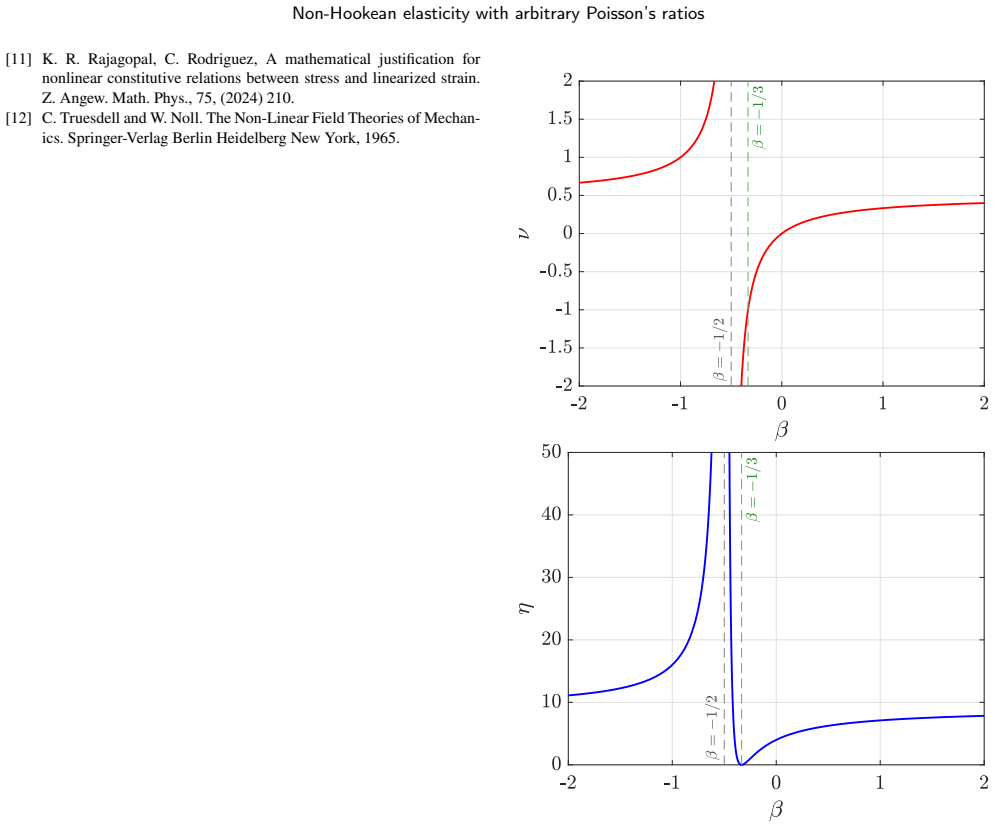
- [§4] §4, Eq. (15): the linearised Poisson ratio expression is given, but the range ν ≠ −1 is stated without showing the limiting behavior as the constants approach the boundary; a brief asymptotic check would strengthen the claim.
- [Figure 4] Figure 4 caption: the specific values of the material constants used for each curve are not listed; adding them would improve clarity and reproducibility.
Simulated Author's Rebuttal
We thank the referee for the positive summary of our manuscript on a positive-definite isotropic strain energy function allowing arbitrary Poisson's ratios (except -1). The recommendation for minor revision is noted. No specific major comments appear in the report, so we have no points to rebut or revise on that basis.
Circularity Check
Minor self-citation to prior model; central strain-energy proposal is independent
full rationale
The manuscript cites its own prior work (Itskov-MoSM) only to describe an earlier hyperelastic model that produced Poisson ratios exceeding 1/2. The present contribution then explicitly constructs and verifies a new isotropic strain-energy function W whose positive-definiteness, thermodynamic consistency, and ability to deliver arbitrary Poisson ratios (except -1) are shown directly from the chosen functional form and its Hessian. No load-bearing step reduces the new function, its positive-definiteness proof, or the Poisson-ratio control to a fitted parameter or to the prior citation by construction. The derivation remains self-contained against external benchmarks of hyperelasticity.
Axiom & Free-Parameter Ledger
free parameters (1)
- material constants
axioms (1)
- domain assumption The strain energy function must be positive-definite to satisfy thermodynamic consistency.
Reference graph
Works this paper leans on
-
[1]
G.Aubert.Quelquesremarquessurlesnotionsde1-rangconvexitéet depolyconvexitéendimensions2et3.ESAIM:M2AN,22(1)(1988) 5–28
work page 1988
-
[2]
M. M. Carroll, Must Elastic Materials be Hyperelastic? Math. Mech. Solids 14(4) (2009) 369-376
work page 2009
-
[3]
L. D. Landau, L.P. Pitaevskii, A.M. Kosevich, and E.M. Lifshitz, Theory of elasticity (Vol. 7) Elsevier, 2012
work page 2012
-
[4]
Love, A Treatise on the Mathematical Theory of Elasticity
A.E.H. Love, A Treatise on the Mathematical Theory of Elasticity. New York, Dover, 1944
work page 1944
-
[5]
Itskov, A hyperelastic isotropic model with Poisson’s ratio greater than one half
M. Itskov, A hyperelastic isotropic model with Poisson’s ratio greater than one half. Mech. Soft Mat. (2026) Published online, https://doi.org/10.1007/s42558-026-00073-2
-
[6]
Itskov, Tensor Algebra and Tensor Analysis for Engineers, 6th edn., Springer, Cham, 2025
M. Itskov, Tensor Algebra and Tensor Analysis for Engineers, 6th edn., Springer, Cham, 2025
work page 2025
- [7]
-
[8]
P. J. Mott and C. Roland, Limits to Poisson’s ratio in isotropic materials - general result for arbitrary deformation. Phys. Scr. 87 (2009) 055404
work page 2009
-
[9]
K. R. Rajagopal, On implicit constitutive theories. Appl. Math., 48, (2003) 279-319
work page 2003
-
[10]
K. R. Rajagopal, On the nonlinear elastic response of bodies in the small strain range. Acta Mech., 225, (2014) 1545-1553. M. Itskov:Preprint submitted to Elsevier Page 4 of 5 Non-Hookean elasticity with arbitrary Poisson’s ratios
work page 2014
-
[11]
K. R. Rajagopal, C. Rodriguez, A mathematical justification for nonlinear constitutive relations between stress and linearized strain. Z. Angew. Math. Phys., 75, (2024) 210
work page 2024
-
[12]
Springer-Verlag Berlin Heidelberg New York, 1965
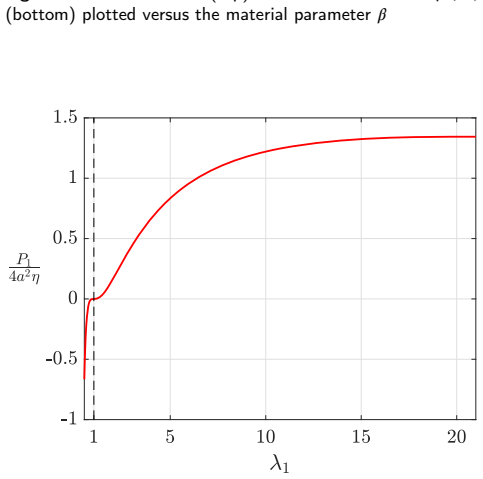
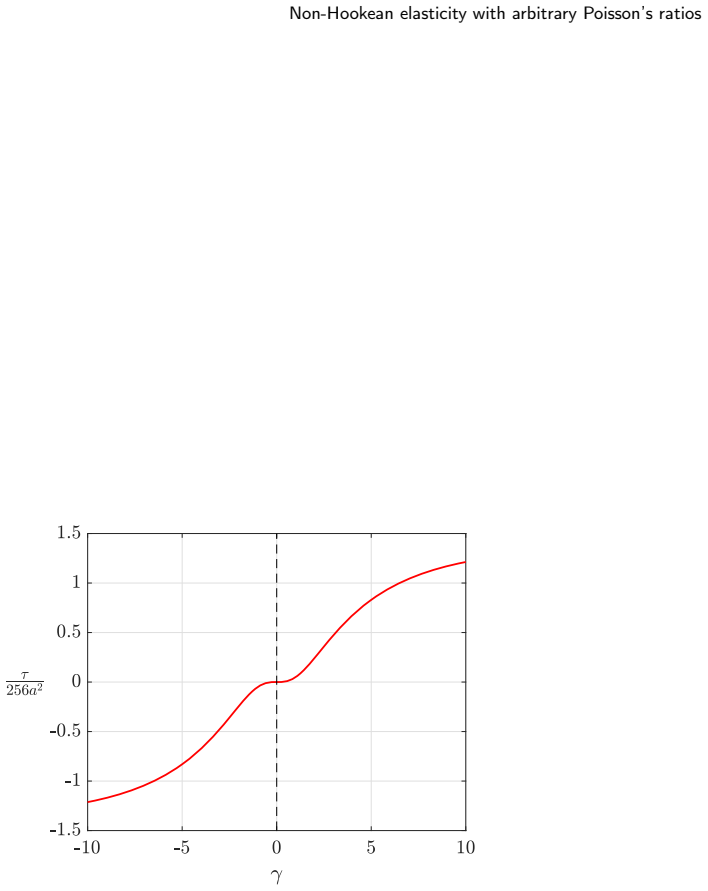
C.TruesdellandW.Noll.TheNon-LinearFieldTheoriesofMechan- ics. Springer-Verlag Berlin Heidelberg New York, 1965. Figure 1:Poisson’s ratio (top) and the stress factor𝜂(20) (bottom) plotted versus the material parameter𝛽 Figure 2:First Piola-Kirchhoff stress versus stretch under uniaxial tension/compression M. Itskov:Preprint submitted to Elsevier Page 5 of ...
work page 1965
discussion (0)
Sign in with ORCID, Apple, or X to comment. Anyone can read and Pith papers without signing in.