Recognition: unknown
A Path to Constraints on Common Envelope Ejection in Massive Binaries: Full Evolutionary Reconstruction of Three Black Hole X-ray Binaries
Pith reviewed 2026-05-10 16:35 UTC · model grok-4.3
The pith
Reconstructing three black hole X-ray binaries requires common envelope ejection efficiencies above unity.
A machine-rendered reading of the paper's core claim, the machinery that carries it, and where it could break.
Core claim
Through full evolutionary reconstruction of GRO J1655-40, SAX J1819.3-2525, and 4U 1543-47, the analysis establishes that self-consistent formation demands CE efficiency parameters satisfying α_0.5U ≳ 6.7, α_U ≳ 4.2 and α_H ≳ 1.7. No viable solutions exist with CE efficiencies below unity, even when envelope binding energy is reduced via enthalpy inclusion. This points to the necessity of additional energy sources or revision of the common envelope formalism itself. The formation of 4U 1543-47 specifically requires natal kicks of at least 50 km/s.
What carries the argument
The common envelope efficiency parameter α, which scales the orbital energy available to unbind the envelope, calculated under three cases: with half internal energy (α_0.5U), all internal energy (α_U), and including enthalpy (α_H).
If this is right
- Standard isolated binary evolution cannot produce the observed systems without high CE efficiencies or extra energy.
- The common envelope phase in massive binaries requires more energy than currently modeled.
- One of the binaries, 4U 1543-47, must have received a substantial natal kick during the supernova.
Where Pith is reading between the lines
- Similar high efficiencies might apply to other binaries, affecting gravitational wave merger rate predictions.
- Dynamical formation channels could be more important if isolated evolution fails for these systems.
- Additional observations of BHXBs could tighten constraints on efficiency parameters.
Load-bearing premise
The three observed black hole X-ray binaries formed exclusively via isolated binary evolution under the standard common envelope energy formalism.
What would settle it
Discovery of a formation pathway for any of these three systems that achieves the observed parameters with a CE efficiency below 1 using the standard formalism, or evidence that one system avoided the common envelope phase entirely.
Figures


read the original abstract
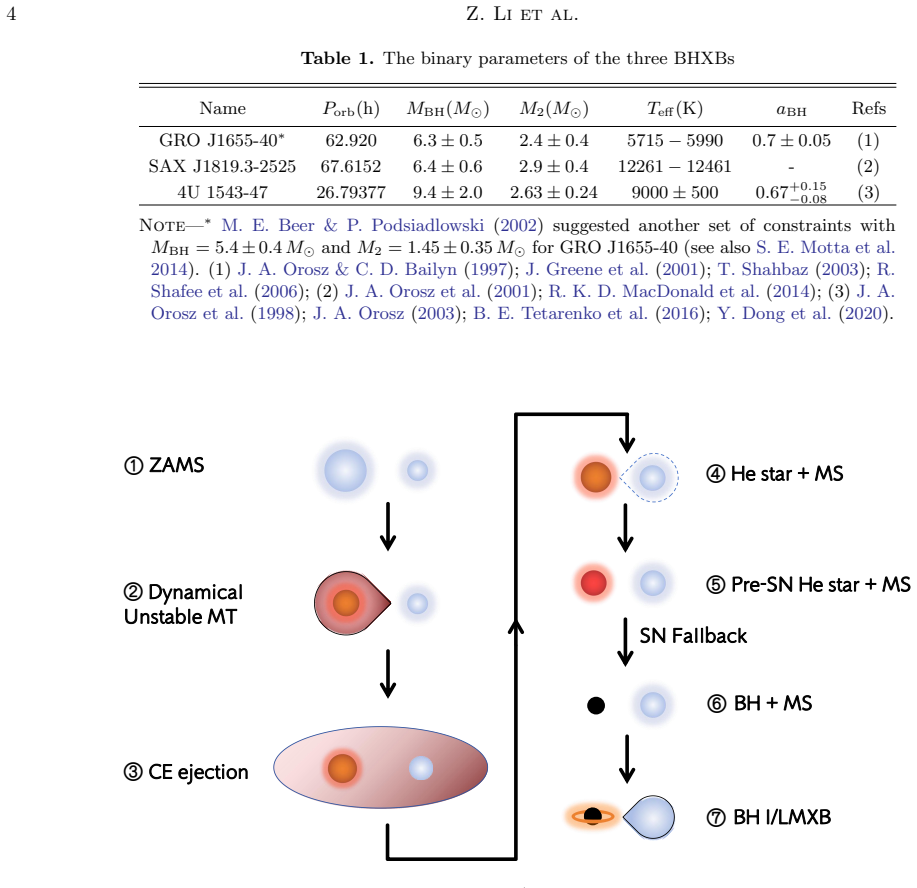
The massive binary common envelope (CE) phase plays a pivotal role in the formation of close black hole/neutron star (BH/NS) binaries, yet significant uncertainties remain in our understanding of this process. In this study, we aim to constrain the massive binary CE phase by systematically reconstructing three observed BH X-ray binaries (BHXBs): GRO J1655-40, SAX J1819.3-2525, and 4U 1543-47. Through comprehensive binary evolution simulations and parametric supernova (SN) modeling, we establish lower limits for the CE efficiency parameters under different energy considerations within the standard energy formalism. Specifically, we derive minimum values for three cases: $\alpha_{\rm 0.5U}$ and $\alpha_{\rm U}$ representing CE efficiencies with half and all of the internal energy contributing to the envelope ejection, respectively, and $\alpha_{\rm H}$ accounting for the envelope's enthalpy. Our analysis reveals that the self-consistent formation of these three BHXBs requires CE efficiency parameters satisfying: $\alpha_{\rm 0.5U}\gtrsim 6.7$, $\alpha_{\rm U}\gtrsim 4.2$ and $\alpha_{\rm H}\gtrsim 1.7$. Notably, we find no viable solutions with CE efficiency values below unity, even when considering the most extreme scenarios in which the envelope binding energy is significantly reduced through enthalpy inclusion. {Our results strongly imply that either additional energy sources are required, or the formalism itself must be revised.} Furthermore, we quantitatively assess the impact of BH natal kicks on our results. A key finding is that 4U 1543-47's formation requires substantial natal kicks ($\gtrsim 50 \;\rm km/s$), as lower kick velocities are incompatible with isolated binary evolution.
Editorial analysis
A structured set of objections, weighed in public.
Referee Report
Summary. The manuscript performs full evolutionary reconstructions of three observed black hole X-ray binaries (GRO J1655-40, SAX J1819.3-2525, and 4U 1543-47) via comprehensive binary evolution simulations combined with parametric supernova modeling. It derives lower limits on common-envelope efficiency under three variants of the standard energy formalism (α_0.5U ≳ 6.7, α_U ≳ 4.2, α_H ≳ 1.7), reports that no solutions exist for efficiencies below unity even with enthalpy contributions, concludes that additional energy sources or formalism revisions are required, and finds that 4U 1543-47 formation demands natal kicks ≳ 50 km/s.
Significance. If the reconstructions hold, the work supplies concrete, observationally anchored lower bounds on CE efficiency in massive binaries, a dominant uncertainty in compact-object binary formation channels. The quantitative thresholds and the kick requirement for one system offer falsifiable inputs for population synthesis and could sharpen predictions for gravitational-wave sources.
Simulated Author's Rebuttal
We thank the referee for their positive evaluation of the manuscript, accurate summary of our results, and recommendation to accept. No major comments were raised requiring detailed responses.
Circularity Check
No circularity: constraints derived from matching external observations via standard simulations
full rationale
The paper performs binary evolution simulations across grids of initial conditions and CE efficiency parameters (α_0.5U, α_U, α_H) within the standard energy formalism, then identifies the minimum values that permit the final states to reproduce the observed properties (masses, periods, etc.) of the three specific BHXBs. This is a direct parameter constraint against independent external benchmarks rather than a self-referential loop. No quoted step reduces a claimed result to its own inputs by construction, no self-citation supplies a load-bearing uniqueness theorem, and no ansatz or renaming is smuggled in. The isolated-evolution premise is explicitly scoped, and the lower bounds are falsifiable by the same observations used as targets.
Axiom & Free-Parameter Ledger
free parameters (1)
- Common envelope efficiency parameters (α_0.5U, α_U, α_H)
axioms (3)
- domain assumption Standard energy formalism governs common envelope ejection
- domain assumption These BHXBs formed via isolated binary evolution
- domain assumption Parametric supernova modeling accurately captures natal kicks
Forward citations
Cited by 1 Pith paper
-
The jet-shaped pipe morphology in planetary nebulae and core-collapse supernova remnants
Morphological similarity between pipe structures in planetary nebulae and supernova remnants, plus a jet simulation, indicates that jittering jets shaped both.
Reference graph
Works this paper leans on
-
[1]
Abdulghani, Y., Lohfink, A. M., & Chauhan, J. 2025, MNRAS, 541, 553, doi: 10.1093/mnras/staf979
-
[2]
R., M¨ uller, B., Antoniadis, J., et al
Aguilera-Dena, D. R., M¨ uller, B., Antoniadis, J., et al. 2023, A&A, 671, A134, doi: 10.1051/0004-6361/202243519
-
[3]
Asplund, M., Grevesse, N., Sauval, A. J., & Scott, P. 2009, ARA&A, 47, 481, doi: 10.1146/annurev.astro.46.060407.145222
-
[4]
2025, Research in Astronomy and Astrophysics, 25, 025010, doi: 10.1088/1674-4527/ada8ef
Bear, E., & Soker, N. 2025, Research in Astronomy and Astrophysics, 25, 025010, doi: 10.1088/1674-4527/ada8ef
-
[5]
Beer, M. E., & Podsiadlowski, P. 2002, MNRAS, 331, 351, doi: 10.1046/j.1365-8711.2002.05189.x
-
[6]
Belloni, D., & Schreiber, M. R. 2023, in Handbook of X-ray and Gamma-ray Astrophysics, 129, doi: 10.1007/978-981-16-4544-0 98-1
-
[7]
Belloni, D., Schreiber, M. R., & Zorotovic, M. 2024a, A&A, 687, A12, doi: 10.1051/0004-6361/202449320
-
[8]
Belloni, D., Zorotovic, M., Schreiber, M. R., et al. 2024b, A&A, 686, A61, doi: 10.1051/0004-6361/202449235
-
[9]
1961, BAN, 15, 291
Boersma, J. 1961, BAN, 15, 291
1961
-
[10]
Briel, M. M., Stevance, H. F., & Eldridge, J. J. 2023, MNRAS, 520, 5724, doi: 10.1093/mnras/stad399
-
[11]
Bronner, V. A., Schneider, F. R. N., Podsiadlowski, P., & R¨ opke, F. K. 2024, A&A, 683, A65, doi: 10.1051/0004-6361/202347397
-
[12]
2025, ApJ, 987, 164, doi: 10.3847/1538-4357/addd04
Burrows, A., Wang, T., & Vartanyan, D. 2025, ApJ, 987, 164, doi: 10.3847/1538-4357/addd04
-
[13]
Chamandy, L., Frank, A., Blackman, E. G., et al. 2018, MNRAS, 480, 1898, doi: 10.1093/mnras/sty1950
-
[14]
T., Mellema, G., Pen, U.-L., et al
Chen, W.-C., & Li, X.-D. 2006, MNRAS, 373, 305, doi: 10.1111/j.1365-2966.2006.11032.x
-
[15]
2024, Progress in Particle and Nuclear Physics, 134, 104083, doi: 10.1016/j.ppnp.2023.104083
Chen, X., Liu, Z., & Han, Z. 2024, Progress in Particle and Nuclear Physics, 134, 104083, doi: 10.1016/j.ppnp.2023.104083
-
[16]
2016, The Astrophysical Journal, 823, 102, doi: 10.3847/0004-637X/823/2/102
Choi, J., Dotter, A., Conroy, C., et al. 2016, ApJ, 823, 102, doi: 10.3847/0004-637X/823/2/102
work page internal anchor Pith review doi:10.3847/0004-637x/823/2/102 2016
-
[17]
2023, Research in Astronomy and Astrophysics, 23, 065023, doi: 10.1088/1674-4527/acd0ec
Cohen, T., & Soker, N. 2023, Research in Astronomy and Astrophysics, 23, 065023, doi: 10.1088/1674-4527/acd0ec
-
[18]
2026, PASP, 138, 034205, doi: 10.1088/1538-3873/ae4cc8
Cohen, Y., Bear, E., & Soker, N. 2026, PASP, 138, 034205, doi: 10.1088/1538-3873/ae4cc8
-
[19]
M., Casares, J., Mu˜ noz-Darias, T., et al
Corral-Santana, J. M., Casares, J., Mu˜ noz-Darias, T., et al. 2016, A&A, 587, A61, doi: 10.1051/0004-6361/201527130 Dashwood Brown, C., Gandhi, P., & Zhao, Y. 2024, MNRAS, 527, L82, doi: 10.1093/mnrasl/slad151
-
[20]
C., Trotta , R., Berkes , P., Starkman , G
Davis, P. J., Kolb, U., & Knigge, C. 2012, MNRAS, 419, 287, doi: 10.1111/j.1365-2966.2011.19690.x de Kool, M., van den Heuvel, E. P. J., & Pylyser, E. 1987, A&A, 183, 47 De Marco, O., & Izzard, R. G. 2017, PASA, 34, e001, doi: 10.1017/pasa.2016.52 De Marco, O., Passy, J.-C., Moe, M., et al. 2011, MNRAS, 411, 2277, doi: 10.1111/j.1365-2966.2010.17891.x
-
[21]
2024, ApJ, 971, 54, doi: 10.3847/1538-4357/ad5fec
Deng, Z.-L., & Li, X.-D. 2024, ApJ, 971, 54, doi: 10.3847/1538-4357/ad5fec
-
[22]
2024, ApJ, 963, 80, doi: 10.3847/1538-4357/ad2357
Deng, Z.-L., Li, X.-D., Shao, Y., & Xu, K. 2024, ApJ, 963, 80, doi: 10.3847/1538-4357/ad2357
-
[23]
Dewey, R. J., & Cordes, J. M. 1987, ApJ, 321, 780, doi: 10.1086/165671 Di Stefano, R., Kruckow, M. U., Gao, Y., Neunteufel, P. G., & Kobayashi, C. 2023, ApJ, 944, 87, doi: 10.3847/1538-4357/acae9b
-
[24]
2012, ApJ, 759, 52, doi: 10.1088/0004-637X/759/1/52
Dominik, M., Belczynski, K., Fryer, C., et al. 2012, ApJ, 759, 52, doi: 10.1088/0004-637X/759/1/52
-
[25]
Dong, Y., Garc´ ıa, J. A., Steiner, J. F., & Gou, L. 2020, MNRAS, 493, 4409, doi: 10.1093/mnras/staa606
-
[26]
Eggleton, P. P. 1983, ApJ, 268, 368, doi: 10.1086/160960
-
[27]
Eggleton, P. P., & Verbunt, F. 1986, MNRAS, 220, 13P, doi: 10.1093/mnras/220.1.13P El Mellah, I., Sundqvist, J. O., & Keppens, R. 2019, A&A, 622, L3, doi: 10.1051/0004-6361/201834543
-
[28]
E., Sukhbold, T., & Ugliano, M
Ugliano, M. 2016, ApJ, 818, 124, doi: 10.3847/0004-637X/818/2/124
-
[29]
Ferguson, J. W., Alexander, D. R., Allard, F., et al. 2005, ApJ, 623, 585, doi: 10.1086/428642
-
[30]
2024, A&A, 684, A124, doi: 10.1051/0004-6361/202347908
Chaty, S. 2024, A&A, 684, A124, doi: 10.1051/0004-6361/202347908
-
[31]
Fragos, T., Andrews, J. J., Ramirez-Ruiz, E., et al. 2019, ApJL, 883, L45, doi: 10.3847/2041-8213/ab40d1
-
[32]
2009, ApJ, 697, 1057, doi: 10.1088/0004-637X/697/2/1057
Fragos, T., Willems, B., Kalogera, V., et al. 2009, ApJ, 697, 1057, doi: 10.1088/0004-637X/697/2/1057
-
[33]
2025, A&A, 697, A68, doi: 10.1051/0004-6361/202452616
Gagnier, D., & Pejcha, O. 2025, A&A, 697, A68, doi: 10.1051/0004-6361/202452616
-
[34]
Gallegos-Garcia, M., Berry, C. P. L., & Kalogera, V. 2023, ApJ, 955, 133, doi: 10.3847/1538-4357/ace434 Garc´ ıa-Segura, G., Taam, R. E., & Ricker, P. M. 2020, ApJ, 893, 150, doi: 10.3847/1538-4357/ab8006
-
[35]
Ge, H., Webbink, R. F., Chen, X., & Han, Z. 2020a, ApJ, 899, 132, doi: 10.3847/1538-4357/aba7b7
-
[36]
Ge, H., Webbink, R. F., & Han, Z. 2020b, ApJS, 249, 9, doi: 10.3847/1538-4365/ab98f6
-
[37]
Ge, H., Tout, C. A., Chen, X., et al. 2022, ApJ, 933, 137, doi: 10.3847/1538-4357/ac75d3
-
[38]
Ge, H., Tout, C. A., Webbink, R. F., et al. 2024a, ApJ, 961, 202, doi: 10.3847/1538-4357/ad158e Constraints on massive CE phase21
-
[39]
Ge, H., Tout, C. A., Chen, X., et al. 2024b, ApJ, 975, 254, doi: 10.3847/1538-4357/ad7ea6 G¨ otberg, Y., Drout, M. R., Ji, A. P., et al. 2023, ApJ, 959, 125, doi: 10.3847/1538-4357/ace5a3
-
[40]
Greene, J., Bailyn, C. D., & Orosz, J. A. 2001, ApJ, 554, 1290, doi: 10.1086/321411
-
[41]
2023, MNRAS, 523, 221, doi: 10.1093/mnras/stad1449
Grichener, A. 2023, MNRAS, 523, 221, doi: 10.1093/mnras/stad1449
-
[42]
2021, ApJ, 922, 61, doi: 10.3847/1538-4357/ac23dd
Grichener, A., Cohen, C., & Soker, N. 2021, ApJ, 922, 61, doi: 10.3847/1538-4357/ac23dd
-
[43]
2022, A&A, 667, A44, doi: 10.1051/0004-6361/202244300
Guo, Y., Liu, C., Wang, L., et al. 2022, A&A, 667, A44, doi: 10.1051/0004-6361/202244300
-
[44]
Han, Z., Podsiadlowski, P., & Eggleton, P. P. 1994, MNRAS, 270, 121, doi: 10.1093/mnras/270.1.121
-
[45]
2020, Research in Astronomy and Astrophysics, 20, 161, doi: 10.1088/1674-4527/20/10/161
Han, Z.-W., Ge, H.-W., Chen, X.-F., & Chen, H.-L. 2020, Research in Astronomy and Astrophysics, 20, 161, doi: 10.1088/1674-4527/20/10/161
-
[46]
Hernandez, M. S., Schreiber, M. R., Parsons, S. G., et al. 2022, MNRAS, 512, 1843, doi: 10.1093/mnras/stac604
-
[47]
2022, ApJL, 937, L42, doi: 10.3847/2041-8213/ac9519
Hirai, R., & Mandel, I. 2022, ApJL, 937, L42, doi: 10.3847/2041-8213/ac9519
-
[48]
Hurley, J. R., Tout, C. A., & Pols, O. R. 2002, MNRAS, 329, 897, doi: 10.1046/j.1365-8711.2002.05038.x
-
[49]
2019, MNRAS, 490, 2550, doi: 10.1093/mnras/stz2756
Iaconi, R., & De Marco, O. 2019, MNRAS, 490, 2550, doi: 10.1093/mnras/stz2756
-
[50]
2017, MNRAS, 464, 4028, doi: 10.1093/mnras/stw2377
Iaconi, R., Reichardt, T., Staff, J., et al. 2017, MNRAS, 464, 4028, doi: 10.1093/mnras/stw2377
-
[51]
Iglesias, C. A., & Rogers, F. J. 1996, ApJ, 464, 943, doi: 10.1086/177381
-
[52]
2002, PhD thesis, University of Oxford, UK
Ivanova, N. 2002, PhD thesis, University of Oxford, UK
2002
-
[53]
2011, ApJ, 730, 76, doi: 10.1088/0004-637X/730/2/76
Ivanova, N. 2011, ApJ, 730, 76, doi: 10.1088/0004-637X/730/2/76
-
[54]
2011, ApJL, 731, L36, doi: 10.1088/2041-8205/731/2/L36
Ivanova, N., & Chaichenets, S. 2011, ApJL, 731, L36, doi: 10.1088/2041-8205/731/2/L36
-
[55]
2020, Common Envelope Evolution, doi: 10.1088/2514-3433/abb6f0
Ivanova, N., Justham, S., & Ricker, P. 2020, Common Envelope Evolution, doi: 10.1088/2514-3433/abb6f0
-
[56]
Ivanova, N., & Nandez, J. L. A. 2016, MNRAS, 462, 362, doi: 10.1093/mnras/stw1676
-
[57]
2013, A&A Rv, 21, 59, doi: 10.1007/s00159-013-0059-2
Ivanova, N., Justham, S., Chen, X., et al. 2013, A&A Rv, 21, 59, doi: 10.1007/s00159-013-0059-2
-
[58]
Janka, H.-T. 2012, Annual Review of Nuclear and Particle Science, 62, 407, doi: 10.1146/annurev-nucl-102711-094901
-
[59]
Janka, H.-T., Melson, T., & Summa, A. 2016, Annual Review of Nuclear and Particle Science, 66, 341, doi: 10.1146/annurev-nucl-102115-044747
-
[60]
Jermyn, A. S., Bauer, E. B., Schwab, J., et al. 2023, ApJS, 265, 15, doi: 10.3847/1538-4365/acae8d
-
[61]
Justham, S., Rappaport, S., & Podsiadlowski, P. 2006, MNRAS, 366, 1415, doi: 10.1111/j.1365-2966.2005.09907.x
-
[62]
T., Mellema, G., Pen, U.-L., et al
Kiel, P. D., & Hurley, J. R. 2006, MNRAS, 369, 1152, doi: 10.1111/j.1365-2966.2006.10400.x
-
[63]
1990, Stellar Structure and Evolution
Kippenhahn, R., & Weigert, A. 1990, Stellar Structure and Evolution
1990
-
[64]
Klencki, J., Nelemans, G., Istrate, A. G., & Chruslinska, M. 2021, A&A, 645, A54, doi: 10.1051/0004-6361/202038707
-
[65]
2017, MNRAS, 469, 3088, doi: 10.1093/mnras/stx842
Klencki, J., Wiktorowicz, G., G ladysz, W., & Belczynski, K. 2017, MNRAS, 469, 3088, doi: 10.1093/mnras/stx842
-
[66]
2024, MNRAS, 535, 3577, doi: 10.1093/mnras/stae2591
Kotko, I., Banerjee, S., & Belczynski, K. 2024, MNRAS, 535, 3577, doi: 10.1093/mnras/stae2591
-
[67]
Izzard, R. G. 2018, MNRAS, 481, 1908, doi: 10.1093/mnras/sty2190
-
[68]
Kruckow, M. U., Tauris, T. M., Langer, N., et al. 2016, A&A, 596, A58, doi: 10.1051/0004-6361/201629420
-
[69]
2021, A&A, 656, A58, doi: 10.1051/0004-6361/202140506
Laplace, E., Justham, S., Renzo, M., et al. 2021, A&A, 656, A58, doi: 10.1051/0004-6361/202140506
-
[70]
Laplace, E., Schneider, F. R. N., & Podsiadlowski, P. 2025, A&A, 695, A71, doi: 10.1051/0004-6361/202451077
-
[71]
Lau, M. Y. M., Hirai, R., Gonz´ alez-Bol´ ıvar, M., et al. 2022, MNRAS, 512, 5462, doi: 10.1093/mnras/stac049
-
[72]
Law-Smith, J. A. P., Everson, R. W., Ramirez-Ruiz, E., et al. 2020, arXiv e-prints, arXiv:2011.06630, doi: 10.48550/arXiv.2011.06630
-
[73]
Li, X.-D. 2008, MNRAS, 384, L16, doi: 10.1111/j.1745-3933.2007.00412.x
-
[74]
2015, NewAR, 64, 1, doi: 10.1016/j.newar.2015.02.001
Li, X.-D. 2015, NewAR, 64, 1, doi: 10.1016/j.newar.2015.02.001
-
[75]
2026, ApJL, 996, L42, doi: 10.3847/2041-8213/ae3008
Li, Z., Jia, S., Wei, D., et al. 2026, ApJL, 996, L42, doi: 10.3847/2041-8213/ae3008
-
[76]
Z., van Paradijs, J., & van den Heuvel, E
Liu, Q. Z., van Paradijs, J., & van den Heuvel, E. P. J. 2007, A&A, 469, 807, doi: 10.1051/0004-6361:20077303
-
[77]
Liu, Z.-W., R¨ opke, F. K., & Han, Z. 2023, Research in Astronomy and Astrophysics, 23, 082001, doi: 10.1088/1674-4527/acd89e
-
[78]
1988, ApJ, 329, 764, doi: 10.1086/166419
Livio, M., & Soker, N. 1988, ApJ, 329, 764, doi: 10.1086/166419
-
[79]
MacDonald, R. K. D., Bailyn, C. D., Buxton, M., et al. 2014, ApJ, 784, 2, doi: 10.1088/0004-637X/784/1/2
-
[80]
2024, ARA&A, 62, 21, doi: 10.1146/annurev-astro-052722-105936
Marchant, P., & Bodensteiner, J. 2024, ARA&A, 62, 21, doi: 10.1146/annurev-astro-052722-105936
discussion (0)
Sign in with ORCID, Apple, or X to comment. Anyone can read and Pith papers without signing in.