A Soft Penetrable Sphere Colloid Model for the Description of Charge and Excluded Volume Interactions in Antibody Solutions
Pith reviewed 2026-05-10 15:46 UTC · model grok-4.3
The pith
A soft penetrable sphere model describes antibody interactions using only structural net charges and dimensions.
A machine-rendered reading of the paper's core claim, the machinery that carries it, and where it could break.
Core claim
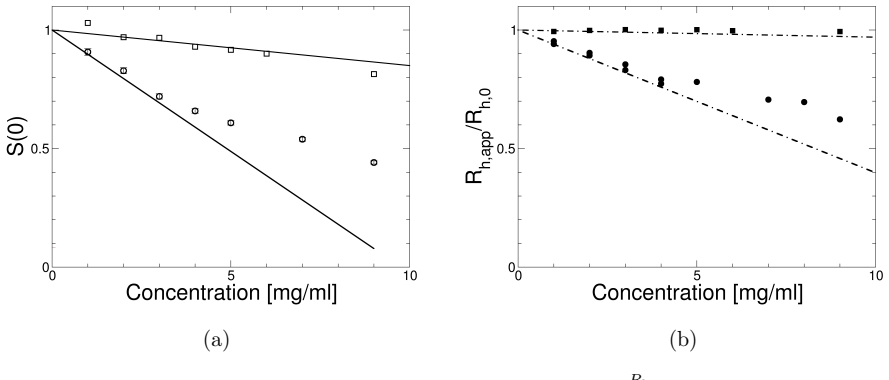
The soft penetrable sphere model quantitatively reproduces experimental data from static and dynamic light scattering at low and high ionic strength for two well-characterized monoclonal antibodies using the net charges and the overall mAb dimensions directly obtained from their molecular structure, while also matching the center-of-mass static structure factor from computer simulations based on a weakly coarse-grained amino-acid-level description.
What carries the argument
The soft penetrable sphere model based on analogies to soft colloids and star polyelectrolytes, which incorporates the Y-shaped antibody geometry and the corresponding charge and ion distribution to treat both electrostatic and excluded-volume interactions.
Load-bearing premise
That analogies to soft colloids and star polyelectrolytes sufficiently capture the Y-shaped antibody geometry and its corresponding charge and ion distribution so that no additional effective parameters are required beyond the structural net charge and overall dimensions.
What would settle it
Light-scattering measurements or structure-factor data for a third monoclonal antibody, calculated solely from its known net charge and dimensions, that deviate substantially from the model's predictions for osmotic compressibility or hydrodynamic radius.
Figures



read the original abstract
Colloid models have frequently been used to successfully describe the influence of protein-protein interactions on antibody solution properties, but they suffer from inherent problems due to the anisotropic shape of the particles. The net charge required to describe electrostatic interactions is an effective quantity that cannot directly be obtained from the known molecular structure of an antibody, and the solution structure caused by excluded volume interactions is strongly overestimated at high concentrations due to the assumption of hard sphere interactions. As a result, these models have descriptive rather than predictive power. Here we present an improved, soft penetrable sphere model based on analogies to soft colloids and star polyelectrolytes that take into account the Y-shaped antibody form and the corresponding charge and ion distribution. The model not only correctly describes the concentration and ionic strength dependence of thermodynamic and collective dynamics quantities such as the osmotic compressibility and the apparent hydrodynamic radius, but also reproduces the center-of-mass static structure factor obtained in computer simulations using a weakly coarse-grained model, in which the antibody is described at an amino acid level. We demonstrate that this soft penetrable sphere model quantitatively reproduces experimental data from static and dynamic light scattering at low and high ionic strength for two well-characterized monoclonal antibodies (mAbs) using the net charges and the overall mAb dimensions directly obtained from their molecular structure.
Editorial analysis
A structured set of objections, weighed in public.
Referee Report
Summary. The manuscript proposes a soft penetrable sphere colloid model for monoclonal antibody solutions, based on analogies to soft colloids and star polyelectrolytes to incorporate the Y-shaped geometry and associated charge/ion distributions. It claims that net charges (from residue counting at given pH) and overall dimensions (from PDB structures) are the sole inputs, with no additional effective parameters required. The model is asserted to quantitatively reproduce experimental static and dynamic light scattering data on osmotic compressibility and apparent hydrodynamic radius for two mAbs across concentrations and ionic strengths, as well as center-of-mass static structure factors from independent amino-acid-level coarse-grained simulations.
Significance. If the central claim of structure-derived, parameter-free inputs holds, the work would advance colloidal modeling of anisotropic proteins by addressing overestimation of excluded volume in hard-sphere models and the effective-charge issue in prior approaches. The dual validation against light scattering experiments and simulations, plus explicit use of molecular structure for charges and size, represents a strength that could aid predictive formulation of high-concentration antibody solutions. This bridges soft-matter analogies to biomolecular applications in a falsifiable manner.
major comments (2)
- [§2] §2 (model definition): The softness length scale and penetrability exponent in the interaction potential are introduced via analogy to star polyelectrolytes rather than derived by explicit integration or averaging over the three Fab/Fc domains in the PDB coordinates. This mapping is load-bearing for the abstract claim that 'net charges and the overall mAb dimensions directly obtained from their molecular structure' are the only inputs; any non-computed choice risks an implicit effective parameter.
- [Results section] Results section (comparison to light scattering): The quantitative match to SLS/DLS data at low and high ionic strength is presented, but the manuscript must explicitly document the pKa values and residue-counting procedure used to obtain net charge from sequence, and confirm that softness parameters were not adjusted to fit these same data sets (or the simulation structure factors).
minor comments (2)
- [Figures] Figure captions: Include explicit labels for each ionic strength and concentration series to improve readability of the osmotic compressibility and hydrodynamic radius plots.
- [Methods] The description of the weakly coarse-grained simulation model lacks a reference or brief methods summary sufficient for independent reproduction of the center-of-mass structure factor extraction.
Simulated Author's Rebuttal
We thank the referee for the detailed and constructive report. The comments highlight important aspects of our model definition and validation that we will address to improve clarity and transparency. Below we respond point by point to the major comments.
read point-by-point responses
-
Referee: [§2] §2 (model definition): The softness length scale and penetrability exponent in the interaction potential are introduced via analogy to star polyelectrolytes rather than derived by explicit integration or averaging over the three Fab/Fc domains in the PDB coordinates. This mapping is load-bearing for the abstract claim that 'net charges and the overall mAb dimensions directly obtained from their molecular structure' are the only inputs; any non-computed choice risks an implicit effective parameter.
Authors: We agree that the softness parameters are not directly computed from the PDB coordinates but are instead motivated by analogies to star polyelectrolytes, as stated in the manuscript. These parameters determine the shape of the interaction potential but are not fitted or adjusted to match the light scattering data or simulation results presented; they are fixed based on literature values for similar soft systems and applied consistently. The system-specific inputs remain the net charge (from sequence) and overall dimensions (from PDB). To strengthen the manuscript, we will revise Section 2 to provide more detail on the choice of these parameters and update the abstract to clarify that the potential form is based on soft colloid analogies while the key inputs are structure-derived. This addresses the concern without introducing effective parameters tuned to the current study. revision: partial
-
Referee: [Results section] Results section (comparison to light scattering): The quantitative match to SLS/DLS data at low and high ionic strength is presented, but the manuscript must explicitly document the pKa values and residue-counting procedure used to obtain net charge from sequence, and confirm that softness parameters were not adjusted to fit these same data sets (or the simulation structure factors).
Authors: We will incorporate these suggestions in the revised manuscript. We will add a subsection or paragraph detailing the pKa values employed (standard values from literature for each amino acid type) and the exact procedure for counting charged residues at the specified pH to compute the net charge. Furthermore, we will explicitly state in the results section that the softness length scale and penetrability exponent were not adjusted to fit the experimental SLS/DLS data or the simulation-derived structure factors; they were predetermined from the star polyelectrolyte analogy and held constant for all comparisons. This will enhance the reproducibility and address the referee's valid point on transparency. revision: yes
Circularity Check
No significant circularity; model inputs from structure and analogies are independent of fitted outputs
full rationale
The paper defines the soft penetrable sphere model via physical analogies to soft colloids and star polyelectrolytes, taking net charge and overall dimensions as direct inputs from molecular structure (PDB/residue counting). It then shows quantitative agreement with independent experimental light-scattering data and coarse-grained simulation structure factors. No quoted step reduces a claimed prediction to a fitted parameter by construction, invokes a self-citation as the sole justification for a uniqueness theorem, or renames an empirical pattern as a derivation. The central claim therefore remains externally falsifiable against the cited data sets rather than tautological.
Axiom & Free-Parameter Ledger
axioms (1)
- domain assumption Antibody charge and ion distribution can be approximated by that of a star polyelectrolyte with equivalent arm number and length.
invented entities (1)
-
soft penetrable sphere
no independent evidence
Reference graph
Works this paper leans on
-
[1]
Muschol, M.; Rosenberger, F. Liquid--liquid phase separation in supersaturated lysozyme solutions and associated precipitate formation/crystallization. The Journal of chemical physics 1997, 107, 1953--1962
work page 1997
-
[2]
A.; Calero-Rubio, C.; Furst, E
Woldeyes, M. A.; Calero-Rubio, C.; Furst, E. M.; Roberts, C. J. Predicting protein interactions of concentrated globular protein solutions using colloidal models. The Journal of Physical Chemistry B 2017, 121, 4756--4767
work page 2017
-
[3]
Potential and limits of a colloid approach to protein solutions
Stradner, A.; Schurtenberger, P. Potential and limits of a colloid approach to protein solutions. Soft Matter 2020, 16, 307--323
work page 2020
-
[4]
Neal, B.; Asthagiri, D.; Velev, O.; Lenhoff, A.; Kaler, E. Why is the osmotic second virial coefficient related to protein crystallization? Journal of Crystal Growth 1999, 196, 377--387
work page 1999
-
[5]
Madani, M.; Hamacher, T.; Platten, F. Urea and salt induced modulation of protein interactions: implications for crystallization and liquid-liquid phase separation . Soft Matter 2025, 21, 1937--1948
work page 2025
-
[6]
M.; Stradner, A.; Schurtenberger, P
Foffi, G.; Savin, G.; Bucciarelli, S.; Dorsaz, N.; Thurston, G. M.; Stradner, A.; Schurtenberger, P. Hard sphere-like glass transition in eye lens -crystallin solutions . Proceedings of the National Academy of Sciences 2014, 111, 16748--16753
work page 2014
-
[7]
Unusual Dynamics of Concentration Fluctuations in Solutions of Weakly Attractive Globular Proteins
Bucciarelli, S.; Casal-Dujat, L.; De Michele , C.; Sciortino, F.; Dhont, J.; Bergenholtz, J.; Farago, B.; Schurtenberger, P.; Stradner, A. Unusual Dynamics of Concentration Fluctuations in Solutions of Weakly Attractive Globular Proteins . Journal of Physical Chemistry Letters 2015, 6, 4470--4474
work page 2015
-
[8]
S.; Farago, B.; Das, S.; Vliegenthart, G
Bucciarelli, S.; Myung, J. S.; Farago, B.; Das, S.; Vliegenthart, G. A.; Holderer, O.; Winkler, R. G.; Schurtenberger, P.; Gompper, G.; Stradner, A. Dramatic influence of patchy attractions on short-time protein diffusion under crowded conditions . Science Advances 2016, 2, e1601432
work page 2016
-
[9]
J.; Garting, T.; De Michele , C.; Schurtenberger, P.; Stradner, A
Bergman, M. J.; Garting, T.; De Michele , C.; Schurtenberger, P.; Stradner, A. Dynamical arrest for globular proteins with patchy attractions . Soft Matter 2025, 21, 1152--1161
work page 2025
-
[10]
Soft matter perspective on protein crystal assembly
Fusco, D.; Charbonneau, P. Soft matter perspective on protein crystal assembly. Colloids and Surfaces B: Biointerfaces 2016, 137, 22--31
work page 2016
-
[11]
J.; Charbonneau, P.; Zaccarelli, E.; Asherie, N
McManus, J. J.; Charbonneau, P.; Zaccarelli, E.; Asherie, N. The physics of protein self-assembly. Current opinion in colloid & interface science 2016, 22, 73--79
work page 2016
-
[12]
G \"o gelein, C.; N \"a gele, G.; Tuinier, R.; Gibaud, T.; Stradner, A.; Schurtenberger, P. A simple patchy colloid model for the phase behavior of lysozyme dispersions. The Journal of chemical physics 2008, 129
work page 2008
-
[13]
S.; Roosen-Runge, F.; Winkler, R
Myung, J. S.; Roosen-Runge, F.; Winkler, R. G.; Gompper, G.; Schurtenberger, P.; Stradner, A. Weak Shape Anisotropy Leads to a Nonmonotonic Contribution to Crowding, Impacting Protein Dynamics under Physiologically Relevant Conditions . The Journal of Physical Chemistry B 2018, 122, 12396--12402
work page 2018
-
[14]
The role of electrostatics in protein--protein interactions of a monoclonal antibody
Roberts, D.; Keeling, R.; Tracka, M.; Van Der Walle, C.; Uddin, S.; Warwicker, J.; Curtis, R. The role of electrostatics in protein--protein interactions of a monoclonal antibody. Molecular pharmaceutics 2014, 11, 2475--2489
work page 2014
-
[15]
Calero-Rubio, C.; Ghosh, R.; Saluja, A.; Roberts, C. J. Predicting protein-protein interactions of concentrated antibody solutions using dilute solution data and coarse-grained molecular models. Journal of pharmaceutical sciences 2018, 107, 1269--1281
work page 2018
-
[16]
Sibanda, N.; Shanmugam, R. K.; Curtis, R. The relationship between protein--protein interactions and liquid--liquid phase separation for monoclonal antibodies. Molecular Pharmaceutics 2023, 20, 2662--2674
work page 2023
-
[17]
A.; Manohar, N.; Lanzaro, A.; Kimball, W
Chowdhury, A. A.; Manohar, N.; Lanzaro, A.; Kimball, W. D.; Witek, M. A.; Woldeyes, M. A.; Majumdar, R.; Qian, K. K.; Xu, S.; Gillilan, R. E., et al. Characterizing protein--protein interactions and viscosity of a monoclonal antibody from low to high concentration using small-angle x-ray scattering and molecular dynamics simulations. Molecular Pharmaceuti...
work page 2023
-
[18]
F.; Uddin, S.; Warwicker, J.; Curtis, R
Roberts, D.; Keeling, R.; Tracka, M.; van der Walle, C. F.; Uddin, S.; Warwicker, J.; Curtis, R. The Role of Electrostatics in Protein-Protein Interactions of a Monoclonal Antibody . Molecular Pharmaceutics 2014, 11, 2475--2489
work page 2014
-
[19]
G.; Stradner, A.; Zaccarelli, E.; Schurtenberger, P
Gulotta, A.; Polimeni, M.; Lenton, S.; Starr, C. G.; Stradner, A.; Zaccarelli, E.; Schurtenberger, P. Combining scattering experiments and colloid theory to characterize charge effects in concentrated antibody solutions. Molecular Pharmaceutics 2024, 21, 2250--2271
work page 2024
-
[20]
A multi-scale numerical approach to study monoclonal antibodies in solution
Polimeni, M.; Zaccarelli, E.; Gulotta, A.; Lund, M.; Stradner, A.; Schurtenberger, P. A multi-scale numerical approach to study monoclonal antibodies in solution. APL bioengineering 2024, 8
work page 2024
-
[21]
Denton, A. R. Counterion penetration and effective electrostatic interactions in solutions of polyelectrolyte stars and microgels . Physical Review E 2003, 67, 011804
work page 2003
-
[22]
Mahapatra, S.; Polimeni, M.; Gentiluomo, L.; Roessner, D.; Frieß, W.; Peters, G. H. J.; Streicher, W. W.; Lund, M.; Harris, P. Self-Interactions of Two Monoclonal Antibodies: Small-Angle X-ray Scattering, Light Scattering, and Coarse-Grained Modeling. Molecular Pharmaceutics 2022, 19, 508--519, PMID: 34939811
work page 2022
-
[23]
Kaieda, S.; Lund, M.; Plivelic, T. S.; Halle, B. Weak self-interactions of globular proteins studied by small-angle X-ray scattering and structure-based modeling. The journal of physical chemistry. B 2014, 118 34, 10111--9
work page 2014
-
[24]
Faunus ? a flexible framework for Monte Carlo simulation
Stenqvist, B.; Thuresson, A.; Kurut, A.; V \'a cha, R.; Lund, M. Faunus ? a flexible framework for Monte Carlo simulation. Molecular Simulation 2013, 39, 1233 -- 1239
work page 2013
-
[25]
Johnson, J. K.; Panagiotopoulos, A. Z.; Gubbins, K. E. Reactive canonical Monte Carlo : a new simulation technique for reacting or associating fluids. Molecular Physics 1994, 81, 717--733
work page 1994
-
[26]
Thurlkill, R. L.; Grimsley, G. R.; Scholtz, J. M.; Pace, C. N. pK values of the ionizable groups of proteins. Protein Science 2006, 15, 1214--1218
work page 2006
-
[27]
N.; L \" o wen, H.; Watzlawek, M.; Abbas, B.; Jucknischke, O.; Allgaier, J.; Richter, D
Likos, C. N.; L \" o wen, H.; Watzlawek, M.; Abbas, B.; Jucknischke, O.; Allgaier, J.; Richter, D. Star Polymers Viewed as Ultrasoft Colloidal Particles . Physical Review Letters 1998, 80, 4450--4453
work page 1998
-
[28]
J.; Gnan, N.; Obiols-Rabasa, M.; Meijer, J.-M.; Rovigatti, L.; Zaccarelli, E.; Schurtenberger, P
Bergman, M. J.; Gnan, N.; Obiols-Rabasa, M.; Meijer, J.-M.; Rovigatti, L.; Zaccarelli, E.; Schurtenberger, P. A new look at effective interactions between microgel particles. Nature Comm. 2018, 9, 5039
work page 2018
-
[29]
Statistical Mechanics ; University Science Books, 2000
McQuarrie, D. Statistical Mechanics ; University Science Books, 2000
work page 2000
-
[30]
Carnahan, N. F.; Starling, K. E. Equation of State for Nonattracting Rigid Spheres . J. Chem. Phys. 1969, 51, 635--636
work page 1969
-
[31]
States of Matter ; Prentice Hall: New York, 1975
Goodstein, D. States of Matter ; Prentice Hall: New York, 1975
work page 1975
-
[32]
Self-consistent integral equations for fluid pair distribution functions: Another attempt
Zerah, G.; Hansen, J.-P. Self-consistent integral equations for fluid pair distribution functions: Another attempt . The Journal of Chemical Physics 1986, 84, 2336--2343
work page 1986
-
[33]
Modeling equilibrium clusters in lysozyme solutions
Cardinaux, F.; Stradner, A.; Schurtenberger, P.; Sciortino, F.; Zaccarelli, E. Modeling equilibrium clusters in lysozyme solutions . Europhysics Letters (EPL) 2007, 77, 48004
work page 2007
-
[34]
U.; Sciortino, F.; Schurtenberger, P
Cardinaux, F.; Zaccarelli, E.; Stradner, A.; Bucciarelli, S.; Farago, B.; Egelhaaf, S. U.; Sciortino, F.; Schurtenberger, P. Cluster-driven dynamical arrest in concentrated lysozyme solutions . Journal of Physical Chemistry B 2011, 115, 7227--7237
work page 2011
-
[35]
On the dynamics and structure of charge-stabilized suspensions
N \" a gele, G. On the dynamics and structure of charge-stabilized suspensions . Phys. Rep. 1996, 272, 215 -- 372
work page 1996
-
[36]
Banchio, A. J.; N \" a gele, G. Short-time transport properties in dense suspensions: From neutral to charge-stabilized colloidal spheres . J. Chem. Phys. 2008, 128, 104903
work page 2008
-
[37]
Yearley, E. J.; Zarraga, I. E.; Shire, S. J.; Scherer, T. M.; Gokarn, Y.; Wagner, N. J.; Liu, Y. Small-Angle Neutron Scattering Characterization of Monoclonal Antibody Conformations and Interactions at High Concentrations . Biophys. J. 2013, 105, 720--731
work page 2013
-
[38]
Corbett, D.; Hebditch, M.; Keeling, R.; Ke, P.; Ekizoglou, S.; Sarangapani, P.; Pathak, J.; Walle, C. F. V. D.; Uddin, S.; Baldock, C.; Avenda \ n o, C.; Curtis, R. A. Coarse-Grained Modeling of Antibodies from Small-Angle Scattering Profiles . J. Phys. Chem. B 2017, 121, 8276--8290
work page 2017
-
[39]
Pedersen, J. S. Structure factors effects in small-angle scattering from block copolymer micelles and star polymers . The Journal of Chemical Physics 2001, 114, 2839--2846
work page 2001
-
[40]
Corti, M.; Degiorgio, V. Quasi-elastic light scattering study of intermicellar interactions in aqueous sodium dodecyl sulfate solutions . The Journal of Physical Chemistry 1981, 85, 711--717
work page 1981
-
[41]
A.; Uddin, S.; Van Der Walle, C
Lanzaro, A.; Roche, A.; Sibanda, N.; Corbett, D.; Davis, P.; Shah, M.; Pathak, J. A.; Uddin, S.; Van Der Walle, C. F.; Yuan, X.-F.; Pluen, A.; Curtis, R. Cluster Percolation Causes Shear Thinning Behavior in Concentrated Solutions of Monoclonal Antibodies . Molecular Pharmaceutics 2021, 18, 2669--2682
work page 2021
-
[42]
Hung, J. J.; Dear, B. J.; Karouta, C. A.; Chowdhury, A. A.; Godfrin, P. D.; Bollinger, J. A.; Nieto, M. P.; Wilks, L. R.; Shay, T. Y.; Ramachandran, K.; Sharma, A.; Cheung, J. K.; Truskett, T. M.; Johnston, K. P. Protein-Protein Interactions of Highly Concentrated Monoclonal Antibody Solutions via Static Light Scattering and Influence on the Viscosity. Th...
work page 2019
-
[43]
Bratko, D.; Striolo, A.; Wu, J. Z.; Blanch, H. W.; Prausnitz, J. M. Orientation-Averaged Pair Potentials between Dipolar Proteins or Colloids . The Journal of Physical Chemistry B 2002, 106, 2714--2720 mcitethebibliography Softsphere-V2.tex0000664000000000000000000026643415166736450012743 0ustar rootroot [journal=jacsat,manuscript=article] achemso achemso...
work page 2002
discussion (0)
Sign in with ORCID, Apple, or X to comment. Anyone can read and Pith papers without signing in.