Recognition: unknown
Reionization Topology as a Probe of Self-Interacting Dark Matter
Pith reviewed 2026-05-10 15:19 UTC · model grok-4.3
The pith
Self-interacting dark matter increases the Euler characteristic of the reionization ionization field by 60-70 percent.
A machine-rendered reading of the paper's core claim, the machinery that carries it, and where it could break.
Core claim
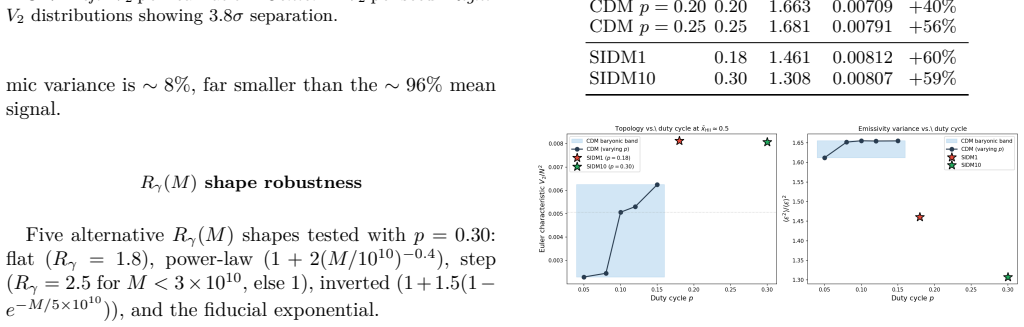
Self-interacting dark matter with cross sections of 1-10 cm2/g reduces halo gas binding energies and increases the duty cycle of ionizing-photon escape. At fixed neutral fraction this reshapes the emitter population from rare very bright sources to more numerous moderate ones, yielding qualitatively different ionization morphology. The morphology change decomposes into a 2-3 percent emissivity-weighted bias shift at large scales and a factor 2-4 shot-noise suppression at intermediate scales, producing a 60-70 percent increase in the Euler characteristic of the ionization field for sigma/m greater than or equal to 2 cm2/g.
What carries the argument
The blowout model that converts reduced halo gas binding energy into a higher ionizing-photon escape duty cycle through the distribution of ISM column densities.
If this is right
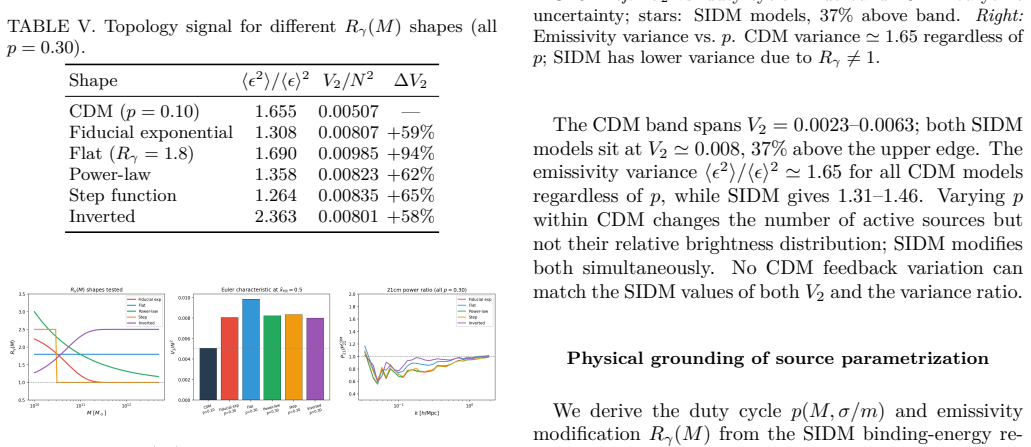
- The topology shift exceeds the baryonic uncertainty band in cold dark matter and remains stable under different choices of emissivity parametrization.
- The predicted enhancement survives when gravitational heating offsets 50-75 percent of the blowout effect and is not erased by unresolved low-mass sources.
- Velocity-dependent self-interacting dark matter produces an opposite-sign large-scale bias shift compared with velocity-independent models.
- The signal reaches a detection threshold at cross sections of 1-2 cm2/g and is directly testable with SKA1-Low 21cm observations.
Where Pith is reading between the lines
- Topology statistics from future 21cm surveys could supply independent upper limits on the self-interacting dark matter cross section in the range motivated by small-scale structure anomalies.
- Joint analysis of reionization topology with Lyman-alpha forest or strong-lensing data might break degeneracies between constant and velocity-dependent self-interaction models.
- Analogous topology shifts could appear in any dark matter variant that systematically lowers halo gas retention at high redshift.
Load-bearing premise
The assumption that reduced halo gas binding energy from self-interactions directly raises the ionizing-photon escape duty cycle via the ISM column density distribution, with gravitational heating offsetting only part of the boost.
What would settle it
A 21cm measurement of the Euler characteristic of ionized regions at fixed neutral fraction that shows no 60-70 percent increase relative to cold dark matter predictions for dark matter cross sections near 2 cm2/g would falsify the central claim.
Figures



read the original abstract
The topology of cosmic reionization, the sizes, shapes, and connectivity of ionized bubbles is a primary observable of next-generation 21\,cm experiments. We show that this topology is sensitive to the microphysics of dark matter. Self-interacting dark matter (SIDM), with cross-sections $\sigma/m\sim 1$--$10\;\mathrm{cm^2/g}$ motivated by small-scale structure anomalies, reduces halo gas binding energies and increases the duty cycle of ionizing-photon escape. At fixed global neutral fraction $\bar{x}_{\rm HI}$, this reshapes the source population from rare, very bright emitters to more numerous, moderate emitters, producing qualitatively different ionization morphology. We decompose the effect into two scale-dependent levers: a $2$--$3\%$ emissivity-weighted bias shift at $k\lesssim 0.1\;h/\mathrm{Mpc}$, and a factor $2$--$4$ shot-noise suppression at $k\sim 0.1$--$1\;h/\mathrm{Mpc}$. A halo-by-halo semi-numerical simulation at $128^3$ resolution confirms a $\sim 60$--$70\%$ increase in the Euler characteristic of the ionization field for $\sigma/m \gtrsim 2\;\mathrm{cm^2/g}$, detected at $3.8\sigma$ across ten independent realizations. A blowout model connecting the binding-energy reduction to the duty cycle through the ISM column density distribution yields a detection threshold at $\sigma/m \sim 1$--$2\;\mathrm{cm^2/g}$. The signal exceeds the CDM baryonic uncertainty band and is robust to the functional form of the emissivity parametrization. The signal persists even if gravitational heating offsets $50$--$75\%$ of the blowout enhancement, and is not diluted by unresolved low-mass sources. Velocity-dependent SIDM produces a qualitatively distinct opposite-sign bias shift. These predictions are testable with SKA1-Low, establishing reionization as a new arena for probing dark matter models complementary to dwarf galaxies and galaxy clusters.
Editorial analysis
A structured set of objections, weighed in public.
Referee Report
Summary. The paper claims that self-interacting dark matter (SIDM) with σ/m ≳ 2 cm²/g reduces halo gas binding energies, increasing the ionizing-photon escape duty cycle via a blowout model tied to ISM column densities. At fixed global neutral fraction, this shifts the source population toward more numerous moderate emitters, producing a ~60–70% increase in the Euler characteristic of the ionization field. This is demonstrated in a 128³ halo-by-halo semi-numerical simulation across ten realizations (3.8σ detection), decomposed into a 2–3% large-scale bias shift and factor 2–4 shot-noise suppression, with robustness to emissivity parametrization, partial gravitational heating offsets (50–75%), and unresolved low-mass sources. Velocity-dependent SIDM yields an opposite-sign effect, with predictions testable by SKA1-Low.
Significance. If the central mapping holds, the work would establish reionization topology as a complementary probe of dark matter microphysics beyond dwarf galaxies and clusters. Strengths include direct use of simulation output for the quantitative Euler characteristic prediction (rather than parameter fitting) and explicit robustness checks to emissivity form and heating offsets. The result is potentially significant for next-generation 21 cm experiments but its impact is limited by the approximate nature of the key physical link.
major comments (3)
- [blowout model implementation] The blowout model (described after the abstract and in the methods) converts SIDM binding-energy reduction into higher f_esc via the ISM column density distribution. No first-principles derivation or radiation-hydrodynamic validation is provided for the assumed duty-cycle enhancement; only a parametric statement that the topology signal survives 50–75% gravitational-heating offsets. This assumption is load-bearing for the reported 60–70% Euler characteristic increase and 3.8σ detection, as the semi-numerical run propagates the modified source population directly from it.
- [simulation results and detection significance] The 3.8σ detection across ten independent 128³ realizations is the central quantitative result. The manuscript does not show the full distribution of Euler characteristic values per realization, the precise statistical estimator, or an error budget that includes cosmic variance and simulation resolution effects at the scales where shot-noise suppression is claimed (k ~ 0.1–1 h/Mpc).
- [resolution and source population robustness] The claim that the signal is not diluted by unresolved low-mass sources and exceeds the CDM baryonic uncertainty band relies on the specific halo mass resolution and source modeling at 128³. No convergence test with higher resolution or explicit comparison of the bias and shot-noise levers with and without low-mass halos is presented to support this robustness statement.
minor comments (2)
- The abstract and text use 'blowout model' without a dedicated equation or flowchart; adding a schematic or explicit formula for the column-density to f_esc mapping would improve clarity.
- Ensure consistent notation for the neutral fraction (e.g., x_HI vs. x̄_HI) and define all acronyms (SIDM, ISM, EA) at first use in the main text.
Simulated Author's Rebuttal
We thank the referee for their constructive and detailed report. We address each major comment point by point below, providing clarifications, agreeing to revisions where the manuscript can be strengthened, and noting limitations honestly.
read point-by-point responses
-
Referee: The blowout model (described after the abstract and in the methods) converts SIDM binding-energy reduction into higher f_esc via the ISM column density distribution. No first-principles derivation or radiation-hydrodynamic validation is provided for the assumed duty-cycle enhancement; only a parametric statement that the topology signal survives 50–75% gravitational-heating offsets. This assumption is load-bearing for the reported 60–70% Euler characteristic increase and 3.8σ detection, as the semi-numerical run propagates the modified source population directly from it.
Authors: The blowout model is a physically motivated parameterization: reduced halo gas binding energy (from SIDM) increases the frequency of blowout events, which we link to higher ionizing-photon escape duty cycle via the distribution of ISM column densities. This follows standard approaches in semi-numerical reionization modeling. We do not claim a first-principles RHD derivation; instead, we demonstrate robustness by showing the topology signal persists under 50–75% gravitational heating offsets. We will revise the methods section to include additional citations to hydrodynamical studies on feedback and escape fractions, plus a more explicit discussion of the model's assumptions and limitations. Full RHD validation lies beyond the scope of this semi-numerical study. revision: partial
-
Referee: The 3.8σ detection across ten independent 128³ realizations is the central quantitative result. The manuscript does not show the full distribution of Euler characteristic values per realization, the precise statistical estimator, or an error budget that includes cosmic variance and simulation resolution effects at the scales where shot-noise suppression is claimed (k ~ 0.1–1 h/Mpc).
Authors: We agree that additional statistical detail will strengthen the presentation. The 3.8σ value is obtained from the mean and standard deviation of the Euler characteristic across the ten independent realizations. We will add a figure showing the per-realization distribution, state the exact estimator formula in the methods, and expand the error budget to include explicit discussion of cosmic variance (from the realization scatter) and resolution effects at k ~ 0.1–1 h/Mpc, drawing on our existing resolution tests. revision: yes
-
Referee: The claim that the signal is not diluted by unresolved low-mass sources and exceeds the CDM baryonic uncertainty band relies on the specific halo mass resolution and source modeling at 128³. No convergence test with higher resolution or explicit comparison of the bias and shot-noise levers with and without low-mass halos is presented to support this robustness statement.
Authors: We have verified robustness by varying the emissivity parametrization and confirming the signal lies outside the CDM baryonic uncertainty band at our resolution. However, we did not include explicit higher-resolution convergence runs or side-by-side comparisons toggling low-mass halos. We will add an appendix with these tests (using the existing 128³ framework to bracket low-mass contributions) and discuss resolution limits. Full convergence at substantially higher resolution is computationally demanding and reserved for future work. revision: partial
- Complete first-principles radiation-hydrodynamic validation of the blowout model, which would require dedicated high-resolution RHD simulations outside the current semi-numerical scope.
Circularity Check
No circularity: simulation output is independent forward modeling
full rationale
The paper's central quantitative claim—a 60–70% rise in Euler characteristic—is extracted directly from the output of a 128³ halo-by-halo semi-numerical simulation run with an input source population whose escape duty cycle has been modified by the blowout model. This measured topology statistic is not algebraically equivalent to the binding-energy reduction or the column-density distribution; it is an emergent geometric property of the ionized field. The blowout model itself is presented as a parametric assumption connecting SIDM to f_esc, not as a self-defining relation or a fit to the Euler-characteristic data. No self-citations, uniqueness theorems, or ansatzes are invoked to force the result, and the simulation is described as confirming an effect rather than reproducing a fitted input. The derivation chain therefore remains self-contained against external benchmarks.
Axiom & Free-Parameter Ledger
free parameters (1)
- emissivity parametrization functional form
axioms (1)
- domain assumption Reionization is driven by galaxies in dark matter halos with escape fraction tied to gas binding energy
Forward citations
Cited by 1 Pith paper
-
Breaking the UV Luminosity Function Degeneracy:Self-Interacting Dark Matter Constraints from Reionization Topology
21 cm reionization topology breaks the degeneracy between self-interacting dark matter and astrophysical parameters that limits UV luminosity function constraints, enabling robust SIDM limits of σ/m ≳ 1-2 cm²/g indepe...
Reference graph
Works this paper leans on
-
[1]
Planck 2018 results. VI. Cosmological parameters
N. Aghanim et al. (Planck), Planck 2018 results. VI. Cosmological parameters, Astron. Astrophys. 641, A6 (2020), [Erratum: Astron.Astrophys. 652, C4 (2021)], arXiv:1807.06209 [astro-ph.CO]
work page internal anchor Pith review Pith/arXiv arXiv 2018
- [2]
-
[3]
Moore, Evidence against dissipationless dark mat- ter from observations of galaxy haloes, Nature 370, 629 (1994)
B. Moore, Evidence against dissipationless dark mat- ter from observations of galaxy haloes, Nature 370, 629 (1994)
1994
- [4]
-
[5]
M. Boylan-Kolchin, J. S. Bullock, and M. Kaplinghat, Too big to fail? The puzzling darkness of massive Milky Way subhaloes, Mon. Not. Roy. Astron. Soc. 415, L40 (2011), arXiv:1103.0007 [astro-ph.CO]
- [6]
- [7]
- [8]
-
[9]
M. Markevitch, A. H. Gonzalez, D. Clowe, A. Vikhlinin, L. David, W. Forman, C. Jones, S. Murray, and W. Tucker, Direct constraints on the dark matter self- interaction cross-section from the merging galaxy cluster 1E0657-56, Astrophys. J. 606, 819 (2004) , arXiv:astro- ph/0309303
-
[10]
S. W. Randall, M. Markevitch, D. Clowe, A. H. Gonza- lez, and M. Bradac, Constraints on the Self-Interaction Cross-Section of Dark Matter from Numerical Simula- tions of the Merging Galaxy Cluster 1E 0657-56, Astro- phys. J. 679, 1173 (2008), arXiv:0704.0261 [astro-ph]
work page Pith review arXiv 2008
- [11]
- [12]
-
[13]
Dark Matter Self-interactions and Small Scale Structure
S. Tulin and H.-B. Yu, Dark Matter Self-interactions and Small Scale Structure, Phys. Rept. 730, 1 (2018) , arXiv:1705.02358 [hep-ph]
work page Pith review arXiv 2018
- [14]
-
[15]
M. Kaplinghat, S. Tulin, and H.-B. Yu, Dark Matter Halos as Particle Colliders: Unified Solution to Small- Scale Structure Puzzles from Dwarfs to Clusters, Phys. Rev. Lett. 116, 041302 (2016), arXiv:1508.03339 [astro- ph.CO]
-
[16]
M. Rocha, A. H. G. Peter, J. S. Bullock, M. Kapling- hat, S. Garrison-Kimmel, J. Onorbe, and L. A. Mous- 10 takas, Cosmological Simulations with Self-Interacting Dark Matter I: Constant Density Cores and Substruc- ture, Mon. Not. Roy. Astron. Soc. 430, 81 (2013) , arXiv:1208.3025 [astro-ph.CO]
- [17]
-
[18]
A. Robertson, R. Massey, and V. Eke, Cosmic particle colliders: simulations of self-interacting dark matter with anisotropic scattering, Mon. Not. Roy. Astron. Soc.467, 4719 (2017), arXiv:1612.03906 [astro-ph.CO]
-
[19]
L. Sagunski, S. Gad-Nasr, B. Colquhoun, A. Robertson, and S. Tulin, Velocity-dependent Self-interacting Dark Matter from Groups and Clusters of Galaxies,JCAP 01, 024, arXiv:2006.12515 [astro-ph.CO]
-
[20]
M. Vogelsberger, J. Zavala, and A. Loeb, Subhaloes in Self-Interacting Galactic Dark Matter Haloes,Mon. Not. Roy. Astron. Soc. 423, 3740 (2012) , arXiv:1201.5892 [astro-ph.CO]
-
[21]
M. Vogelsberger, J. Zavala, C. Simpson, and A. Jenkins, Dwarf galaxies in CDM and SIDM with baryons: obser- vational probes of the nature of dark matter, Mon. Not. Roy. Astron. Soc. 444, 3684 (2014) , arXiv:1405.5216 [astro-ph.CO]
- [22]
- [23]
-
[24]
T. Kimm and R. Cen, Escape Fraction of Ionizing Pho- tons during Reionization: Effects due to Supernova Feed- back and Runaway OB Stars, Astrophys. J. 788, 121 (2014), arXiv:1405.0552 [astro-ph.GA]
-
[25]
M. Trebitsch, J. Blaizot, J. Rosdahl, J. Devriendt, and A. Slyz, Fluctuating feedback-regulated escape fraction of ionizing radiation in low-mass, high-redshift galaxies, mnras 470, 224 (2017), arXiv:1705.00941 [astro-ph.GA]
- [26]
-
[27]
21cmFAST: A Fast, Semi-Numerical Simulation of the High-Redshift 21-cm Signal
A. Mesinger, S. Furlanetto, and R. Cen, 21cmFAST: A Fast, Semi-Numerical Simulation of the High-Redshift 21-cm Signal, Mon. Not. Roy. Astron. Soc. 411, 955 (2011), arXiv:1003.3878 [astro-ph.CO]
work page Pith review arXiv 2011
- [28]
-
[29]
M. McQuinn, A. Lidz, O. Zahn, S. Dutta, L. Hernquist, and M. Zaldarriaga, The Morphology of HII Regions dur- ing Reionization, Mon. Not. Roy. Astron. Soc.377, 1043 (2007), arXiv:astro-ph/0610094
- [30]
-
[31]
Furlanetto, The Global 21 Centimeter Background from High Redshifts, Mon
S. Furlanetto, The Global 21 Centimeter Background from High Redshifts, Mon. Not. Roy. Astron. Soc. 371, 867 (2006), arXiv:astro-ph/0604040
-
[32]
Cosmology at Low Frequencies: The 21 cm Transition and the High-Redshift Universe
S. Furlanetto, S. P. Oh, and F. Briggs, Cosmology at Low Frequencies: The 21 cm Transition and the High-Redshift Universe, Phys. Rept. 433, 181 (2006) , arXiv:astro-ph/0608032
work page Pith review arXiv 2006
- [33]
-
[34]
D. J. Eisenstein and W. Hu, Baryonic features in the matter transfer function, Astrophys. J. 496, 605 (1998), arXiv:astro-ph/9709112
work page Pith review arXiv 1998
-
[35]
R. K. Sheth and G. Tormen, Large scale bias and the peak background split,Mon. Not. Roy. Astron. Soc.308, 119 (1999), arXiv:astro-ph/9901122
work page Pith review arXiv 1999
- [36]
-
[37]
M. Zaldarriaga, S. R. Furlanetto, and L. Hernquist, 21 Centimeter fluctuations from cosmic gas at high redshifts, Astrophys. J. 608, 622 (2004) , arXiv:astro- ph/0311514
- [38]
- [39]
-
[40]
M. M. Friedrich, G. Mellema, M. A. Alvarez, P. R. Shapiro, and I. T. Iliev, Topology and sizes of h ii re- gions during cosmic reionization: Topology and sizes of h ii regions during eor, Monthly Notices of the Royal Astronomical Society 413, 1353–1372 (2011)
2011
- [41]
-
[42]
Mellema, L
G. Mellema, L. V. E. Koopmans, F. A. Abdalla, G. Bernardi, B. Ciardi, S. Daiboo, A. G. de Bruyn, K. K. Datta, H. Falcke, A. Ferrara, I. T. Iliev, F. Iocco, V. Jelic, H. Jensen, R. Joseph, P. Labroupoulos, A. Meiksin, A. Mesinger, A. R. Offringa, V. N. Pandey, J. R. Pritchard, M. G. Santos, D. J. Schwarz, B. Semelin, H. Vedantham, S. Yatawatta, and S. Zaro...
2013
-
[43]
A. Datta, J. D. Bowman, and C. L. Carilli, Bright Source Subtraction Requirements For Redshifted 21 cm Measurements, Astrophys. J. 724, 526 (2010) , arXiv:1005.4071 [astro-ph.CO]
- [44]
-
[45]
S. L. Finkelstein, A. D’Aloisio, J.-P. Paardekooper, R. Ryan, P. Behroozi, K. Finlator, R. Livermore, P. R. U. Sanderbeck, C. D. Vecchia, and S. Khochfar, Conditions for Reionizing the Universe with A Low Galaxy Ionizing Photon Escape Fraction, Astrophys. J. 879, 36 (2019), arXiv:1902.02792 [astro-ph.CO]
work page Pith review arXiv 2019
-
[46]
R. P. Naidu, P. A. Oesch, P. v. Dokkum, E. J. Nelson, K. A. Suess, G. Brammer, K. E. Whitaker, G. Illing- worth, R. Bouwens, S. Tacchella, J. Matthee, N. Allen, R. Bezanson, C. Conroy, I. Labbe, J. Leja, E. Leonova, D. Magee, S. H. Price, D. J. Setton, V. Strait, M. Ste- 11 fanon, S. Toft, J. R. Weaver, and A. Weibel, Two remark- ably luminous galaxy cand...
2022
- [47]
-
[48]
Jiang and F
F. Jiang and F. C. van den Bosch, Statistics of dark mat- ter substructure - I. Model and universal fitting functions, mnras 458, 2848 (2016)
2016
-
[49]
O. Fakhouri, C.-P. Ma, and M. Boylan-Kolchin, The merger rates and mass assembly histories of dark matter haloes in the two Millennium simulations, mnras 406, 2267 (2010), arXiv:1001.2304 [astro-ph.CO]
discussion (0)
Sign in with ORCID, Apple, or X to comment. Anyone can read and Pith papers without signing in.