Towards Automated Solar Panel Integrity: Hybrid Deep Feature Extraction for Advanced Surface Defect Identification
Pith reviewed 2026-05-10 15:57 UTC · model grok-4.3
The pith
A hybrid of DenseNet-169 deep features and Gabor filters classified by SVM detects solar panel surface defects at 99.17 percent accuracy.
A machine-rendered reading of the paper's core claim, the machinery that carries it, and where it could break.
Core claim
The central claim is that concatenating deep features from DenseNet-169 with handcrafted Gabor filter responses and classifying the combined vector with a support vector machine produces 99.17 percent accuracy on solar panel defect identification, exceeding the performance of the other hybrid and standalone feature sets examined in the study.
What carries the argument
The concatenation of DenseNet-169 deep features with Gabor filter handcrafted features, supplied as input to an SVM classifier that separates defective from intact solar panel surfaces.
If this is right
- Large-scale and remote solar plants can be monitored continuously without constant human presence.
- Early defect detection helps maintain maximum power generation and prevents larger failures.
- The hybrid framework supplies greater accuracy, robustness, and adaptability than single-feature approaches for practical PV monitoring.
Where Pith is reading between the lines
- The same concatenated feature pipeline could be tested on video streams from drones or fixed cameras for ongoing surveillance.
- Similar handcrafted-plus-deep combinations may transfer to surface inspection tasks on other energy infrastructure such as wind-turbine blades.
- Lightweight versions of the model would need evaluation on edge hardware before widespread field deployment.
Load-bearing premise
The augmented dataset used for evaluation sufficiently represents the variety of real-world solar panel defects, lighting conditions, and panel types encountered in operational plants.
What would settle it
Apply the trained DenseNet-169 plus Gabor SVM model to a new, unaugmented image set collected directly from operating solar installations under diverse weather and panel conditions and check whether accuracy stays near 99.17 percent or falls substantially.
Figures



read the original abstract
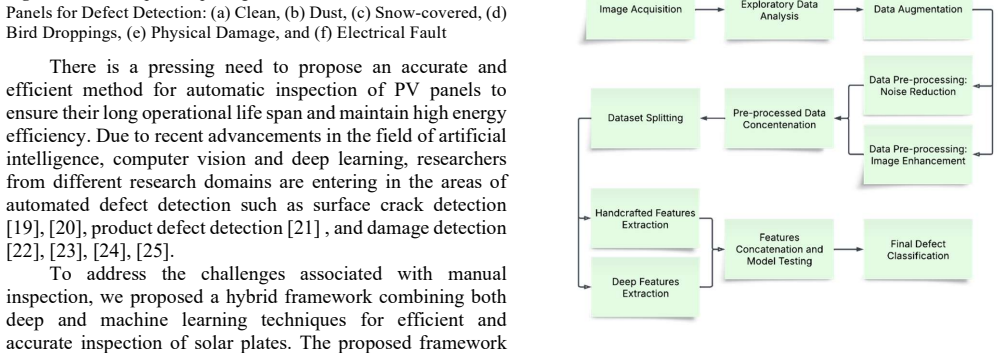
To ensure energy efficiency and reliable operations, it is essential to monitor solar panels in generation plants to detect defects. It is quite labor-intensive, time consuming and costly to manually monitor large-scale solar plants and those installed in remote areas. Manual inspection may also be susceptible to human errors. Consequently, it is necessary to create an automated, intelligent defect-detection system, that ensures continuous monitoring, early fault detection, and maximum power generation. We proposed a novel hybrid method for defect detection in SOLAR plates by combining both handcrafted and deep learning features. Local Binary Pattern (LBP), Histogram of Gradients (HoG) and Gabor Filters were used for the extraction of handcrafted features. Deep features extracted by leveraging the use of DenseNet-169. Both handcrafted and deep features were concatenated and then fed to three distinct types of classifiers, including Support Vector Machines (SVM), Extreme Gradient Boost (XGBoost) and Light Gradient-Boosting Machine (LGBM). Experimental results evaluated on the augmented dataset show the superior performance, especially DenseNet-169 + Gabor (SVM), had the highest scores with 99.17% accuracy which was higher than all the other systems. In general, the proposed hybrid framework offers better defect-detection accuracy, resistance, and flexibility that has a solid basis on the real-life use of the automated PV panels monitoring system.
Editorial analysis
A structured set of objections, weighed in public.
Referee Report
Summary. The manuscript proposes a hybrid feature extraction framework for solar panel surface defect detection that concatenates handcrafted features (LBP, HoG, Gabor filters) with deep features from DenseNet-169 and feeds the combined representation to SVM, XGBoost, and LGBM classifiers. The central empirical claim is that the DenseNet-169 + Gabor + SVM variant achieves 99.17% accuracy on an augmented dataset and outperforms the other tested combinations.
Significance. If the performance numbers are shown to hold under proper dataset documentation and real-world hold-out testing, the hybrid approach could provide a practical contribution to automated PV plant monitoring by improving early defect detection and reducing manual inspection costs. The combination of multiple handcrafted descriptors with a standard CNN backbone is a conventional but potentially useful direction in industrial defect detection.
major comments (2)
- [Abstract] Abstract: The headline result of 99.17% accuracy for DenseNet-169 + Gabor (SVM) is reported without any information on the size of the original (non-augmented) dataset, the specific augmentation operations and parameters applied, the train-test split ratios, cross-validation procedure, or statistical significance testing. These omissions make the superiority claim impossible to assess for reliability or generalizability.
- [Abstract] Abstract and evaluation section: The manuscript states that results were obtained exclusively on the augmented dataset and claims the method “has a solid basis on the real-life use,” yet provides no hold-out evaluation on real operational imagery (varying lighting, panel types, or naturally occurring defects such as cracks and delamination). This gap directly undermines the practical significance asserted for automated PV monitoring.
minor comments (2)
- [Abstract] Abstract: “SOLAR plates” should read “solar panels.” The phrase “resistance, and flexibility” is unclear; “robustness” is the intended meaning.
- The manuscript does not specify the dimensionality of the concatenated feature vector or any dimensionality-reduction step prior to classification, which affects reproducibility.
Simulated Author's Rebuttal
We thank the referee for their detailed and constructive feedback. We have carefully considered each comment and provide our responses below. We will make revisions to address the concerns regarding dataset documentation and the scope of our evaluation.
read point-by-point responses
-
Referee: [Abstract] Abstract: The headline result of 99.17% accuracy for DenseNet-169 + Gabor (SVM) is reported without any information on the size of the original (non-augmented) dataset, the specific augmentation operations and parameters applied, the train-test split ratios, cross-validation procedure, or statistical significance testing. These omissions make the superiority claim impossible to assess for reliability or generalizability.
Authors: We agree with the referee that these details are crucial for assessing the reliability of our results. Although the full manuscript includes some description of the data augmentation process, we will revise the abstract and add a comprehensive 'Dataset and Experimental Setup' section that explicitly states the original dataset size, the specific augmentation operations and their parameters, the train-test split ratios, the cross-validation procedure, and results of statistical significance testing (such as p-values from appropriate tests) to support the performance claims. revision: yes
-
Referee: [Abstract] Abstract and evaluation section: The manuscript states that results were obtained exclusively on the augmented dataset and claims the method “has a solid basis on the real-life use,” yet provides no hold-out evaluation on real operational imagery (varying lighting, panel types, or naturally occurring defects such as cracks and delamination). This gap directly undermines the practical significance asserted for automated PV monitoring.
Authors: We acknowledge that our experiments were conducted solely on the augmented dataset and that the phrasing regarding real-life applicability may overstate the current evidence. In the revised version, we will modify the abstract and conclusion to remove or qualify the claim of having a 'solid basis on the real-life use,' instead emphasizing the potential for practical application while clearly stating the limitations. We will include a new subsection discussing the challenges of real-world deployment and propose future directions for testing on operational PV imagery under varying conditions. However, we currently lack access to such diverse real-world hold-out datasets for inclusion in this study. revision: partial
- We are unable to provide hold-out evaluation results on real operational imagery as no such data was used in the current study.
Circularity Check
No circularity: empirical ML evaluation on held-out augmented data
full rationale
The paper reports an empirical pipeline: handcrafted features (LBP, HoG, Gabor) concatenated with DenseNet-169 deep features, fed to SVM/XGBoost/LGBM classifiers, with accuracies measured directly on an augmented dataset (highest 99.17% for DenseNet-169+Gabor+SVM). No equations, fitted parameters renamed as predictions, self-citations, or uniqueness claims appear in the provided text. The central result is a straightforward experimental measurement rather than a derivation that reduces to its inputs by construction.
Axiom & Free-Parameter Ledger
free parameters (1)
- Classifier hyperparameters (SVM kernel, XGBoost learning rate, LGBM parameters)
axioms (1)
- domain assumption Handcrafted features (LBP, HoG, Gabor) and DenseNet-169 deep features provide complementary information sufficient for defect classification
Lean theorems connected to this paper
-
IndisputableMonolith/Cost/FunctionalEquation.leanwashburn_uniqueness_aczel unclear?
unclearRelation between the paper passage and the cited Recognition theorem.
DenseNet-169 + Gabor (SVM) had the highest scores with 99.17% accuracy... hybrid feature extraction network based on the combination of traditional machine learning approaches and deep learning models
What do these tags mean?
- matches
- The paper's claim is directly supported by a theorem in the formal canon.
- supports
- The theorem supports part of the paper's argument, but the paper may add assumptions or extra steps.
- extends
- The paper goes beyond the formal theorem; the theorem is a base layer rather than the whole result.
- uses
- The paper appears to rely on the theorem as machinery.
- contradicts
- The paper's claim conflicts with a theorem or certificate in the canon.
- unclear
- Pith found a possible connection, but the passage is too broad, indirect, or ambiguous to say the theorem truly supports the claim.
Reference graph
Works this paper leans on
-
[1]
Traditional energy resources in India (coal, crude oil, natural gas): A review,
L. S. Tiewsoh, M. Sivek and J. Jirásek, "Traditional energy resources in India (coal, crude oil, natural gas): A review," Energy Sources, Part B: Economics, Planning, and Policy, vol. 12, p. 110–118, 2017
work page 2017
-
[2]
Economic, societal, and environmental impacts of available energy sources: A review,
F. Al Mubarak, R. Rezaee and D. A. Wood, "Economic, societal, and environmental impacts of available energy sources: A review," Eng, vol. 5, p. 1232–1265, 2024
work page 2024
-
[3]
Renewable energy resources for electricity generation in Sudan,
A. M. Omer, "Renewable energy resources for electricity generation in Sudan," Renewable and Sustainable Energy Reviews, vol. 11, p. 1481–1497, 2007
work page 2007
-
[4]
X. Sun, S. Jiang, H. Huang, H. Li, B. Jia and T. Ma, "Solar energy catalysis," Angewandte Chemie, vol. 134, p. e202204880, 2022
work page 2022
-
[5]
Energy conversion strategies for wind energy system: Electrical, mechanical and material aspects,
A. Chaudhuri, R. Datta, M. P. Kumar, J. P. Davim and S. Pramanik, "Energy conversion strategies for wind energy system: Electrical, mechanical and material aspects," Materials, vol. 15, p. 1232, 2022
work page 2022
-
[6]
Potential use of industrial biomass waste as a sustainable energy source in the future,
T. Kalak, "Potential use of industrial biomass waste as a sustainable energy source in the future," Energies, vol. 16, p. 1783, 2023
work page 2023
-
[7]
A review on hydro power plants and turbines,
R. K. Karre, K. Srinivas, K. Mannan, B. Prashanth and C. R. Prasad, "A review on hydro power plants and turbines," in AIP Conference Proceedings, 2022
work page 2022
-
[8]
A comprehensive study of renewable energy sources: Classifications, challenges and suggestions,
T.-Z. Ang, M. Salem, M. Kamarol, H. S. Das, M. A. Nazari and N. Prabaharan, "A comprehensive study of renewable energy sources: Classifications, challenges and suggestions," Energy strategy reviews, vol. 43, p. 100939, 2022
work page 2022
-
[9]
C. I. Igwe, "Geothermal energy: a review," Int. J. Eng. Res. Technol.(IJERT), vol. 10, p. 655–661, 2021
work page 2021
-
[10]
Clean energy production using solar energy resources,
B. Kumar, D. Garg, K. Swamy and P. Kumar, "Clean energy production using solar energy resources," in Sustainable and Clean Energy Production Technologies, Springer, 2022, p. 269–288
work page 2022
-
[11]
Solar energy technology and its roles in sustainable development,
A. O. M. Maka and J. M. Alabid, "Solar energy technology and its roles in sustainable development," Clean Energy, vol. 6, p. 476–483, 2022
work page 2022
-
[12]
Polo, Advances and Challenges in Solar PV Systems’ Performance, vol
J. Polo, Advances and Challenges in Solar PV Systems’ Performance, vol. 15, MDPI, 2022, p. 6080
work page 2022
-
[13]
Recent Advances and Future Challenges of Solar Power Generation Forecasting,
N. Jannah, T. S. Gunawan, S. H. Yusoff, M. S. A. Hanifah and S. N. M. Sapihie, "Recent Advances and Future Challenges of Solar Power Generation Forecasting," IEEE Access, 2024
work page 2024
-
[14]
Y. Ledmaoui, A. El Maghraoui, M. El Aroussi and R. Saadane, "Enhanced fault detection in photovoltaic panels using cnn-based classification with pyqt5 implementation," Sensors, vol. 24, p. 7407, 2024
work page 2024
-
[15]
Inter-modality feature prediction through multimodal fusion for 3D shape defect detection,
M. Asad, W. Azeem, H. T. Mustafa, Y. Fang, J. Yang, Y. Zuo and W. Liu, "Inter-modality feature prediction through multimodal fusion for 3D shape defect detection," Neural Networks, vol. 193, p. 108057, 2026
work page 2026
-
[16]
3D-MMFN: Multi-level multimodal fusion network for 3D industrial image anomaly detection,
M. Asad, W. Azeem, A. A. Malik, H. Jiang, A. Ali, J. Yang and W. Liu, "3D-MMFN: Multi-level multimodal fusion network for 3D industrial image anomaly detection," Advanced Engineering Informatics, vol. 65, p. 103284, 2025
work page 2025
-
[17]
2M3DF: Advancing 3D Industrial Defect Detection With 10 Multi-Perspective Multimodal Fusion Network,
M. Asad, W. Azeem, H. Jiang, H. Tayyab Mustafa, J. Yang and W. Liu, "2M3DF: Advancing 3D Industrial Defect Detection With 10 Multi-Perspective Multimodal Fusion Network," IEEE Transactions on Circuits and Systems for Video Technology, vol. 35, pp. 6803- 6815, 2025
work page 2025
-
[18]
F. H. K. Al-Zaabi, A. M. S. Al Washahi, R. K. M. Al-Maaini, M. K. Boddu and others, "Advancing Solar PV Component Inspection: Early Defect Detection with UAV Based Thermal Imaging and Machine Learning," in 2023 Middle East and North Africa Solar Conference (MENA-SC), 2023
work page 2023
-
[19]
R. Singh, R. Kashyap and A. Kumar, "Prominent solution for solar panel defect detection using AI-based computer vision technology with IoT sensors in the solar panel manufacturing industry," International Journal of Information Technology, p. 1–17, 2024
work page 2024
-
[20]
U. Hijjawi, S. Lakshminarayana, T. Xu, G. P. M. Fierro and M. Rahman, "A review of automated solar photovoltaic defect detection systems: Approaches, challenges, and future orientations," Solar Energy, vol. 266, p. 112186, 2023
work page 2023
-
[21]
Y. S. Afridi, K. Ahmad and L. Hassan, "Artificial intelligence based prognostic maintenance of renewable energy systems: A review of techniques, challenges, and future research directions," International Journal of Energy Research, vol. 46, p. 21619–21642, 2022
work page 2022
- [22]
-
[23]
Local binary pattern(lbp) optimization for feature extraction,
Z. Sedaghatjoo, H. Hosseinzadeh and B. S. Bigham, "Local binary pattern (lbp) optimization for feature extraction," arXiv preprint arXiv:2407.18665, 2024
-
[24]
Image feature generation using binary patterns—LBP, SLBP and GBP,
S. Divya, L. P. Suresh and A. John, "Image feature generation using binary patterns—LBP, SLBP and GBP," in ICT Analysis and Applications, Springer, 2022, p. 233–239
work page 2022
-
[25]
A review of local binary pattern based texture feature extraction,
N. Kaur, N. Nazir and others, "A review of local binary pattern based texture feature extraction," in 2021 9th International Conference on Reliability, Infocom Technologies and Optimization (Trends and Future Directions)(ICRITO), 2021
work page 2021
-
[26]
Image analysis with local binary patterns,
M. Pietikäinen, "Image analysis with local binary patterns," in Scandinavian Conference on Image Analysis, 2005
work page 2005
-
[27]
A framework for recognition of facial expression using HOG features,
V. A. Saeed, "A framework for recognition of facial expression using HOG features," International Journal of Mathematics, Statistics, and Computer Science, vol. 2, p. 1–8, 2024
work page 2024
-
[28]
E. A. Siddiqui, V. Chaurasia and M. Shandilya, "Detection and classification of lung cancer computed tomography images using a novel improved deep belief network with Gabor filters," Chemometrics and Intelligent Laboratory Systems, vol. 235, p. 104763, 2023
work page 2023
-
[29]
Crowd Scene Analysis Using Deep Learning Techniques,
M. J. Asif, "Crowd Scene Analysis Using Deep Learning Techniques," arXiv preprint arXiv:2505.08834, 2025
-
[30]
Image classification based on CNN: a survey,
A. A. Elngar, M. Arafa, A. Fathy, B. Moustafa, O. Mahmoud, M. Shaban and N. Fawzy, "Image classification based on CNN: a survey," Journal of Cybersecurity and Information Management, vol. 6, p. 18–50, 2021
work page 2021
-
[31]
Survey on SVM and their application in image classification,
M. A. Chandra and S. S. Bedi, "Survey on SVM and their application in image classification," International Journal of Information Technology, vol. 13, p. 1–11, 2021
work page 2021
-
[32]
H. Tanveer, M. A. Adam, M. A. Khan, M. A. Ali and A. Shakoor, "Analyzing the performance and efficiency of machine learning algorithms, such as deep learning, decision trees, or support vector machines, on various datasets and applications," The asian bulletin of big data management, vol. 3, p. 126–136, 2023
work page 2023
-
[33]
Comparison of the Effectiveness of ANN and CNN in Image Classification,
A. Mirakowski, "Comparison of the Effectiveness of ANN and CNN in Image Classification," in International Conference on Computational Collective Intelligence, 2024
work page 2024
-
[34]
Deep learning models for image classification: comparison and applications,
S. Sharma and K. Guleria, "Deep learning models for image classification: comparison and applications," in 2022 2nd International Conference on Advance Computing and Innovative Technologies in Engineering (ICACITE), 2022
work page 2022
-
[35]
P. Dinesh, A. S. Vickram and P. Kalyanasundaram, "Medical image prediction for diagnosis of breast cancer disease comparing the machine learning algorithms: SVM, KNN, logistic regression, random forest and decision tree to measure accuracy," in AIP Conference Proceedings, 2024
work page 2024
-
[36]
M. S. Islam, S. Sultana, F. A. Farid, M. N. Islam, M. Rashid, B. S. Bari, N. Hashim and M. N. Husen, "Multimodal hybrid deep learning approach to detect tomato leaf disease using attention based dilated convolution feature extractor with logistic regression classification," Sensors, vol. 22, p. 6079, 2022
work page 2022
-
[37]
Breast cancer diagnosis from histopathology images using deep neural network and XGBoost,
A. Maleki, M. Raahemi and H. Nasiri, "Breast cancer diagnosis from histopathology images using deep neural network and XGBoost," Biomedical Signal Processing and Control, vol. 86, p. 105152, 2023
work page 2023
-
[38]
Defect detection in solar modules using ICA basis images,
D.-M. Tsai, S.-C. Wu and W.-Y. Chiu, "Defect detection in solar modules using ICA basis images," IEEE Transactions on Industrial Informatics, vol. 9, p. 122–131, 2012
work page 2012
-
[39]
X. Zhang, H. Sun, Y. Zhou, J. Xi and M. Li, "A novel method for surface defect detection of photovoltaic module based on independent component analysis," Mathematical problems in engineering, vol. 2013, p. 520568, 2013
work page 2013
-
[40]
Deep learning-based detection and segmentation of damage in solar panels,
A. Shaik, A. Balasundaram, L. S. Kakarla and N. Murugan, "Deep learning-based detection and segmentation of damage in solar panels," Automation, vol. 5, p. 128–150, 2024
work page 2024
-
[41]
AI-Powered VGG16-based Method for Detecting, Classifying, and Visualizing Solar Panel Defects,
N. Appavu, "AI-Powered VGG16-based Method for Detecting, Classifying, and Visualizing Solar Panel Defects," in 2025 4th International Conference on Distributed Computing and Electrical Circuits and Electronics (ICDCECE), 2025
work page 2025
-
[42]
A Deep Learning Approach for Fault Detection in Photovoltaic Systems Using MobileNetV3,
S. Mansurov, Z. Çetin, E. Aslan and Y. Özüpak, "A Deep Learning Approach for Fault Detection in Photovoltaic Systems Using MobileNetV3," Gazi University Journal of Science Part A: Engineering and Innovation, vol. 12, p. 197–212, 2025
work page 2025
-
[43]
Federated Transfer Learning for Image-Based Solar Panel Fault Detection,
K. Kazemi, "Federated Transfer Learning for Image-Based Solar Panel Fault Detection," in 2025 12th Iranian Conference on Renewable Energies and Distributed Generation (ICREDG), 2025
work page 2025
-
[44]
Visual Diagnostics: Deep Learning with DenseNet121 for Identifying Faults in Solar Panels,
S. R. Joshua, S. Park and K. Kwon, "Visual Diagnostics: Deep Learning with DenseNet121 for Identifying Faults in Solar Panels," in 2024 15th International Conference on Information and Communication Technology Convergence (ICTC), 2024
work page 2024
-
[45]
Using Densenet169 for Image-Based Classification of Solar Panel Defects,
S. Nagar, M. K. Mishra and P. K. Rai, "Using Densenet169 for Image-Based Classification of Solar Panel Defects," in 2024 7th International Conference on Contemporary Computing and Informatics (IC3I), 2024
work page 2024
-
[46]
Detecting defects in solar panels using the YOLO v10 and v11 algorithms,
A. Ghahremani, S. D. Adams, M. Norton, S. Y. Khoo and A. Z. Kouzani, "Detecting defects in solar panels using the YOLO v10 and v11 algorithms," Electronics, vol. 14, p. 344, 2025
work page 2025
-
[47]
Optimized YOLO based model for photovoltaic defect detection in electroluminescence images,
A. Mohamed, Y. Nacera, B. Ahcene, A. Teta, E. O. Belabbaci, A. Rabehi, Y. A. Alsabah and M. Benghanem, "Optimized YOLO based model for photovoltaic defect detection in electroluminescence images," Scientific Reports, vol. 15, p. 32955, 2025
work page 2025
-
[48]
Strategic Customer Segmentation: Harnessing Machine Learning For Retaining Satisfied Customers,
H. Khalid, S. Saqib, M. J. Asif and D. A. Dewi, "Strategic Customer Segmentation: Harnessing Machine Learning For Retaining Satisfied Customers," Lahore Garrison University Research Journal of Computer Science and Information Technology, vol. 8, p. 31–41, 2024
work page 2024
discussion (0)
Sign in with ORCID, Apple, or X to comment. Anyone can read and Pith papers without signing in.