Recognition: unknown
Machine Learning Study on Single Production of a Singlet Vector-like Lepton at the Large Hadron Collider
Pith reviewed 2026-05-10 15:11 UTC · model grok-4.3
The pith
Machine learning with XGBoost extends LHC exclusion limits for singlet vector-like leptons to 620 GeV.
A machine-rendered reading of the paper's core claim, the machinery that carries it, and where it could break.
Core claim
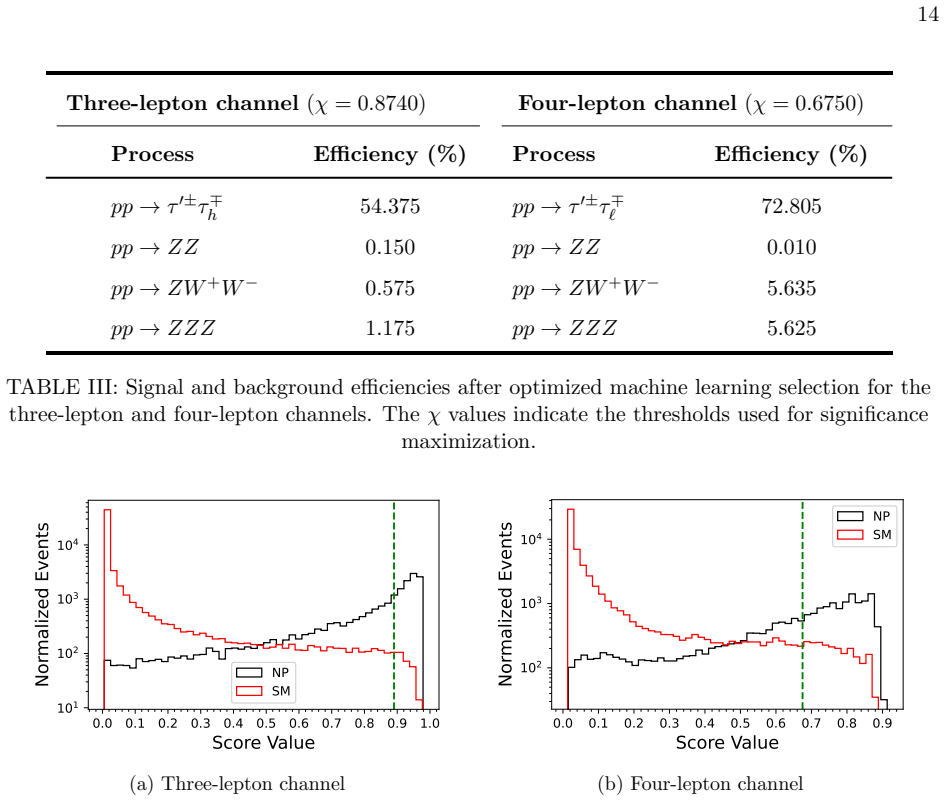
The analysis shows that at sqrt(s) = 14 TeV with an integrated luminosity of 3000 fb^{-1}, the expected 2 sigma exclusion limits in the three- and four-lepton channels can reach vector-like lepton masses up to 620 GeV and 490 GeV, respectively. These findings demonstrate that machine learning techniques can substantially improve the sensitivity of collider searches for vector-like leptons.
What carries the argument
The XGBoost gradient boosting algorithm applied to kinematic features of three- and four-lepton events to discriminate single-production signals of tau-mixing vector-like leptons from Standard Model backgrounds.
If this is right
- The three-lepton channel achieves a higher mass reach than the four-lepton channel under the same conditions.
- Machine learning substantially improves sensitivity for vector-like lepton searches compared to conventional methods.
- The results apply at the high-luminosity LHC phase for the assumed mixing strength.
- Stronger limits would more tightly constrain theoretical models containing vector-like leptons.
Where Pith is reading between the lines
- Validation against real data would be needed to confirm whether simulation-based projections hold for the tau-mixing dependence.
- Adapting the classifier for varying mixing parameters could extend the method to other production modes or particles.
- Gradient boosting methods may prove useful in related searches for exotic fermions in multi-lepton signatures.
- This approach highlights opportunities for data-driven techniques to reduce reliance on simulation accuracy.
Load-bearing premise
The projected limits assume Monte Carlo simulations accurately capture both signal kinematics dependent on the tau-mixing parameter and all relevant backgrounds, with no unaccounted systematic uncertainties degrading XGBoost performance.
What would settle it
Actual LHC data showing no events or mismatched kinematic distributions in the three- or four-lepton channels, or XGBoost efficiencies differing from simulation predictions in control regions, would invalidate the projected mass reaches.
Figures



read the original abstract
Vector-like leptons are non-chiral, colorless fermions from new physics beyond the Standard Model, appearing in many theoretical extensions. We investigate the prospect for detecting the single production of a singlet vector-like lepton that mixes with the $\tau$ lepton at the Large Hadron Collider. The corresponding final states are classified as the three- and four-lepton search channels. The machine learning algorithm XGBoost is employed to enhance signal-background discrimination. Our analysis indicates that, at $\sqrt{s} = 14~\mathrm{TeV}$ with an integrated luminosity of $3000~\mathrm{fb}^{-1}$, the expected $2\sigma$ exclusion limits in the three- and four-lepton channels can reach vector-like lepton masses up to $620~\mathrm{GeV}$ and $490~\mathrm{GeV}$, respectively. These findings demonstrate that machine learning techniques can substantially improve the sensitivity of collider searches for vector-like leptons.
Editorial analysis
A structured set of objections, weighed in public.
Referee Report
Summary. The manuscript investigates single production of a singlet vector-like lepton mixing with the tau lepton at the LHC, classifying events into three- and four-lepton final states. It employs the XGBoost algorithm to discriminate signal from background and projects 2σ exclusion limits reaching 620 GeV (three-lepton channel) and 490 GeV (four-lepton channel) at √s = 14 TeV with 3000 fb^{-1}.
Significance. If the projected reaches are substantiated, the work would illustrate how standard ML classifiers can improve sensitivity to vector-like leptons relative to cut-based methods, offering a useful benchmark for HL-LHC searches in this BSM scenario. The approach relies on conventional Monte Carlo generation and a well-established classifier, which is a strength for reproducibility.
major comments (2)
- [Machine Learning Analysis / Results] The analysis procedure provides no information on simulation settings, training/validation splits, systematic uncertainties (e.g., lepton ID, jet energy scale, pile-up, or ML-specific effects), or background estimation methods. This is load-bearing for the central claim because the quoted 2σ limits of 620 GeV and 490 GeV are derived directly from the XGBoost output on simulated samples; without these details the numerical results cannot be verified or reproduced.
- [Event Generation and Signal Model] The signal kinematics depend on the tau-mixing parameter, which is treated as an input assumption rather than measured or varied; the specific value used to obtain the quoted mass limits is not stated explicitly. This affects the generality of the projected reaches in both channels.
minor comments (1)
- [Abstract] The abstract would benefit from briefly stating the assumed mixing strength and the dominant backgrounds considered.
Simulated Author's Rebuttal
We thank the referee for the careful reading of our manuscript and the constructive comments, which will help improve the clarity and reproducibility of the work. We address each major comment below and will revise the manuscript accordingly.
read point-by-point responses
-
Referee: The analysis procedure provides no information on simulation settings, training/validation splits, systematic uncertainties (e.g., lepton ID, jet energy scale, pile-up, or ML-specific effects), or background estimation methods. This is load-bearing for the central claim because the quoted 2σ limits of 620 GeV and 490 GeV are derived directly from the XGBoost output on simulated samples; without these details the numerical results cannot be verified or reproduced.
Authors: We agree that the current manuscript lacks sufficient technical details on the simulation and analysis chain, which are necessary for full reproducibility of the projected limits. In the revised version we will add a dedicated subsection on event generation, specifying the Monte Carlo generators (MadGraph5_aMC@NLO for hard processes, Pythia for showering and hadronization, Delphes for detector simulation), PDF sets, and matching/merging settings. We will explicitly state the training/validation/test split ratios (e.g., 70/15/15), the XGBoost hyperparameters, and the cross-validation procedure used to optimize the classifier. Systematic uncertainties will be addressed by quoting the dominant sources (lepton identification and isolation efficiencies, jet energy scale and resolution, pile-up modeling, and statistical uncertainties from the finite training sample) and describing how they are propagated to the final limits. Background estimation will be clarified as fully simulation-based, with any normalization factors or control-region extrapolations stated. These additions will allow independent verification of the 2σ reaches. revision: yes
-
Referee: The signal kinematics depend on the tau-mixing parameter, which is treated as an input assumption rather than measured or varied; the specific value used to obtain the quoted mass limits is not stated explicitly. This affects the generality of the projected reaches in both channels.
Authors: We acknowledge that the specific numerical value of the tau-mixing parameter (or the equivalent coupling strength) is not stated explicitly in the present text. This parameter directly controls the single-production cross section and the kinematic distributions. In the revision we will add an explicit statement of the benchmark value adopted for the quoted 620 GeV and 490 GeV limits, together with a short discussion of its consistency with existing electroweak precision and direct-search constraints. We will also note that the projected reaches scale with the square of the mixing parameter and indicate how the limits would change for other allowed values, thereby clarifying the generality of the results. revision: yes
Circularity Check
Projected 2σ limits from MC simulation plus standard XGBoost classifier exhibit no circularity
full rationale
The paper derives its headline exclusion limits (620 GeV in 3ℓ, 490 GeV in 4ℓ at 3000 fb^{-1}) by generating Monte Carlo samples for signal (single VLL production with τ mixing) and backgrounds, training an XGBoost classifier on kinematic features, and converting the resulting discrimination power into expected significance. This procedure uses external event generators and a generic supervised ML algorithm; no equations, fitted parameters, or self-citations reduce the quoted mass reach to an input by construction. The τ-mixing strength is an explicit external assumption that sets the signal cross-section, not a quantity derived or renamed within the analysis. No load-bearing step invokes prior author work as a uniqueness theorem or ansatz that would force the result. The chain is therefore self-contained against standard benchmarks of MC accuracy and classifier performance.
Axiom & Free-Parameter Ledger
free parameters (1)
- tau-mixing parameter
axioms (2)
- domain assumption Monte Carlo generators accurately model signal and background kinematics and rates at 14 TeV
- domain assumption The singlet vector-like lepton model and its decay branching ratios follow standard BSM extensions
Reference graph
Works this paper leans on
-
[1]
A Natural Left-Right Symmetry,
R. N. Mohapatra and J. C. Pati, “A Natural Left-Right Symmetry,” Phys. Rev. D 11 (1975) 2558
1975
-
[2]
Lepton Number as the Fourth Color,
J. C. Pati and A. Salam, “Lepton Number as the Fourth Color,” Phys. Rev. D 10 (1974) 275–289. [Erratum: Phys.Rev.D 11, 703–703 (1975)]
1974
-
[3]
Symmetry Breaking and Naturalness of Parity Conservation in Weak Neutral Currents in Left-Right Symmetric Gauge Theories,
R. N. Mohapatra, F. E. Paige, and D. P. Sidhu, “Symmetry Breaking and Naturalness of Parity Conservation in Weak Neutral Currents in Left-Right Symmetric Gauge Theories,” Phys. Rev. D 17 (1978) 2462
1978
-
[4]
Dark matter and collider studies in the left-right symmetric model with vectorlike leptons,
S. Bahrami, M. Frank, D. K. Ghosh, N. Ghosh, and I. Saha, “Dark matter and collider studies in the left-right symmetric model with vectorlike leptons,” Phys. Rev. D 95 (2017) 095024, arXiv:1612.06334 [hep-ph]
-
[5]
Prospects for new physics from gauge 17 left-right-colour-family grand unification hypothesis,
A. P. Morais, R. Pasechnik, and W. Porod, “Prospects for new physics from gauge 17 left-right-colour-family grand unification hypothesis,” Eur. Phys. J. C 80 (2020) 1162, arXiv:2001.06383 [hep-ph]
-
[6]
Grand Unified Origin of Gauge Interactions and Families Replication in the Standard Model,
A. P. Morais, R. Pasechnik, and W. Porod, “Grand Unified Origin of Gauge Interactions and Families Replication in the Standard Model,” Universe 7 (2021) 461, arXiv:2001.04804 [hep-ph]
-
[7]
T. Li and D. V. Nanopoulos, “General Gauge and Anomaly Mediated Supersymmetry Breaking in Grand Unified Theories with Vector-Like Particles,” JHEP 10 (2011) 090, arXiv:1005.3798 [hep-ph]
-
[8]
Spacetime Grand Unified Theory,
G. M. Quinta, “Spacetime Grand Unified Theory,” arXiv:2507.11564 [hep-ph]
-
[9]
Vectorlike Leptons as the Tip of the Dark Matter Iceberg,
J. Halverson, N. Orlofsky, and A. Pierce, “Vectorlike Leptons as the Tip of the Dark Matter Iceberg,” Phys. Rev. D 90 (2014) 015002, arXiv:1403.1592 [hep-ph]
-
[10]
Baryon Asymmetry and Dark Matter Through the Vector-Like Portal,
P. Fileviez Perez and M. B. Wise, “Baryon Asymmetry and Dark Matter Through the Vector-Like Portal,” JHEP 05 (2013) 094, arXiv:1303.1452 [hep-ph]
-
[11]
Dark Matter and Vectorlike Leptons from Gauged Lepton Number,
P. Schwaller, T. M. P. Tait, and R. Vega-Morales, “Dark Matter and Vectorlike Leptons from Gauged Lepton Number,” Phys. Rev. D 88 (2013) 035001, arXiv:1305.1108 [hep-ph]
-
[12]
Review of fundamental composite dynamics,
G. Cacciapaglia, A. Deandrea, and K. Sridhar, “Review of fundamental composite dynamics,” Eur. Phys. J. ST 231 (2022) 1221–1222
2022
-
[13]
Fundamental Composite Dynamics: A Review,
G. Cacciapaglia, C. Pica, and F. Sannino, “Fundamental Composite Dynamics: A Review,” Phys. Rept. 877 (2020) 1–70, arXiv:2002.04914 [hep-ph]
-
[14]
Extra vector-like matter and the lightest Higgs scalar boson mass in low-energy supersymmetry,
S. P. Martin, “Extra vector-like matter and the lightest Higgs scalar boson mass in low-energy supersymmetry,” Phys. Rev. D 81 (2010) 035004, arXiv:0910.2732 [hep-ph]
-
[15]
Dark matter and collider signals in an MSSM extension with vector-like multiplets,
J. Y. Araz, S. Banerjee, M. Frank, B. Fuks, and A. Goudelis, “Dark matter and collider signals in an MSSM extension with vector-like multiplets,” Phys. Rev. D 98 (2018) 115009, arXiv:1810.07224 [hep-ph]
-
[16]
Higgs Mass and Muon Anomalous Magnetic Moment in Supersymmetric Models with Vector-Like Matters,
M. Endo, K. Hamaguchi, S. Iwamoto, and N. Yokozaki, “Higgs Mass and Muon Anomalous Magnetic Moment in Supersymmetric Models with Vector-Like Matters,” Phys. Rev. D 84 (2011) 075017, arXiv:1108.3071 [hep-ph]
-
[17]
Lepton flavor violation in the supersymmetric standard model with vector like leptons,
R. Kitano and K. Yamamoto, “Lepton flavor violation in the supersymmetric standard model with vector like leptons,” Phys. Rev. D 62 (2000) 073007, arXiv:hep-ph/0003063
-
[18]
A Supersymmetric Theory of Vector-like Leptons,
A. Joglekar, P. Schwaller, and C. E. M. Wagner, “A Supersymmetric Theory of Vector-like Leptons,” JHEP 07 (2013) 046, arXiv:1303.2969 [hep-ph]
-
[19]
Leptonic CP violation from a vector-like lepton,
A. L. Cherchiglia, G. De Conto, and C. C. Nishi, “Leptonic CP violation from a vector-like lepton,” JHEP 03 (2022) 010, arXiv:2112.03943 [hep-ph]
-
[20]
W mass in a model with vectorlike leptons and U(1)’,
J. Kawamura and S. Raby, “W mass in a model with vectorlike leptons and U(1)’,” Phys. Rev. D 106 (2022) 035009, arXiv:2205.10480 [hep-ph]
-
[21]
(g − 2)e,µ in an extended inverse type-III seesaw model,
P. Escribano, J. Terol-Calvo, and A. Vicente, “ (g − 2)e,µ in an extended inverse type-III seesaw model,” Phys. Rev. D 103 (2021) 115018, arXiv:2104.03705 [hep-ph]
-
[22]
Minimal SU(5) GUTs with vectorlike fermions,
S. Antusch, K. Hinze, and S. Saad, “Minimal SU(5) GUTs with vectorlike fermions,” Phys. Rev. D 108 (2023) 095010, arXiv:2308.08585 [hep-ph]
-
[23]
Current status on pair-produced muon-philic vectorlike leptons in multilepton channels at the LHC,
J. Kawamura and S. Shin, “Current status on pair-produced muon-philic vectorlike leptons in multilepton channels at the LHC,” JHEP 11 (2023) 025, arXiv:2308.07814 [hep-ph]
-
[24]
µ → eγ at a Rate of One Out of 10 9 Muon Decays?,
P. Minkowski, “ µ → eγ at a Rate of One Out of 10 9 Muon Decays?,” Phys. Lett. B 67 (1977) 421–428
1977
-
[25]
Complex Spinors and Unified Theories
M. Gell-Mann, P. Ramond, and R. Slansky, “Complex Spinors and Unified Theories,” Conf. Proc. C 18 790927 (1979) 315–321, arXiv:1306.4669 [hep-th]
work page Pith review arXiv 1979
-
[26]
Horizontal gauge symmetry and masses of neutrinos,
T. Yanagida, “Horizontal gauge symmetry and masses of neutrinos,” Conf. Proc. C 7902131 (1979) 95–99
1979
-
[27]
Seesaw Neutrino Masses Induced by a Triplet of Leptons,
R. Foot, H. Lew, X. G. He, and G. C. Joshi, “Seesaw Neutrino Masses Induced by a Triplet of Leptons,” Z. Phys. C 44 (1989) 441
1989
-
[28]
Prospects for vectorlike leptons at future proton-proton colliders,
P. N. Bhattiprolu and S. P. Martin, “Prospects for vectorlike leptons at future proton-proton colliders,” Phys. Rev. D 100 (2019) 015033, arXiv:1905.00498 [hep-ph]
-
[29]
S. P. Martin, “Raising the Higgs Mass with Yukawa Couplings for Isotriplets in Vector-Like Extensions of Minimal Supersymmetry,” Phys. Rev. D 82 (2010) 055019, arXiv:1006.4186 [hep-ph]
-
[30]
CMS Collaboration, A. Hayrapetyan et al., “Review of searches for vector-like quarks, vector-like leptons, and heavy neutral leptons in proton–proton collisions at √s=13 TeV at the CMS experiment,” Phys. Rept. 1115 (2025) 570–677, arXiv:2405.17605 [hep-ex]
-
[31]
N. Kumar and S. P. Martin, “Vectorlike Leptons at the Large Hadron Collider,” Phys. Rev. D 92 (2015) 115018, arXiv:1510.03456 [hep-ph]
-
[32]
CMS Collaboration, V. Chekhovsky et al., “Search for vector-like leptons with long-lived particle decays in the CMS muon system in proton-proton collisions at √s = 13 TeV,” JHEP 08 (2025) 156, arXiv:2503.16699 [hep-ex]
-
[33]
Phenomenology of vector-like leptons with Deep Learning at the Large Hadron Collider,
F. F. Freitas, J. Gon¸ calves, A. P. Morais, and R. Pasechnik, “Phenomenology of vector-like leptons with Deep Learning at the Large Hadron Collider,” JHEP 01 (2021) 076, arXiv:2010.01307 [hep-ph]
-
[34]
Model Independent Framework for Searches of Top Partners
M. Buchkremer, G. Cacciapaglia, A. Deandrea, and L. Panizzi, “Model Independent Framework for Searches of Top Partners,” Nucl. Phys. B 876 (2013) 376–417, arXiv:1305.4172 [hep-ph]
work page Pith review arXiv 2013
-
[35]
A handbook of vector-like quarks: mixing and single production
J. A. Aguilar-Saavedra, R. Benbrik, S. Heinemeyer, and M. P´ erez-Victoria, “Handbook of vectorlike quarks: Mixing and single production,” Phys. Rev. D 88 (2013) 094010, arXiv:1306.0572 [hep-ph]
work page Pith review arXiv 2013
-
[36]
Review of particle physics,
Particle Data Group Collaboration, S. Navas et al., “Review of particle physics,” Phys. Rev. D 110 (2024) 030001
2024
-
[37]
CMS Collaboration, A. Tumasyan et al., “Search for pair-produced vector-like leptons in final states with third-generation leptons and at least three b quark jets in proton-proton collisions at s=13TeV,” Phys. Lett. B 846 (2023) 137713, arXiv:2208.09700 [hep-ex]
-
[38]
Y. Mahmoud, J. Kawamura, H. Abdallah, M. T. Hussein, and S. Elgammal, “Investigating vector-like leptons decaying into an electron and missing transverse energy in e + e− collisions with √s = 500 GeV at the ILC,” JHEP 03 (2025) 001, arXiv:2411.08143 [hep-ex]
-
[39]
Searching for singlet vector-like leptons via pair production at ILC,
C.-X. Yue, Y.-Q. Wang, H. Wang, Y.-H. Wang, and S. Li, “Searching for singlet vector-like leptons via pair production at ILC,” Nucl. Phys. B 1000 (2024) 116482, arXiv:2402.02072 [hep-ph]
- [40]
-
[41]
J. Alwall, R. Frederix, S. Frixione, V. Hirschi, F. Maltoni, O. Mattelaer, H. S. Shao, T. Stelzer, P. Torrielli, and M. Zaro, “The automated computation of tree-level and next-to-leading order differential cross sections, and their matching to parton shower simulations,” JHEP 07 (2014) 079, arXiv:1405.0301 [hep-ph]
work page internal anchor Pith review arXiv 2014
-
[42]
Parton distributions with LHC data
R. D. Ball et al., “Parton distributions with LHC data,” Nucl. Phys. B 867 (2013) 244–289, arXiv:1207.1303 [hep-ph] . 19
work page Pith review arXiv 2013
-
[43]
Parton distributions with QED corrections,
NNPDF Collaboration, R. D. Ball, V. Bertone, S. Carrazza, L. Del Debbio, S. Forte, A. Guffanti, N. P. Hartland, and J. Rojo, “Parton distributions with QED corrections,” Nucl. Phys. B 877 (2013) 290–320, arXiv:1308.0598 [hep-ph]
-
[44]
T. Sj¨ ostrand, S. Ask, J. R. Christiansen, R. Corke, N. Desai, P. Ilten, S. Mrenna, S. Prestel, C. O. Rasmussen, and P. Z. Skands, “An introduction to PYTHIA 8.2,” Comput. Phys. Commun. 191 (2015) 159–177, arXiv:1410.3012 [hep-ph]
work page internal anchor Pith review arXiv 2015
-
[45]
DELPHES 3, A modular framework for fast simulation of a generic collider experiment
DELPHES 3 Collaboration, J. de Favereau, C. Delaere, P. Demin, A. Giammanco, V. Lemaˆ ıtre, A. Mertens, and M. Selvaggi, “DELPHES 3, A modular framework for fast simulation of a generic collider experiment,” JHEP 02 (2014) 057, arXiv:1307.6346 [hep-ex]
work page internal anchor Pith review arXiv 2014
-
[46]
The anti-k_t jet clustering algorithm
M. Cacciari, G. P. Salam, and G. Soyez, “The anti- kt jet clustering algorithm,” JHEP 04 (2008) 063, arXiv:0802.1189 [hep-ph]
work page internal anchor Pith review arXiv 2008
-
[47]
XGBoost: A Scalable Tree Boosting System
T. Chen and C. Guestrin, “XGBoost: A Scalable Tree Boosting System,” arXiv:1603.02754 [cs.LG]
-
[48]
Greedy function approximation: A gradient boosting machine.,
J. H. Friedman, “Greedy function approximation: A gradient boosting machine.,” Annals Statist. 29 (2001) 1189–1232
2001
-
[49]
Asymptotic formulae for likelihood-based tests of new physics
G. Cowan, K. Cranmer, E. Gross, and O. Vitells, “Asymptotic formulae for likelihood-based tests of new physics,” Eur. Phys. J. C 71 (2011) 1554, arXiv:1007.1727 [physics.data-an] . [Erratum: Eur.Phys.J.C 73, 2501 (2013)]
work page internal anchor Pith review arXiv 2011
discussion (0)
Sign in with ORCID, Apple, or X to comment. Anyone can read and Pith papers without signing in.