Recognition: no theorem link
Absence of thermalization after a local quench and strong violation of the eigenstate thermalization hypothesis
Pith reviewed 2026-05-10 15:45 UTC · model grok-4.3
The pith
A local quench in XX spin chains prevents thermalization and violates even the weak eigenstate thermalization hypothesis.
A machine-rendered reading of the paper's core claim, the machinery that carries it, and where it could break.
Core claim
In XX-spin-chain models with open boundary conditions, initiating the system in thermal equilibrium and then suddenly switching on or slightly changing a single-spin impurity either at the end or in the center of the chain results in the absence of thermalization. This is accompanied by a strong violation of the eigenstate thermalization hypothesis, where not even the weaker version is fulfilled. Numerically similar behavior appears in more general XXZ models for an end impurity but not for a central one.
What carries the argument
The local quench generated by a single-spin impurity in XX-spin-chain models with open boundary conditions, which produces non-thermalizing dynamics and breaks the weak eigenstate thermalization hypothesis.
If this is right
- Absence of thermalization occurs after a purely local quench in the XX models.
- The eigenstate thermalization hypothesis fails strongly, as even its weak version does not hold.
- Qualitatively similar non-thermalization appears in XXZ models for end impurities.
- Non-thermalization after a local quench is possible without requiring a global perturbation.
Where Pith is reading between the lines
- The mechanism might extend to other integrable models where a local impurity can break expected equilibration.
- Quantum simulators with tunable impurities could directly test whether local changes suffice to suppress thermalization.
- Extensions to slightly non-integrable cases could clarify how robust the strong ETH violation remains under weak perturbations.
Load-bearing premise
The analytical results rely on the specific choice of XX-spin-chain models with open boundary conditions and the particular form of the local quench generated by a single-spin impurity.
What would settle it
Analytical or numerical evidence that the long-time state after the described local quench in these XX spin chains does reach thermal equilibrium would falsify the central claim.
Figures



read the original abstract
Absence of thermalization after a global quantum quench is a well-established numerical observation in integrable many-body systems, and can be empirically related to a violation of the eigenstate thermalization hypothesis (ETH) in such models. Still, in many of those examples a weaker version of the conventional ETH (wETH) has been numerically reported or even rigorously proven. In this paper we show analytically and illustrate numerically that the absence of thermalization is already possible after a local quench. A closely related finding is a strong violation of the ETH, meaning that not even the wETH is fulfilled anymore. In our analytical explorations we focus on XX-spin-chain models with open boundary conditions, where the local quench is generated by initiating the system in thermal equilibrium and then suddenly switching on (or slightly changing) a single-spin impurity either at the end or in the center of the chain. Numerically we observe qualitatively similar phenomena also for more general XXZ-models in the case of an end-impurity, but not in the case of a central impurity.
Editorial analysis
A structured set of objections, weighed in public.
Referee Report
Summary. The paper claims that in XX-spin-chain models with open boundary conditions, a local quench generated by initiating the system in thermal equilibrium and then suddenly switching on or changing a single-spin impurity at the end or center prevents thermalization. Analytically, this is shown to lead to a strong violation of the eigenstate thermalization hypothesis, such that not even the weak ETH is fulfilled. Numerically, similar phenomena are observed for XXZ models with an end-impurity but not with a central impurity.
Significance. Assuming the analytical derivations are correct, the result is significant in the field of quantum many-body dynamics as it provides a concrete, exactly solvable example of non-thermalization following a local quench in an integrable system. This extends the known cases of ETH violation from global to local quenches. The explicit analytical treatment in the free-fermion XX model, combined with numerical checks in the XXZ case, strengthens the finding. The restriction to specific models is appropriately stated.
minor comments (2)
- [Abstract] The acronym 'wETH' is introduced without definition; a short explanation of what the weak eigenstate thermalization hypothesis entails would aid accessibility.
- [Numerical illustrations] The system sizes and specific parameter values (e.g., anisotropy for XXZ) used in the numerical figures should be explicitly listed in the captions or main text for reproducibility.
Simulated Author's Rebuttal
We thank the referee for their careful reading of the manuscript and for the positive assessment of its significance. The referee's summary accurately reflects our main claims regarding the absence of thermalization after a local quench in open XX chains and the resulting strong violation of the ETH (including its weak form). We are pleased that the analytical treatment in the free-fermion case and the numerical checks in XXZ are viewed as strengthening the results. As the report contains no major comments, we have no point-by-point responses to provide. We will incorporate any minor editorial suggestions in the revised version.
Circularity Check
No significant circularity identified
full rationale
The paper derives its central claims via explicit analytical solution of the XX chain (free fermions) under open boundaries with a local single-spin impurity quench, constructing the post-quench steady state directly from the model's integrability and eigenstates. This is self-contained and does not reduce to fitted parameters, self-citations, or definitional equivalences; the abstract explicitly limits the analytic part to these models while treating XXZ numerics as qualitative only. No load-bearing step collapses to its own inputs by construction.
Axiom & Free-Parameter Ledger
axioms (1)
- domain assumption The XX and XXZ Hamiltonians with open boundaries are integrable and possess the necessary conserved quantities to prevent thermalization.
Reference graph
Works this paper leans on
-
[1]
The straight black lines in Fig
obviously is (again as analytically predicted) not re- stricted to large system sizes L. The straight black lines in Fig. 3 depict the extrapo- lation of the numerically exact results (red crosses) for L ≤ 24 into the regime L >24. The main point is that these extrapolations are still quite close to the “true” numerical values at L = 10 4 (leftmost red cr...
-
[2]
localization
02 L − 10 L − 5 L 10− 4 10− 2 L − 10 L − 5 L ⟨sz α ⟩t − ⟨ sz α ⟩th α FIG. 4. Time-averaged expectation values ⟨sz α ⟩t − ⟨ sz α ⟩th vs α ∈ { L − 10, ..., L } for the same XX model as in Fig. 3(b). Red crosses: Extrapolations of the numerically exact resul ts for L = 8, 10, ..., 24 to L → ∞ by means of the same procedure as indicated by the black lines in ...
-
[3]
and discussed in more detail in Sec. IV G. The inset as well as the green curve in the main plot corroborate an exponantial de- cay of the numerical results with L − α , as analytically predicted by Eq. ( 100). F. Temporal relaxation behavior While the focus in the previous sections was on time- averaged expectation values, the present section provides so...
-
[4]
IV D [see also discussion below Eq
Analytical approximations Similarly as in Sec. IV D [see also discussion below Eq. ( 16)], we take the approximation ( 15) for granted and focus on the behavior of the quantity ˜CVA(t) from Eq. (16). Moreover, the perturbations V and observables A are again assumed to be of the specific form ( 8), ( 11), and ( 42), hence we can employ the exact result ( 35...
-
[5]
and (104)], we can exploit Eq. ( 79) to deduce the approxima- tion ˜CVA(t) ≃ b(t) +p2c(t) 4 for |p| ≪ 1, (105) b(t) := [ J0(t) +J2(t)]2 , (106) c(t) := [ J1(t) +J3(t)]2 − 2 [J0(t) +J2(t)] [J2(t) +J4(t)] , (107) where Jn(t) are Bessel functions of the first kind. Simi- larly, by expoiting Eq. ( 83) one obtains ˜CVA(t) ≃ J 2 0 (t) +J 2 1 (t) 4 for |p|= 1. (1...
-
[6]
Finally, going beyond the approximations (
is readily feasible in principle, but the analytical expressions would become even more involved than in the above findings. Finally, going beyond the approximations (
-
[7]
( 105), ( 108), and ( 109) be- comes very arduous by analytical means
and ( 104) and beyond the p-values in Eqs. ( 105), ( 108), and ( 109) be- comes very arduous by analytical means
-
[8]
fluctuations
Numerical examples Here we illustrate the detailed temporal relaxation be- havior by employing the same numerical methods as in Sec. IV E. Moreover, we compare the analytical approxi- mations from the previous section with such numerically exact results. The red curves in Fig. 5 exemplify the numerical ex- pectation values ⟨A⟩t − ⟨A⟩th for A = sz L and th...
-
[9]
already emulate very well the behavior in the thermodynamic limit L → ∞ up to times of about
-
[10]
Indeed, our numerically exact results for L = 10 4 would be indistinguishable for t < 1
75L. Indeed, our numerically exact results for L = 10 4 would be indistinguishable for t < 1. 75L from the blue curves in Fig. 5 and are therefore not shown. The intu- itive physical explanation is that the system’s behavior after a local quench at the right chain-end needs some 0 0.1 0.2 0 50 (c) 0 0.1 0.2 (b) 0 0.1 0.2 (a) 0 0.1 50 150 0 0.1 50 150 0 0....
-
[11]
2 < pc in (a), p = 1 ≃ pc in (b), and p = 2 > pc in (c), where pc = (L + 1)/L = 1
Note that p = 0. 2 < pc in (a), p = 1 ≃ pc in (b), and p = 2 > pc in (c), where pc = (L + 1)/L = 1. 0001, see also Eqs. ( 17) and ( 63). The black curves in Fig. 6 exemplify the approximations from Eqs. ( 105)-(110). In order to fulfill the requirement (103) in those approximations, we have chosen in Fig. 6 a smaller value of β than in Fig. 5. While the ag...
-
[12]
critical point,
is not yet very well fulfilled for the choice of p = 2 in Fig. 6(c). We numerically found that the agree- ment indeed becomes better upon further increasing p (not shown). On the other hand, for larger p-values, cor- respondingly smaller β -values must be chosen in order to still fulfill Eq. ( 103). Moreover, upon increasing p the overall temporal variation...
-
[13]
n-spin excitations
(apart from |0⟩) as some n-particle excitation of the general form |k1,...,k n⟩ :=f † k1 · · ·f † kn |0⟩ (112) with k1,...,k n ∈ { 1,...,L } and k1 < k2 < ... < kn. Sim- ilarly as above, one thus can conclude (see Appendix A in Ref. [13]) that |k1,...,k n⟩ = ∑′u(l1,...,l n)σ + l1 · · ·σ + ln |0⟩, (113) where ∑′ indicates a sum over all l1,...,l n ∈ { 1,.....
-
[14]
in the middle of the spectrum of H
and the com- plicated form of the coefficients in Eq. ( 114) make a more tangible physical interpretation quite difficult. There- fore, we now turn to the signatures of localization which do not manifest themselves directly in the system’s en- ergy eigenstates, but rather in certain characteristic fea- tures of some suitably chosen expectation values. A first ...
-
[15]
indirect
and ( 101). A quanti- tative numerical example is provided in Fig. 4. Note that the first two above signatures are of rather theoretical character in the sense that properties of sin- gle energy eigenstates are quite difficult to observe in an experimental many-body system. The third one is ex- perimentally unproblematic but is of a rather “indirect” charact...
-
[16]
02 L − 10 L − 5 L 10− 3 10− 2 L − 10 L − 5 L ⟨sz α ⟩t − ⟨ sz α ⟩th α FIG. 8. Same as Fig. 4 but now for the corresponding XXZ model with Jz = 0. 3 in Eq. (115). 0 0.1 0.2 0 50 (c) 0 0.1 0.2 (b) 0 0.1 0.2 (a) 0 0.05 50 150 0 0.05 50 150 0 0.05 50 150 t ⟨sz L⟩t − ⟨ sz L⟩th FIG. 9. Same as Fig. 5 but now for the corresponding XXZ model with Jz = 0. 3 in Eq. ...
-
[17]
( 24)] with ν = L + 1 2 , (116) 18 0 0.02 0 0 .1 (b) 0 0.01 (a) ⟨ sz (L+1)/2 ⟩ t − ⟨ sz (L+1)/2 ⟩ th 1/L FIG
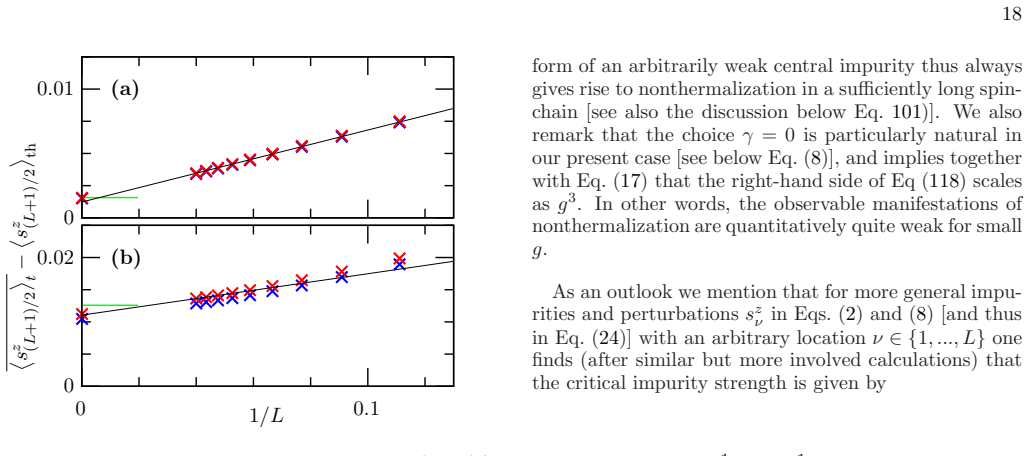
and ( 8) [and thus in Eq. ( 24)] with ν = L + 1 2 , (116) 18 0 0.02 0 0 .1 (b) 0 0.01 (a) ⟨ sz (L+1)/2 ⟩ t − ⟨ sz (L+1)/2 ⟩ th 1/L FIG. 10. Same as in Fig. 3 but now for ν = α = ( L + 1)/ 2 (central impurity), g = 0 . 2 in (a), g = 0 . 4 in (b), and L = 10001, 25, 23, ..., 11, 9. The green bars indicate the analytical approximation for L → ∞ from Eqs. (11...
-
[18]
and ( 42). General- izations to even L and arbitrary inner impurities are in principle straightforward, but require more lengthy cal- culations and case differentiations, and will therefore only be briefly summarized at the end of this section. For the rest, the detailed calculations are largely analogous to those in the previous Sec. IV, and are therefore ...
-
[19]
(118) Likewise, a strong violation of the ETH immediately fol- lows by similar arguments as in Sec
and ( 101) now assumes the form ⟨sz α ⟩t − ⟨sz α ⟩th =gβ p2e−|p||ν − α | 16 cosh 2(β/ 2) . (118) Likewise, a strong violation of the ETH immediately fol- lows by similar arguments as in Sec. IV D, and the con- comitant signatures of localization in the system’s Hamil- tonian (
-
[20]
are analogous to those in Sec. IV G. The most important difference compared to the end- impurities considered in Sec. IV is that in the present case of a central impurity the critical value in Eq. ( 117) approaches zero for largeL. In particular, a quench in the form of an arbitrarily weak central impurity thus always gives rise to nonthermalization in a s...
-
[21]
and ( 8) [and thus in Eq. ( 24)] with an arbitrary location ν ∈ { 1,...,L } one finds (after similar but more involved calculations) that the critical impurity strength is given by pc = 1 ν + 1 L + 1 − ν , (119) and that the same conclusions as in the previous para- graph apply whenever |p| exceeds this critical value. In particular, one readily recovers Eqs. (
-
[22]
bulk” of the spin-chain in the first case and in one of the “end-regions
and ( 117) in the special cases from Eqs. ( 42) and ( 116), respectively. Moreover,pc in Eq. ( 119) approaches zero whenever the impurity site ν scales with the system size L in such a way that both ν and L − ν diverge for large L. On the other hand, whenever either ν or L − ν remains finite as L → ∞ , the critical value in Eq. ( 119) approaches a non-vani...
-
[23]
For- mally, this amounts to replacing the upper summation limit L − 1 in Eq
Periodic boundary conditions A further, quite minor and natural extension is to con- sider periodic instead of open boundary conditions. For- mally, this amounts to replacing the upper summation limit L − 1 in Eq. (
-
[24]
Obviously, in such a case the actual position ν of the im- purity in Eq
by L and setting sa L+1 := sa 1. Obviously, in such a case the actual position ν of the im- purity in Eq. (
-
[25]
quantum chaos
becomes irrelevant. Moreover, it seems reasonable to expect that the system behaves similarly as an open system with a central impurity. A confirmation of this expectation follows upon comparing the numeri- cally exact findings in Fig. 11 with those in Fig. 10. We remark that also an analytical confirmation is in principle possible by a pertinent generalizat...
-
[26]
( 3) and ( 10) for sufficiently large L [see also the discussion above Eq
and ( 10) In this Appendix we provide a detailed justification of why β can be chosen equal in Eqs. ( 3) and ( 10) for sufficiently large L [see also the discussion above Eq. ( 9)]. We adopt the same definition of the system’s initial stateρ(0) as in Eq. ( 3) with an arbitrary but fixed value of β . However, instead of ρcan in Eq. ( 10), we now consider more g...
-
[27]
we will derive ( A4) even without this extra assumption. To begin with, let us define a set of auxiliary Hamilto- nians Hr and concomitant canonical ensembles ρr, Hr := H0 +r(H − H0) , (A6) ρr := e− βH r/Z r , (A7) Zr := tr {e− βH r } , (A8) where r ∈ [0, 1] is a parameter. Recalling the basic re- lations − ∂ ∂β lnZr = tr {ρrHr} and H = H0 +gV [see Eq. ( 5...
-
[28]
partner state
Evaluation of D and W (β m) Let us first remark that the derivation of ( A21) is still valid for entirely general Hamiltonians H and H0. Furthermore, our final result ( A5) follows immediately from ( A21) under the following three conditions: (i) v in (A15) remains bounded for L → ∞ , (ii) D in ( A16) re- mains bounded for L → ∞ , (iii) |W (βm)|in (A19) gro...
-
[29]
Similarly as in Eqs
can be recast by means of a Jordan- Wigner transformation into the form ( 26) and thus ( F1), and likewise for H0. Similarly as in Eqs. ( 27) and ( 28), there furthermore must exist unitary L × L matrices U and ˜U with entries Ukl and ˜Ukl, respectively, so that H = L∑ k=1 Ekf † kfk, (F3) H0 = L∑ k=1 ˜Ek ˜f † k ˜fk, (F4) where fk := L∑ l=1 Uklcl, (F5) ˜fk...
-
[30]
(F15) To further evaluate the right-hand side of Eq
that ⟨c† lcl⟩t = L∑ j,k =1 UjlU ∗ klei(Ej − Ek)tTjk, (F13) Tjk := L∑ m,n =1 S∗ jmSknpmn, (F14) pmn := tr {ρ(0) ˜f † m ˜fn} . (F15) To further evaluate the right-hand side of Eq. ( F15), we focus on our specific initial conditions from Eq. ( 3). By exploiting (F4) one thus finds after a straightforward cal- culation (see e.g. Eqs. (B21)-(B29) in Ref. [13] fo...
-
[31]
transition
for our stan- dard observables A =sz α [see Eq. ( 11)] and Hamiltonians H [see Eq. ( 24)] can be analytically evaluated without any approximation, as shown in Ref. [13] [see Eq. (B41) therein], yielding ⟨sz α ⟩th = − 1 2 L∑ k=1 |Ukα |2 tanh(βEk/ 2) . (G1) We recall that Eq. ( G1) must be an odd of function p [see below Eq. ( 17)]. Furthermore, Eq. ( G1) i...
-
[32]
Observ- ing Eqs
with an arbitrary but fixed value of γ. Observ- ing Eqs. (5), (9), and ( 10), the left-hand side of Eq. ( G12) can be identified with the (negative) change of the ther- mal expectation value when increasing γ in Eq. (
-
[33]
remainders
by g. According to Eqs. ( 17) and ( 24) we thus can increase p by means of many small steps in g, and add up the corresponding small (negative) changes of the thermal expectation values on the left-hand side of Eq. ( G12). Moreover, from the symmetry properties below Eq. ( G1) we can conclude that the thermal expectation value van- ishes for γ = 0. Starti...
-
[34]
Gogolin and J
C. Gogolin and J. Eisert, Equilibration, thermalization, and the emergence of statistical mechanics in closed quantum systems, Rep. Prog. Phys. 79, 056001 (2016)
2016
-
[35]
T. Mori, T. N. Ikeda, E. Kaminishi, and M. Ueda, Ther- malization and prethermalization in isolated quantum systems: a theoretical overview, J. Phys. B 51, 112001 (2018)
2018
-
[36]
Shiraishi and H
N. Shiraishi and H. Tasaki, Nature abhors a vacuum: A simple rigorous example of thermalization in an iso- lated macroscopic quantum system, J. Stat. Phys. 191, 82 (2024)
2024
-
[37]
J. M. Deutsch, Quantum statistical mechanics in a closed system, Phys. Rev. A 43, 2046 (1991)
2046
-
[38]
Srednicki, Chaos and quantum thermalization, Phys
M. Srednicki, Chaos and quantum thermalization, Phys. Rev. E 50, 888 (1994)
1994
-
[39]
Rigol, V
M. Rigol, V. Dunjko, and M. Olshanii, Thermalization and its mechanism for generic isolated quantum systems, Nature 452, 854 (2008)
2008
-
[40]
D’Alessio, Y
L. D’Alessio, Y. Kafri, A. Polkovnikov, and M. Rigol, From Quantum Chaos and Eigenstate Thermalization to Statistical Mechanics and Thermodynamics, Adv. Phys. 65, 239 (2016)
2016
-
[41]
F. H. L. Essler and M. Fagotti, Quench dynamics and relaxation in isolated integrable quantum spin chains, J. Stat. Mech. 6, 064002 (2016)
2016
-
[42]
Barouch, B
E. Barouch, B. M. McCoy, and M. Dresden, Statistical Mechanics of the XY Model. I, Phys. Rev. A 2, 1075 (1970); E. Barouch and B. M. McCoy, Statistical Me- chanics of the XY Model. III, Phys. Rev. A 3, 2137 (1971)
1970
-
[43]
Weak eigenstate thermalization with large deviationbound,
G. Biroli, C. Kollath, and A. M. L¨ auchli, Effect of Rare Fluctuations on the Thermalization of Isolated Quantum Systems, Phys. Rev. Lett. 105, 250401 (2010); V. Alba, Eigenstate thermalization hypothesis and integrability i n quantum spin chains, Phys. Rev. B 91, 155123 (2015); T. Mori, Weak eigenstate thermalization with large devia- tion bound, arXiv:1...
-
[44]
Farrelly, F
T. Farrelly, F. G. S. L. Brand˜ ao, and M. Cramer, Ther- malization and return to equilibrium on finite quantum lattice systems, Phys. Rev. Lett. 118, 140601 (2017)
2017
-
[45]
Dabelow, P
L. Dabelow, P. Vorndamme, and P. Reimann, Thermal- ization of locally perturbed many-body quantum sys- tems, Phys. Rev. B 105, 024310 (2022)
2022
-
[46]
Reimann and C
P. Reimann and C. Eidecker-Dunkel, Thermalization in a simple spin-chain model Phys. Rev. B 111, 054312 (2025)
2025
-
[47]
Brenes, T
M. Brenes, T. LeBlond, J. Goold, and M. Rigol, Eigen- state Thermalization in a Locally Perturbed Integrable System, Phys. Rev. Lett. 125, 070605 (2020)
2020
-
[48]
Rigol, private communication regarding Ref
M. Rigol, private communication regarding Ref. [14]
-
[49]
L. F. Santos, Integrability of a disordered Heisenberg spin-1/2 chain, J. Phys. A 37, 4723 (2004)
2004
-
[50]
O. S. Barisic, P. Prelovsek, A. Metavitsiadis, and X. Zo- tos, Incoherent transport induced by a single static im- purity in a Heisenberg chain, Phys. Rev. B 80, 125118 (2009)
2009
-
[51]
E. J. Torres-Herrera and L. F. Santos, Local quenches with global effects in interacting quantum systems, Phys. Rev. E 89, 062110 (2014)
2014
-
[52]
Pandey, P
M. Pandey, P. W. Claeys, D. K. Campbell, A. Polkovnikov, and D. Sels, Adiabatic deformations as a sensitive probe for quantum chaos, Phys. Rev. X 10, 041017 (2020)
2020
-
[53]
L. F. Santos, F. P´ erez-Bernal, and E. J. Torres-Herrera, Speck of chaos, Phys. Rev. Research 2, 043034 (2020)
2020
-
[54]
As usual, the units of the magnetic moments are chosen such that the spin-1/2 operators sa l can be expressed in the eigenbasis of sz l by the corresponding Pauli matrices σ a l as sz l = σ a l / 2
-
[55]
Touchette, Equivalence and nonequivalence of ensem- bles: thermodynamic, macrostate, and measure levels, J
H. Touchette, Equivalence and nonequivalence of ensem- bles: thermodynamic, macrostate, and measure levels, J. Stat. Phys. 159, 987 (2015)
2015
-
[56]
F. G. S. L. Brandao and M. Cramer, Equivalence of Sta- tistical Mechanical Ensembles for Non-Critical Quantum Systems, arXiv:1502.03263
-
[57]
Tasaki, On the local equivalence between the canon- ical and the microcanonical ensembles for quantum spin systems, J
H. Tasaki, On the local equivalence between the canon- ical and the microcanonical ensembles for quantum spin systems, J. Stat. Phys. 172, 905 (2018)
2018
-
[58]
Kuwahara and K
T. Kuwahara and K. Saito, Gaussian concentration bound and ensemble equivalence in generic quantum many-body systems including long-range interactions, Ann. Phys. 421, 168278 (2020)
2020
-
[59]
Reimann and C
P. Reimann and C. Eidecker-Dunkel, Onsager’s regres- sion hypothesis adjusted to quantum systems, Phys. Rev. B 101, 014306 (2024)
2024
-
[60]
Our present notation is similar but not exactly identical to the one in Ref. [26]. In particular, our present Eq. ( 5) corresponds to Eq. (11) in Ref. [26]
-
[61]
Eidecker-Dunkel and P
C. Eidecker-Dunkel and P. Reimann, Allosteric impurity effects in long spin chains, Phys. Rev. B 108, 054407 (2023)
2023
-
[62]
G. S. Uhrig, J. Hackmann, D. Stanek, J. Stolze, and F. B. Anders, Conservation laws protect dynamic spin correlations from decay: Limited role of integrability in the central spin model, Phys. Rev. B 90, 060301(R) (2014)
2014
-
[63]
A. M. Alhambra, J. Riddell, and L. P. Garcia-Pintos, Time evolution of correlation functions in quantum many-body systems, Phys. Rev. Lett. 124, 110605 (2020)
2020
-
[64]
Spohn, Interacting and noninteracting integrable sys- tems, J
H. Spohn, Interacting and noninteracting integrable sys- tems, J. Math. Phys. 59, 091402 (2018)
2018
-
[65]
E. Lieb, T. Schultz, and D. Mattis, Two Soluble Mod- els of an Antiferromagnetic Chain, Ann. Phys. 16, 407 (1961)
1961
-
[66]
H. B. Cruz and L. L. Goncalves, Time-dependent cor- relations of the one-dimensional isotropic XY model, J. Phys. C: Solid State Phys. 14, 2785 (1981)
1981
-
[67]
Stolze, V
J. Stolze, V. S. Viswanath, and G. M¨ uller, Dynamics of semi-infinite quantum spin chains at T = ∞ , Z. Phys. B 89, 45 (1992)
1992
-
[68]
Stolze, A
J. Stolze, A. N¨ oppert, and G. M¨ uller, Gaussian, exponen- tial, and power-law decay of time-dependent correlation functions in quantum spin chains, Phys. Rev. B 52, 4319 (1995)
1995
-
[69]
Derzhko, T
O. Derzhko, T. Krokhmalskii, and J. Stolze, Dynamics of the spin-1/2 isotropic XY chain in a transverse field, 30 J. Phys. A: Math. Gen. 33, 3063 (2000)
2000
-
[70]
See also the general symmetry considerations around Eq. ( 41)
-
[71]
H. Tasaki, Heat flows from hot to cold: A simple rigor- ous example of thermalization in an isolated macroscopic quantum system, arXiv:2404.04533
-
[72]
Murthy and M
C. Murthy and M. Srednicki, Relaxation to Gaussian and generalized Gibbs states in systems of particles with quadratic Hamiltonians, Phys. Rev. E 100, 012146 (2019)
2019
-
[73]
The latter finding is strictly speaking not yet sufficient to guarantee the occurrence of thermalization, see item (ii) at the end of Sec. II D
-
[74]
9 and 5, as can be deduced from the similarity of the red crosses in Figs
Note that the mean-values of the long-time fluctuations are again quantitatively quite similar in Figs. 9 and 5, as can be deduced from the similarity of the red crosses in Figs. 3(b) and 6(b)
-
[75]
E. K. Sklyanin, Boundary conditions for integrable quan- tum systems, J. Phys. A 21, 2375 (1988)
1988
-
[76]
F. C. Alcaraz, M. N. Barber, M. T. Batchelor, R. J. Baxter, and G. R. W. Quispel, Surface exponents of the quantum XXZ, Ashkin-Teller and Potts models, J. Phys. A 20, 6397 (1987)
1987
-
[77]
Beisert, L
N. Beisert, L. Fievet, M. de Leeuw, and F. Loebbert, Integrable deformations of the XXZ spin chain, J. Stat. Mech. P09028 (2013)
2013
-
[78]
Hokkyo, Rigorous test for quantum integrability and nonintegrability, arXiv:2501.18400 (2025)
A. Hokkyo, Rigorous test for quantum integrability and nonintegrability, arXiv:2501.18400
-
[79]
Francica, T
G. Francica, T. J. G. Appolaro, N. Lo Gullo, and F. Plastina, Local quench, Majorana zero modes, and dis- turbance propagation in the Ising chain, Phys. Rev. B 94, 245103 (2016)
2016
-
[80]
Gaussification
More precisely speaking, for the end-impurities from Sec. IV, thermalization has been verified in Ref. [13] for all single-site observables of the form ( 11), while for the inner impurities from Sec. VI, only a subset of such single-site observables was covered. In both cases, the generalization from single-site to arbitrary local (multiple-site) observabl...
discussion (0)
Sign in with ORCID, Apple, or X to comment. Anyone can read and Pith papers without signing in.