Recognition: unknown
Inverse engineering of cooling protocols: from normal behavior to Mpemba effects
Pith reviewed 2026-05-10 14:53 UTC · model grok-4.3
The pith
Any prescribed internal temperature history can be produced by calculating the exact external temperature protocol needed to drive it.
A machine-rendered reading of the paper's core claim, the machinery that carries it, and where it could break.
Core claim
For any chosen internal temperature evolution T_int(t), the external protocol is found by inverting the cooling dynamics: in the Newtonian case this yields T_ext(t) = T_int(t) + (1/k) dT_int/dt, while analogous inversions are performed analytically for the two-level and Brownian models. When the cooling law is generalized to include Mpemba-like anomalies, overcooling, or delays, the inverse mapping from T_int(t) to T_ext(t) may fail to exist for some target curves or may admit multiple solutions.
What carries the argument
The algebraic or differential inversion of the cooling equation that solves for the driving external temperature T_ext(t) required to produce a prescribed internal temperature T_int(t).
If this is right
- Analytical external protocols exist for standard Newtonian cooling and for the two-level and Brownian microscopic models.
- Generalized cooling laws that produce Mpemba effects or overcooling still admit inverse engineering, but with modified equations.
- Some desired internal cooling curves cannot be realized by any physically realizable external protocol.
- Other target curves can be realized by more than one distinct external temperature history.
- Time-dependent external heat sources can be designed systematically to steer cooling rather than chosen by trial and error.
Where Pith is reading between the lines
- The same inversion technique could be used to design heating protocols or to optimize paths through phase transitions.
- Laboratory tests could verify the method by programming the computed T_ext(t) into a thermostat and recording the resulting T_int(t).
- When multiple protocols exist, one could be selected for minimal energy cost or minimal excursion outside safe temperature ranges.
Load-bearing premise
The system's cooling dynamics are fully captured by the chosen model, whether Newtonian or microscopic, without additional unmodeled effects.
What would settle it
Impose the analytically calculated T_ext(t) on a laboratory system whose dynamics obey Newton's law and check whether the measured internal temperature follows the prescribed curve within experimental error; any consistent mismatch falsifies the inversion procedure.
Figures

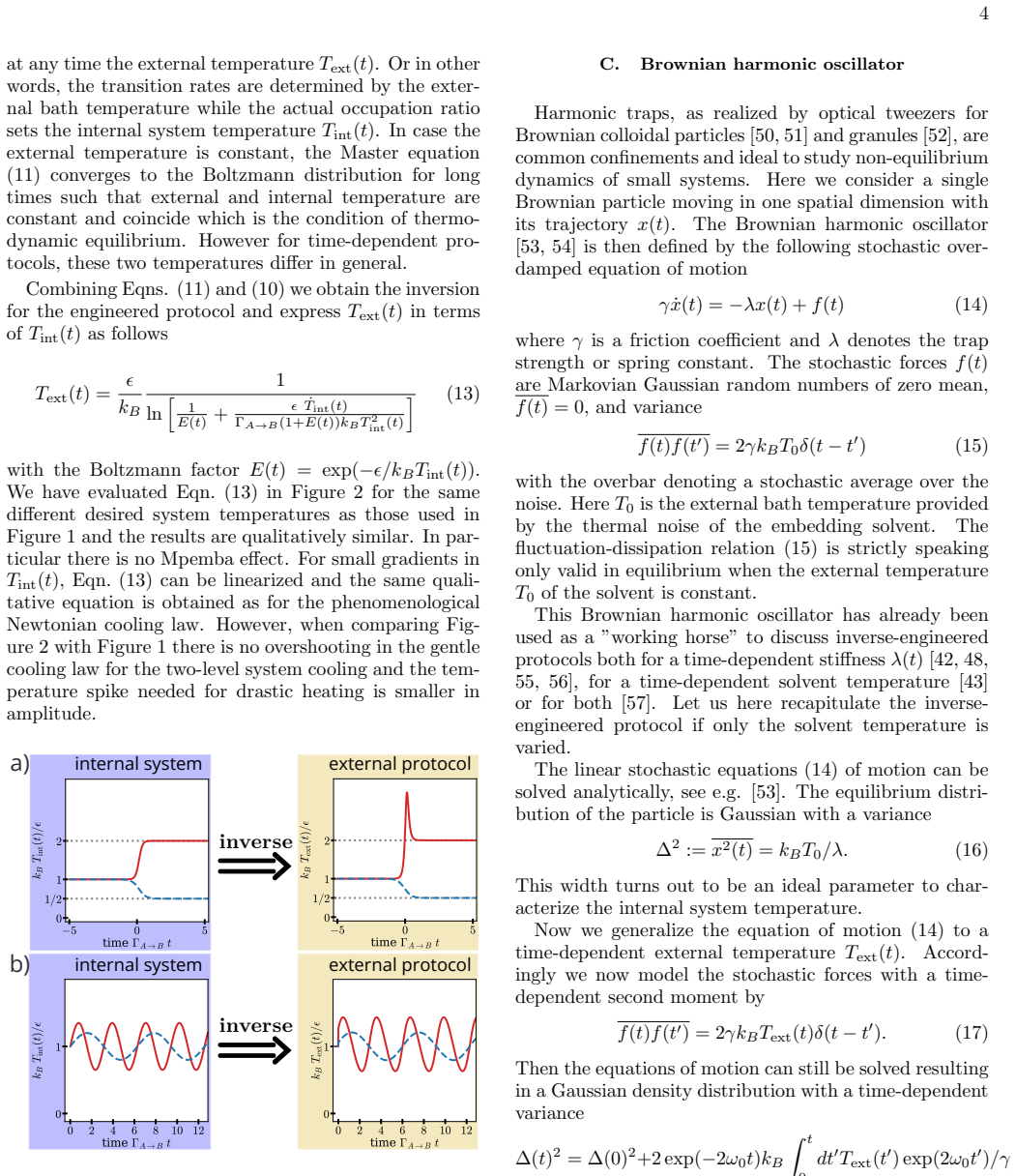


read the original abstract
When a cup of hot coffee is suddenly put into a cold environment, it cools down as a function of time $t$ until the internal temperature $T_\text{int}$ of the coffee equals the external ambient temperature $T_\text{ext}$. This instantaneous shock-freezing corresponds to an imposed cooling protocol of the external temperature $T_\text{ext}(t)$, ideally described as a step-function in time, causing the time-dependent change of the internal temperature $T_\text{int}(t)$. While the effect of different given protocols $T_\text{ext}(t)$ on the resulting system cooling behaviour, embodied in $T_\text{int}(t)$, has been studied extensively, we consider here the inverse question: for a given system cooling $T_\text{int}(t)$ how can an appropriate protocol $T_\text{ext}(t)$ be engineered to produce the desired prescribed $T_\text{int}(t)$. We use both the phenomenological Newtonian equation for cooling and microscopic models, such as a discrete two-level system and a Brownian harmonic oscillator with time-dependent noise, to compute analytically the protocol $T_\text{ext}(t)$ needed to achieve a prescribed $T_\text{int}(t)$. We then discuss the same question for phenomenological generalizations of the Newtonian law which include anomalous Mpemba effects, overcooling, asymmetries in cooling and heating as well as delay phenomena. It is shown that backward-engineered protocols do not always exist and can be non-unique. The results are important for steering the cooling behavior by time-varying external heat sources in a systematic way.
Editorial analysis
A structured set of objections, weighed in public.
Referee Report
Summary. The manuscript addresses the inverse cooling problem: given a prescribed internal temperature trajectory T_int(t), derive the required external protocol T_ext(t). It solves this analytically for the Newtonian cooling law, a two-level system via its master equation, and a Brownian harmonic oscillator with time-dependent noise. The analysis is extended to phenomenological generalizations that incorporate Mpemba effects, overcooling, cooling-heating asymmetries, and delay phenomena. The central results are explicit inversion formulas together with demonstrations that solutions may fail to exist or may be non-unique, subject to physical constraints on T_ext(t).
Significance. If the derivations hold, the work supplies an analytical toolkit for engineering cooling protocols rather than relying on forward simulation or numerical optimization. This is potentially useful for controlled thermal processes in materials science and biophysics. The explicit treatment of existence/non-uniqueness conditions and the extension to anomalous Mpemba-type behavior constitute clear strengths, yielding falsifiable predictions that can be tested experimentally. The combination of phenomenological and microscopic models adds generality.
major comments (2)
- [Microscopic models] Section on microscopic models (two-level system and Brownian oscillator): the inversion procedure yields T_ext(t) by direct algebraic rearrangement, but the paper does not explicitly bound the parameter regimes in which the resulting protocol remains consistent with the underlying stochastic dynamics (e.g., non-negative transition rates or fluctuation-dissipation compliance). This is load-bearing for the claim that solutions 'sometimes fail to exist' because the non-existence criteria are stated only at the phenomenological level.
- [Generalized Newtonian laws] Discussion of generalized Newtonian laws with Mpemba effects: while the inversion is performed formally, the manuscript does not verify that the engineered T_ext(t) preserves the thermodynamic consistency of the original anomalous model (e.g., does not induce unphysical negative effective heat capacities). A concrete counter-example or inequality check would strengthen the non-uniqueness and existence statements.
minor comments (2)
- Notation: the symbols T_int(t) and T_ext(t) are introduced clearly in the abstract but should be restated with units and initial conditions at the start of each model section to avoid ambiguity when switching between phenomenological and microscopic treatments.
- The abstract lists 'delay phenomena' among the generalizations, yet the main text provides only a brief mention without an explicit example equation or plot; adding one short worked example would improve readability.
Simulated Author's Rebuttal
We thank the referee for the careful reading, positive assessment, and recommendation for minor revision. We address each major comment below and will incorporate clarifications to strengthen the manuscript.
read point-by-point responses
-
Referee: [Microscopic models] Section on microscopic models (two-level system and Brownian oscillator): the inversion procedure yields T_ext(t) by direct algebraic rearrangement, but the paper does not explicitly bound the parameter regimes in which the resulting protocol remains consistent with the underlying stochastic dynamics (e.g., non-negative transition rates or fluctuation-dissipation compliance). This is load-bearing for the claim that solutions 'sometimes fail to exist' because the non-existence criteria are stated only at the phenomenological level.
Authors: We agree that explicit consistency bounds are needed for the microscopic models. For the two-level system, the inverted T_ext(t) must keep transition rates non-negative; for the Brownian oscillator, the noise must obey fluctuation-dissipation. We will add a dedicated subsection deriving the relevant inequalities on T_int(t) and model parameters that ensure physical validity, thereby supplying microscopic criteria for non-existence that complement the phenomenological analysis. revision: yes
-
Referee: [Generalized Newtonian laws] Discussion of generalized Newtonian laws with Mpemba effects: while the inversion is performed formally, the manuscript does not verify that the engineered T_ext(t) preserves the thermodynamic consistency of the original anomalous model (e.g., does not induce unphysical negative effective heat capacities). A concrete counter-example or inequality check would strengthen the non-uniqueness and existence statements.
Authors: We accept this observation. We will augment the generalized Newtonian section with an inequality check (or brief counter-example) confirming that the inverted T_ext(t) does not produce unphysical features such as negative effective heat capacities. This will directly support the existence and non-uniqueness claims for the anomalous models. revision: yes
Circularity Check
No significant circularity: direct algebraic inversion of standard equations
full rationale
The paper starts from established forward models (Newtonian cooling law, two-level master equation, time-dependent Langevin equation) and performs explicit algebraic rearrangements to solve for the required T_ext(t) given a target T_int(t). These steps are reversible mathematical inversions of the governing ODEs or rate equations, with the paper itself identifying non-existence and non-uniqueness cases. No fitted parameters are renamed as predictions, no self-definitional loops appear, and no load-bearing self-citations or imported uniqueness theorems are invoked in the provided derivation chain. The approach is self-contained against the input equations.
Axiom & Free-Parameter Ledger
axioms (2)
- domain assumption The Newtonian law of cooling accurately describes the system's temperature evolution
- domain assumption Microscopic models (two-level system, Brownian oscillator) capture the relevant dynamics for analytical solution
Forward citations
Cited by 1 Pith paper
-
Self-propulsion protocols for swift non-equilibrium state transitions and enhanced cooling in active systems
Self-propulsion noise statistics define speed limits on non-equilibrium transitions in active matter, with non-stationary initials allowing faster cooling than passive protocols.
Reference graph
Works this paper leans on
-
[1]
to cool hot water quickly, begin by putting it in the sun
and emerging energy technology [6]. A fundamen- tal scientific treatment of cooling involves nontrivial con- cepts from non-equilibrium statistical physics. One of the simplest phenomenological description is the traditional Newtonian cooling law [7–9]: If a system with an internal temperatureT int is brought in contact with an external bath at fixed temp...
1969
-
[2]
is one prominent example. The standard protocol typ- ically studied in the context of the Mpemba effect is an instantaneous temperature shock at timet= 0 where the temperature of the bath quickly jumps from a tempera- ture equilibrated with the system,T ext(t= 0) =T int(t=
-
[3]
Inverse engineering of cooling protocols: from normal behavior to Mpemba effects
towards a smaller target temperatureT ext(∞). In this case, the external temperature protocolT ext(t) can be idealized by a step function, i.e. Text(t) =T ext(0) + Θ(t)(Text(∞)–Text(0)).(1) Research has typically addressed the impact of dif- ferent time-dependent protocolsT ext(t) on the system cooling curveT int(t). Or, in other terms, the question is ho...
work page internal anchor Pith review Pith/arXiv arXiv 2026
-
[4]
Then an arrested ther- mal transport is maintained between the two final states rather than an established final thermal equilibrium
a new protocol type arises in which the external tem- perature is driven to the isolation pointT int(∞)−T c for t→ ∞rather than toT int(∞). Then an arrested ther- mal transport is maintained between the two final states rather than an established final thermal equilibrium. VI. DISCUSSION AND CONCLUSIONS We have computed external cooling protocols in or- d...
-
[5]
Di Lorenzo, F
E. Di Lorenzo, F. Romano, L. Ciriaco, N. Iaccarino, L. Izzo, A. Randazzo, P. Musto, and E. Di Maio, Com- mun. Eng.4, 5 (2025)
2025
-
[6]
A. J. T. M. Mathijssen, M. Lisicki, V. N. Prakash, and E. J. L. Mossige, Rev. Mod. Phys.95, 025004 (2023)
2023
-
[7]
Youssef, A
A. Youssef, A. Verachtert, G. De Bruyne, and J.-M. Aerts, Appl. Sci.9, 3372 (2019)
2019
-
[8]
Thelning,Steel and Its Heat Treatment (Butterworth-Heinemann, 1984)
K.-E. Thelning,Steel and Its Heat Treatment (Butterworth-Heinemann, 1984)
1984
-
[9]
B. T. Afflerbach, C. Francis, L. E. Schultz, J. Speth- son, V. Meschke, E. Strand, L. Ward, J. H. Perepezko, D. Thoma, P. M. Voyles, I. Szlufarska, and D. Morgan, Chem. Mater.34, 3000 (2022)
2022
-
[10]
Y. Shi, M. Liu, and F. Fang,Combined Cooling, Heating and Power Systems(John Wiley & Sons, 2017)
2017
-
[11]
Newton, Phil
I. Newton, Phil. Trans. R. Soc.22, 824 (1701)
-
[12]
Besson, Sci
U. Besson, Sci. Educ.21, 1085 (2012)
2012
-
[13]
M. I. Davidzon, Int. J. Heat Mass Transf.55, 5397 (2012)
2012
-
[14]
Vollmer, Eur
M. Vollmer, Eur. J. Phys.30, 1063 (2009)
2009
-
[15]
Aristoteles and H. D. P. Lee,Meteorologica(Harvard Univ. Press, Cambridge, 1952)
1952
-
[16]
E. B. Mpemba and D. G. Osborne, Phys. Educ.4, 172 (1969)
1969
-
[17]
G. Teza, J. Bechhoefer, A. Lasanta, O. Raz, and M. Vucelja, Physica Reports1164, 1 (2026)
2026
-
[18]
Kumar and J
A. Kumar and J. Bechhoefer, Nature584, 64 (2020)
2020
-
[19]
Kumar, R
A. Kumar, R. Ch´ etrite, and J. Bechhoefer, Proc. Natl. Acad. Sci. U.S.A.119, e2118484119 (2022)
2022
-
[20]
Malhotra and H
I. Malhotra and H. L¨ owen, J. Chem. Phys.161, 164903 (2024)
2024
-
[21]
Lasanta, F
A. Lasanta, F. Vega Reyes, A. Prados, and A. Santos, Phys. Rev. Lett.119, 148001 (2017)
2017
-
[22]
Biswas, A
A. Biswas, A. A. Prasad, and R. Rajesh, Phys. Rev. E 108, 024902 (2023)
2023
-
[23]
Meg´ ıas and A
A. Meg´ ıas and A. Santos, Front. Phys.10, 971671 (2022)
2022
-
[24]
A. K. Chatterjee, S. Takada, and H. Hayakawa, Phys. Rev. Lett.131, 080402 (2023)
2023
-
[25]
Nava and R
A. Nava and R. Egger, Phys. Rev. Lett.133, 136302 (2024)
2024
-
[26]
L. K. Joshi, J. Franke, A. Rath, F. Ares, S. Murciano, F. Kranzl, R. Blatt, P. Zoller, B. Vermersch, P. Cal- abrese, C. F. Roos, and M. K. Joshi, Phys. Rev. Lett. 133, 010402 (2024)
2024
-
[27]
Mororder, O
M. Mororder, O. Culhane, K. Zawadzki, and J. Goold, Phys. Rev. Lett.133, 140404 (2024)
2024
- [28]
-
[29]
Bechhoefer, A
J. Bechhoefer, A. Kumar, and R. Ch´ etrite, Nat. Rev. Phys.3, 534 (2021)
2021
-
[30]
Santos, Phys
A. Santos, Phys. Rev. E111, 055402 (2025)
2025
- [31]
-
[32]
Gal and O
A. Gal and O. Raz, Phys. Rev. Lett.124, 060602 (2020)
2020
-
[33]
A. J. Kovacs, R. A. Stratton, and J. D. Ferry, J. Phys. Chem.67, 152 (1963)
1963
-
[34]
A. J. Kovacs, J. J. Aklonis, J. M. Hutchinson, and A. R. Ramos, J. Polym. Sci. Polym. Phys. Ed.17, 1097 (1979)
1979
-
[35]
E. M. Bertin, J.-P. Bouchaud, J.-M. Drouffe, and C. Godr` eche, J. Phys. A: Math. Gen.36, 10701 (2003)
2003
-
[36]
K¨ ursten, V
R. K¨ ursten, V. Sushkov, and T. Ihle, Phys. Rev. Lett. 119, 188001 (2017)
2017
-
[37]
Nava and R
A. Nava and R. Egger, Phys. Rev. Lett.135, 140404 (2025)
2025
-
[38]
Maes, SciPost Phys
C. Maes, SciPost Phys. Lect. Notes32(2021)
2021
-
[39]
Zerbe, P
C. Zerbe, P. Jung, and P. H¨ anggi, Phys. Rev. E49, 3626 (1994)
1994
-
[40]
Brouard and J
S. Brouard and J. Plata, J. Phys. A: Math. Gen.34, 11185 (2001)
2001
-
[41]
A. V. Barzykin, K. Seki, and F. Shibata, Phys. Rev. E 57, 6555 (1998)
1998
-
[42]
Berdichevsky and M
V. Berdichevsky and M. Gitterman, Phys. Rev. E60, 1494 (1999)
1999
-
[43]
Gammaitoni, P
L. Gammaitoni, P. H¨ anggi, P. Jung, and F. Marchesoni, Rev. Mod. Phys.70, 223 (1998)
1998
-
[44]
Schmiedel and U
T. Schmiedel and U. Seifert, Europhys. Lett.81, 20003 (2008)
2008
-
[45]
Guery-Odelin, A
D. Guery-Odelin, A. Ruschhaupt, A. Kiely, E. Tor- rontegui, S. Martinez-Garaot, and J. G. Muga, Rev. Mod. Phys.91, 8045001 (2019)
2019
-
[46]
Martinez, A
I. Martinez, A. Petrosyan, D. Guery-Odelin, E. Trizac, and S. Ciliberto, Nat. Phys.12, 843 (2016)
2016
-
[47]
L. B. Pires, R. Goerlich, A. L. da Fonseca, M. Debiossac, P.-A. Hervieux, G. Manfredi, and C. Genet, Phys. Rev. Lett.131, 097101 (2023)
2023
-
[48]
Prados, Phys
A. Prados, Phys. Rev. Res.3, 023128 (2021)
2021
-
[49]
Patron, A
A. Patron, A. Prados, and C. A. Plata, Eur. Phys. J. Plus137, 1011 (2022)
2022
- [50]
-
[51]
K. S. Olsen and H. L¨ owen, arXiv (2026)
2026
-
[52]
Guery-Odelin, C
D. Guery-Odelin, C. Jarzynski, C. A. Plata, A. Prados, and E. Trizac, Rep. Prog. Phys.86, 6035902 (2023)
2023
-
[53]
F. P. Abreu and W. A. M. Morgad, Physica A683, 131204 (2026)
2026
-
[54]
Volpe, O
G. Volpe, O. M. Marag` o, H. Rubinsztein-Dunlop, G. Pesce, A. B. Stilgoe, G. Volpe, G. Tkachenko, V. G. Truong, S. N. Chormaic, and F. Kalantarifard, J. Phys. Photonics5, 022501 (2023)
2023
-
[55]
Buttinoni, L
I. Buttinoni, L. Caprini, L. Alvarez, F. Schwarzendahl, and H. L¨ owen, EPL140, 27001 (2022)
2022
-
[56]
Dauchot and V
O. Dauchot and V. D´ emery, Phys. Rev. Lett.122, 068002 (2019)
2019
-
[57]
L¨ owen, J
H. L¨ owen, J. Phys.: Condens. Matter21, 474203 (2009)
2009
-
[58]
Abreu and U
D. Abreu and U. Seifert, EPL94, 10001 (2011)
2011
-
[59]
Chupeau, S
M. Chupeau, S. Ciliberto, D. Guery-Odelin, and E. Trizac, New J. Phys.20, 075003 (2018)
2018
- [60]
-
[61]
Chupeau, B
M. Chupeau, B. Besga, D. Gu´ ery-Odelin, E. Trizac, A. Petrosyan, and S. Ciliberto, Phys. Rev. E98, 010104 10 (2018)
2018
-
[62]
M. R. Nath, S. Sen, and G. Gangopadhyay, J. Chem. Phys.127, 094505 (2007)
2007
- [63]
-
[64]
Baity-Jesi, E
M. Baity-Jesi, E. Calore, A. Cruz, L. A. Fernan- dez, J. Gil-Narvion, A. Gordillo-Guerrero, D. Iniguez, A. Lasanta, A. Maiorano, E. Marinari, V. Martin- Mayor, J. Moreno-Gordo, A. Munoz-Sudupe, D. Navarro, G. Parisi, S. Perez-Gaviro, F. Ricci-Tersenghi, J. J. Ruiz-Lorenzo, S. F. Schifano, B. Seoane, A. Tarancon, R. Tripiccione, and D. Yllanes, Proc. Natl....
2019
-
[65]
F. J. Schwarzendahl and H. L¨ owen, Phys. Rev. Lett.129, 138002 (2022)
2022
-
[66]
A. P. Antonov and H. L¨ owen, Phys. Rev. E113, 025407 (2026)
2026
-
[67]
A. Dhar, A. Kundu, S. N. Majumdar, S. Sabhapandit, and G. Schehr, Phys. Rev. E99, 032132 (2019)
2019
-
[68]
Lapolla and A
A. Lapolla and A. c. v. Godec, Phys. Rev. Lett.125, 110602 (2020)
2020
-
[69]
Van Vu and Y
T. Van Vu and Y. Hasegawa, Phys. Rev. Res.3, 043160 (2021)
2021
-
[70]
Ib´ a˜ nez, C
M. Ib´ a˜ nez, C. Dieball, A. Lasanta, A. Godec, and R. A. Rica, Nat. Phys.20, 135 (2024)
2024
-
[71]
Tejero, R
A. Tejero, R. S´ anchez, L. E. Kaoutit, D. Manzano, and A. Lasanta, Phys. Rev. Res.7, 023020 (2025)
2025
-
[72]
He and J
S. He and J. Wang, Phys. Rev. Res.7, 033142 (2025)
2025
-
[73]
Zhang, Z
Z.-C. Zhang, Z. Liu, and C.-S. Yu, Phys. Rev. A112, 042219 (2025)
2025
-
[74]
D. He, S. Buyukdagli, and B. Hu, Phys. Rev. B80, 104302 (2009)
2009
-
[75]
B. Li, L. Wang, and G. Casati, Applied Physics Letters 88, 104302 (2006)
2006
-
[76]
S. Krekels, C. Maes, I. Santra, and R. Zhai, arXiv:2604.00777 (2026)
work page internal anchor Pith review arXiv 2026
-
[77]
G. Qin, Z. Qin, H. Wang, and M. Hu, Phys. Rev. B95, 195416 (2017)
2017
-
[78]
Kielar, C
S. Kielar, C. Li, H. Huang, R. Hu, C. Slebodnick, A. Alatas, and Z. Tian, Nat. Commun.15, 6981 (2024)
2024
-
[79]
Blickle and C
V. Blickle and C. Bechinger, Nat. Phys.8, 143 (2012)
2012
-
[80]
I. A. Martinez, E. Roldan, L. Dinis, D. Petrov, J. M. R. Parrondo, and R. A. Rica, Nat. Phys.12, 67 (2016)
2016
discussion (0)
Sign in with ORCID, Apple, or X to comment. Anyone can read and Pith papers without signing in.