Shape-dependence of electrophoretic mobility
Pith reviewed 2026-05-10 15:51 UTC · model grok-4.3
The pith
A nearly spherical particle receives a universal quadrupolar shape correction to its electrophoretic mobility that depends on Debye length and vanishes in the thin-layer limit.
A machine-rendered reading of the paper's core claim, the machinery that carries it, and where it could break.
Core claim
For a surface written as r_s(θ) = a[1 + ε f(θ)] with ε ≪ 1, domain perturbation of the volume-integral formulation yields the parallel mobility C_∥ = f_H(κa)[1 + ε c₂ σ₂(κa)], where f_H is Henry's function, c₂ is the coefficient of the P₂ Legendre polynomial in f(θ), and σ₂(κa) is a universal coefficient that equals +1/5 at κa = 0 and 0 at κa → ∞. Higher spherical harmonics in f(θ) produce no first-order correction because the angular integrals with the applied dipolar field vanish.
What carries the argument
The universal coefficient σ₂(κa) obtained by domain perturbation of the volume-integral electrokinetic equations around the spherical base solution.
If this is right
- Mobility is independent of shape to this order in the thin-double-layer limit.
- Only the quadrupolar (P₂) component of the surface shape enters the mobility correction.
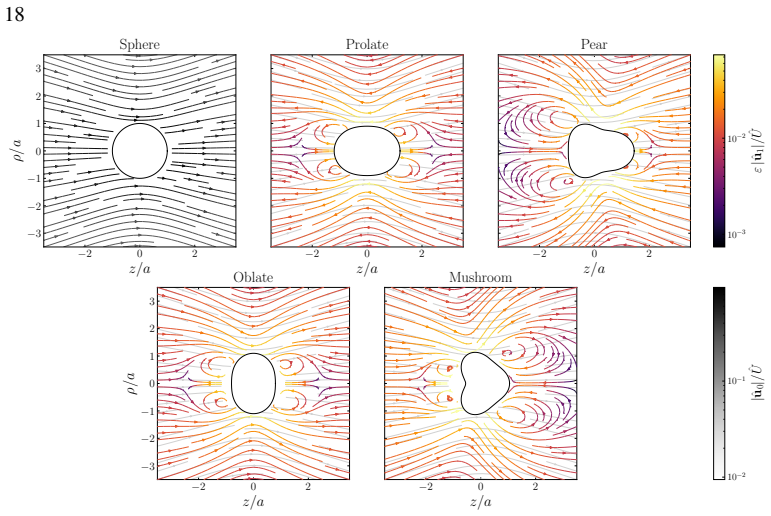
- The derived σ₂(κa) reproduces exact analytic results for both prolate and oblate spheroids.
- Higher harmonics in the shape function remain electrophoretically silent at leading order.
Where Pith is reading between the lines
- Any small deviation from sphericity can be decomposed into spherical harmonics and the mobility correction applied using only its l=2 coefficient.
- Experiments that vary salt concentration on slightly aspherical particles would map out the function σ₂(κa) directly.
- The same angular selection rules may simplify shape corrections in other phoretic transport problems driven by a uniform external field.
Load-bearing premise
The particle surface lies close enough to a sphere that a first-order perturbation expansion in the small displacement parameter ε accurately captures the leading shape effect.
What would settle it
A numerical solution of the full coupled Stokes and Poisson-Nernst-Planck equations for a particle with pure quadrupolar surface perturbation at an intermediate value such as κa = 1, checked against the predicted numerical value of σ₂(1).
Figures




read the original abstract
The electrophoretic mobility of a spherical particle is well understood, yet how particle shape modifies this mobility at arbitrary Debye length remains an open question. Here, we compute the electrophoretic mobility of a nearly spherical particle whose surface is described by $r_s(\theta) = a[1 + \varepsilon f(\theta)]$, with $\varepsilon \ll 1$, at arbitrary ratio of particle size to Debye length $\kappa a$. Using a volume-integral formulation combined with domain perturbation techniques, we derive a universal shape correction coefficient $\sigma_2(\kappa a)$ such that the mobility takes the compact form $C_\parallel = f_H(\kappa a)\,[1 + \varepsilon\,c_2\,\sigma_2(\kappa a)]$, where $f_H$ is Henry's function. We show that $\sigma_2$ interpolates between $+1/5$ in the thick-double-layer (H\"{u}ckel) limit, governed solely by the Stokes drag correction, and zero in the thin-double-layer (Smoluchowski) limit, recovering the classical shape-independence theorem. The perturbation theory agrees quantitatively with exact spheroid solutions for both prolate and oblate orientations. A key finding is that only the $P_2$ (quadrupolar) component of the particle shape affects the mobility at leading order; higher harmonics are electrophoretically silent due to angular selection rules governing the coupling between the dipolar applied field and the shape perturbation. The results in this paper were generated using Claude Code (Anthropic, Opus 4.6 model) with supervision from the authors. Our thoughts on the usage of AI for theoretical research, along with representative prompts from the development process, are provided in the manuscript and Appendix.
Editorial analysis
A structured set of objections, weighed in public.
Referee Report
Summary. The paper claims to derive a universal shape correction coefficient σ₂(κa) for the electrophoretic mobility of nearly spherical particles at arbitrary κa. Using a volume-integral formulation of the electrokinetic equations combined with domain perturbation around the spherical base solution, the parallel mobility takes the compact form C_∥ = f_H(κa)[1 + ε c₂ σ₂(κa)], where f_H is Henry's function. The coefficient σ₂(κa) interpolates between +1/5 in the Hückel limit and 0 in the Smoluchowski limit; only the P₂ component of the shape function f(θ) contributes at leading order due to angular selection rules. Quantitative agreement with exact spheroid solutions for small eccentricity is reported.
Significance. If the central derivation holds, the result supplies a practical, parameter-free multiplicative correction that extends the spherical Henry's function to small shape deviations across the full range of κa. The recovery of the classical limits, the demonstration that higher shape harmonics are electrophoretically silent, and the independent cross-check against spheroid solutions are notable strengths that could make the compact form useful for interpreting experiments on slightly non-spherical colloids.
major comments (1)
- The step-by-step application of the domain perturbation to the volume-integral equations that produces the explicit expression for σ₂(κa) is not expanded in sufficient detail. Providing the intermediate equations for the first-order corrections to the electric potential, fluid velocity, and force balance would allow independent verification that the claimed compact form and the angular selection rules follow without gaps.
minor comments (1)
- The disclosure that the results were generated with Claude Code appears in the abstract; relocating the discussion of AI-assisted derivation to the acknowledgments or a dedicated methods paragraph would improve conventional presentation.
Simulated Author's Rebuttal
We thank the referee for the positive assessment and the recommendation for minor revision. The single major comment is addressed below.
read point-by-point responses
-
Referee: The step-by-step application of the domain perturbation to the volume-integral equations that produces the explicit expression for σ₂(κa) is not expanded in sufficient detail. Providing the intermediate equations for the first-order corrections to the electric potential, fluid velocity, and force balance would allow independent verification that the claimed compact form and the angular selection rules follow without gaps.
Authors: We agree that the derivation would benefit from greater explicitness. In the revised manuscript we will insert a new subsection that walks through the domain perturbation of the volume-integral formulation step by step. This will present the first-order corrections to the electric potential, fluid velocity, and force balance, together with the angular integrals that enforce the selection rules and produce the compact form of σ₂(κa). The added material will enable independent verification while leaving the final results unchanged. revision: yes
Circularity Check
No significant circularity; derivation is self-contained
full rationale
The paper applies standard domain perturbation to the volume-integral form of the electrokinetic equations around the known spherical base solution (Henry's function f_H(κa)). The resulting universal coefficient σ₂(κa) is obtained directly from the linearized governing equations and angular selection rules that isolate the P₂ component; it is not fitted to data nor defined in terms of the target mobility. The derivation recovers the independent Hückel (+1/5) and Smoluchowski (0) limits by construction of the asymptotics and shows quantitative agreement with exact spheroid solutions for small eccentricity, supplying an external cross-check. No load-bearing step reduces to a self-citation, ansatz, or renamed empirical input.
Axiom & Free-Parameter Ledger
axioms (2)
- domain assumption The perturbation parameter ε is much less than 1
- standard math The flow is at low Reynolds number and the electrostatics follow the standard Poisson-Boltzmann or Debye-Huckel approximation
Reference graph
Works this paper leans on
-
[1]
Anderson, J. L. 1989 Colloid transport by interfacial forces . Annu. Rev. Fluid Mech. 21 , 61--99
work page 1989
-
[2]
Brady, J. F. 2021 Phoretic motion in active matter . J. Fluid Mech. 922 , A10
work page 2021
-
[3]
1964 The Stokes resistance of a slightly deformed sphere
Brenner, H. 1964 The Stokes resistance of a slightly deformed sphere . Chem. Engng Sci. 19 , 519--539
work page 1964
-
[4]
Doane, T. L. , Chuang, C.-H. , Hill, R. J. & Burda, C. 2012 Nanoparticle -potentials . Acc. Chem. Res. 45 , 317--326
work page 2012
-
[5]
Ganguly, A. , Alessio, B. M. & Gupta, A. 2023 Diffusiophoresis: a novel transport mechanism -- fundamentals, applications, and future opportunities . Front. Sens. 4 , 1322906
work page 2023
-
[6]
Ganguly, A. & Gupta, A. 2023 Going in circles: Slender body analysis of a self-propelling bent rod . Phys. Rev. Fluids 8 , 014103
work page 2023
-
[7]
Ganguly, A. , Roychowdhury, S. & Gupta, A. 2024 Unified mobility expressions for externally-driven and self-phoretic propulsion of particles . J. Fluid Mech. 994 , A2
work page 2024
-
[8]
Golestanian, R. , Liverpool, T. B. & Ajdari, A. 2007 Designing phoretic micro- and nano-swimmers . New J. Phys. 9 , 126
work page 2007
-
[9]
Gupta, A. , Rallabandi, B. & Stone, H. A. 2019 Diffusiophoretic and diffusioosmotic velocities for mixtures of valence-asymmetric electrolytes . Phys. Rev. Fluids 4 , 043702
work page 2019
-
[10]
2001 Principles of DNA separation with capillary electrophoresis
Heller, C. 2001 Principles of DNA separation with capillary electrophoresis . Electrophoresis 22 , 629--643
work page 2001
-
[11]
Henry, D. C. 1931 The cataphoresis of suspended particles. Part I . The equation of cataphoresis . Proc. R. Soc. Lond. A 133 , 106--129
work page 1931
-
[12]
1924 Die Kataphorese der Kugel
H\" u ckel, E. 1924 Die Kataphorese der Kugel . Phys. Z. 25 , 204--210
work page 1924
-
[13]
Khair, A. S. 2022 Nonlinear electrophoresis of colloidal particles . Curr. Opin. Colloid Interface Sci. 59 , 101587
work page 2022
-
[14]
Kim, S. & Karrila, S. J. 2005 Microhydrodynamics: Principles and Selected Applications\/ . New York: Dover
work page 2005
-
[15]
Masoud, H. & Stone, H. A. 2019 The reciprocal theorem in fluid dynamics and transport phenomena . J. Fluid Mech. 879 , P1
work page 2019
-
[16]
Morrison, F. A. 1970 Electrophoresis of a particle of arbitrary shape . J. Colloid Interface Sci. 34 , 210--214
work page 1970
-
[17]
Nabil, M. & Nourhani, A. 2024 Revisiting Brenner 's method for Stokes resistance of a deformed sphere . J. Fluid Mech. 994 , A17
work page 2024
-
[18]
O'Brien, R. W. & White, L. R. 1978 Electrophoretic mobility of a spherical colloidal particle . J. Chem. Soc. Faraday Trans. 2 74 , 1607--1626
work page 1978
-
[19]
1996 Henry's function for electrophoresis of a cylindrical colloidal particle
Ohshima, H. 1996 Henry's function for electrophoresis of a cylindrical colloidal particle . J. Colloid Interface Sci. 180 , 299--301
work page 1996
-
[20]
Paxton, W. F. , Kistler, K. C. , Olmeda, C. C. , Sen, A. , St. Angelo , S. K. , Cao, Y. , Mallouk, T. E. , Lammert, P. E. & Crespi, V. H. 2004 Catalytic nanomotors: autonomous movement of striped nanorods . J. Am. Chem. Soc. 126 , 13424--13431
work page 2004
-
[21]
Payne, L. E. & Pell, W. H. 1960 The Stokes flow problem for a class of axially symmetric bodies . J. Fluid Mech. 7 , 529--549
work page 1960
-
[22]
Prieve, D. C. , Anderson, J. L. , Ebel, J. P. & Lowell, M. E. 1984 Motion of a particle generated by chemical gradients. Part 2 . Electrolytes . J. Fluid Mech. 148 , 247--269
work page 1984
-
[23]
Raj, R. R. , Ganguly, A. , Becker, C. , Shields IV , C. W. & Gupta, A. 2023 Motion of an active bent rod with an articulating hinge: exploring mechanical and chemical modes of swimming . Front. Phys. 11 , 1307168
work page 2023
-
[24]
Smoluchowski, M. 1921 Elektrische Endosmose und Str\" o mungsstr\" o me . In Handbuch der Elektrizit\" a t und des Magnetismus\/ (ed. L. Graetz ) , , vol. 2 . Leipzig: Barth
work page 1921
-
[25]
Solomentsev, Y. & Anderson, J. L. 1994 Electrophoresis of slender particles . J. Fluid Mech. 279 , 197--215
work page 1994
-
[26]
Stone, H. A. & Samuel, A. D. T. 1996 Propulsion of microorganisms by surface distortions . Phys. Rev. Lett. 77 , 4102--4104
work page 1996
-
[27]
1982 The motion of charged colloidal particles in electric fields
Teubner, M. 1982 The motion of charged colloidal particles in electric fields . J. Chem. Phys. 76 , 5564--5573
work page 1982
- [28]
-
[29]
Yoon, B. J. & Kim, S. 1989 Electrophoresis of spheroidal particles . J. Colloid Interface Sci. 128 , 275--288
work page 1989
-
[30]
, " * write output.state after.block = add.period write newline
ENTRY address author booktitle chapter edition editor howpublished institution journal key month note number organization pages publisher school series title type volume year eprint label extra.label sort.label short.list INTEGERS output.state before.all mid.sentence after.sentence after.block FUNCTION init.state.consts #0 'before.all := #1 'mid.sentence ...
-
[31]
" write newline "" before.all 'output.state := FUNCTION n.dashify 't := "" t empty not t #1 #1 substring "-" = t #1 #2 substring "--" = not "--" * t #2 global.max substring 't := t #1 #1 substring "-" = "-" * t #2 global.max substring 't := while if t #1 #1 substring * t #2 global.max substring 't := if while FUNCTION word.in bbl.in capitalize " " * FUNCT...
discussion (0)
Sign in with ORCID, Apple, or X to comment. Anyone can read and Pith papers without signing in.