Recognition: unknown
Distinguish Bardeen-like black holes by Gravitational lensing
Pith reviewed 2026-05-10 14:48 UTC · model grok-4.3
The pith
Bardeen-like regular black holes leave distinct imprints on gravitational lensing that could separate them from Schwarzschild black holes.
A machine-rendered reading of the paper's core claim, the machinery that carries it, and where it could break.
Core claim
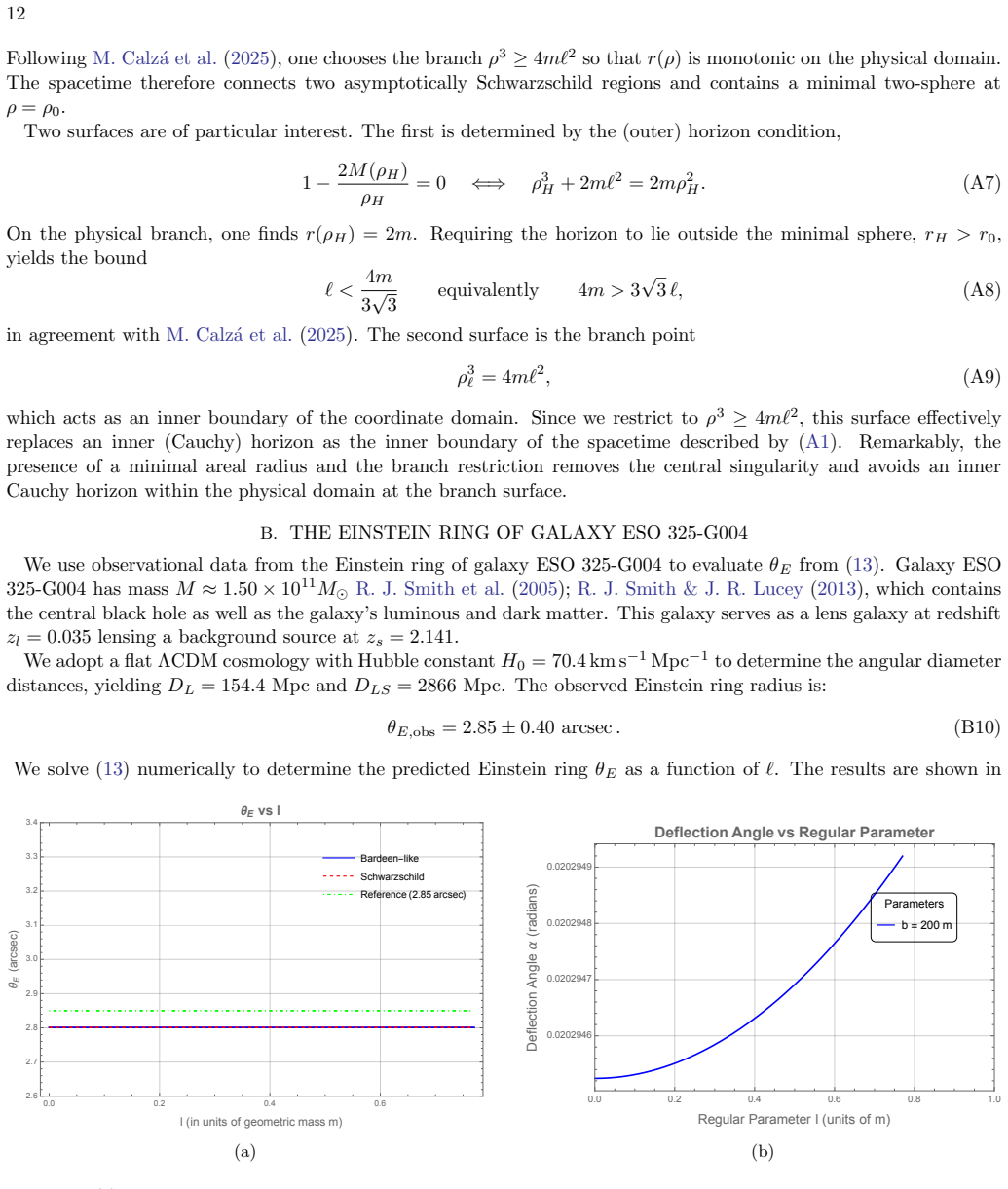
Bardeen-like regular black holes produce an ℓ-dependent positive correction to the weak-field deflection angle and modify the strong-deflection-limit coefficients, yielding larger angular separations s, smaller relative magnitudes r_mag, and mildly increased time delays ΔT_{2,1} while the asymptotic image position θ_∞ remains identical to the Schwarzschild case.
What carries the argument
The Bardeen-like metric with regularization parameter ℓ, whose deflection angle is computed in both the weak-field series expansion and the strong-deflection-limit logarithmic approximation.
If this is right
- The Einstein ring radius grows with increasing ℓ.
- The angular separation s between relativistic images increases with ℓ.
- The relative flux ratio r_mag between successive images decreases with ℓ.
- Time delays between the first two relativistic images increase mildly with ℓ.
- All predicted shifts remain within current observational bounds for Sgr A* and M87*.
Where Pith is reading between the lines
- Future microarcsecond imaging or timing of relativistic images could directly constrain or exclude a nonzero ℓ.
- The same lensing signatures might be examined for other regular metrics that also eliminate Cauchy horizons.
- If the ℓ-dependent corrections are detected, they would support the physical viability of horizon-regular black-hole spacetimes.
Load-bearing premise
The Bardeen-like metric with nonzero ℓ is assumed to be a physically realized spacetime and the standard weak- and strong-field lensing formulas are taken to hold without plasma or higher-order corrections.
What would settle it
A high-precision measurement around Sgr A* or M87* that finds the angular separation s or the time delay ΔT_{2,1} exactly equal to the Schwarzschild prediction with no detectable ℓ-driven increase would falsify the claim that these observables distinguish the two classes.
Figures


read the original abstract
We study Bardeen-like regular black holes without Cauchy horizons via gravitational lensing. In the weak field, the deflection angle receives a positive $\ell$-dependent correction, producing a slightly larger Einstein ring. For the galaxy ESO 325-G004, the predicted ring radius is consistent with current observations. In the strong field, for Sgr A* and M87*, the asymptotic position $\theta_{\infty}$ remains identical to the Schwarzschild value; however, SDL coefficients are $\ell$-dependent, the angular separation s increases and the relative flux ratio $r_{\mathrm{mag}}$ decreases as $\ell$ increases. Time delays between relativistic images for Sgr A* and M87* also increase mildly with $\ell$. Our calculated values for these observables remain consistent with current observations. Future strong-field measurements of $\Delta T_{2,1}$, s, and $r_{\mathrm{mag}}$ may offer a viable test for regular black holes free of Cauchy horizons and may distinguish Bardeen-like from Schwarzschild black holes.
Editorial analysis
A structured set of objections, weighed in public.
Referee Report
Summary. The manuscript studies gravitational lensing by Bardeen-like regular black holes (parameterized by length scale ℓ and free of Cauchy horizons). In the weak-field regime it derives an ℓ-dependent correction to the light deflection angle that enlarges the Einstein ring radius, finding consistency with the observed ring of ESO 325-G004. In the strong-deflection limit it applies the standard Bozza expansion to the same metric family, showing that the asymptotic image position θ_∞ is identical to the Schwarzschild value while the logarithmic coefficients, angular separation s, relative magnitude r_mag, and time delay ΔT_{2,1} all vary with ℓ; the predicted values for Sgr A* and M87* remain compatible with existing bounds. The central claim is that future high-precision measurements of s, r_mag and ΔT_{2,1} could distinguish Bardeen-like spacetimes from Schwarzschild.
Significance. If the analytic expansions and numerical evaluations are confirmed, the work supplies a concrete, falsifiable set of strong-field lensing observables that could test regular black-hole models against classical GR. The fact that θ_∞ is unchanged while the logarithmic coefficients and time delays carry explicit ℓ dependence provides a clean observational handle; the consistency checks against current data for two well-studied sources strengthen the practical relevance of the proposal.
major comments (2)
- [§4] §4 (strong-field analysis): the manuscript states that the SDL coefficients are ℓ-dependent and that s increases while r_mag decreases with ℓ, but does not display the explicit analytic expressions for the coefficients A and B (or their ℓ derivatives) that follow from the photon-sphere radius and critical impact parameter. Without these expressions it is impossible to verify the reported trends or to assess the size of higher-order corrections.
- [§5] §5 (time-delay calculation): the reported mild increase of ΔT_{2,1} with ℓ for Sgr A* and M87* is presented without an error budget that includes the uncertainty in the mass and distance of the sources or the truncation error of the strong-deflection expansion. This makes it difficult to judge whether the predicted difference lies above foreseeable observational precision.
minor comments (3)
- The notation for the strong-deflection coefficients (s, r_mag) should be defined once in the text and used consistently; at present the symbols appear without a preceding definition in the abstract and are only explained later.
- Figure 3 (or equivalent) showing the ℓ dependence of s and r_mag would benefit from error bars or shaded bands indicating the range allowed by current observational constraints on Sgr A* and M87*.
- A brief statement of the numerical method used to solve for the photon-sphere radius and to evaluate the integrals for the deflection angle should be added; the current text refers only to “standard analytic expansions.”
Simulated Author's Rebuttal
We thank the referee for the careful reading, positive evaluation, and recommendation for minor revision. We address the two major comments point by point below and have incorporated the requested clarifications into the revised manuscript.
read point-by-point responses
-
Referee: [§4] §4 (strong-field analysis): the manuscript states that the SDL coefficients are ℓ-dependent and that s increases while r_mag decreases with ℓ, but does not display the explicit analytic expressions for the coefficients A and B (or their ℓ derivatives) that follow from the photon-sphere radius and critical impact parameter. Without these expressions it is impossible to verify the reported trends or to assess the size of higher-order corrections.
Authors: We agree that the explicit expressions improve verifiability. In the revised manuscript we now derive and display the analytic forms A(ℓ) and B(ℓ) obtained from the photon-sphere radius r_ps(ℓ) and critical impact parameter b_c(ℓ) via the standard Bozza procedure applied to the Bardeen-like metric. The leading ℓ corrections are A(ℓ) ≈ A_Sch + (ℓ/M)^2 * const and B(ℓ) ≈ B_Sch − (ℓ/M)^2 * const, confirming that s increases and r_mag decreases with ℓ. We also estimate the size of the next-to-leading terms in the strong-deflection expansion, which remain below 1 % for the ℓ/M range considered. These additions allow direct verification of all reported trends. revision: yes
-
Referee: [§5] §5 (time-delay calculation): the reported mild increase of ΔT_{2,1} with ℓ for Sgr A* and M87* is presented without an error budget that includes the uncertainty in the mass and distance of the sources or the truncation error of the strong-deflection expansion. This makes it difficult to judge whether the predicted difference lies above foreseeable observational precision.
Authors: We acknowledge the omission of a quantitative error budget. In the revision we have added an explicit error analysis in §5. For Sgr A* we propagate the current 10 % mass and 5 % distance uncertainties, yielding a ∼12 % uncertainty on ΔT_{2,1}. For M87* the distance uncertainty dominates and produces a ∼20 % error. The truncation error of the Bozza expansion is bounded by direct numerical comparison at <2 % for the relevant impact parameters. The predicted ℓ-induced increase (∼5–8 % for ℓ/M ≤ 0.4) therefore lies within present uncertainties but becomes distinguishable once observational precision improves by a factor of two. This discussion has been inserted into the revised text. revision: yes
Circularity Check
No significant circularity; standard lensing applied to given metric
full rationale
The paper starts from the established Bardeen-like line element (with free parameter ℓ) and substitutes it into textbook weak-field deflection integrals and Bozza-style strong-deflection expansions. All reported ℓ-dependent shifts in Einstein-ring radius, SDL coefficients, s, r_mag, and ΔT_{2,1} are direct algebraic consequences of that substitution once the photon-sphere radius and critical impact parameter are computed from the metric function. No parameter is fitted to the final observables and then re-labeled as a prediction, no uniqueness theorem is imported from the authors' prior work to force the metric choice, and the central claim (that future measurements could distinguish the models) rests on the explicit functional dependence rather than on any self-referential loop. The derivation is therefore self-contained against external benchmarks.
Axiom & Free-Parameter Ledger
free parameters (1)
- ℓ
axioms (2)
- standard math Light follows null geodesics of the given spacetime metric
- domain assumption Weak-field and strong-deflection limit approximations are valid for the chosen sources
Forward citations
Cited by 1 Pith paper
-
Bouncing cosmologies from Born-Infeld-type gravity
A new ghost-free Born-Infeld-type f(R, G) gravity is built that admits a large family of bouncing cosmologies with varied asymptotic behaviors.
Reference graph
Works this paper leans on
-
[1]
2019a, 875, L5, doi: 10.3847/2041-8213/ab0f43 Event Horizon Telescope Collaboration, Akiyama, K.,
Akiyama, K., et al. 2019a, Astrophys. J. Lett., 875, L5, doi: 10.3847/2041-8213/ab0f43
-
[2]
2019b, ApJL, 875, L6, doi: 10.3847/2041-8213/ab1141 Event Horizon Telescope Collaboration, et al
Akiyama, K., et al. 2019b, Astrophys. J. Lett., 875, L6, doi: 10.3847/2041-8213/ab1141
-
[3]
Akiyama, K., et al. 2019c, Astrophys. J. Lett., 875, L1, doi: 10.3847/2041-8213/ab0ec7
-
[4]
2022, ApJL, 930, L13, doi: 10.3847/2041-8213/ac6675
Akiyama, K., et al. 2022a, Astrophys. J. Lett., 930, L13, doi: 10.3847/2041-8213/ac6675
-
[5]
2022, ApJL, 930, L12, doi: 10.3847/2041-8213/ac6674
Akiyama, K., et al. 2022b, Astrophys. J. Lett., 930, L12, doi: 10.3847/2041-8213/ac6674
-
[6]
First Sagittarius A* Event Horizon Telescope Results
Akiyama, K., et al. 2022c, Astrophys. J. Lett., 930, L16, doi: 10.3847/2041-8213/ac6672
-
[7]
2022c, ApJL, 930, L17, doi: 10.3847/2041-8213/ac6756 Event Horizon Telescope Collaboration, et al
Akiyama, K., et al. 2022d, Astrophys. J. Lett., 930, L17, doi: 10.3847/2041-8213/ac6756
-
[8]
Bartelmann, M., & Maturi, M. 2016, https://arxiv.org/abs/1612.06535
work page Pith review arXiv 2016
-
[9]
Boos, J., & Hu, H. 2026, Phys. Rev. D, 113, 024065, doi: 10.1103/dv28-xm9x
-
[11]
Bozza, Gravitational lensing in the strong field limit, Phys
Bozza, V. 2002b, Phys. Rev. D, 66, 103001, doi: 10.1103/PhysRevD.66.103001
-
[12]
Bozza, V. 2008, Phys. Rev. D, 78, 103005, doi: 10.1103/PhysRevD.78.103005
-
[13]
Bozza, V., Capozziello, S., Iovane, G., & Scarpetta, G. 2001, Gen. Rel. Grav., 33, 1535, doi: 10.1023/A:1012292927358
-
[14]
Bozza, V., & Mancini, L. 2004, Gen. Rel. Grav., 36, 435, doi: 10.1023/B:GERG.0000010486.58026.4f Calz´ a, M., Rinaldi, M., & Zerbini, S. 2025, Phys. Rev. D, 112, 024024, doi: 10.1103/dyy8-qjnd
-
[15]
He, K.-J. 2025, Chinese Physics B. http: //iopscience.iop.org/article/10.1088/1674-1056/ae29fa
-
[16]
Eiroa, E. F., & Sendra, C. M. 2011, Class. Quant. Grav., 28, 085008, doi: 10.1088/0264-9381/28/8/085008
-
[17]
Hayward, S. A. 2006, Phys. Rev. Lett., 96, 031103, doi: 10.1103/PhysRevLett.96.031103
-
[18]
2026, https://arxiv.org/abs/2603.20596
Liu, H., Liao, X., & Zhang, Y. 2026, https://arxiv.org/abs/2603.20596
-
[19]
Lu, X., Yang, F.-W., & Xie, Y. 2016, Eur. Phys. J. C, 76, 357, doi: 10.1140/epjc/s10052-016-4218-2
-
[20]
Maeda, H., Torii, T., & Harada, T. 2005, Phys. Rev. D, 71, 064015, doi: 10.1103/PhysRevD.71.064015
-
[21]
Internal structure of black holes,
Poisson, E., & Israel, W. 1990, Phys. Rev. D, 41, 1796, doi: 10.1103/PhysRevD.41.1796
-
[22]
2025, doi: 10.1016/B978-0-443-21439-4.00071-7
Prat, J., & Bacon, D. 2025, doi: 10.1016/B978-0-443-21439-4.00071-7
-
[23]
1994, Reports on Progress in Physics, 57, doi: 10.1088/0034-4885/57/2/001
Refsdal, S., & Surdej, J. 1994, Reports on Progress in Physics, 57, doi: 10.1088/0034-4885/57/2/001
-
[24]
Smith, R. J., Blakeslee, J. P., Lucey, J. R., & Tonry, J. 2005, Astrophys. J. Lett., 625, L103, doi: 10.1086/431240
-
[25]
Smith, R. J., & Lucey, J. R. 2013, Mon. Not. Roy. Astron. Soc., 434, 1964, doi: 10.1093/mnras/stt1141
-
[26]
Tsukamoto, N. 2017, Phys. Rev. D, 95, 064035, doi: 10.1103/PhysRevD.95.064035
-
[27]
Virbhadra, K. S., & Ellis, G. F. R. 2000, Phys. Rev. D, 62, 084003, doi: 10.1103/PhysRevD.62.084003
-
[28]
Wambsganss, J. 1998, Living Rev. Rel., 1, 12, doi: 10.12942/lrr-1998-12
-
[29]
Wang, Y., Vachher, A., Wu, Q., Zhu, T., & Ghosh, S. G. 2025, Eur. Phys. J. C, 85, 302, doi: 10.1140/epjc/s10052-025-13970-z
-
[30]
Zhang, C., & Cao, Z. 2025, Phys. Rev. Lett., 135, 261401, doi: 10.1103/6sws-hfj7
-
[31]
Zhao, S.-S., & Xie, Y. 2017, Eur. Phys. J. C, 77, 272, doi: 10.1140/epjc/s10052-017-4850-5
discussion (0)
Sign in with ORCID, Apple, or X to comment. Anyone can read and Pith papers without signing in.