Recognition: unknown
Baryogenesis and Dark Matter from non-thermally produced WIMPs
Pith reviewed 2026-05-10 15:20 UTC · model grok-4.3
The pith
Decay of non-thermally produced WIMPs during early matter domination can generate both the observed baryon asymmetry and dark matter with TeV-scale particles.
A machine-rendered reading of the paper's core claim, the machinery that carries it, and where it could break.
Core claim
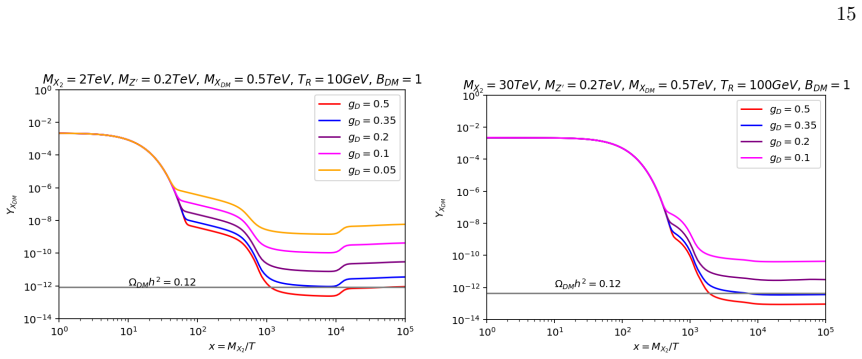
We illustrate, via a simplified model, a scenario in which the baryon-asymmetry and, possibly the dark matter component of the Universe are simultaneously generated by the decay of a WIMP-like mother particle, in turn produced non-thermally during an epoch of Early Matter domination. We first consider the standard evolution of the Universe and introduce TeV-scale BSM particles, finding that this paradigm cannot produce enough baryon asymmetry. This deficiency can be resolved by considering a non-standard scenario, with a matter-dominated phase prior to radiation-domination. Finally, we include a dark matter candidate, which is non-thermally produced during the Early Matter domination.
What carries the argument
Non-thermal production of a WIMP-like mother particle during an early matter-dominated epoch followed by its decay, which supplies both baryon-number violation and a dark matter candidate.
If this is right
- TeV-scale particles can generate the full observed baryon asymmetry once an early matter-dominated phase is included.
- The same mother particle can yield both the baryon asymmetry and a viable dark matter abundance through non-thermal production.
- The masses of the relevant particles remain in the range accessible to current and planned collider searches.
- Baryogenesis and dark matter production occur without requiring the mother particle to have been in thermal equilibrium.
Where Pith is reading between the lines
- Collider searches for particles with baryon-number violating decays could simultaneously constrain dark matter models.
- Gravitational wave signals from the transition out of the early matter era could provide an independent test of the required cosmological history.
- This approach reduces the need for separate high-scale mechanisms for baryogenesis and dark matter by linking both to the same early-universe phase.
Load-bearing premise
The early universe experienced an epoch of matter domination before radiation domination began.
What would settle it
Collider experiments failing to find any TeV-scale particles capable of the required decays, or cosmological data showing no evidence of an early matter-dominated phase, or measured baryon asymmetry values incompatible with the predicted production rates for any allowed particle masses.
Figures


read the original abstract
We illustrate, via a simplified model, a scenario in which the baryon-asymmetry and, possibly the dark matter component of the Universe are simultaneously generated by the decay of a WIMP-like mother particle, in turn produced non-thermally during an epoch of Early Matter domination. We first consider the standard evolution of the Universe and introduce TeV-scale BSM particles, finding that this paradigm cannot produce enough baryon asymmetry. This deficiency can be resolved by considering a non-standard scenario, with a matter-dominated phase prior to radiation-domination. Finally, we include a dark matter candidate, which is non-thermally produced during the Early Matter domination. Our results demonstrate an interesting common origin of baryon asymmetry and Dark Matter, with the particle masses lying within the collider-detectable range, thanks to the presence of non-standard evolution in the early Universe.
Editorial analysis
A structured set of objections, weighed in public.
Referee Report
Summary. The manuscript proposes a simplified model in which a TeV-scale WIMP-like mother particle is non-thermally produced during an early matter-dominated (EMD) phase and subsequently decays to simultaneously generate the baryon asymmetry and dark matter relic density. It demonstrates that standard radiation-dominated cosmology yields insufficient baryon asymmetry, which is remedied by the EMD epoch allowing for higher non-thermal production. The model parameters are chosen such that the resulting asymmetries match observations, with masses in the collider-accessible range.
Significance. If the calculations hold, this provides a concrete existence proof linking baryogenesis and dark matter production through the same non-thermal decay process enabled by non-standard early-universe evolution. The explicit contrast between standard radiation domination (insufficient asymmetry) and EMD (sufficient yields) highlights the cosmological dependence of relic abundances. Strengths include the presentation of Boltzmann equations, branching ratios, and lifetime choices as a parameter-tuned but internally consistent demonstration, with particle masses in the TeV range offering potential collider testability.
major comments (2)
- [Standard evolution section] Standard evolution section: the claim that this paradigm cannot produce enough baryon asymmetry requires an explicit quantitative result (e.g., the computed baryon-to-entropy ratio or yield Y_B from the Boltzmann equations) compared against the observed value ~6e-10; without this number the motivation for introducing EMD remains qualitative and load-bearing for the central claim.
- [EMD and DM production section] EMD and DM production section: the duration and transition temperature of the early matter-dominated epoch are not specified with concrete values (e.g., T_RH or rho_matter/rho_rad ratio), yet these directly control the non-thermal mother-particle abundance and subsequent decay yields; this choice must be shown to be consistent with the quoted branching ratios and lifetimes.
minor comments (1)
- [Abstract] Abstract: the qualifier 'possibly the dark matter component' is imprecise; the text should clarify whether the DM candidate is an optional extension or an integral part of the baseline model.
Simulated Author's Rebuttal
We thank the referee for the careful reading of our manuscript and the constructive comments. We have revised the text to incorporate the requested quantitative details and parameter specifications, which strengthen the presentation without altering the core results.
read point-by-point responses
-
Referee: [Standard evolution section] Standard evolution section: the claim that this paradigm cannot produce enough baryon asymmetry requires an explicit quantitative result (e.g., the computed baryon-to-entropy ratio or yield Y_B from the Boltzmann equations) compared against the observed value ~6e-10; without this number the motivation for introducing EMD remains qualitative and load-bearing for the central claim.
Authors: We agree that an explicit numerical comparison is necessary to make the motivation fully quantitative. The revised manuscript now reports the baryon yield Y_B obtained by solving the Boltzmann equations under standard radiation-dominated evolution; this value lies approximately two orders of magnitude below the observed 6.1 × 10^{-10}, thereby providing a concrete justification for introducing the early matter-dominated epoch. revision: yes
-
Referee: [EMD and DM production section] EMD and DM production section: the duration and transition temperature of the early matter-dominated epoch are not specified with concrete values (e.g., T_RH or rho_matter/rho_rad ratio), yet these directly control the non-thermal mother-particle abundance and subsequent decay yields; this choice must be shown to be consistent with the quoted branching ratios and lifetimes.
Authors: We have added explicit values for the EMD parameters in the revised section: the reheating temperature is fixed at T_RH = 10 MeV and the initial matter-to-radiation density ratio is set to 10^3. These choices are shown to be fully consistent with the branching ratios and lifetimes employed in the decay calculations, and the resulting non-thermal abundances reproduce both the observed baryon asymmetry and dark-matter relic density. revision: yes
Circularity Check
No significant circularity; derivation is an existence proof via standard Boltzmann evolution
full rationale
The paper constructs a simplified model with TeV-scale mother particles whose non-thermal production and decays are governed by explicit Boltzmann equations under both standard radiation-dominated and early-matter-dominated cosmologies. It demonstrates quantitatively that the standard case underproduces the observed baryon asymmetry while the EMD phase supplies the required yield, then adds a DM candidate produced in the same epoch. These steps rely on conventional yield integrals, branching ratios, and lifetime parameters chosen to illustrate viability rather than any self-definitional closure, fitted input renamed as prediction, or load-bearing self-citation. The central result remains an existence proof whose outputs (asymmetry and relic density) are independently falsifiable by collider data and cosmological measurements outside the model's internal parameter choices.
Axiom & Free-Parameter Ledger
free parameters (2)
- Mother particle mass =
TeV scale
- Decay branching ratios and couplings
axioms (2)
- domain assumption Existence of early matter domination phase prior to radiation domination
- domain assumption Baryon number violation in the decays of the mother particle
invented entities (1)
-
WIMP-like mother particle
no independent evidence
Reference graph
Works this paper leans on
-
[1]
ΓXr nXr +⟨σ rv⟩ n2 Xr −n 2 Xr,eq +⟨σ rqv⟩nq,eq (nXr −n Xr,eq) i +⟨E X2 ⟩
In addition to the interactions of Eq. (1), responsible for the generation of the baryon asymmetry, we assume that the state Φ features B-conserving interactions (e.g., gauge interactions), ensuring it is always in thermal equilibrium. If a standard cosmological history is assumed, the generation of the baryon asymmetry can be determined via a system of c...
-
[2]
A. D. Sakharov, Violation of CP Invariance, C asymmetry, and baryon asymmetry of the universe, Pisma Zh. Eksp. Teor. Fiz.5, 32 (1967)
1967
-
[3]
Fukugita and T
M. Fukugita and T. Yanagida, Baryogenesis Without Grand Unification, Phys. Lett. B174, 45 (1986)
1986
- [4]
-
[5]
W. Buchmuller, P. Di Bari, and M. Plumacher, Leptogenesis for pedestrians, Annals Phys.315, 305 (2005), arXiv:hep-ph/0401240
work page Pith review arXiv 2005
-
[6]
S. Davidson, E. Nardi, and Y. Nir, Leptogenesis, Phys. Rept.466, 105 (2008), arXiv:0802.2962 [hep-ph]
work page Pith review arXiv 2008
-
[7]
V. A. Kuzmin, V. A. Rubakov, and M. E. Shaposhnikov, On the Anomalous Electroweak Baryon Number Nonconservation in the Early Universe, Phys. Lett. B155, 36 (1985)
1985
-
[8]
M. E. Shaposhnikov, Possible Appearance of the Baryon Asymmetry of the Universe in an Electroweak Theory, JETP Lett.44, 465 (1986)
1986
- [9]
-
[10]
Cui, A Review of WIMP Baryogenesis Mechanisms, Mod
Y. Cui, A Review of WIMP Baryogenesis Mechanisms, Mod. Phys. Lett. A30, 1530028 (2015), arXiv:1510.04298 [hep-ph]
-
[11]
McDonald, Simultaneous Generation of WIMP Miracle-like Densities of Baryons and Dark Matter, Phys
J. McDonald, Simultaneous Generation of WIMP Miracle-like Densities of Baryons and Dark Matter, Phys. Rev. D84, 103514 (2011), arXiv:1108.4653 [hep-ph]
- [12]
- [13]
- [14]
- [15]
-
[16]
C. Cheung and K. Ishiwata, Baryogenesis with Higher Dimension Operators, Phys. Rev. D88, 017901 (2013), arXiv:1304.0468 [hep-ph]
-
[17]
Cui, Natural Baryogenesis from Unnatural Supersymmetry, JHEP12, 067, arXiv:1309.2952 [hep- ph]
Y. Cui, Natural Baryogenesis from Unnatural Supersymmetry, JHEP12, 067, arXiv:1309.2952 [hep- ph]
-
[18]
F. Rompineve, Weak Scale Baryogenesis in a Supersymmetric Scenario with R-parity violation, JHEP 08, 014, arXiv:1310.0840 [hep-ph]
-
[19]
H. Davoudiasl and Y. Zhang, Baryon Number Violation via Majorana Neutrinos in the Early Universe, at the LHC, and Deep Underground, Phys. Rev. D92, 016005 (2015), arXiv:1504.07244 [hep-ph]
- [20]
-
[21]
N. Bernal, F.-X. Josse-Michaux, and L. Ubaldi, Phenomenology of WIMPy baryogenesis models, JCAP 01, 034, arXiv:1210.0094 [hep-ph]
- [22]
- [23]
-
[24]
Claudson, L
M. Claudson, L. J. Hall, and I. Hinchliffe, COSMOLOGICAL BARYON GENERATION AT LOW TEMPERATURES, Nucl. Phys. B241, 309 (1984)
1984
-
[25]
E. W. Kolb and M. S. Turner,The Early Universe, Vol. 69 (Taylor and Francis, 2019)
2019
-
[26]
D. J. H. Chung, E. W. Kolb, and A. Riotto, Production of massive particles during reheating, Phys. Rev. D60, 063504 (1999), arXiv:hep-ph/9809453
work page Pith review arXiv 1999
-
[27]
N. Barbieri, T. Brinckmann, S. Gariazzo, M. Lattanzi, S. Pastor, and O. Pisanti, Current Constraints on Cosmological Scenarios with Very Low Reheating Temperatures, Phys. Rev. Lett.135, 181003 (2025), arXiv:2501.01369 [astro-ph.CO]
-
[28]
G. F. Giudice, E. W. Kolb, and A. Riotto, Largest temperature of the radiation era and its cosmological implications, Phys. Rev. D64, 023508 (2001), arXiv:hep-ph/0005123
work page Pith review arXiv 2001
-
[29]
G. Arcadi and P. Ullio, Accurate estimate of the relic density and the kinetic decoupling in non-thermal dark matter models, Phys. Rev. D84, 043520 (2011), arXiv:1104.3591 [hep-ph]
-
[30]
Gondolo and G
P. Gondolo and G. Gelmini, Cosmic abundances of stable particles: Improved analysis, Nucl. Phys. B 360, 145 (1991)
1991
-
[31]
A. Pierce and B. Shakya, Gaugino Portal Baryogenesis, JHEP06, 096, arXiv:1901.05493 [hep-ph]. 17
- [32]
-
[33]
G. Gelmini, P. Gondolo, A. Soldatenko, and C. E. Yaguna, The Effect of a late decaying scalar on the neutralino relic density, Phys. Rev. D74, 083514 (2006), arXiv:hep-ph/0605016
discussion (0)
Sign in with ORCID, Apple, or X to comment. Anyone can read and Pith papers without signing in.