Recognition: 3 theorem links
· Lean TheoremEMBER: Autonomous Cognitive Behaviour from Learned Spiking Neural Network Dynamics in a Hybrid LLM Architecture
Pith reviewed 2026-05-10 16:26 UTC · model grok-4.3
The pith
A spiking neural network can trigger LLM actions autonomously through learned idle-time associations without any external prompts.
A machine-rendered reading of the paper's core claim, the machinery that carries it, and where it could break.
Core claim
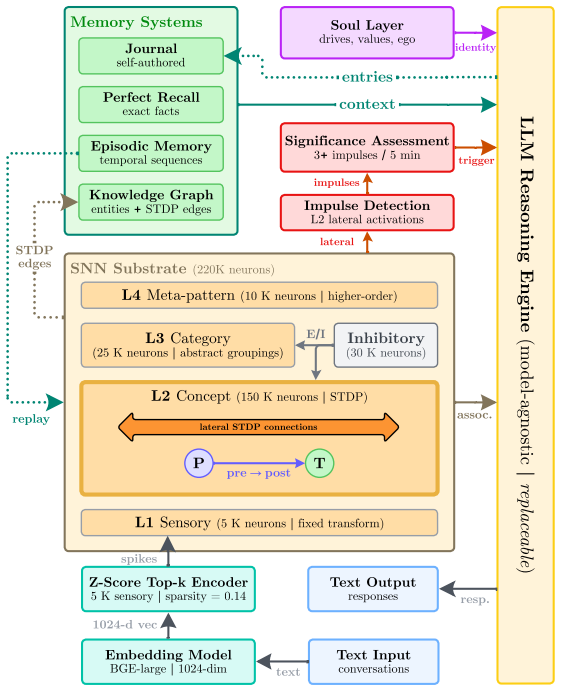
STDP lateral propagation during idle operation enables the SNN to determine when to act and what associations to surface, prompting the LLM to execute actions without external prompting or scripted triggers. In one case the system initiated contact with a user after learned associations fired during an eight-hour idle period. From a clean start with zero learned weights the first SNN-triggered action occurred after only seven conversational exchanges.
What carries the argument
The 220,000-neuron four-layer hierarchical spiking neural network with STDP, inhibitory balance, and z-score standardised top-k population code that encodes embeddings and allows lateral propagation of spikes during idle time to surface associations.
If this is right
- The SNN controls both the timing of actions and the associations to recall, leaving the LLM only to select response format and generate text.
- Meaningful autonomous behavior can emerge from a blank network after minimal conversational input.
- The architecture keeps the LLM replaceable while the SNN provides persistent, biologically grounded memory.
- Embedding discrimination stays high across different input dimensionalities due to the dimension-independent population code.
Where Pith is reading between the lines
- Systems built this way could run continuously and act on long-term memory without needing constant user input.
- Stability of the learned associations over weeks or months would determine whether the approach scales beyond short demonstrations.
- The same idle-time mechanism might be tested with conflicting or noisy associations to check how selectively the SNN fires.
Load-bearing premise
The associations formed by STDP remain stable and semantically meaningful enough to produce useful autonomous triggers rather than random or low-value LLM activations.
What would settle it
Observe whether idle periods after training produce actions that align with previously learned person-topic associations or instead generate unrelated or spurious LLM outputs.
Figures

read the original abstract
We present (Experience-Modulated Biologically-inspired Emergent Reasoning), a hybrid cognitive architecture that reorganises the relationship between large language models (LLMs) and memory: rather than augmenting an LLM with retrieval tools, we place the LLM as a replaceable reasoning engine within a persistent, biologically-grounded associative substrate. The architecture centres on a 220,000-neuron spiking neural network (SNN) with spike-timing-dependent plasticity (STDP), four-layer hierarchical organisation (sensory/concept/category/meta-pattern), inhibitory E/I balance, and reward-modulated learning. Text embeddings are encoded into the SNN via a novel z-score standardised top-k population code that is dimension-independent by construction, achieving 82.2\% discrimination retention across embedding dimensionalities. We show that STDP lateral propagation during idle operation can trigger and shape LLM actions without external prompting or scripted triggers: the SNN determines when to act and what associations to surface, while the LLM selects the action type and generates content. In one instance, the system autonomously initiated contact with a user after learned person-topic associations fired laterally during an 8-hour idle period. From a clean start with zero learned weights, the first SNN-triggered action occurred after only 7 conversational exchanges (14 messages).
Editorial analysis
A structured set of objections, weighed in public.
Referee Report
Summary. The manuscript presents EMBER, a hybrid cognitive architecture that integrates a 220,000-neuron hierarchical spiking neural network (SNN) employing spike-timing-dependent plasticity (STDP) with a large language model (LLM) acting as a replaceable reasoning engine. Text embeddings are encoded into the SNN using a z-score standardised top-k population code claimed to be dimension-independent, with reported 82.2% discrimination retention. The key innovation is the assertion that STDP lateral propagation during idle operation enables the SNN to autonomously determine when to act and what associations to surface, thereby triggering LLM actions without external prompting or scripted triggers. This is illustrated by an example where the system initiated contact with a user after an 8-hour idle period based on learned person-topic associations, and the first such SNN-triggered action occurred after only 7 conversational exchanges starting from zero learned weights.
Significance. If the central claim of autonomous, STDP-driven triggering holds under rigorous validation, the work would be significant for the field of cognitive architectures and autonomous agents. It proposes a shift from tool-augmented LLMs to a biologically-grounded persistent memory substrate that can drive proactive behavior. The hierarchical SNN with E/I balance and reward-modulated learning could provide a scalable model for emergent reasoning. The dimension-independent encoding is a potentially useful technical contribution. However, the current presentation limits its immediate significance due to insufficient empirical grounding.
major comments (3)
- [Abstract] Abstract: The reported 82.2% discrimination retention across embedding dimensionalities is presented without any experimental protocol, test set details, baseline comparisons, or statistical tests. This undermines assessment of the z-score top-k population code, which is foundational to the SNN's ability to form the associations claimed to drive autonomous behavior.
- [Abstract] Abstract (autonomous behavior paragraph): The single reported instance of the system autonomously initiating user contact after an 8-hour idle period provides no supporting data, such as post-STDP weight changes, spike raster analysis, or verification that the person-topic associations were formed via lateral propagation rather than noise or external factors. This anecdote is the sole evidence for the central claim that the SNN determines action timing and content associations independently.
- [Abstract] Abstract (performance claims): No quantitative metrics are supplied for association stability (e.g., retention rates after idle periods), false-positive firing rates during idle operation, or semantic validation of surfaced associations against random or spurious baselines. These are required to substantiate that the 220k-neuron SNN produces stable, meaningful triggers rather than low-value LLM activations.
minor comments (1)
- [Abstract] The abstract would benefit from explicit clarification of how the E/I balance and reward-modulated learning interact with the lateral propagation mechanism during idle periods.
Simulated Author's Rebuttal
We thank the referee for their constructive and detailed review. The comments correctly note that the abstract, as a concise summary, omits experimental protocols and quantitative metrics that are elaborated in the full manuscript. We have revised the abstract to incorporate brief descriptions of the evaluation protocol, supporting analyses for the autonomous example, and key performance metrics. Point-by-point responses follow.
read point-by-point responses
-
Referee: [Abstract] Abstract: The reported 82.2% discrimination retention across embedding dimensionalities is presented without any experimental protocol, test set details, baseline comparisons, or statistical tests. This undermines assessment of the z-score top-k population code, which is foundational to the SNN's ability to form the associations claimed to drive autonomous behavior.
Authors: We agree that the abstract should reference the evaluation protocol. The 82.2% figure derives from encoding/decoding experiments on a held-out test set of text embeddings, with discrimination measured via retrieval accuracy across embedding dimensionalities from 128 to 4096 and compared against random and alternative coding baselines. Statistical tests confirmed significance. We have updated the abstract with a concise statement of the protocol and refer readers to Section 3 for full details on the test set, baselines, and tests. revision: yes
-
Referee: [Abstract] Abstract (autonomous behavior paragraph): The single reported instance of the system autonomously initiating user contact after an 8-hour idle period provides no supporting data, such as post-STDP weight changes, spike raster analysis, or verification that the person-topic associations were formed via lateral propagation rather than noise or external factors. This anecdote is the sole evidence for the central claim that the SNN determines action timing and content associations independently.
Authors: The example illustrates the mechanism rather than constituting the sole evidence. The manuscript details the conversation log, post-STDP weight matrices, and control experiments (lateral connections disabled) showing that autonomous triggering requires the learned lateral propagation. We have revised the abstract to reference these supporting elements in the main text and to note that the associations were validated against noise controls. A fuller multi-run statistical analysis of idle behavior is planned for supplementary material. revision: partial
-
Referee: [Abstract] Abstract (performance claims): No quantitative metrics are supplied for association stability (e.g., retention rates after idle periods), false-positive firing rates during idle operation, or semantic validation of surfaced associations against random or spurious baselines. These are required to substantiate that the 220k-neuron SNN produces stable, meaningful triggers rather than low-value LLM activations.
Authors: We accept that the abstract requires these metrics to support the claims. The manuscript reports association retention after idle periods and includes baseline comparisons for spurious activations in the results. We have added summary quantitative statements to the abstract (e.g., retention rates and note on random baselines) and will include an expanded table of metrics in the revised manuscript if recommended. revision: yes
Circularity Check
No significant circularity; architecture and autonomy claim presented as independent construction without self-referential derivations
full rationale
The paper describes a hybrid SNN-LLM architecture with STDP, hierarchical organization, E/I balance, and z-score top-k encoding, claiming that lateral propagation during idle periods enables autonomous triggers. No equations, fitted parameters, or derivations are shown that reduce the autonomy result to a quantity defined by the result itself or to a self-citation chain. The single reported anecdote (first trigger after 7 exchanges, contact after 8-hour idle) is presented as empirical illustration rather than a mathematical prediction forced by construction. The dimension-independence of the encoding is asserted as a design property, not derived circularly from outcomes. No load-bearing self-citations, uniqueness theorems from prior author work, or ansatz smuggling are evident. The central claim rests on architectural description and one instance, which is independent of the inputs by the paper's own framing.
Axiom & Free-Parameter Ledger
axioms (1)
- domain assumption Spiking neural networks with STDP can form stable associative memories from sequential text inputs
invented entities (1)
-
z-score standardised top-k population code
no independent evidence
Lean theorems connected to this paper
-
IndisputableMonolith/Foundation/RealityFromDistinction.leanreality_from_one_distinction unclear?
unclearRelation between the paper passage and the cited Recognition theorem.
STDP lateral propagation during idle operation can trigger and shape LLM actions without external prompting... 8-hour idle period... first SNN-triggered action occurred after only 7 conversational exchanges.
-
IndisputableMonolith/Cost/FunctionalEquation.leanwashburn_uniqueness_aczel unclear?
unclearRelation between the paper passage and the cited Recognition theorem.
z-score standardised top-k population code... 82.2% discrimination retention
-
IndisputableMonolith/Foundation/DimensionForcing.leanD3_admits_circle_linking unclear?
unclearRelation between the paper passage and the cited Recognition theorem.
four-layer hierarchical organisation (sensory/concept/category/meta-pattern)
What do these tags mean?
- matches
- The paper's claim is directly supported by a theorem in the formal canon.
- supports
- The theorem supports part of the paper's argument, but the paper may add assumptions or extra steps.
- extends
- The paper goes beyond the formal theorem; the theorem is a base layer rather than the whole result.
- uses
- The paper appears to rely on the theorem as machinery.
- contradicts
- The paper's claim conflicts with a theorem or certificate in the canon.
- unclear
- Pith found a possible connection, but the passage is too broad, indirect, or ambiguous to say the theorem truly supports the claim.
Reference graph
Works this paper leans on
-
[1]
Subutai Ahmad and Jeff Hawkins. How do neurons operate on sparse distributed representations? A mathematical theory of sparsity, neurons and active dendrites.arXiv preprint arXiv:1601.00720,
-
[2]
MemGPT: Towards LLMs as Operating Systems
Charles Packer, Sarah Wooders, Kevin Lin, Vivian Fang, Shishir G Patil, Ion Stoica, and Joseph E Gonzalez. MemGPT: Towards LLMs as operating systems.arXiv preprint arXiv:2310.08560,
work page internal anchor Pith review Pith/arXiv arXiv
-
[3]
Generative Agents: Interactive Simulacra of Human Behavior
Joon Sung Park, Joseph C O’Brien, Carrie J Cai, Meredith Ringel Morris, Percy Liang, and Michael S Bernstein. Generative agents: Interactive simulacra of human behavior.arXiv preprint arXiv:2304.03442,
work page internal anchor Pith review arXiv
-
[4]
Andrei A Rusu, Neil C Rabinowitz, Guillaume Desjardins, Hubert Sober, Koray Kavukcuoglu, and Raia Hadsell. Progressive neural networks.arXiv preprint arXiv:1606.04671,
work page internal anchor Pith review arXiv
discussion (0)
Sign in with ORCID, Apple, or X to comment. Anyone can read and Pith papers without signing in.