Quantum Message Passing for Factor Graphs over Finite Abelian Groups
Pith reviewed 2026-05-10 14:56 UTC · model grok-4.3
The pith
If incoming quantum messages are heralded mixtures of group-covariant states, outgoing messages through factor-graph primitives remain in the same class.
A machine-rendered reading of the paper's core claim, the machinery that carries it, and where it could break.
Core claim
For group-covariant pure-state channels the Gram matrix of the output states is diagonalized by the character basis of the dual group, which characterizes the channel up to isometric equivalence by its character-indexed eigen list. Using this representation, explicit update rules are derived for check, equality, homomorphism, marginalization, and automorphism factors such that any heralded mixture of group-covariant pure-state channels remains inside the same class after the update.
What carries the argument
Heralded mixtures of group-covariant pure-state channels whose Gram matrices are diagonalized by the character basis of the dual group, enabling closed-form preservation under factor updates.
If this is right
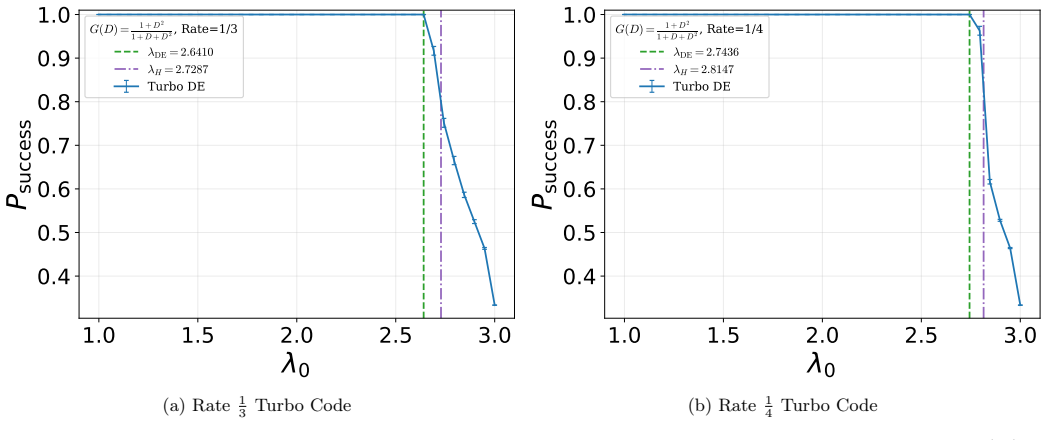
- The framework applies directly to polar codes, LDPC codes, convolutional codes, and turbo codes whose alphabets are finite abelian groups.
- It recovers the earlier q-ary belief-propagation-with-quantum-messages algorithm as the special case in which the group is cyclic of order q.
- Message updates remain closed for any factor-graph constraints expressible by homomorphisms between products of abelian groups.
- Non-cyclic alphabets are now included inside the quantum message-passing setting.
Where Pith is reading between the lines
- The same symmetry that keeps messages closed may also simplify classical belief-propagation calculations on the same factor graphs when the group structure is present.
- Hardware implementations of the covariant states could be tested on small abelian groups to measure whether the closed updates reduce resource overhead compared with fully general quantum messages.
- The framework suggests a route to quantum decoding of codes over larger or non-cyclic groups that previously lacked a compact message representation.
Load-bearing premise
The underlying channel must be a group-covariant pure-state channel whose overlaps respect the finite abelian group structure so that the Gram matrix diagonalizes in the character basis.
What would settle it
Take the smallest non-cyclic group Z_2 x Z_2, choose a pure-state channel whose overlaps break the group covariance, and compute the output of a single equality or check factor to see whether the result remains a heralded mixture of covariant states.
Figures

read the original abstract
We develop a quantum message-passing framework for factor graphs over finite abelian groups. Our starting point is the task of discriminating between a collection of quantum states indexed by the elements of a finite abelian group $\mathcal{G}$ whose overlaps respect the structure of a group-covariant pure-state channel (PSC). For such channels, we show that the Gram matrix constructed from the output states is diagonalized by the character basis of the dual group $\widehat{\mathcal{G}}$. Hence, the channel is characterized, up to isometric equivalence, by its character-indexed eigen list. Based on this representation, we analyze the induced classical-quantum channels associated with check, equality, homomorphism, marginalization, and automorphism factors. For each factor, we derive explicit update rules showing that if the incoming messages are heralded mixtures of group-covariant PSCs, then the outgoing message remains in the same class. This provides a closed quantum message-passing framework for tree-structured factor graphs assembled from these primitives. The framework applies directly to several standard code families over finite abelian groups, including polar codes, LDPC codes, and convolutional and turbo codes. It recovers the previously studied $q$-ary formulation as the special case $(\mathcal{G}=\mathbb{Z}_q)$, while extending the belief propagation with quantum messages (BPQM) framework introduced by Renes to non-cyclic alphabets and more general factor-graph constraints described by homomorphisms between products of abelian groups.
Editorial analysis
A structured set of objections, weighed in public.
Referee Report
Summary. The paper develops a quantum message-passing framework for factor graphs over finite abelian groups. It considers discrimination of states indexed by group elements under group-covariant pure-state channels (PSCs), showing that the Gram matrix of output states is diagonalized by the character basis of the dual group. Explicit update rules are then derived for the check, equality, homomorphism, marginalization, and automorphism factors such that heralded mixtures of group-covariant PSCs remain closed under message passing. The resulting framework applies to tree-structured graphs and recovers standard coding constructions including polar codes, LDPC codes, convolutional codes, and turbo codes over these groups, while extending the BPQM approach to non-cyclic alphabets and homomorphism constraints.
Significance. If the derivations hold, the work supplies a symmetry-based closed-form quantum message-passing scheme that leverages representation theory of finite abelian groups to keep messages within the PSC class. This is a clear technical advance for quantum decoding on factor graphs with group structure, generalizing prior q-ary and BPQM results without introducing free parameters or fitted quantities. The explicit closure under the listed primitive factors is a substantive strength that could enable systematic design of quantum decoders for abelian-group codes.
minor comments (3)
- Abstract: the claim that 'explicit update rules are derived' for each factor is central; a one-sentence pointer to the specific theorem or proposition number for the homomorphism case would help readers locate the closure proof immediately.
- The Gram-matrix diagonalization step (stated in the abstract) relies on standard Fourier analysis over finite abelian groups; the manuscript should cite the precise representation-theory reference used for the character basis to avoid any ambiguity in the eigen-list characterization.
- Applications section: while the recovery of the q-ary case and extension of BPQM are noted, a short worked example applying one update rule (e.g., the check factor) to a small polar-code graph would improve readability without altering the technical content.
Simulated Author's Rebuttal
We thank the referee for the positive summary, significance assessment, and recommendation of minor revision. No specific major comments were provided in the report.
Circularity Check
No significant circularity in derivation chain
full rationale
The paper derives the Gram-matrix diagonalization from the representation theory of finite abelian groups applied to group-covariant pure-state channels, then obtains explicit closed-form update rules for check, equality, homomorphism, marginalization, and automorphism factors directly from the channel definition and the resulting eigenstructure. These steps are self-contained first-principles calculations that do not reduce to fitted parameters, self-citations, or imported ansatzes; the closure property follows by algebraic construction from the covariance assumption rather than by redefinition or statistical forcing. The extension of prior BPQM work is achieved through new derivations for non-cyclic groups, preserving independence from the input assumptions.
Axiom & Free-Parameter Ledger
axioms (2)
- standard math Finite abelian groups admit a character basis that diagonalizes the Gram matrix of any group-covariant pure-state channel.
- domain assumption The listed factors (check, equality, homomorphism, marginalization, automorphism) map the class of heralded mixtures of group-covariant PSCs into itself.
Reference graph
Works this paper leans on
-
[1]
E. Arikan, “Channel polarization: A method for constructing capacity-achieving codes for symmetric binary-input memoryless channels,”IEEE Transactions on information Theory, vol. 55, no. 7, pp. 3051– 3073, 2009
work page 2009
-
[2]
Low-density parity-check codes,
R. Gallager, “Low-density parity-check codes,”IRE Transactions on information theory, vol. 8, no. 1, pp. 21–28, 1962
work page 1962
-
[3]
Near shannon limit error-correcting coding and decoding: Turbo-codes. 1,
C. Berrou, A. Glavieux, and P. Thitimajshima, “Near shannon limit error-correcting coding and decoding: Turbo-codes. 1,” inProceedings of ICC’93-IEEE International Conference on Communications, IEEE, vol. 2, 1993, pp. 1064–1070
work page 1993
-
[4]
Turbo decoding as an instance of pearl’s
R. J. McEliece, D. J. C. MacKay, and J.-F. Cheng, “Turbo decoding as an instance of pearl’s" belief propagation" algorithm,”IEEE Journal on selected areas in communications, vol. 16, no. 2, pp. 140–152, 1998
work page 1998
-
[5]
On the bcjr trellis for linear block codes,
R. J. McEliece, “On the bcjr trellis for linear block codes,”IEEE Transactions on Information Theory, vol. 42, no. 4, pp. 1072–1092, 2002
work page 2002
-
[6]
Optimal decoding of linear codes for minimizing symbol error rate (corresp.),
L. Bahl, J. Cocke, F. Jelinek, and J. Raviv, “Optimal decoding of linear codes for minimizing symbol error rate (corresp.),”IEEE Transactions on information theory, vol. 20, no. 2, pp. 284–287, 2003
work page 2003
-
[7]
Codes on graphs: Normal realizations,
G. D. Forney, “Codes on graphs: Normal realizations,”IEEE Transactions on Information Theory, vol. 47, no. 2, pp. 520–548, 2002
work page 2002
-
[8]
Codes on graphs: Fundamentals,
G. D. Forney, “Codes on graphs: Fundamentals,”IEEE Transactions on Information Theory, vol. 60, no. 10, pp. 5809–5826, 2014
work page 2014
-
[9]
The capacity of the quantum channel with general signal states,
A. S. Holevo, “The capacity of the quantum channel with general signal states,”IEEE Transactions on Information Theory, vol. 44, no. 1, pp. 269–273, 1998
work page 1998
-
[10]
Sending classical information via noisy quantum channels,
B. Schumacher and M. D. Westmoreland, “Sending classical information via noisy quantum channels,” Physical Review A, vol. 56, no. 1, p. 131, 1997
work page 1997
-
[11]
Polar codes for classical-quantum channels,
M. M. Wilde and S. Guha, “Polar codes for classical-quantum channels,”IEEE Transactions on Informa- tion Theory, vol. 59, no. 2, pp. 1175–1187, 2012
work page 2012
-
[12]
Towards efficient decoding of classical-quantum polar codes,
M. M. Wilde, O. Landon-Cardinal, and P. Hayden, “Towards efficient decoding of classical-quantum polar codes,” in8th Conference on the Theory of Quantum Computation, Communication and Cryptography, 2013, p. 157
work page 2013
-
[13]
Reed–muller codes on cq channels via a new correlation bound for quantum observables,
A. Mandal and H. D. Pfister, “Reed–muller codes on cq channels via a new correlation bound for quantum observables,” in2025 IEEE International Symposium on Information Theory (ISIT), IEEE, 2025, pp. 1–6
work page 2025
-
[14]
Belief propagation decoding of quantum channels by passing quantum messages,
J. M. Renes, “Belief propagation decoding of quantum channels by passing quantum messages,”New Journal of Physics, vol. 19, no. 7, p. 072001, 2017
work page 2017
-
[15]
Belief propagation with quantum messages for quantum-enhanced classical communications,
N. Rengaswamy, K. P. Seshadreesan, S. Guha, and H. D. Pfister, “Belief propagation with quantum messages for quantum-enhanced classical communications,”npj Quantum Information, vol. 7, no. 1, p. 97, 2021
work page 2021
-
[16]
Belief propagation with quantum messages for symmetric classical-quantum channels,
S. Brandsen, A. Mandal, and H. D. Pfister, “Belief propagation with quantum messages for symmetric classical-quantum channels,” in2022 IEEE Information Theory Workshop (ITW), IEEE, 2022, pp. 494– 499
work page 2022
-
[17]
Belief-propagation with quantum messages for polar codes on classical-quantum channels,
A. Mandal, S. Brandsen, and H. D. Pfister, “Belief-propagation with quantum messages for polar codes on classical-quantum channels,” in2023 IEEE International Symposium on Information Theory (ISIT), IEEE, 2023, pp. 613–618. 39
work page 2023
-
[18]
Polar codes for cq channels: Decoding via belief-propagation with quantum messages,
A. Mandal, S. Brandsen, and H. D. Pfister, “Polar codes for cq channels: Decoding via belief-propagation with quantum messages,”arXiv preprint arXiv:2401.07167, 2024
-
[19]
Belief propagation with quantum messages for symmetric q-ary pure-state channels,
A. Mandal and H. D. Pfister, “Belief propagation with quantum messages for symmetric q-ary pure-state channels,”arXiv preprint arXiv:2601.21330, 2026
-
[20]
Efficient and optimal quantum state discrimination via quantum belief propagation,
C. Piveteau and J. M. Renes, “Efficient and optimal quantum state discrimination via quantum belief propagation,”arXiv preprint arXiv:2509.19441, 2025
-
[21]
Luong,Fourier analysis on finite Abelian groups
B. Luong,Fourier analysis on finite Abelian groups. Springer Science & Business Media, 2009
work page 2009
-
[22]
A ‘pretty good’measurement for distinguishing quantum states,
P. Hausladen and W. K. Wootters, “A ‘pretty good’measurement for distinguishing quantum states,” Journal of Modern Optics, vol. 41, no. 12, pp. 2385–2390, 1994
work page 1994
-
[23]
On asymptotically optimal hypotheses testing in quantum statistics,
A. S. Holevo, “On asymptotically optimal hypotheses testing in quantum statistics,”Teoriya Veroyatnostei i ee Primeneniya, vol. 23, no. 2, pp. 429–432, 1978
work page 1978
-
[24]
On quantum detection and the square-root measurement,
Y. C. Eldar and G. D. Forney, “On quantum detection and the square-root measurement,”IEEE Trans- actions on Information Theory, vol. 47, no. 3, pp. 858–872, 2002
work page 2002
-
[25]
T. Richardson and R. Urbanke,Modern coding theory. Cambridge university press, 2008. 40 Appendix A Example for Check-Factor Quantum Message Passing Example 23.ConsiderG=Z 3 ×Z 2, written additively, and define the characters χu,v(a, b) =ω ua(−1)vb, whereω=e 2πi/3 and(u, v),(a, b)∈Z 3 ×Z 2. Then bG={χ u,v :u∈Z 3, v∈Z 2}and (χu,v)−1 =χ −u,v. Index the eigen...
work page 2008
discussion (0)
Sign in with ORCID, Apple, or X to comment. Anyone can read and Pith papers without signing in.