Recognition: unknown
MAST: Mask-Guided Attention Mass Allocation for Training-Free Multi-Style Transfer
Pith reviewed 2026-05-10 15:03 UTC · model grok-4.3
The pith
MAST controls diffusion attention with masks to apply multiple styles to one image without boundary artifacts or structural collapse.
A machine-rendered reading of the paper's core claim, the machinery that carries it, and where it could break.
Core claim
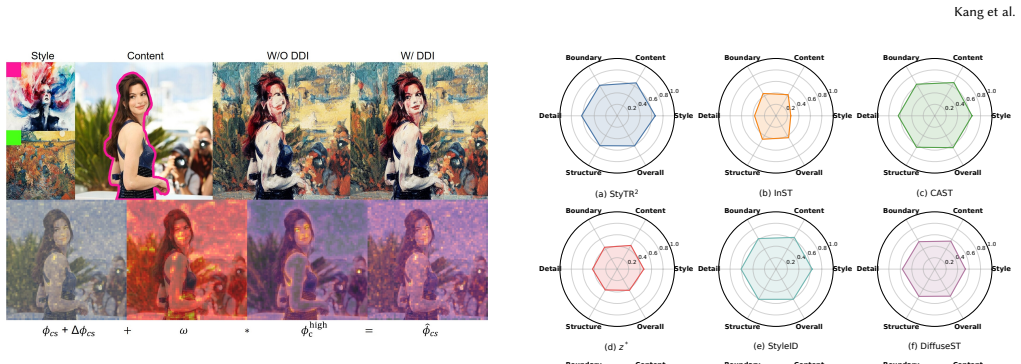
MAST integrates Layout-preserving Query Anchoring, Logit-level Attention Mass Allocation, Sharpness-aware Temperature Scaling, and Discrepancy-aware Detail Injection inside the diffusion attention mechanism. These modules together let the model assign distinct style representations to different spatial regions via masks, distribute attention probability mass without overlap artifacts, restore sharpness lost from multi-style expansion, and inject missing high-frequency details where structural discrepancies appear. The result is stylization that remains consistent and artifact-free even when the number of applied styles grows.
What carries the argument
Mask-Guided Attention Mass Allocation, which uses spatial masks to deterministically distribute attention probability mass across regions so multiple styles fuse without boundary interference.
If this is right
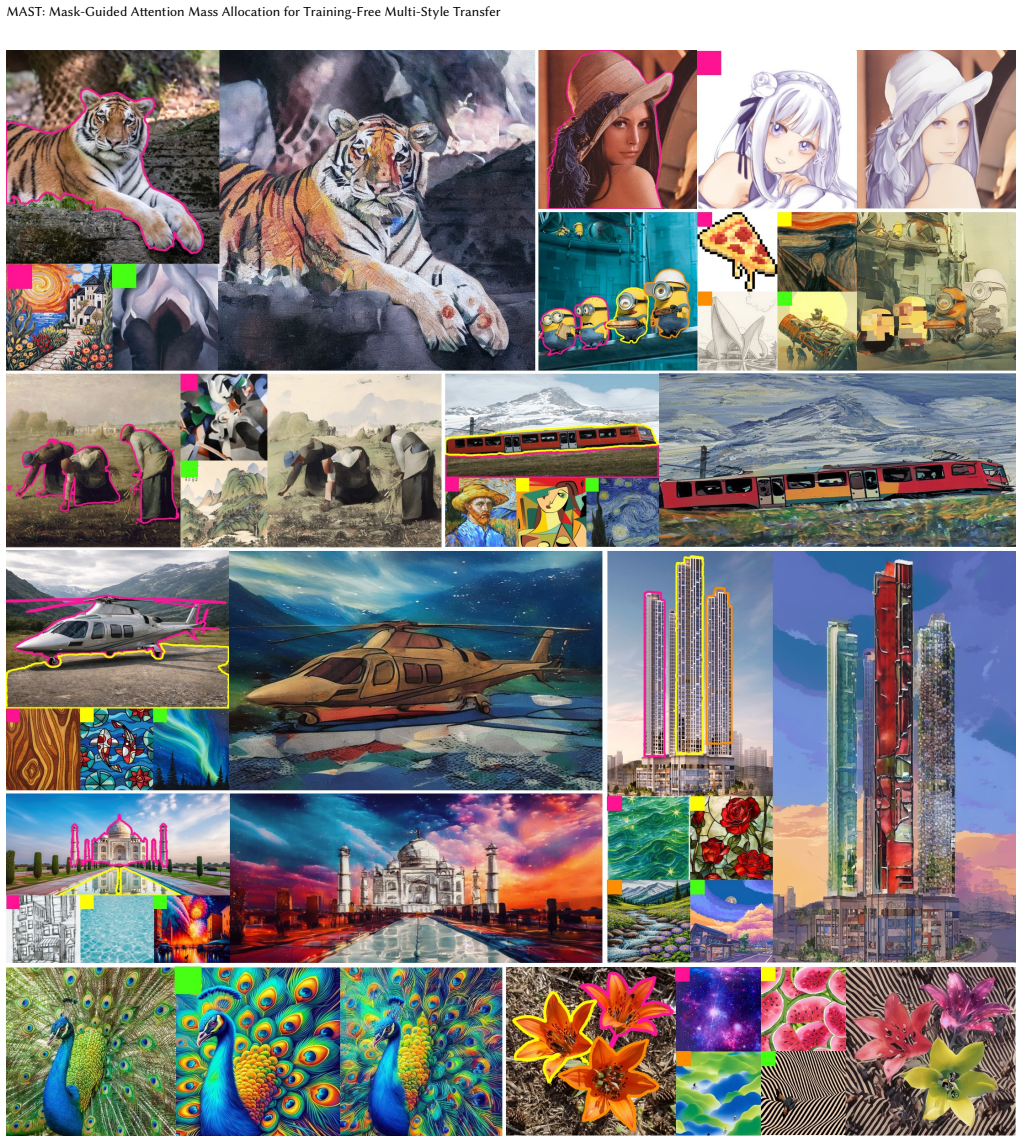
- Multiple distinct styles can be applied to different parts of the same image with seamless transitions and no retraining of the base diffusion model.
- Structural layout remains anchored even as the number of styles increases, preventing the global collapse seen in prior multi-style attempts.
- High-frequency texture details are recovered adaptively in each styled region by measuring and compensating for local discrepancies.
- The method works inside existing diffusion attention without modifying model weights or requiring paired training data.
Where Pith is reading between the lines
- The same mask-based allocation logic could be tested on video frames to enforce temporal style consistency across time.
- Because the approach is training-free, it might be combined with existing single-style methods to create region-specific editing tools for artists.
- If the attention-mass control generalizes beyond stylization, it could apply to other multi-condition diffusion tasks such as simultaneous object and lighting control.
Load-bearing premise
The four modules can be combined to control multi-style attention deterministically without creating new instabilities or needing any style-specific tuning.
What would settle it
Running MAST on a content image split into two adjacent regions with clearly different styles and observing either visible seams at the boundary or measurable loss of structural coherence compared to single-style baselines would falsify the central claim.
Figures







read the original abstract
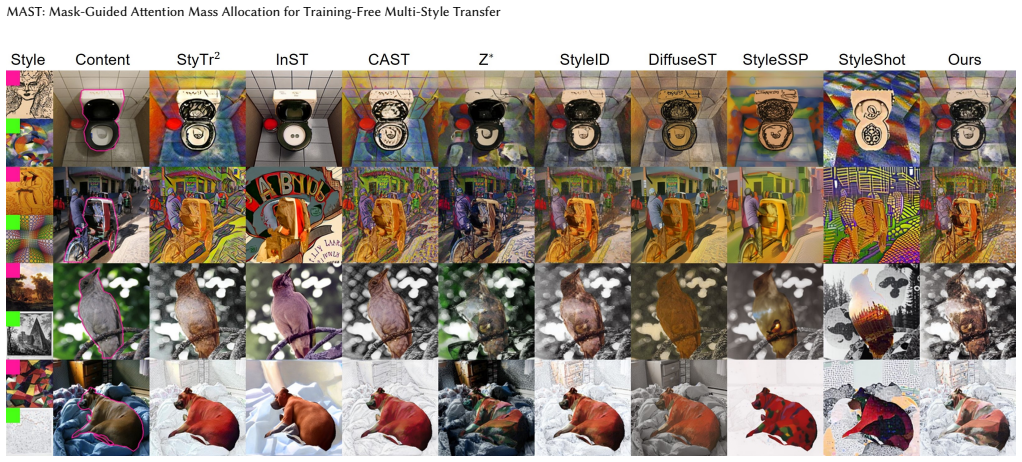
Style transfer aims to render a content image with the visual characteristics of a reference style while preserving its underlying semantic layout and structural geometry. While recent diffusion-based models demonstrate strong stylization capabilities by leveraging powerful generative priors and controllable internal representations, they typically assume a single global style. Extending them to multi-style scenarios often leads to boundary artifacts, unstable stylization, and structural inconsistency due to interference between multiple style representations. To overcome these limitations, we propose MAST (Mask-Guided Attention Mass Allocation for Training-Free Multi-Style Transfer), a novel training-free framework that explicitly controls content-style interactions within the diffusion attention mechanism. To achieve artifact-free and structure-preserving stylization, MAST integrates four connected modules. First, Layout-preserving Query Anchoring prevents global layout collapse by firmly anchoring the semantic structure using content queries. Second, Logit-level Attention Mass Allocation deterministically distributes attention probability mass across spatial regions, seamlessly fusing multiple styles without boundary artifacts. Third, Sharpness-aware Temperature Scaling restores the attention sharpness degraded by multi-style expansion. Finally, Discrepancy-aware Detail Injection adaptively compensates for localized high-frequency detail losses by measuring structural discrepancies. Extensive experiments demonstrate that MAST effectively mitigates boundary artifacts and maintains structural consistency, preserving texture fidelity and spatial coherence even as the number of applied styles increases.
Editorial analysis
A structured set of objections, weighed in public.
Referee Report
Summary. The paper proposes MAST, a training-free framework for multi-style transfer using diffusion models. It addresses boundary artifacts, unstable stylization, and structural inconsistency arising from multiple style representations by controlling content-style interactions in the diffusion attention mechanism. MAST integrates four modules: Layout-preserving Query Anchoring (to anchor semantic structure via content queries), Logit-level Attention Mass Allocation (to deterministically distribute attention mass across regions for seamless style fusion), Sharpness-aware Temperature Scaling (to restore attention sharpness), and Discrepancy-aware Detail Injection (to compensate for high-frequency detail losses via structural discrepancy measurement). The central claim is that these modules together enable artifact-free, structure-preserving multi-style stylization that scales with the number of styles.
Significance. If validated, the result would be significant for controllable image generation, as it offers a deterministic, training-free solution to a common limitation in diffusion-based stylization without requiring per-style tuning or introducing new instabilities. Credit is due for the training-free design, explicit logit-level operations that preserve normalization, and the modular decomposition that separates layout preservation, fusion, sharpness, and detail compensation. This could support more flexible multi-style applications in computer vision.
major comments (1)
- Abstract and Experiments section: the assertion that 'extensive experiments demonstrate' mitigation of boundary artifacts and maintenance of structural consistency is not supported by any quantitative metrics, baselines, ablation studies, or specific evaluation protocols in the provided description. This weakens verification of the headline claim that performance holds as the number of styles increases.
minor comments (1)
- The integration of the four modules is described as complementary, but a figure or pseudocode illustrating the combined attention computation (e.g., how query anchoring interacts with mass allocation) would improve clarity.
Simulated Author's Rebuttal
We thank the referee for the positive evaluation of MAST's significance and for the constructive major comment. We address the concern point by point below.
read point-by-point responses
-
Referee: Abstract and Experiments section: the assertion that 'extensive experiments demonstrate' mitigation of boundary artifacts and maintenance of structural consistency is not supported by any quantitative metrics, baselines, ablation studies, or specific evaluation protocols in the provided description. This weakens verification of the headline claim that performance holds as the number of styles increases.
Authors: We agree that the headline claim regarding scalability with the number of styles would be strengthened by explicit quantitative support. The current manuscript presents extensive qualitative results, including visual comparisons against baselines and ablations across varying style counts, which we believe demonstrate the mitigation of boundary artifacts and preservation of structure. However, to directly address the referee's point, we will revise the Experiments section to include quantitative metrics (e.g., FID for stylization quality, LPIPS and SSIM for structural consistency), user studies, and a dedicated protocol for multi-style evaluation. Ablation studies will be expanded with tables showing performance trends as the style count increases from 1 to 5+. These additions will be placed in a new subsection with clear evaluation protocols. revision: yes
Circularity Check
No significant circularity in the MAST training-free framework
full rationale
The paper presents a training-free method for multi-style transfer via four explicitly described modules (Layout-preserving Query Anchoring, Logit-level Attention Mass Allocation, Sharpness-aware Temperature Scaling, and Discrepancy-aware Detail Injection) operating on diffusion attention. No equations, derivations, or fitted parameters are introduced that reduce claimed performance to self-referential definitions, prior fits, or self-citation chains. The modules are positioned as complementary and deterministic without any load-bearing uniqueness theorems or ansatzes imported from the authors' prior work. Experimental claims rest on empirical validation rather than tautological construction, making the derivation chain self-contained.
Axiom & Free-Parameter Ledger
Reference graph
Works this paper leans on
-
[1]
Yuval Alaluf, Daniel Garibi, Or Patashnik, Hadar Averbuch-Elor, and Daniel Cohen-Or. 2024. Cross-image attention for zero-shot appearance transfer. In ACM SIGGRAPH 2024 conference papers. 1–12
2024
- [2]
- [3]
-
[4]
Jiwoo Chung, Sangeek Hyun, and Jae-Pil Heo. 2024. Style injection in diffusion: A training-free approach for adapting large-scale diffusion models for style transfer. InProceedings of the IEEE/CVF conference on computer vision and pattern recognition. 8795–8805
2024
-
[5]
Yingying Deng, Xiangyu He, Fan Tang, and Weiming Dong. 2024. Z*: Zero-shot style transfer via attention reweighting. InProceedings of the IEEE/CVF Conference on Computer Vision and Pattern Recognition. 6934–6944
2024
-
[6]
Yingying Deng, Fan Tang, Weiming Dong, Chongyang Ma, Xingjia Pan, Lei Wang, and Changsheng Xu. 2022. Stytr2: Image style transfer with transformers. In Proceedings of the IEEE/CVF conference on computer vision and pattern recognition. 11326–11336
2022
- [7]
-
[8]
Junyao Gao, Yanan Sun, Yanchen Liu, Yinhao Tang, Yanhong Zeng, Ding Qi, Kai Chen, and Cairong Zhao. 2025. Styleshot: A snapshot on any style.IEEE Transactions on Pattern Analysis and Machine Intelligence(2025)
2025
-
[9]
Leon A Gatys, Alexander S Ecker, and Matthias Bethge. 2016. Image style transfer using convolutional neural networks. InProceedings of the IEEE conference on computer vision and pattern recognition. 2414–2423
2016
-
[10]
Lei Hu, Zihao Zhang, Yongjing Ye, Yiwen Xu, and Shihong Xia. 2024. On-the-fly Learning to Transfer Motion Style with Diffusion Models: A Semantic Guidance Approach.CoRR(2024)
2024
-
[11]
Ying Hu, Chenyi Zhuang, and Pan Gao. 2024. Diffusest: Unleashing the capa- bility of the diffusion model for style transfer. InProceedings of the 6th ACM International Conference on Multimedia in Asia. 1–1
2024
- [12]
-
[13]
Xun Huang and Serge Belongie. 2017. Arbitrary style transfer in real-time with adaptive instance normalization. InProceedings of the IEEE international conference on computer vision. 1501–1510
2017
- [14]
-
[15]
Mingkun Lei, Xue Song, Beier Zhu, Hao Wang, and Chi Zhang. 2025. StyleStudio: Text-Driven Style Transfer with Selective Control of Style Elements. InProceed- ings of the Computer Vision and Pattern Recognition Conference. 23443–23452
2025
-
[16]
Songlin Lei, Qiuxia Yang, Ke Yang, Zhengpeng Zhao, and Yuanyuan Pu. 2025. Training-free style transfer via content-style image inversion.Computers & Graphics(2025), 104352
2025
-
[17]
Yijun Li, Chen Fang, Jimei Yang, Zhaowen Wang, Xin Lu, and Ming-Hsuan Yang. 2017. Universal style transfer via feature transforms.Advances in neural information processing systems30 (2017)
2017
-
[18]
Microsoft COCO: Common Objects in Context
Tsung-Yi Lin, Michael Maire, Serge J. Belongie, Lubomir D. Bourdev, Ross B. Gir- shick, James Hays, Pietro Perona, Deva Ramanan, Piotr Doll’a r, and C. Lawrence Zitnick. 2014. Microsoft COCO: Common Objects in Context.CoRRabs/1405.0312 (2014). arXiv:1405.0312 http://arxiv.org/abs/1405.0312
work page internal anchor Pith review arXiv 2014
-
[19]
Jeeseung Park and Younggeun Kim. 2022. Styleformer: Transformer based generative adversarial networks with style vector. InProceedings of the IEEE/CVF conference on computer vision and pattern recognition. 8983–8992
2022
-
[20]
Robin Rombach, Andreas Blattmann, Dominik Lorenz, Patrick Esser, and Björn Ommer. 2022. High-resolution image synthesis with latent diffusion models. In Proceedings of the IEEE/CVF conference on computer vision and pattern recognition. 10684–10695
2022
-
[21]
Jiaming Song, Chenlin Meng, and Stefano Ermon. 2020. Denoising diffusion implicit models.arXiv preprint arXiv:2010.02502(2020)
work page internal anchor Pith review Pith/arXiv arXiv 2020
- [22]
-
[23]
Hanyu Wang, Pengxiang Wu, Kevin Dela Rosa, Chen Wang, and Abhinav Shri- vastava. 2024. Multimodality-guided image style transfer using cross-modal gan inversion. InProceedings of the IEEE/CVF winter conference on applications of computer vision. 4976–4985
2024
-
[24]
Jianbo Wang, Huan Yang, Jianlong Fu, Toshihiko Yamasaki, and Baining Guo
-
[25]
InProceedings of the Asian conference on computer vision
Fine-grained image style transfer with visual transformers. InProceedings of the Asian conference on computer vision. 841–857
-
[26]
Ye Wang, Ruiqi Liu, Jiang Lin, Fei Liu, Zili Yi, Yilin Wang, and Rui Ma. 2025. OmniStyle: Filtering High Quality Style Transfer Data at Scale. InProceedings of the Computer Vision and Pattern Recognition Conference. 7847–7856
2025
-
[27]
Zhizhong Wang, Lei Zhao, and Wei Xing. 2023. Stylediffusion: Controllable disentangled style transfer via diffusion models. InProceedings of the IEEE/CVF international conference on computer vision. 7677–7689
2023
-
[28]
WikiArt. 2026. WikiArt: Visual Art Encyclopedia. https://www.wikiart.org/. Accessed: 2026-03-22
2026
-
[29]
Zhengtao Xiang, Xing Wan, Libo Xu, Xin Yu, and Yuhan Mao. 2024. A Training- Free Latent Diffusion Style Transfer Method.Information15, 10 (2024), 588
2024
-
[30]
Ruojun Xu, Weijie Xi, XiaoDi Wang, Yongbo Mao, and Zach Cheng. 2025. Stylessp: Sampling startpoint enhancement for training-free diffusion-based method for style transfer. InProceedings of the Computer Vision and Pattern Recognition Conference. 18260–18269
2025
- [31]
-
[32]
Yuxin Zhang, Nisha Huang, Fan Tang, Haibin Huang, Chongyang Ma, Weiming Dong, and Changsheng Xu. 2023. Inversion-based style transfer with diffusion models. InProceedings of the IEEE/CVF conference on computer vision and pattern recognition. 10146–10156
2023
-
[33]
Yuxin Zhang, Fan Tang, Weiming Dong, Haibin Huang, Chongyang Ma, Tong- Yee Lee, and Changsheng Xu. 2022. Domain enhanced arbitrary image style transfer via contrastive learning. InACM SIGGRAPH 2022 conference proceedings. 1–8
2022
-
[34]
Zhiwen Zuo, Lei Zhao, Shuobin Lian, Haibo Chen, Zhizhong Wang, Ailin Li, Wei Xing, and Dongming Lu. 2022. Style Fader Generative Adversarial Networks for Style Degree Controllable Artistic Style Transfer.. InIJCAI. 5002–5009. Kang et al. A Research Methods A.1 Mathematical Formulation ofLAMA In this section, we present the mathematical formulation ofLAMA ...
2022
-
[35]
A.4.3 Style Fidelity Comparison in the 2-Style Setting.Fig
These results show that our method generalizes well beyond a fixed setup and maintains stable region-wise style injection under more challenging spatial configurations. A.4.3 Style Fidelity Comparison in the 2-Style Setting.Fig. 16 presents a comparison between our method and strong baselines ( 𝑍 ∗ [5], StyleID [4], and StyleShot [8]) in the 2-style setti...
discussion (0)
Sign in with ORCID, Apple, or X to comment. Anyone can read and Pith papers without signing in.