Chiral state conversion near an exceptional point: speed-noise competition
Pith reviewed 2026-05-10 15:36 UTC · model grok-4.3
The pith
Encircling speed and noise strength compete to set the chirality of state conversion near exceptional points.
A machine-rendered reading of the paper's core claim, the machinery that carries it, and where it could break.
Core claim
The central claim is that the non-chirality degree χ_c measuring chiral state conversion near exceptional points is fixed by the competition between encircling speed and noise strength. This competition produces two regimes: a noisy limit in which noise dominates the outcome and a clean limit in which the noiseless chiral dynamics are recovered. The critical boundary between the regimes obeys a simple scaling law that follows from first-order perturbation theory together with the condition number of the transfer matrix. Exact noiseless solutions reveal chirality oscillations that are extremely sensitive to noise at low speeds, while numerical integration tracks the effect of added noise.
What carries the argument
The non-chirality degree χ_c, a quantitative measure of how chiral the final state conversion is after one loop around the exceptional point.
If this is right
- In the clean limit the system recovers the ideal chiral conversion predicted by noiseless theory.
- In the noisy limit the final state becomes independent of the loop direction regardless of speed.
- The scaling law gives a concrete relation that predicts the noise level at which chirality is lost for any given speed.
- The condition number of the transfer matrix directly controls how quickly the transition to the noisy limit occurs.
- Experimental protocols must tune speed relative to the prevailing noise floor to remain in the clean regime.
Where Pith is reading between the lines
- The same speed-noise competition could appear in other non-Hermitian effects such as skin modes or PT-symmetric transitions.
- In quantum control settings the scaling law offers a practical rule for choosing loop times to protect or suppress chiral conversion.
- Engineered noise of controlled strength might be used to steer the outcome of the conversion rather than merely degrade it.
- The transfer-matrix condition number may serve as a general diagnostic for noise sensitivity in any non-Hermitian dynamical protocol.
Load-bearing premise
The analysis assumes a specific non-Hermitian model whose exact noiseless solution remains a reliable baseline once noise is introduced and that first-order perturbation theory correctly captures the scaling of the speed-noise boundary.
What would settle it
Measure χ_c across a grid of encircling speeds and noise strengths and check whether the observed switch between noisy and clean regimes follows the predicted scaling law derived from the transfer-matrix condition number.
Figures


read the original abstract
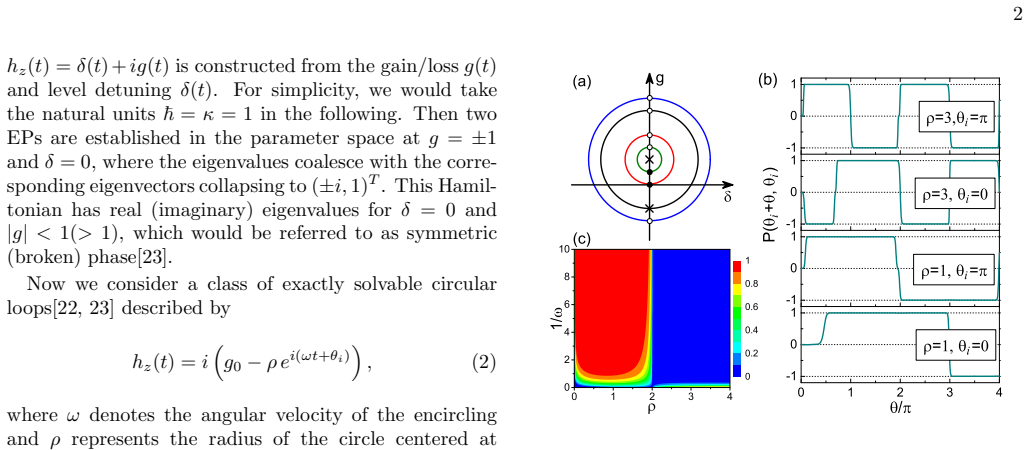
One intriguing property of non-Hermitian systems is the breakdown of adiabatic theorem and chiral state conversion as the system dynamically encircles exceptional points. However, the subtle dependence of the chiral dynamics on the loop geometry, the starting point, the encircling speed and especially the noise has not been studied systematically. Here we propose a non-chirality degree $\chi_c$ to measure the chirality quantitatively and analyze it in dynamics without noise by exact solution and dynamics with noise by numerical integration. The exact dynamics starting from the broken phase show chirality oscillations, which are extremely sensitive to noise when the speed is small. The encircling speed and the noise strength are found to compete with each other in determining $\chi_c$, resulting in two distinguished limits, namely the noisy limit and the clean limit. The critical boundary between the two limits satisfies a simple scaling law, which could be explained in terms of first-order perturbation theory and the condition number of the transfer matrix. Our findings reveal the essential role played by noise in non-Hermitian dynamics and are relevant for both theoretical and experimental investigations.
Editorial analysis
A structured set of objections, weighed in public.
Referee Report
Summary. The manuscript studies chiral state conversion in non-Hermitian systems dynamically encircling an exceptional point. It introduces a quantitative non-chirality measure χ_c, derives an exact solution for the noiseless dynamics that exhibits chirality oscillations, and performs numerical integration for the noisy case. The central result is that encircling speed and noise strength compete to set χ_c, producing distinct noisy and clean limits whose boundary obeys a simple scaling law; this law is attributed to first-order perturbation theory combined with the condition number of the transfer matrix.
Significance. If the scaling law and its perturbative explanation hold under scrutiny, the work would usefully clarify the essential role of noise in non-Hermitian chiral dynamics near EPs. The exact noiseless solution and the proposed competition between speed and noise constitute concrete, falsifiable contributions that could inform both theory and experiments in non-Hermitian optics or open quantum systems.
major comments (2)
- [section presenting the scaling law] The scaling law for the critical boundary between noisy and clean limits is derived from first-order perturbation theory and the transfer-matrix condition number. However, no explicit bound is given on the size of the non-Hermitian perturbation, nor is there a comparison against higher-order terms or exact numerics in the low-speed, finite-noise regime where the EP causes eigenvalue coalescence and the condition number diverges; this leaves open whether the scaling is an artifact of the truncation.
- [numerical results section] The numerical integration of the noisy dynamics is used to identify the two limits and the boundary, yet the manuscript supplies no error analysis, convergence tests with respect to time-step or ensemble size, or systematic checks against the exact noiseless solution in the zero-noise limit; these omissions make it difficult to assess the robustness of the reported competition and scaling.
minor comments (2)
- [introduction of χ_c] The definition of χ_c is introduced without an explicit formula or normalization; adding the precise expression would improve reproducibility.
- [figures showing noisy dynamics] Figure captions for the noisy trajectories should state the integration method, time-step, and number of realizations used.
Simulated Author's Rebuttal
We thank the referee for the positive evaluation of our work and the detailed, constructive comments. We address each major comment below and outline the revisions that will be incorporated in the next version of the manuscript.
read point-by-point responses
-
Referee: [section presenting the scaling law] The scaling law for the critical boundary between noisy and clean limits is derived from first-order perturbation theory and the transfer-matrix condition number. However, no explicit bound is given on the size of the non-Hermitian perturbation, nor is there a comparison against higher-order terms or exact numerics in the low-speed, finite-noise regime where the EP causes eigenvalue coalescence and the condition number diverges; this leaves open whether the scaling is an artifact of the truncation.
Authors: We appreciate the referee pointing out the need to clarify the regime of validity for the first-order perturbative derivation of the scaling law. The derivation assumes the non-Hermitian perturbation remains small relative to the eigenvalue splitting away from the exceptional point. In the revised manuscript we will add an explicit bound on the allowable perturbation size, expressed in terms of the distance to the EP and the encircling speed. We will also include a direct comparison of the first-order result against the second-order correction, which shows that higher-order contributions remain negligible throughout the parameter region where the scaling law is reported. For the low-speed, finite-noise regime we will supplement the existing numerics with additional simulations that compare the perturbative boundary prediction against full stochastic integration; these checks confirm that the scaling continues to describe the observed transition until the condition number becomes extremely large, at which point the approximation naturally breaks down. This demonstrates that the reported scaling captures the leading-order competition rather than being a truncation artifact. revision: partial
-
Referee: [numerical results section] The numerical integration of the noisy dynamics is used to identify the two limits and the boundary, yet the manuscript supplies no error analysis, convergence tests with respect to time-step or ensemble size, or systematic checks against the exact noiseless solution in the zero-noise limit; these omissions make it difficult to assess the robustness of the reported competition and scaling.
Authors: We agree that the numerical section requires additional validation to strengthen confidence in the results. In the revised manuscript we will add a dedicated subsection on numerical accuracy that includes: (i) error bars and standard deviations computed across independent ensemble realizations, (ii) convergence tests demonstrating that the reported values of χ_c stabilize when the integration time step is reduced by factors of two and four and when the ensemble size is increased from 500 to 2000 trajectories, and (iii) direct comparisons of the stochastic trajectories at vanishingly small noise strength against the exact noiseless analytic solution derived earlier in the paper. These additions will explicitly confirm that the clean-limit behavior is recovered and that the location of the noisy-to-clean boundary is insensitive to the numerical parameters within the regime studied. revision: yes
Circularity Check
No significant circularity; scaling law derived from external standard tools
full rationale
The paper derives the scaling law for the speed-noise boundary using first-order perturbation theory applied to the non-Hermitian Hamiltonian and the condition number of the transfer matrix. These are standard mathematical tools independent of the paper's new definitions (χ_c, noisy/clean limits). The exact solution without noise and numerical integration with noise are presented as direct computations, not fitted or self-referential. No self-citation chains, self-definitional loops, or renamings of known results appear in the load-bearing steps. The derivation chain remains self-contained against external benchmarks.
Axiom & Free-Parameter Ledger
axioms (2)
- domain assumption First-order perturbation theory applies near exceptional points to derive the scaling law for the speed-noise boundary
- domain assumption The transfer-matrix condition number quantifies sensitivity in the chiral dynamics
Reference graph
Works this paper leans on
-
[1]
Chiral state conversion near an exceptional point: speed-noise competition
showed that the presence of noise is essential and would drastically alters the dynamics of non-Hermitian systems. However, systematic studies of the chirality in the noise-speed parameter space is till lacking. One important issue here is to search for general rules or universal relations in the chiral/nonchiral state conver- sion process, which has a co...
work page internal anchor Pith review Pith/arXiv arXiv 2026
-
[2]
tells us that the quasienergies are just the eigen- values of the time-averaged Hamiltonian and hence (v) Tr[S(θi ± 2π,θ i)] = 2 cos(2π √ 1 − g2 0/ω ). The properties (i) to (v) depend only on the symme- try of the Hamiltonian and tell us important information about the transfer matrix. They could be used to check the correctness of any analytical solutio...
-
[3]
W. D. Heiss, Repulsion of resonance states and excep- tional points, Phys. Rev. E 61, 929 (2000)
work page 2000
-
[4]
E. M. Graefe, U. G¨ unther, H. J. Korsch, and A. E. Niederle, A non-hermitian pt-symmetric bose-hubbard model: eigenvalue rings from unfolding higher-order ex- ceptional points, J. Phys. A 41, 255206 (2008)
work page 2008
-
[5]
J. Garrison and E. M. Wright, Complex geometrical phases for dissipative systems, Phys. Lett. A 128, 177 (1988)
work page 1988
-
[6]
F. Keck, H. J. Korsch, and S. Mossmann, Unfolding a diabolic point: a generalized crossing scenario, J. Phys. A 36, 2125 (2003)
work page 2003
-
[7]
M. V. Berry, Physics of nonhermitian degeneracies, Czech. J. Phys. 54, 1039 (2004)
work page 2004
-
[8]
A. Guo, G. J. Salamo, D. Duchesne, R. Morandotti, M. Volatier-Ravat, V. Aimez, G. A. Siviloglou, and D. N. Christodoulides, Observation of PT -symmetry breaking in complex optical potentials, Phys. Rev. Lett. 103, 093902 (2009)
work page 2009
-
[9]
L. Feng, Z. J. Wong, R.-M. Ma, Y. Wang, and X. Zhang, Single-mode laser by parity-time symmetry breaking, Sci- ence 346, 972 (2014)
work page 2014
-
[10]
H. Hodaei, M.-A. Miri, M. Heinrich, D. N. Christodoulides, and M. Khajavikhan, Parity- time–symmetric microring lasers, Science 346, 975 (2014)
work page 2014
-
[11]
Z. Lin, H. Ramezani, T. Eichelkraut, T. Kottos, H. Cao, and D. N. Christodoulides, Unidirectional invisibility in - duced by PT -symmetric periodic structures, Phys. Rev. Lett. 106, 213901 (2011)
work page 2011
-
[12]
L. Feng, Y.-L. Xu, S. F. William, M.-H. Lu, E. B. O. Jose, R. A. Vilson, Y.-F. Chen, and S. Axel, Experimen- tal demonstration of a unidirectional reflectionless parit y- time metamaterial at optical frequencies, Nat. Mater. 12, 6 108 (2013)
work page 2013
-
[13]
A. A. Mailybaev, O. N. Kirillov, and A. P. Seyranian, Geometric phase around exceptional points, Phys. Rev. A 72, 014104 (2005)
work page 2005
-
[14]
W. D. Heiss, The physics of exceptional points, J. Phys. A 45, 444016 (2012)
work page 2012
-
[15]
C. Dembowski, H.-D. Gr¨ af, H. L. Harney, A. Heine, W. D. Heiss, H. Rehfeld, and A. Richter, Experimen- tal observation of the topological structure of exceptiona l points, Phys. Rev. Lett. 86, 787 (2001)
work page 2001
-
[16]
T. Gao, E. Estrecho, K. Y. Bliokh, T. C. H. Liew, M. D. Fraser, S. Brodbeck, M. Kamp, C. Schneider, S. H¨ ofling, Y. Yamamoto, F. Nori, Y. S. Kivshar, A. G. Truscott, R. G. Dall, and E. A. Ostrovskaya, Observation of non- hermitian degeneracies in a chaotic exciton-polariton bil - liard, Nature 526, 554 (2015)
work page 2015
- [17]
- [18]
- [19]
-
[20]
H. Cartarius, J. Main, and G. Wunner, Exceptional points in atomic spectra, Phys. Rev. Lett. 99, 173003 (2007)
work page 2007
-
[21]
R. Lefebvre, O. Atabek, M. ˇSindelka, and N. Moiseyev, Resonance coalescence in molecular photodissociation, Phys. Rev. Lett. 103, 123003 (2009)
work page 2009
-
[22]
T. E. Lee, Anomalous edge state in a non-hermitian lat- tice, Phys. Rev. Lett. 116, 133903 (2016)
work page 2016
- [23]
-
[24]
A. U. Hassan, B. Zhen, M. Soljaˇ ci´ c, M. Khajavikhan, and D. N. Christodoulides, Dynamically encircling ex- ceptional points: Exact evolution and polarization state conversion, Phys. Rev. Lett. 118, 093002 (2017)
work page 2017
- [25]
-
[26]
A. Li, J. Dong, J. Wang, Z. Cheng, J. S. Ho, D. Zhang, J. Wen, X.-L. Zhang, C. T. Chan, A. Al` u, C.-W. Qiu, and L. Chen, Hamiltonian hopping for efficient chiral mode switching in encircling exceptional points, Phys. Rev. Lett. 125, 187403 (2020)
work page 2020
-
[27]
J. Doppler, A. A. Mailybaev, J. B¨ ohm, U. Kuhl, A. Girschik, F. Libisch, T. J. Milburn, P. Rabl, N. Moi- seyev, and S. Rotter, Dynamically encircling an excep- tional point for asymmetric mode switching, Nature 537, 76 (2016)
work page 2016
-
[28]
H. Xu, D. Mason, L. Jiang, and J. G. E. Harris, Topo- logical energy transfer in an optomechanical system with exceptional points, Nature 537, 80 (2016)
work page 2016
-
[29]
N. Even, B. Nennig, G. Lefebvre, and E. Perrey-Debain, Experimental observation of exceptional points in cou- pled pendulums, J. Sound Vib. 575, 118239 (2024)
work page 2024
-
[30]
N. Even, B. Nennig, G. Lefebvre, and E. Perrey-Debain, Experimental dynamical encircling of an exceptional point in coupled pendulums, Proc. R. Soc. A 481, 20240335 (2025)
work page 2025
-
[31]
J. W. Yoon, Y. Choi, C. Hahn, G. Kim, S. Ho Song, K. Y. Yang, J. Yub Lee, Y. Kim, C. S. Lee, J. K. Shin, H. S. Lee, and P. Berini, Time-asymmetric loop around an exceptional point over the full optical communications band, Nature 562, 86 (2018)
work page 2018
-
[32]
X. L. Zhang, T. Jiang, and C. Chan, Dynamically en- circling an exceptional point in anti-parity-time symmet- ric systems: asymmetric mode switching for symmetry- broken modes., Light: Sci. Appl. 8, 88 (2020)
work page 2020
-
[33]
X. L. Zhang and C. Chan, Dynamically encircling excep- tional points in a three-mode waveguide system, Com- mun. Phys. 2, 63 (2019)
work page 2019
-
[34]
Q. Liu, S. Li, B. Wang, S. Ke, C. Qin, K. Wang, W. Liu, D. Gao, P. Berini, and P. Lu, Efficient mode transfer on a compact silicon chip by encircling moving exceptional points, Phys. Rev. Lett. 124, 153903 (2020)
work page 2020
-
[35]
A. Li, W. Chen, H. Wei, G. Lu, A. Al` u, C.-W. Qiu, and L. Chen, Riemann-encircling exceptional points for effi- cient asymmetric polarization-locked devices, Phys. Rev. Lett. 129, 127401 (2022)
work page 2022
-
[36]
X. Shu, A. Li, G. Hu, J. Wang, A. Al´ u, and L. Chen, Fast encirclement of an exceptional point for highly efficient and compact chiral mode converters, Nat. Commun. 13, 2123 (2022)
work page 2022
-
[37]
H. Zhu, J. Wang, A. Al´ u, and L. Chen, Polarization- controlled chiral transport, Light: Sci. Appl. 14, 77 (2025)
work page 2025
-
[38]
Y. Wu, Y. Sun, Q. Liang, H. Zhang, L. Xia, X. Xu, and Y. Zou, Accelerated exceptional point encirclement in anti-parity-time symmetric systems for ultra-compact chiral mode switching, Appl. Phys. Rev. 12, 041409 (2025)
work page 2025
-
[39]
J. Yao, C. L¨ u, J. Zhang, J. Song, S. Tang, and Y. Jiang, Realization of encircling the exceptional point in non- hermitian acoustic waveguide coupler, Appl. Phys. Lett. 127, 122201 (2025)
work page 2025
-
[40]
Y. Choi, J. W. Yoon, J. K. Hong, Y. R. Ryu, and S. H. Song, Direct observation of time-asymmetric breakdown of the standard adiabaticity around an exceptional point, Commun. Phys. 3, 140 (2020)
work page 2020
-
[41]
L. J. Fern´ andez-Alc´ azar, H. Li, F. Ellis, A. Al´ u, and T. Kottos, Robust scattered fields from adiabatically driven targets around exceptional points, Phys. Rev. Lett. 124, 133905 (2020)
work page 2020
-
[42]
W. Liu, Y. Zhang, Z. Deng, J. Ye, K. Wang, B. Wang, D. Gao, and P. Lu, On-chip chiral mode switching by en- circling an exceptional point in an anti-parity-time sym- metric system, Laser Photonics Rev. 16, 2100675 (2022)
work page 2022
-
[43]
K. Bai, L. Fang, T.-R. Liu, J.-Z. Li, D. Wan, and M. Xiao, Nonlinearity-enabled higher-order exceptional singular i- ties with ultra-enhanced signal-to-noise ratio, Natl. Sci . Rev. 10, nwac259 (2022)
work page 2022
-
[44]
A. U. Hassan, G. L. Galmiche, G. Harari, P. LiKamWa, M. Khajavikhan, M. Segev, and D. N. Christodoulides, Chiral state conversion without encircling an exceptional point, Phys. Rev. A 96, 052129 (2017)
work page 2017
-
[45]
J. Feilhauer, A. Schumer, J. Doppler, A. A. Mailybaev, J. B¨ ohm, U. Kuhl, N. Moiseyev, and S. Rotter, Encircling exceptional points as a non-hermitian extension of rapid adiabatic passage, Phys. Rev. A 102, 040201 (2020)
work page 2020
-
[46]
Q. Liu, J. Liu, D. Zhao, and B. Wang, On-chip exper- iment for chiral mode transfer without enclosing an ex- 7 ceptional point, Phys. Rev. A 103, 023531 (2021)
work page 2021
- [47]
-
[48]
N. S. Nye, Universal state conversion in discrete and slowly varying non-hermitian cyclic systems: An analytic proof and exactly solvable examples, Phys. Rev. Res. 5, 033053 (2023)
work page 2023
-
[49]
X. Shu, Q. Zhong, K. Hong, O. You, J. Wang, G. Hu, A. Al´ u, S. Zhang, D. N. Christodoulides, and L. Chen, Chiral transmission by an open evolution trajectory in a non-Hermitian system, Light: Sci. Appl. 13, 65 (2024)
work page 2024
-
[50]
X.-L. Zhang, J.-F. Song, C. T. Chan, and H.-B. Sun, Dis- tinct outcomes by dynamically encircling an exceptional point along homotopic loops, Phys. Rev. A 99, 063831 (2019)
work page 2019
- [51]
- [52]
-
[53]
N. S. Nye and N. V. Kantartzis, Adiabatic state conver- sion for (a)cyclic non-hermitian quantum hamiltonians of generalized functional form, APL Quantum 1, 046107 (2024)
work page 2024
- [54]
-
[55]
P. Lu, Y. Liu, Q. Lao, T. Liu, X. Rao, J. Bian, H. Wu, F. Zhu, and L. Luo, Dynamical topology of chiral and nonreciprocal state transfers in a non-hermitian quantum system, Commun. Phys. 8, 91 (2025)
work page 2025
-
[56]
X. Tang, T. Chen, and X. Zhang, Controlling transfer and chirality of topological quantum state through dis- sipation in quantum walk, Phys. Rev. Res. 7, 013159 (2025)
work page 2025
- [57]
-
[58]
K. Kawabata, T. Bessho, and M. Sato, Classifica- tion of exceptional points and non-hermitian topological semimetals, Phys. Rev. Lett. 123, 066405 (2019)
work page 2019
- [59]
-
[60]
C.-X. Guo, S. Chen, K. Ding, and H. Hu, Exceptional non-abelian topology in multiband non-hermitian sys- tems, Phys. Rev. Lett. 130, 157201 (2023)
work page 2023
- [61]
- [62]
-
[63]
See Supplemental Material for symmetry analysis of the transfer matrix, exact solution, asymmetric analysis, Flo - quet analysis, and more numerical results
-
[64]
H. Gao, K. Sun, D. Qu, K. Wang, L. Xiao, W. Yi, and P. Xue, Photonic chiral state transfer near the liouvillian exceptional point, Phys. Rev. Lett. 134, 146602 (2025). 1 Supplemental Material SI. HAMILTONIAN, TRANSFER MATRIX AND EXACT SOLUTION We consider the Hamiltonian H =κσ x +hz(t)σz, where hz(t) = i ( g0 − ρeiθ) , (S1) with θ =ωt . The evolution equa...
work page 2025
-
[65]
930279 − 0. 517406i − 1. 06448 ) It’s obviously wrong since its trace is zero ( which should be 2) and its d eterminant is very close to zero (which should be 1). Even worse is to evaluate the transfer matrix by numerical integra tion of the evolution equation. For example, for θi = π,κ/ω = 10,ρ/κ = 6, using double precision, 4th-order Runge-Kutta method ...
work page 2000
-
[66]
87012162532 + 0. 35510941223i 0. 060205162014 ) . Further increase the precision to 250 and the step number to 1000 0, Snum,prec=250,steps=10000 ≈ ( 2. 05973794035 − 0. 942704950489 − 0. 484099037946i
-
[67]
942704950489 − 0. 484099037946i − 0. 0597379403497 ) . Now, the trace, determinant and the symmetry are all correct up to a small relative error. The lesson : In numerical simulation of non-Hermitian dynamics the precision and step size are crucial in obtaining the correct result. The reason is that non-Hermitian dynamics is usually exponentially sensitiv...
-
[68]
07674 × 1022 1. 07551 × 1022 − 5. 15253 × 1020i − 1. 07551 × 1022 − 5. 15253 × 1020i − 1. 07674 × 1022 ) . The relative error becomes even smaller. The lession : The sensitivity to noise of the non-Hermitian dynamics is dependent on the starting/ending points of the loop. In the special case studied above, the sensitivity is high (low) if the starting poi...
-
[69]
This is consistent with our general arguments based on the symmetry of the Hamilton ian. [See the main text, above Eq.(4)] • The ratio S21 S12 has the asymptotic expression S21 S12 =eiφ → e2η 0 (−η2 0)2iκ/ω ( Γ(1 − iκ/ω ) Γ(1 + iκ/ω ) )2 , and hence φ ≈ 4κ ω ( 1 + ρ κ + log(ρ/κ ) ) − π. The important thing is that the ratio S21 S12 rotates on the unit cir...
-
[70]
(S31) Using the analytic continuation as θ0 → θ0 + 2π : U (0) → U (0)e− 4πiκ/ω − 2πie − 2πiκ/ω Γ(1 + 2κ/ω )Γ( −κ/ω )F (0), U (1) → U (1)e− 4πiκ/ω + 2πie − 2πiκ/ω (1 + 2κ/ω )Γ(1 + 2κ/ω )Γ( −κ/ω )F (1), the transfer matrix in one period reads S(t0 +T,t 0) = eiκTM (t0 +T )M − 1 0 =eiκT { M0 + [ 0 U (0) 0 (e− 4πi κ ω − 1) − 2πie − 2πiκ/ω Γ(1+2 κ/ω )Γ( − κ/ω )...
work page 2025
discussion (0)
Sign in with ORCID, Apple, or X to comment. Anyone can read and Pith papers without signing in.