Scattering Faddeev calculations in the double continuum
Pith reviewed 2026-05-10 15:23 UTC · model grok-4.3
The pith
Configuration-space Faddeev equations collect three-particle scattering from single and double continua into one matrix.
A machine-rendered reading of the paper's core claim, the machinery that carries it, and where it could break.
Core claim
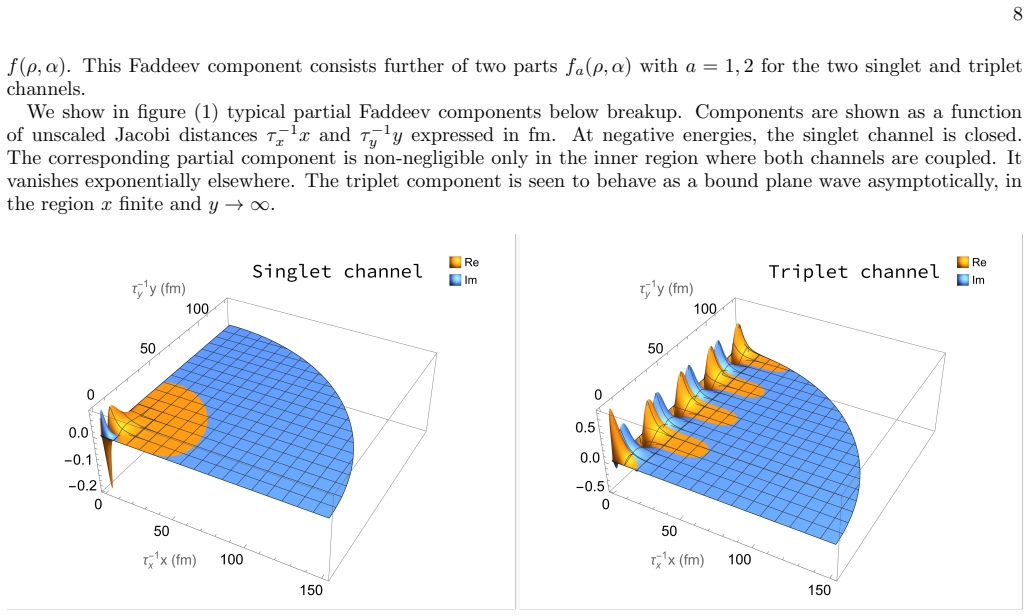
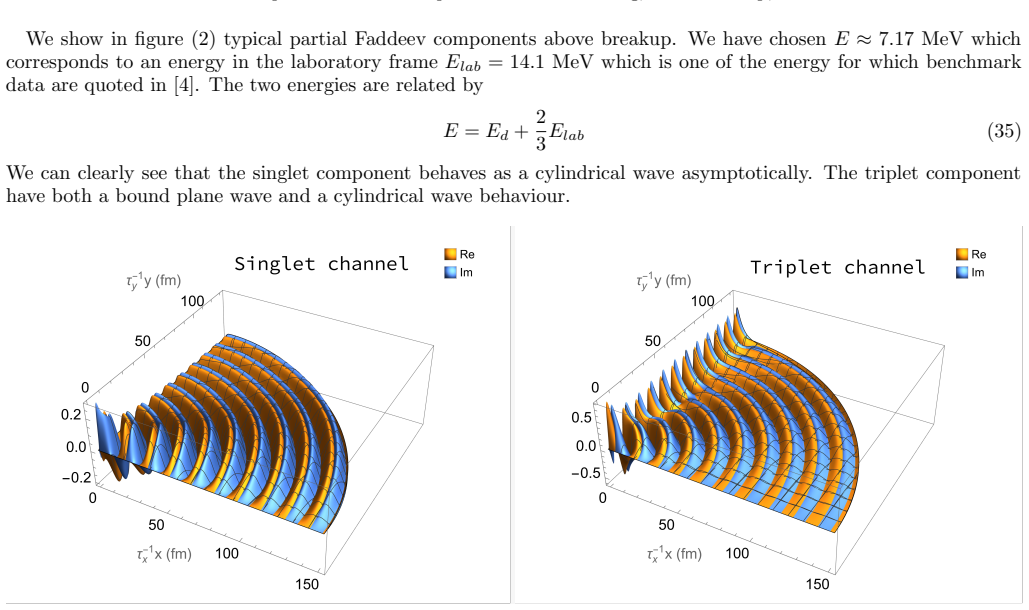
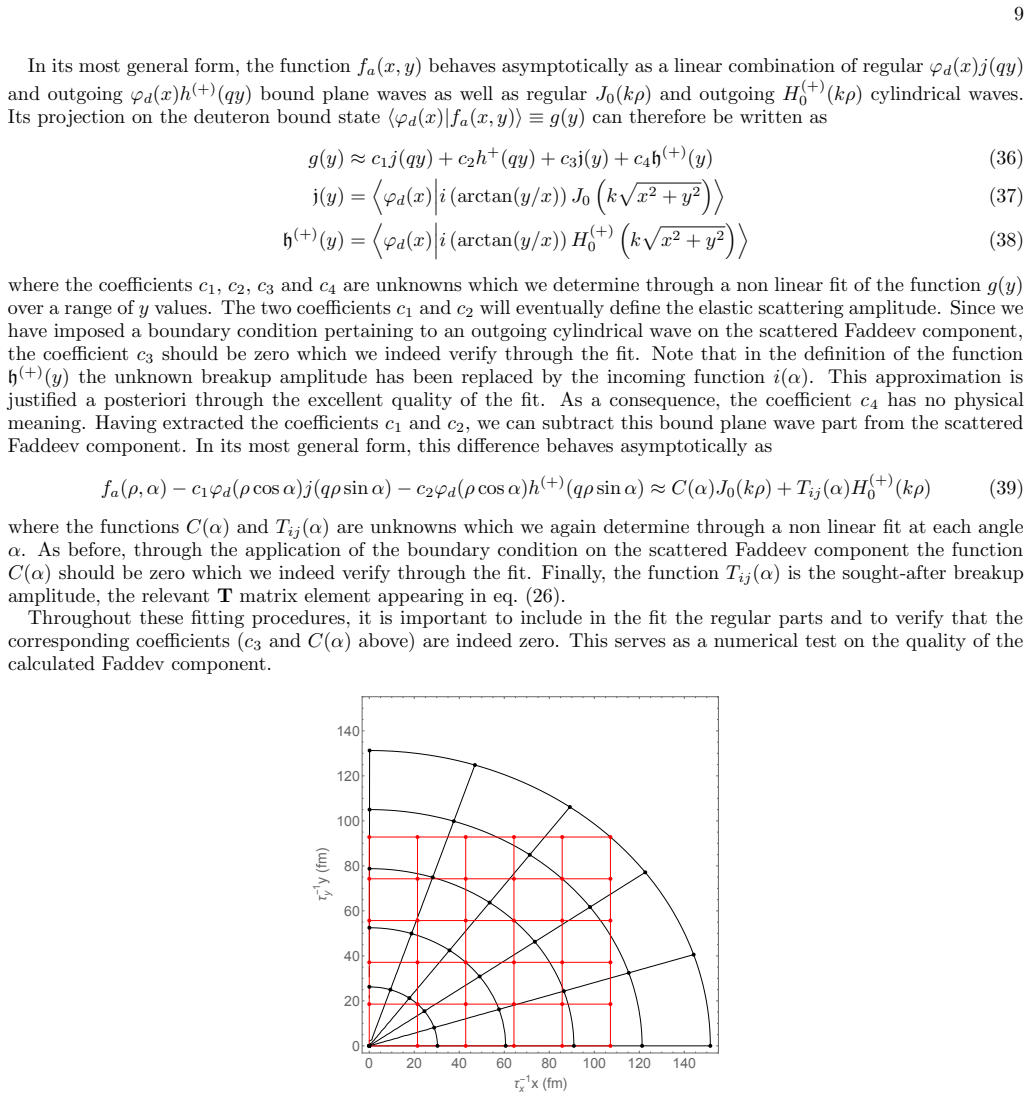
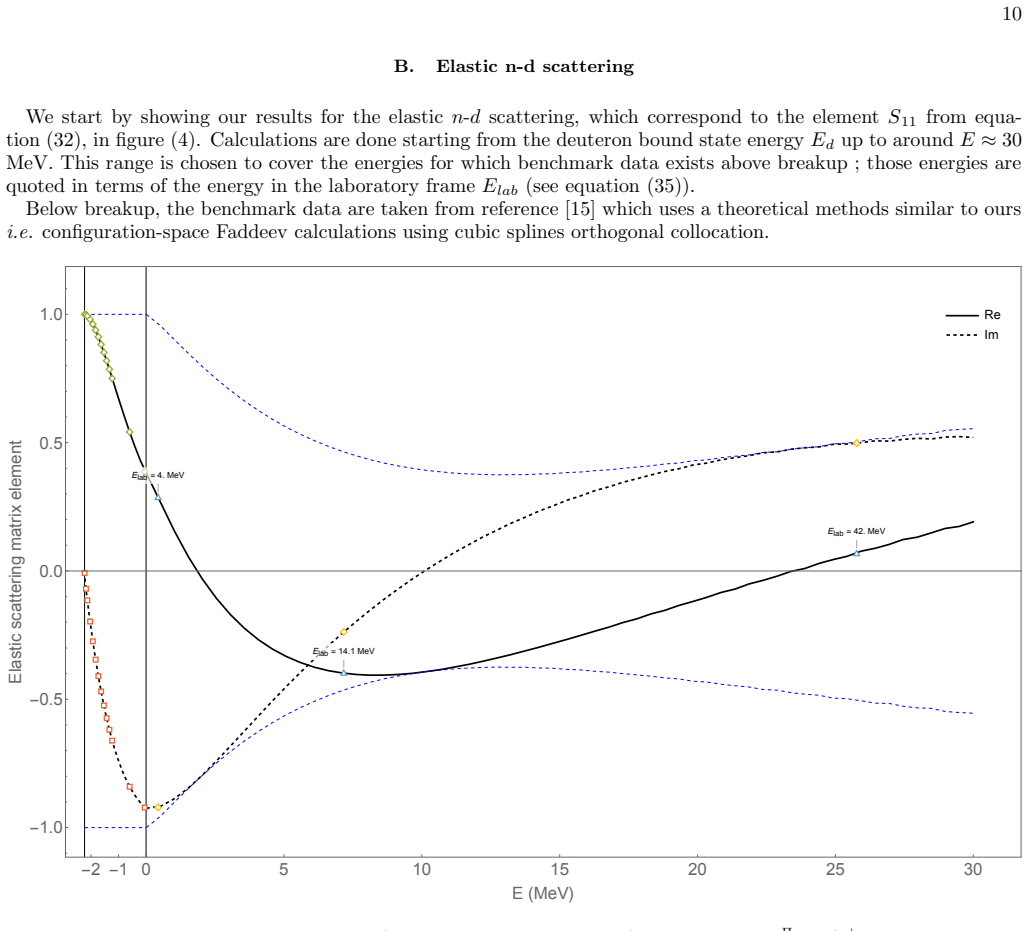
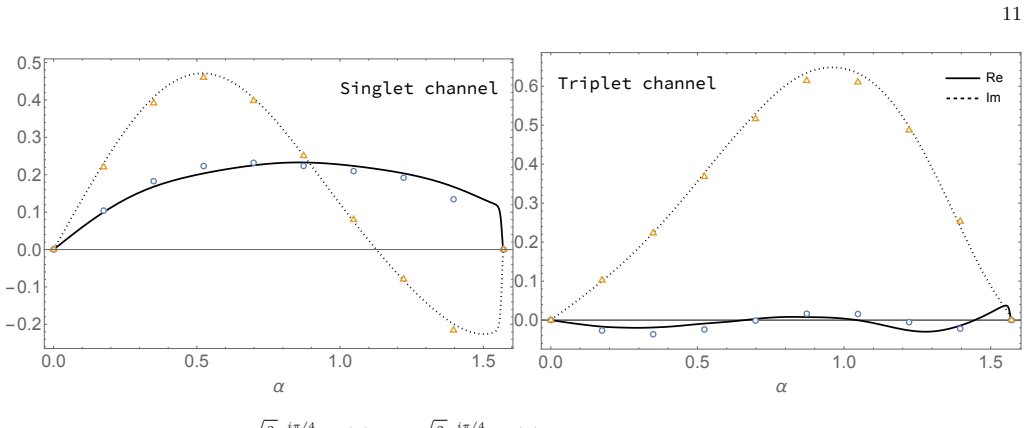
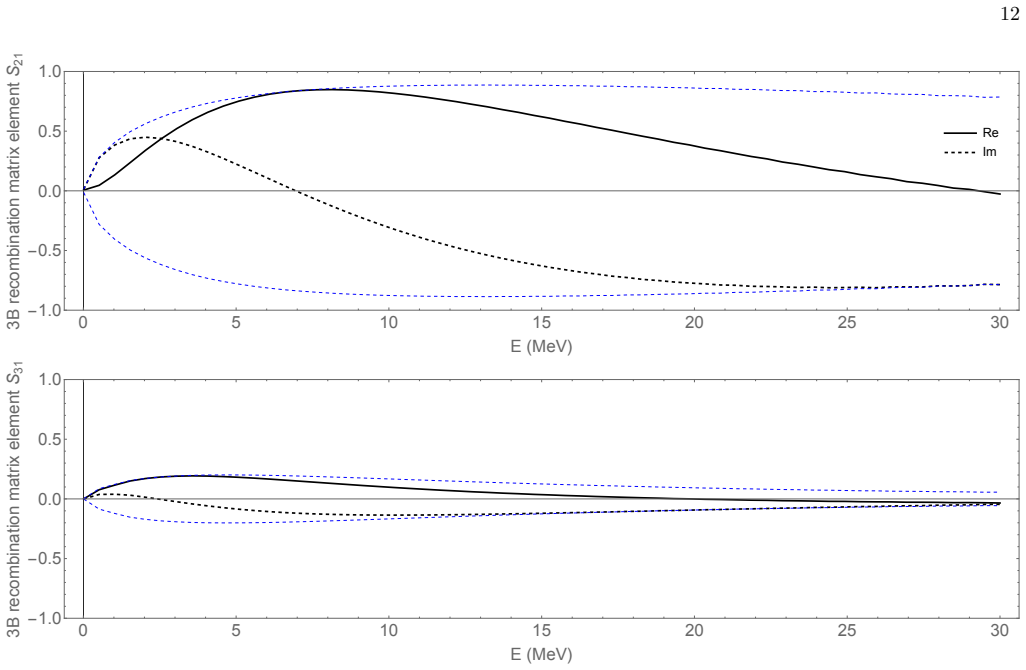
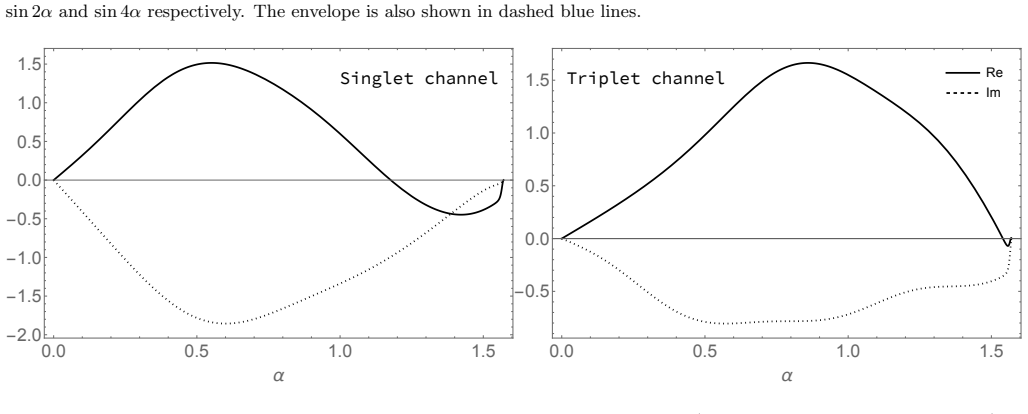
We use the configuration-space Faddeev formalism to study scattering of three particles in the double continuum where all particles are free. All scattering processes, starting from and ending in both single and double continua, are collected in a unique matrix. We apply our method to the benchmark system of neutron-deuteron scattering.
What carries the argument
The configuration-space Faddeev formalism, which decomposes the three-body wave function into components that satisfy coupled equations and yields a single matrix encoding all continuum-to-continuum transitions.
If this is right
- Scattering amplitudes connecting single-continuum and double-continuum states can be read directly from one matrix.
- Break-up reactions in three-particle systems receive the same formal treatment as elastic or rearrangement processes.
- The neutron-deuteron benchmark supplies concrete numbers against which other three-body codes can be compared.
- The same framework applies without reformulation to any three-body system whose interactions permit a configuration-space solution.
Where Pith is reading between the lines
- A single matrix may reduce the need to run separate calculations for each channel combination.
- The approach could be carried to systems with long-range forces once stability in the double continuum is confirmed.
- Time-dependent versions of the same equations might become feasible if the steady-state matrix proves robust.
Load-bearing premise
The configuration-space Faddeev equations remain numerically stable and complete when extended to the double continuum without additional approximations or channel-specific adjustments.
What would settle it
Numerical instability appears in the double-continuum matrix elements for neutron-deuteron scattering, or the extracted cross sections deviate from established single-continuum benchmarks.
Figures
read the original abstract
We use the configuration-space Faddeev formalism to study scattering of three particles in the double continuum where all particles are free. All scattering processes, starting from and ending in both single and double continua, are collected in a unique matrix. We apply our method to the benchmark system of neutron-deuteron scattering.
Editorial analysis
A structured set of objections, weighed in public.
Referee Report
Summary. The manuscript extends the configuration-space Faddeev formalism to three-particle scattering in the double continuum (all particles free), asserting that all processes from and to single and double continua are collected in one matrix. The approach is applied to the neutron-deuteron scattering benchmark.
Significance. A validated implementation would supply a unified matrix description of three-body scattering including breakup, which is relevant to few-body nuclear physics. The absence of any numerical results, convergence data, error estimates, or comparisons in the text, however, prevents assessment of whether the extension is stable or complete.
major comments (2)
- Abstract: the central claim that the configuration-space Faddeev equations remain numerically stable and complete in the double continuum without channel-specific adjustments or extra approximations is not supported by any numerical evidence, convergence checks, or benchmark data; this is load-bearing for the assertion of a unique matrix collecting all processes.
- Abstract (double-continuum extension): the long-range three-body breakup asymptotics typically require specialized boundary conditions or regularization (hyperspherical coordinates or Merkuriev cutoffs), yet no description is given of how these are implemented, leaving the completeness of the matrix unverified.
minor comments (1)
- The manuscript should include explicit statements of the numerical method, discretization, and boundary-condition implementation to allow reproducibility.
Simulated Author's Rebuttal
We thank the referee for the detailed review and for highlighting the need for stronger validation of the double-continuum extension. We agree that the central claims require explicit numerical support and technical clarification on asymptotics. Below we respond point by point and indicate the revisions that will be made.
read point-by-point responses
-
Referee: Abstract: the central claim that the configuration-space Faddeev equations remain numerically stable and complete in the double continuum without channel-specific adjustments or extra approximations is not supported by any numerical evidence, convergence checks, or benchmark data; this is load-bearing for the assertion of a unique matrix collecting all processes.
Authors: We acknowledge that the abstract asserts numerical stability and completeness without accompanying data in the current text. The manuscript presents the unified matrix formalism and states its application to neutron-deuteron scattering, but does not yet display convergence studies or benchmark comparisons. In the revised manuscript we will add a dedicated results section containing convergence tests with respect to basis size and cutoff radius, error estimates, and direct comparisons with established n-d elastic and breakup observables. This will substantiate that the equations remain stable and complete in the double continuum without channel-specific adjustments. revision: yes
-
Referee: Abstract (double-continuum extension): the long-range three-body breakup asymptotics typically require specialized boundary conditions or regularization (hyperspherical coordinates or Merkuriev cutoffs), yet no description is given of how these are implemented, leaving the completeness of the matrix unverified.
Authors: The referee is correct that a clear description of the three-body breakup asymptotics is essential. The configuration-space Faddeev components are constructed to satisfy the appropriate outgoing-wave boundary conditions for the double continuum by construction, without additional regularization. We will insert a new subsection in the methods section that explicitly states the asymptotic form imposed on each Faddeev component, the numerical implementation of the boundary conditions at large hyperradius, and why no hyperspherical or Merkuriev cutoffs are required. This addition will allow verification that the single matrix indeed collects all processes. revision: yes
Circularity Check
No circularity: application of established Faddeev formalism to double continuum
full rationale
The paper presents an application of the pre-existing configuration-space Faddeev equations to three-body scattering in the double continuum, collecting all single- and double-continuum processes into one matrix and benchmarking on neutron-deuteron scattering. No derivation step reduces by construction to a fitted parameter, self-defined quantity, or load-bearing self-citation whose content is itself unverified; the formalism is invoked as an external, independent tool whose numerical stability in the new regime is asserted rather than derived tautologically from the target matrix. The central claim therefore retains independent content outside its inputs.
Axiom & Free-Parameter Ledger
Reference graph
Works this paper leans on
-
[1]
1 2 1 singlet 2 (0,0)0 (1, 1
-
[2]
The two channels for the doublet (J Π = 1/2+) system
1 2 0 triplet TABLE I. The two channels for the doublet (J Π = 1/2+) system. In those channels,s a (ta) refer to the (iso)spin of a pair whileσ a is the spin of the spectator. In the evalu- ation of the kernel operator which acts between different Jacobi arrangements, recoupling coefficients of the form ⟨(sjsk)sjk , si, S|(sisk)sik, sj, S⟩have to be consi...
-
[3]
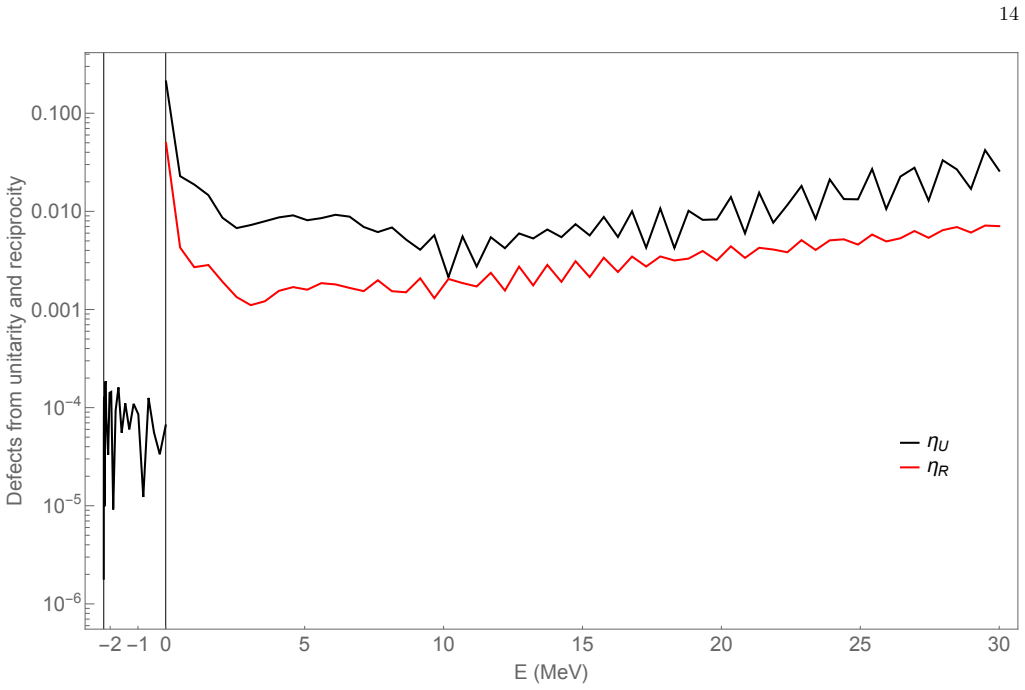
Unitarity The unitarity condition forSreads S∗S † =I∗I † (42) The above expression equates outgoing probability flux (the left hand side) to incoming flux (the right hand side). Further, we can always choose the functionsi(α) inIto have unit incoming flux with respect to⟨·,·⟩to obtain S∗S † =1(43) We note however that a unit flux with respect to⟨·,·⟩does ...
-
[4]
Reciprocity In order to verify reciprocity, the breakup amplitudesS 12(α) andS 13(α) have to be projected with respect to⟨·,·⟩ onto the incoming functionsi 1(α) andi 2(α) inI. This can be perform in a compact way using the∗operation and thus we define S=I∗S T (46) and the reciprocity property ofSmeans thatSmust be symmetric. We then define a defect from r...
-
[5]
Scattering theory for a three-particle system.Sov
LD Fadeev. Scattering theory for a three-particle system.Sov. Phys.-JETP, 12:1014–1019, 1961
work page 1961
-
[6]
Three-body scattering in configuration space.Annals of physics, 99(1):30–71, 1976
SP Merkuriev, C Gignoux, and A Laverne. Three-body scattering in configuration space.Annals of physics, 99(1):30–71, 1976
work page 1976
-
[7]
Three-body configuration space calculations with hard-core potentials
EA Kolganova, AK Motovilov, and SA Sofianos. Three-body configuration space calculations with hard-core potentials. Journal of Physics B: Atomic, Molecular and Optical Physics, 31(6):1279, 1998
work page 1998
-
[8]
Benchmark solutions for n-d breakup amplitudes
James Lewis Friar, GL Payne, W Gl¨ ockle, D H¨ uber, and H Wita la. Benchmark solutions for n-d breakup amplitudes. Physical Review C, 51(5):2356, 1995
work page 1995
-
[9]
PA Belov and SL Yakovlev. Asymptotic method for determining the amplitude for three-particle breakup: Neutron- deuteron scattering.Physics of Atomic Nuclei, 76(2):126–138, 2013
work page 2013
-
[10]
Romain Gu´ erout. Calculation of bound and continuum states of the ne3 van der waals trimer.Journal of Physics B: Atomic, Molecular and Optical Physics, 58(1):015201, 2024
work page 2024
-
[11]
Tertiary and general-order collisions (ii).Nuclear Physics, 20:275–308, 1960
LM Delves. Tertiary and general-order collisions (ii).Nuclear Physics, 20:275–308, 1960
work page 1960
-
[12]
W Gl¨ ockle and GL Payne. Boundary conditions for three-body scattering in configuration space.Physical Review C, 45(3):974, 1992
work page 1992
-
[13]
Princeton university press, 1996
Alan Robert Edmonds.Angular momentum in quantum mechanics, volume 4. Princeton university press, 1996
work page 1996
-
[14]
Marc Nadal-Ferret, Ricard Gelabert, Miquel Moreno, and Jos´ e M Lluch. A method to compute probability current in generic coordinates.The Journal of chemical physics, 134(7), 2011
work page 2011
-
[15]
Automatic grid construction for few-body quantum-mechanical calculations
Vladimir Roudnev and Michael Cavagnero. Automatic grid construction for few-body quantum-mechanical calculations. Computer Physics Communications, 182(10):2099–2106, 2011
work page 2099
-
[16]
Youcef Saad and Martin H Schultz. Gmres: A generalized minimal residual algorithm for solving nonsymmetric linear systems.SIAM Journal on scientific and statistical computing, 7(3):856–869, 1986
work page 1986
-
[17]
NW Schellingerhout, LP Kok, and GD Bosveld. Configuration-space faddeev calculations: Supercomputer accuracy on a personal computer.Physical Review A, 40(10):5568, 1989
work page 1989
-
[18]
The faddeev–yakubovsky symphony.Few-Body Systems, 60(4):62, 2019
Rimantas Lazauskas and Jaume Carbonell. The faddeev–yakubovsky symphony.Few-Body Systems, 60(4):62, 2019
work page 2019
-
[19]
Low-energy nucleon-deuteron scattering.Physical Review C, 39(4):1261, 1989
CR Chen, GL Payne, James Lewis Friar, and Benjamin F Gibson. Low-energy nucleon-deuteron scattering.Physical Review C, 39(4):1261, 1989
work page 1989
-
[20]
Benchmark solutions for a model three-nucleon scattering problem.Physical Review C, 42(5):1838, 1990
James Lewis Friar, Benjamin F Gibson, G Berthold, W Gl¨ ockle, Th Cornelius, H Witala, J Haidenbauer, Y Koike, GL Payne, JA Tjon, et al. Benchmark solutions for a model three-nucleon scattering problem.Physical Review C, 42(5):1838, 1990
work page 1990
discussion (0)
Sign in with ORCID, Apple, or X to comment. Anyone can read and Pith papers without signing in.