Recognition: unknown
Impact of the SNe Ia Magnitude Transition at 20 Mpc on Cosmological Parameter Estimation
Pith reviewed 2026-05-10 14:34 UTC · model grok-4.3
The pith
A step change in Type Ia supernova absolute magnitude at 20 Mpc raises the inferred Hubble constant by roughly 2 percent while leaving other cosmological parameters stable.
A machine-rendered reading of the paper's core claim, the machinery that carries it, and where it could break.
Core claim
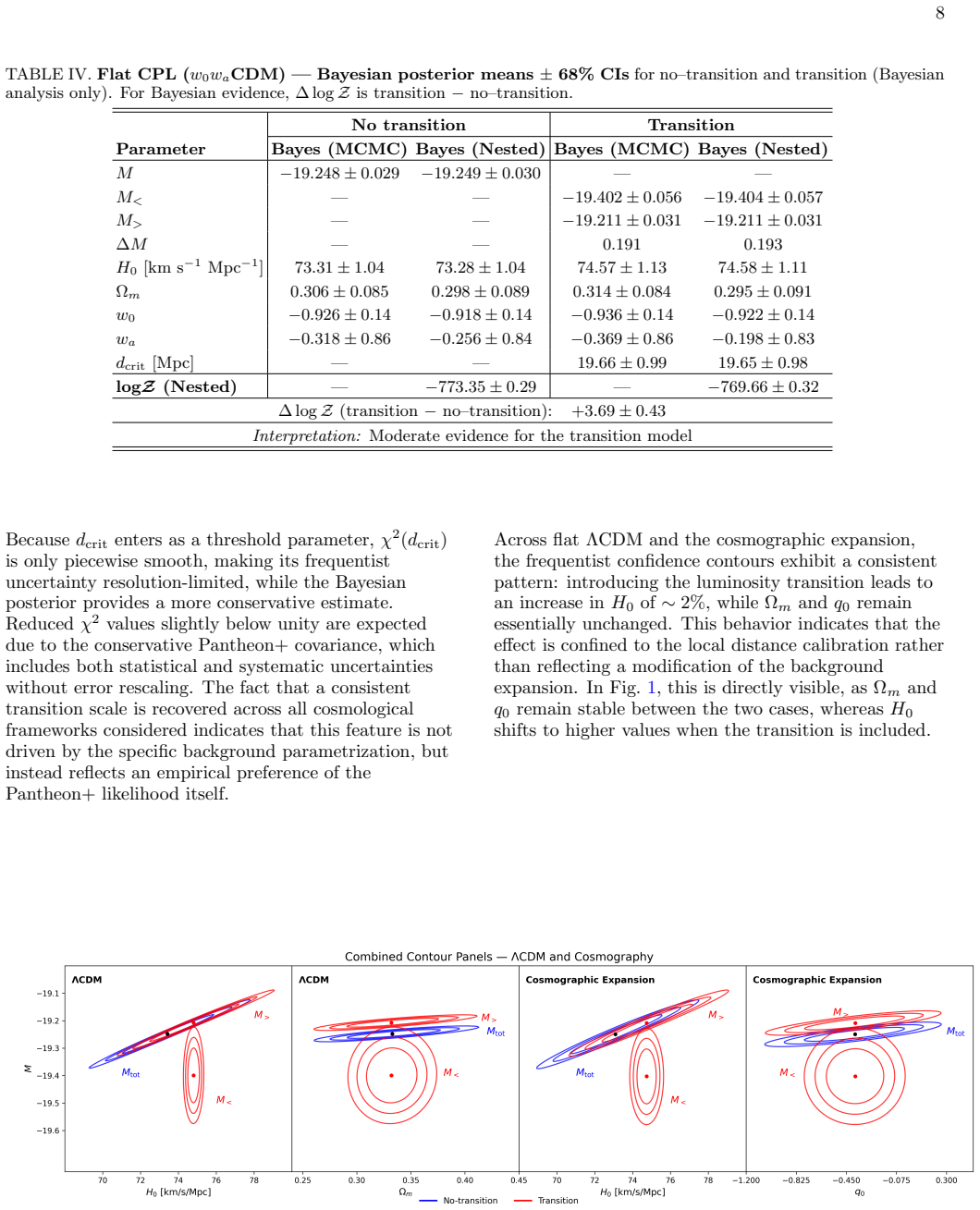
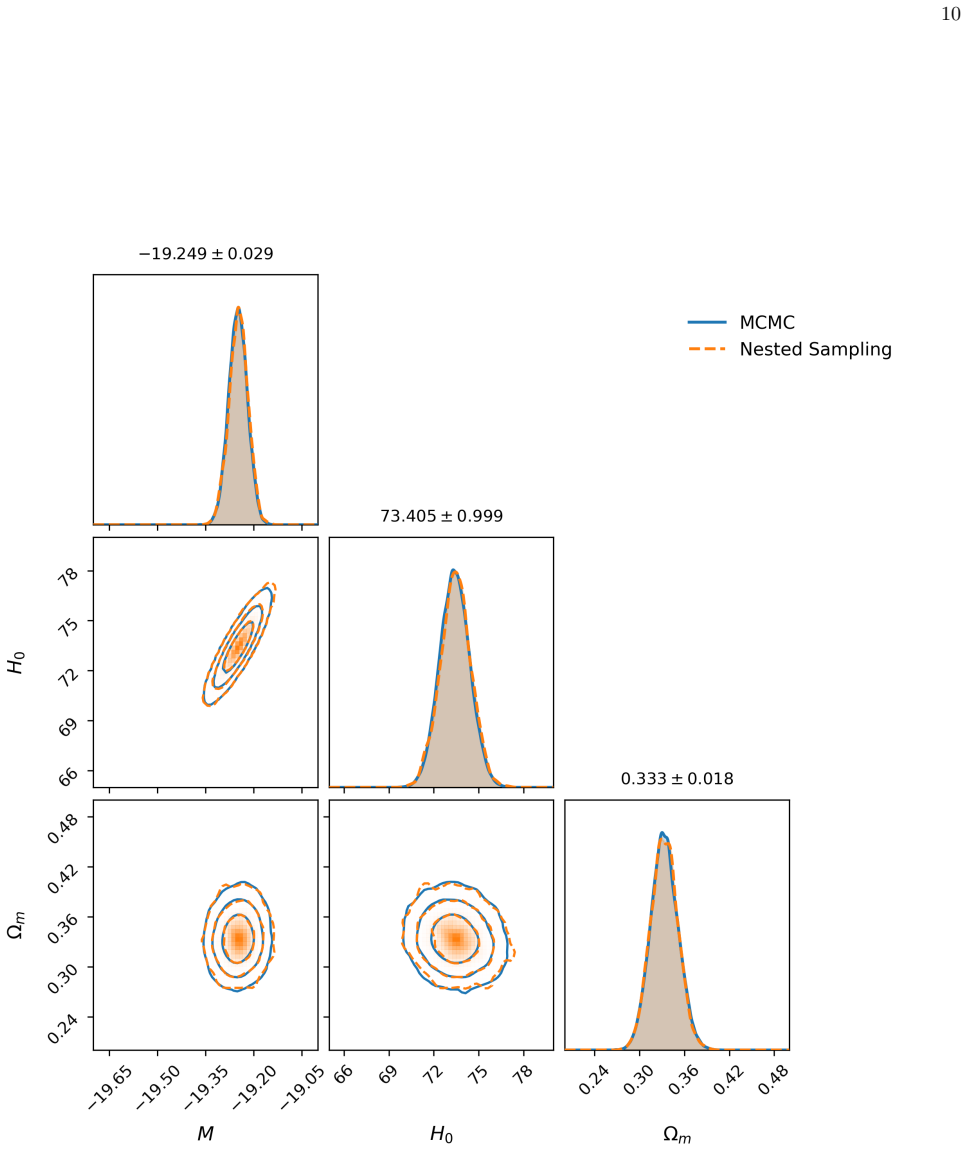
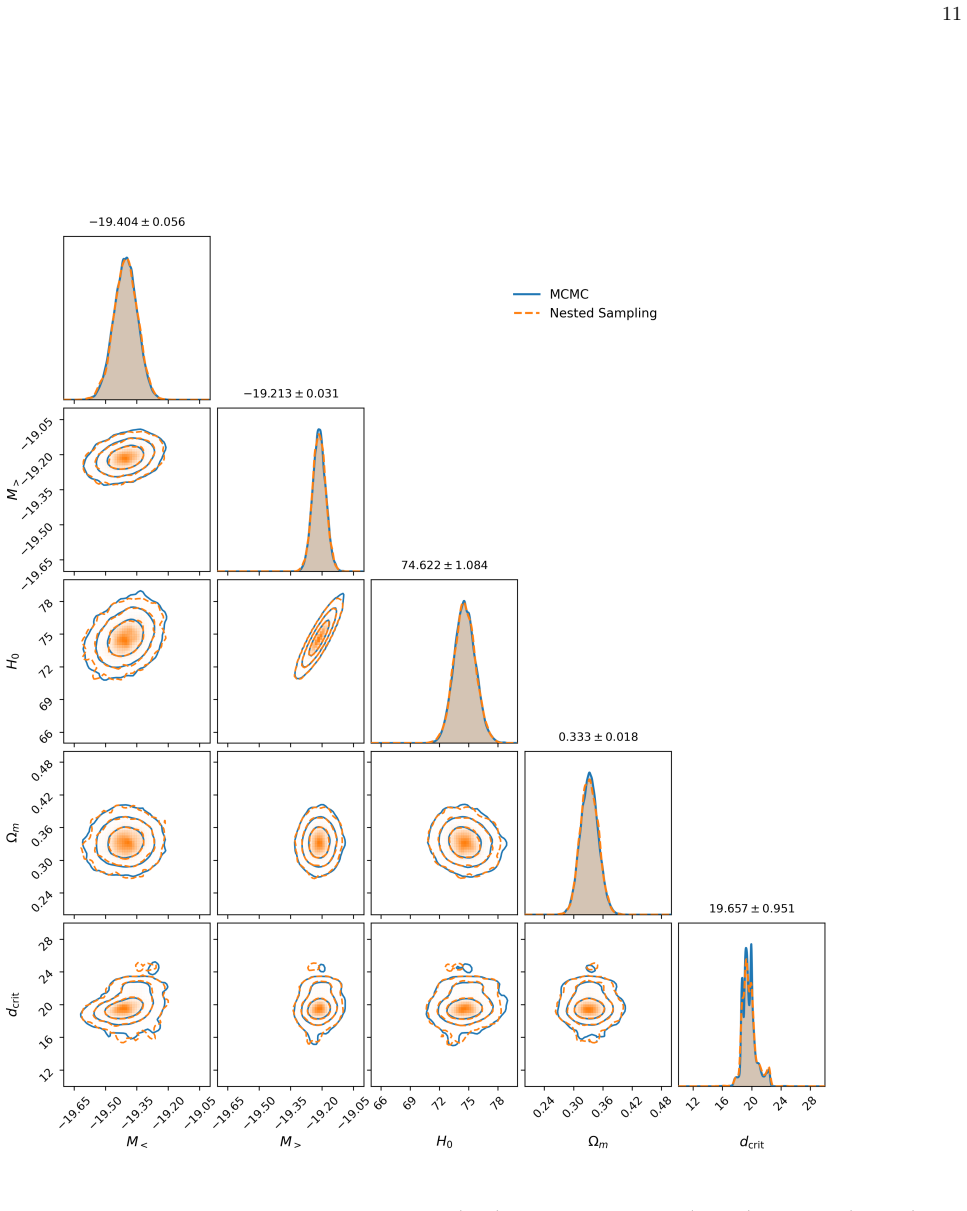
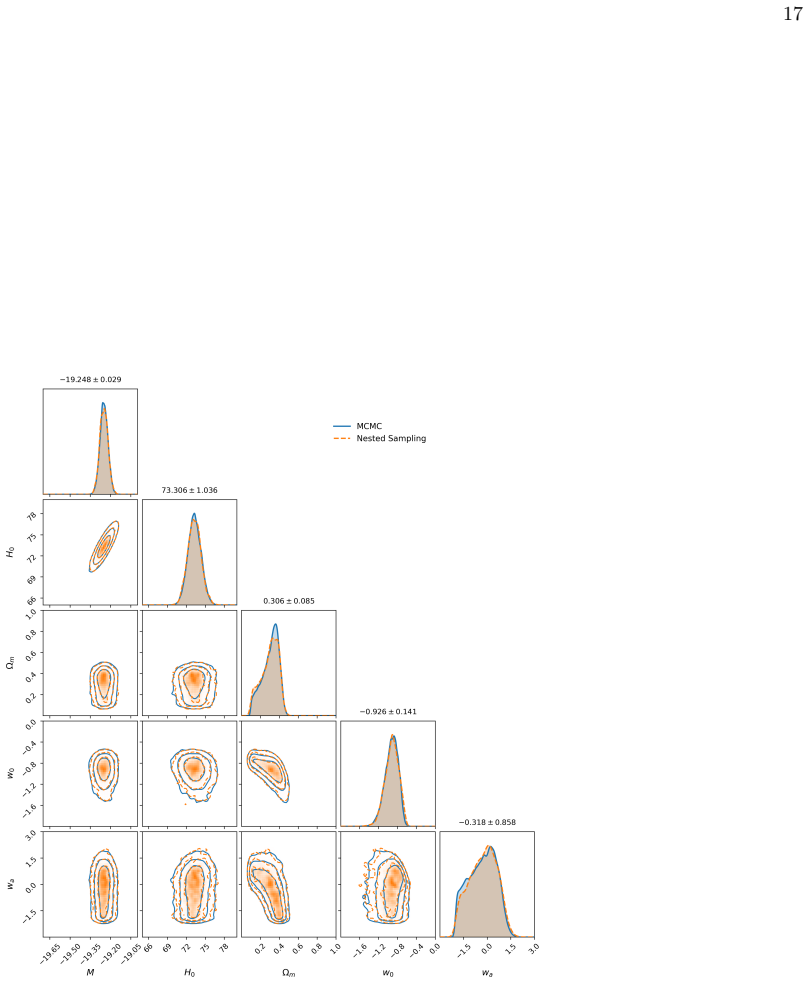
Extending prior work limited to flat LambdaCDM, the Pantheon+ data consistently favor a step in absolute magnitude of Delta M approximately 0.19 mag at a critical distance of 20 Mpc. Including this transition produces a statistically significant improvement in fit quality and induces a systematic increase in the inferred Hubble constant of approximately 2 percent across all tested models. In contrast, the dynamical parameters that govern the background expansion, including the matter density Omega_m and the dark energy equation of state w0 and wa, remain stable and largely unaffected, indicating that the 20 Mpc feature functions primarily as a low-redshift calibration shift.
What carries the argument
The step transition in standardized absolute magnitude M at a characteristic distance d_crit of approximately 20 Mpc, which functions as a low-redshift calibration adjustment that selectively shifts the Hubble constant inference without altering the late-time expansion history.
If this is right
- The Hubble constant increases by approximately 2 percent in flat LambdaCDM, wCDM, CPL parametrizations, and model-independent cosmographic expansions.
- Matter density Omega_m and dark energy equation-of-state parameters w0 and wa show little systematic change.
- Statistical criteria including AIC, BIC, and Bayesian evidence indicate a significant improvement in fit quality when the transition is included.
- The feature is interpreted as acting primarily on local calibration rather than modifying the inferred global expansion history.
Where Pith is reading between the lines
- If the transition reflects an environmental dependence, supernova standardization procedures may need revision for the lowest-redshift objects used in distance-ladder measurements.
- Future surveys with denser sampling of nearby supernovae could separate a true magnitude step from residual systematics in the current sample.
- Accounting for the feature might reduce part of the tension between local Hubble constant determinations and inferences from the cosmic microwave background.
- Similar distance-dependent corrections could be relevant for other low-redshift probes that anchor the cosmic distance ladder.
Load-bearing premise
That the observed improvement in fit quality arises from a genuine physical transition in supernova properties at 20 Mpc rather than from unmodeled selection effects, standardization residuals, or distance-dependent biases in the low-redshift Pantheon+ subsample.
What would settle it
High-precision, independent distance measurements to galaxies within 30 Mpc that show no corresponding step in fully standardized Type Ia supernova absolute magnitudes after accounting for known corrections would falsify the transition as a real feature.
Figures





read the original abstract
We investigate the impact of a late-time transition in the standardized absolute magnitude $M$ on the best-fit values of cosmological parameters using the Pantheon+ dataset. Extending previous analyses which focused on flat $\Lambda$CDM, we examine this transition within flat $\Lambda$CDM, wCDM, and CPL cosmologies, as well as a model-independent cosmographic expansion, employing both frequentist ($\chi^2$ minimization with \textit{AIC}/\textit{BIC}) and Bayesian (MCMC and Nested Sampling) inference frameworks. We confirm that the data consistently favor a step in absolute magnitude of $\Delta M \simeq 0.19~\mathrm{mag}$ at a characteristic distance of $d_{\mathrm{crit}} \approx 20~\mathrm{Mpc}$. The inclusion of this transition leads to a statistically significant improvement in the quality of fit and has a distinct impact on parameter estimation: it induces a systematic increase in the inferred Hubble constant of approximately $2\%$ across all tested models. In contrast, we find that the dynamical parameters governing the background expansion, including the matter density $\Omega_m$ and the dark energy equation of state ($w_0, w_a$), remain stable and largely unaffected. These results indicate that the $20~\mathrm{Mpc}$ feature acts primarily as a low-redshift calibration shift rather than a modification of the late-time expansion history.
Editorial analysis
A structured set of objections, weighed in public.
Referee Report
Summary. The manuscript investigates the impact of a hypothesized step-like transition in the standardized absolute magnitude M of Type Ia supernovae at d_crit ≈ 20 Mpc on cosmological parameter estimation. Using the Pantheon+ dataset, it performs both frequentist (χ² minimization with AIC/BIC) and Bayesian (MCMC and nested sampling) analyses across flat ΛCDM, wCDM, CPL, and cosmographic models. The central claim is that the data favor ΔM ≃ 0.19 mag, yielding a statistically significant fit improvement and a systematic ~2% increase in H0 while leaving Ωm, w0, and wa stable.
Significance. If the reported transition is physical rather than an artifact of low-z systematics, the result would indicate that the feature acts primarily as a local calibration offset affecting the Hubble constant inference without modifying the late-time expansion history. The consistency of the H0 shift and parameter stability across four cosmologies and two inference frameworks is a strength, as is the use of both information criteria and Bayesian evidence. However, the overall significance remains moderate pending explicit isolation from potential selection or standardization biases in the d ≲ 30 Mpc subsample.
major comments (3)
- [Results section (and abstract)] The reported improvement in χ²/AIC/BIC and the H0 shift are obtained by simultaneously fitting the two additional parameters (ΔM, d_crit) to the identical Pantheon+ magnitudes used to constrain the cosmological parameters; this introduces a degree of circularity that is not fully mitigated by the stability of Ωm and dark-energy parameters alone. A cross-validation test or comparison against an independent low-z compilation would be required to establish that the improvement is not partly by construction.
- [Methodology and robustness discussion] No explicit null tests are presented against distance-dependent systematics in the low-redshift (d ≲ 30 Mpc) Pantheon+ subsample, such as varying peculiar-velocity corrections, host-mass corrections, or photometric calibration offsets that could produce a step-like feature. The paper relies on the assumption that standardization has removed all such residuals, yet the low-z sample is dominated by a small number of surveys.
- [Discussion and conclusions] While the stability of Ωm, w0, and wa is reported across models, the quantitative effect on the H0 tension (e.g., by re-deriving constraints when the modified M is propagated to joint CMB+BAO analyses) is not explored; this limits the claim that the transition “acts primarily as a low-redshift calibration shift.”
minor comments (3)
- [Section 3] The definition of the step-function transition and the precise likelihood implementation (including how d_crit is treated in the distance modulus) should be stated explicitly in an equation rather than described in prose.
- [Figures 2–4] Figure captions and axis labels for the binned residual plots could be clarified to indicate whether the data points include the fitted transition or the baseline model.
- [Bayesian analysis subsection] A brief statement on the prior ranges adopted for ΔM and d_crit in the Bayesian runs would aid reproducibility.
Simulated Author's Rebuttal
We thank the referee for their constructive and detailed report. We address each major comment point by point below, indicating the revisions we will make to improve the manuscript.
read point-by-point responses
-
Referee: The reported improvement in χ²/AIC/BIC and the H0 shift are obtained by simultaneously fitting the two additional parameters (ΔM, d_crit) to the identical Pantheon+ magnitudes used to constrain the cosmological parameters; this introduces a degree of circularity that is not fully mitigated by the stability of Ωm and dark-energy parameters alone. A cross-validation test or comparison against an independent low-z compilation would be required to establish that the improvement is not partly by construction.
Authors: We acknowledge the concern regarding potential circularity from fitting ΔM and d_crit simultaneously with cosmological parameters on the same Pantheon+ data. The transition is predominantly constrained by the low-redshift supernovae, while the full sample constrains the background cosmology, and the observed stability of Ωm, w0, and wa across models and methods indicates the H0 shift is not solely by construction. To address this, we will add a dedicated discussion of the limitation and include a supplementary test fixing the transition parameters from a low-z subsample fit before applying them to the full dataset. A complete cross-validation against an independent low-z compilation lies outside the present scope, as it would require external standardized data, but we will flag this for future work. revision: partial
-
Referee: No explicit null tests are presented against distance-dependent systematics in the low-redshift (d ≲ 30 Mpc) Pantheon+ subsample, such as varying peculiar-velocity corrections, host-mass corrections, or photometric calibration offsets that could produce a step-like feature. The paper relies on the assumption that standardization has removed all such residuals, yet the low-z sample is dominated by a small number of surveys.
Authors: We agree that explicit null tests for distance-dependent systematics would enhance robustness. The Pantheon+ magnitudes incorporate the standardization procedures and corrections described in the source papers, and we have proceeded under the assumption that residuals are minimized. However, we did not perform targeted tests for step-like artifacts from peculiar-velocity, host-mass, or calibration variations. In the revised manuscript we will insert a new robustness subsection that discusses these potential systematics, examines sensitivity to variations in the corrections where feasible, and notes the limited number of surveys contributing to the d ≲ 30 Mpc regime. revision: yes
-
Referee: While the stability of Ωm, w0, and wa is reported across models, the quantitative effect on the H0 tension (e.g., by re-deriving constraints when the modified M is propagated to joint CMB+BAO analyses) is not explored; this limits the claim that the transition “acts primarily as a low-redshift calibration shift.”
Authors: We concur that quantifying the impact on the Hubble tension via joint CMB+BAO analyses would strengthen the interpretation of the feature as a local calibration offset. The present work isolates the effect within the supernova dataset alone. Propagating the adjusted magnitudes into combined early- and late-universe likelihoods constitutes a substantial extension requiring separate methodological development. We will revise the discussion and conclusions to state explicitly that the reported results are SN-only and that full propagation to joint constraints is reserved for future study, thereby qualifying the claim accordingly. revision: no
Circularity Check
No significant circularity in the derivation chain
full rationale
The paper reports empirical fits of an additional step-function parameter (ΔM and d_crit) to the Pantheon+ supernova magnitudes, then measures the resulting shifts in cosmological parameters (primarily H0) and the penalized fit improvement via AIC/BIC. This is a direct output of χ² minimization and MCMC/Nested Sampling on the same dataset, with no claimed first-principles derivation, no 'prediction' that reduces to the fitted inputs by construction, and no load-bearing self-citation or imported uniqueness theorem. The stability of Ωm and dark-energy parameters across models is an internal cross-check within the same analysis. The work is a standard model-comparison exercise on observational data and does not exhibit any of the enumerated circularity patterns.
Axiom & Free-Parameter Ledger
free parameters (2)
- ΔM =
0.19 mag
- d_crit =
20 Mpc
axioms (2)
- domain assumption The Pantheon+ dataset after standardization provides unbiased distance moduli once a single step in M is allowed at low redshift.
- ad hoc to paper A sharp step function is an adequate description of any magnitude transition; no smooth transition or additional redshift dependence is required.
Reference graph
Works this paper leans on
-
[1]
The theoretical distance modulus is defined as µth(z;θ) = 5 log 10 dL(z;θ) Mpc + 25,(2) whered L(z;θ) is the luminosity distance
Frequentist Inference:χ 2 Minimization We first perform a frequentist analysis by minimizing theχ 2 likelihood χ2(θ) =Q T C −1 Q,(1) 3 whereQ=µ obs −µ th(θ) is the vector of residuals be- tween the observed and theoretical distance moduli,θ denotes the set of cosmological parameters, andCis the total covariance matrix including both statistical and system...
-
[2]
In our case,dcorresponds to the Pantheon+ mea- surements, consisting of the redshifts, corrected apparent magnitudes of Type Ia supernovae and Cepheid distance moduli
Bayesian Inference In the Bayesian framework, the inference of model pa- rametersθgiven datadis based on Bayes’ theorem, P(θ|d) = L(d|θ)π(θ) Z ,(7) whereπ(θ) is the prior probability density of the param- eters,L(d|θ) is the likelihood function, and Z= Z L(d|θ)π(θ)dθ(8) is the Bayesian evidence, which acts as a normalization constant in parameter estimati...
-
[3]
For this purpose, we em- ploy thedynestynested sampling algorithm [65], which 4 simultaneously yields posterior samples and an accurate estimate ofZ
MCMC & Nested Sampling Setup While MCMC is well suited for parameter estimation, it does not directly provide the Bayesian evidenceZre- quired for model comparison. For this purpose, we em- ploy thedynestynested sampling algorithm [65], which 4 simultaneously yields posterior samples and an accurate estimate ofZ. The ratio of Bayesian evidences between tw...
-
[4]
Consequently, the two quantities cannot be determined independently without an external calibration
Cepheid Calibrator and Likelihood The observed apparent magnitudem B,i of a Type Ia supernova is related to its absolute magnitudeM and luminosity distanced L,i through the standard dis- tance–modulus relation, µi =m B,i −M= 5 log 10 dL,i Mpc + 25.(12) In cosmological analyses based solely on Hubble–flow su- pernovae, the parametersMandH 0 are fully degen...
-
[5]
Leandros Perivolaropoulos and Foteini Skara, “Chal- lenges for ΛCDM: An update,” New Astron. Rev.95 (2022), 10.1016/j.newar.2022.101659, arXiv:2105.05208 [astro-ph.CO]
-
[6]
Tensions between the Early and the Late Universe
L. Verde, T. Treu, and A. G. Riess, “Tensions between the Early and the Late Universe,” Nature Astron.3, 891 (2019), arXiv:1907.10625 [astro-ph.CO]
work page internal anchor Pith review arXiv 2019
-
[7]
Jose Luis Bernal, Licia Verde, and Adam G. Riess, “The trouble withH 0,” JCAP1610, 019 (2016), arXiv:1607.05617 [astro-ph.CO]
-
[8]
Dark energy two decades after: Observables, probes, consistency tests,
Dragan Huterer and Daniel L Shafer, “Dark energy two decades after: Observables, probes, consistency tests,” Rept. Prog. Phys.81, 016901 (2018), arXiv:1709.01091 [astro-ph.CO]
-
[10]
Adam G. Riesset al., “A Comprehensive Measurement of the Local Value of the Hubble Constant with 1 km s−1 Mpc−1 Uncertainty from the Hubble Space Telescope and the SH0ES Team,” Astrophys. J. Lett.934, L7 (2022), arXiv:2112.04510 [astro-ph.CO]
work page internal anchor Pith review arXiv 2022
-
[11]
The Pantheon+ Analysis: Cosmological Constraints
Dillon Broutet al., “The Pantheon+ Analysis: Cos- mological Constraints,” Astrophys. J.938, 110 (2022), arXiv:2202.04077 [astro-ph.CO]
work page internal anchor Pith review arXiv 2022
-
[12]
D. M. Scolnicet al., “The Complete Light-curve Sam- ple of Spectroscopically Confirmed SNe Ia from Pan- STARRS1 and Cosmological Constraints from the Com- bined Pantheon Sample,” Astrophys. J.859, 101 (2018), arXiv:1710.00845 [astro-ph.CO]
work page Pith review arXiv 2018
-
[13]
2020, Cosmological model insensitivity of local H_0 from the Cepheid distance ladder
S. Dhawan, D. Brout, D. Scolnic, A. Goobar, A. G. Riess, and V. Miranda, “Cosmological Model Insensitivity of LocalH 0 from the Cepheid Distance Ladder,” Astrophys. J.894, 54 (2020), arXiv:2001.09260 [astro-ph.CO]
-
[14]
Correcting type ia super- nova distances for selection biases and contamination in photometrically identified samples,
R. Kessler and D. Scolnic, “Correcting type ia super- nova distances for selection biases and contamination in photometrically identified samples,” The Astrophysical Journal836, 56 (2017)
2017
-
[15]
A 2.4% Determination of the Local Value of the Hubble Constant
Adam G. Riesset al., “A 2.4% Determination of the Local Value of the Hubble Constant,” Astrophys. J.826, 56 (2016), arXiv:1604.01424 [astro-ph.CO]
work page Pith review arXiv 2016
-
[16]
Planck 2018 results. VI. Cosmological parameters
N. Aghanimet al.(Planck), “Planck 2018 results. VI. Cosmological parameters,” Astron. Astrophys.641, A6 (2020), arXiv:1807.06209 [astro-ph.CO]
work page internal anchor Pith review Pith/arXiv arXiv 2018
-
[17]
N. Aghanimet al.(Planck), “Planck 2018 results. I. Overview and the cosmological legacy of Planck,” Astron. Astrophys.641, A1 (2020), arXiv:1807.06205 [astro- ph.CO]
-
[18]
G.E. Addison, Y. Huang, D.J. Watts, C.L. Bennett, M. Halpern, G. Hinshaw, and J.L. Weiland, “Quanti- fying discordance in the 2015 Planck CMB spectrum,” Astrophys. J.818, 132 (2016), arXiv:1511.00055 [astro- ph.CO]
-
[19]
Lloyd Knox and Marius Millea, “The Hubble Hunter’s Guide,” (2019), arXiv:1908.03663 [astro-ph.CO]
-
[20]
Adam G. Riess, Stefano Casertano, Wenlong Yuan, Lu- cas M. Macri, and Dan Scolnic, “Large Magellanic Cloud Cepheid Standards Provide a 1% Foundation for the De- termination of the Hubble Constant and Stronger Evi- dence for Physics beyond ΛCDM,” Astrophys. J.876, 85 (2019), arXiv:1903.07603 [astro-ph.CO]
work page Pith review arXiv 2019
-
[21]
The Pantheon+ Analysis: The Full Dataset and Light-Curve Release
Dan Scolnicet al., “The Pantheon+ Analysis: The Full Data Set and Light-curve Release,” Astrophys. J.938, 113 (2022), arXiv:2112.03863 [astro-ph.CO]
work page internal anchor Pith review arXiv 2022
-
[22]
Anthony Carret al., “The pantheon+ analysis: Improv- ing the redshifts and peculiar velocities of type ia su- pernovae used in cosmological analyses,” Publications of the Astronomical Society of Australia39(2022), 10.1017/pasa.2022.41
-
[23]
The pantheon+ analysis: Eval- uating peculiar velocity corrections in cosmological anal- yses with nearby type ia supernovae,
Erik R. Petersonet al., “The pantheon+ analysis: Eval- uating peculiar velocity corrections in cosmological anal- yses with nearby type ia supernovae,” The Astrophysical Journal938, 112 (2022)
2022
-
[24]
Testing the cosmological principle with the pan- theon+ sample and the region-fitting method,
J. P. Hu, Y. Y. Wang, J. Hu, and F. Y. Wang, “Testing the cosmological principle with the pan- theon+ sample and the region-fitting method,” (2023), arXiv:2310.11727 [astro-ph.CO]
-
[25]
Type Ia supernova con- straints on compact object dark matter,
S. Dhawan and E. M¨ ortsell, “Type Ia supernova con- straints on compact object dark matter,” (2023), arXiv:2301.10204 [astro-ph.CO]
-
[26]
High Redshift ΛCDM Cosmology: To Bin or not to Bin?
Eoin ´O. Colg´ ain, M. M. Sheikh-Jabbari, and Rance Solomon, “High Redshift ΛCDM Cosmology: To Bin or not to Bin?” (2022), arXiv:2211.02129 [astro-ph.CO]
-
[27]
Pantheon+ tomography and Hubble ten- sion,
Deng Wang, “Pantheon+ tomography and Hubble ten- sion,” (2022), arXiv:2207.10927 [astro-ph.CO]
-
[28]
W. D’Arcy Kenworthyet al., “Measurements of the Hub- ble Constant with a Two-rung Distance Ladder: Two Out of Three Ain’t Bad,” Astrophys. J.935, 83 (2022), arXiv:2204.10866 [astro-ph.CO]
-
[29]
Eleonora Di Valentinoet al., “In the realm of the Hubble tension—a review of solutions,” Class. Quant. Grav.38, 153001 (2021), arXiv:2103.01183 [astro-ph.CO]
-
[30]
David Camarena and Valerio Marra, “Local determina- tion of the hubble constant and the deceleration param- eter,” Physical Review Research2(2020), 10.1103/phys- revresearch.2.013028
-
[31]
Not empty enough: a local void cannot solve theh 0 tension,
Dragan Huterer and Hao-Yi Wu, “Not empty enough: a local void cannot solve theh 0 tension,” (2023), arXiv:2309.05749 [astro-ph.CO]
-
[32]
The $H_0$ tension in light of vacuum dynamics in the Universe
Joan Sol` a, Adri` a G´ omez-Valent, and Javier de Cruz P´ erez, “TheH 0 tension in light of vac- uum dynamics in the Universe,” Phys. Lett.B774, 317–324 (2017), arXiv:1705.06723 [astro-ph.CO]
work page Pith review arXiv 2017
-
[33]
To h0 or not to h0?
George Efstathiou, “To h0 or not to h0?” Monthly No- tices of the Royal Astronomical Society505, 3866–3872 (2021)
2021
-
[34]
Nandita Khetanet al., “A new measurement of the Hub- ble constant using Type Ia supernovae calibrated with surface brightness fluctuations,” Astron. Astrophys.647, A72 (2021), arXiv:2008.07754 [astro-ph.CO]
-
[35]
Systematic uncertainties associated with the cosmological analysis of the first pan-starrs1 type ia supernova sample,
D. Scolnicet al., “Systematic uncertainties associated with the cosmological analysis of the first pan-starrs1 type ia supernova sample,” The Astrophysical Journal 795, 45 (2014)
2014
-
[36]
Supernova calibration by gravitational wave,
Xuchen Lu and Yungui Gong, “Supernova calibration by gravitational wave,” (2023), arXiv:2206.10262 [gr-qc]
-
[37]
Early Dark Energy Can Resolve The Hubble Tension
Vivian Poulin, Tristan L. Smith, Tanvi Karwal, and Marc Kamionkowski, “Early Dark Energy Can Resolve The Hubble Tension,” Phys. Rev. Lett.122, 221301 (2019), arXiv:1811.04083 [astro-ph.CO]
work page Pith review arXiv 2019
- [38]
-
[39]
Marc Kamionkowski and Adam G. Riess, “The Hub- ble Tension and Early Dark Energy,” (2022), arXiv:2211.04492 [astro-ph.CO]
-
[40]
Interacting Dark Sec- tor and Precision Cosmology,
Manuel A. Buen-Abad, Martin Schmaltz, Julien Lesgour- gues, and Thejs Brinckmann, “Interacting Dark Sec- tor and Precision Cosmology,” JCAP01, 008 (2018), arXiv:1708.09406 [astro-ph.CO]
-
[41]
Atomic dark matter, interacting dark radiation, and the hubble tension,
Manuel A. Buen-Abad, Zackaria Chacko, Ina Flood, Can Kilic, Gustavo Marques-Tavares, and Taewook Youn, “Atomic dark matter, interacting dark radiation, and the hubble tension,” (2024), arXiv:2411.08097 [hep-ph]
-
[42]
George Efstathiou, Erik Rosenberg, and Vivian Poulin, “Improved planck constraints on axion-like early dark energy as a resolution of the hubble tension,” (2023), arXiv:2311.00524 [astro-ph.CO]
-
[43]
Strong dependence of type ia super- nova standardization on the local specific star formation rate,
M. Rigaultet al., “Strong dependence of type ia super- nova standardization on the local specific star formation rate,” Astronomy & Astrophysics644, A176 (2020)
2020
-
[44]
Modelling the impact of host galaxy dust on type ia supernova distance measurements,
B. Popovicet al., “Modelling the impact of host galaxy dust on type ia supernova distance measurements,” (2024), arXiv:2406.05051 [astro-ph.CO]
-
[45]
Reduction of the type ia supernova host galaxy step in the outer regions of galaxies,
M. Toyet al., “Reduction of the type ia supernova host galaxy step in the outer regions of galaxies,” (2025), arXiv:2408.03749 [astro-ph.CO]
-
[46]
Vivian Poulin, Kimberly K. Boddy, Simeon Bird, and Marc Kamionkowski, “Implications of an extended dark energy cosmology with massive neutrinos for cos- mological tensions,” Physical Review D97(2018), 10.1103/physrevd.97.123504
-
[47]
Sounds discordant: Classical distance ladder andλcdm- based determinations of the cosmological sound horizon,
Kevin Aylor, Mackenzie Joy, Lloyd Knox, Marius Mil- lea, Srinivasan Raghunathan, and W. L. Kimmy Wu, “Sounds discordant: Classical distance ladder andλcdm- based determinations of the cosmological sound horizon,” The Astrophysical Journal874, 4 (2019)
2019
-
[48]
No-go guide for the hubble tension: Late-time solutions,
Rong-Gen Cai, Zong-Kuan Guo, Shao-Jiang Wang, Wang-Wei Yu, and Yong Zhou, “No-go guide for the hubble tension: Late-time solutions,” Physical Review D 105(2022), 10.1103/physrevd.105.l021301
-
[49]
Prakhar Bansal and Dragan Huterer, “On the difficulties with late-time solutions for the hubble tension,” (2026), arXiv:2602.06293 [astro-ph.CO]
-
[50]
Leandros Perivolaropoulos and Foteini Skara, “Hubble tension or a transition of the Cepheid SnIa calibra- tor parameters?” Phys. Rev. D104, 123511 (2021), arXiv:2109.04406 [astro-ph.CO]
-
[51]
Valerio Marra and Leandros Perivolaropoulos, “A rapid transition ofG eff atz t ≃0.01 as a possible solution of the Hubble and growth tensions,” Phys. Rev. D104, L021303 (2021), arXiv:2102.06012 [astro-ph.CO]
-
[52]
Hints for a Gravitational Transi- tion in Tully–Fisher Data,
George Alestas, Ioannis Antoniou, and Leandros Perivolaropoulos, “Hints for a Gravitational Transi- tion in Tully–Fisher Data,” Universe7, 366 (2021), arXiv:2104.14481 [astro-ph.CO]
-
[53]
On the homogeneity of snia absolute magnitude in the pan- theon+ sample,
Leandros Perivolaropoulos and Foteini Skara, “On the homogeneity of snia absolute magnitude in the pan- theon+ sample,” Monthly Notices of the Royal Astro- nomical Society520, 5110–5125 (2023)
2023
-
[54]
A new look at the statistical model identi- fication,
H. Akaike, “A new look at the statistical model identi- fication,” IEEE Transactions on Automatic Control19, 716–723 (1974)
1974
-
[55]
Giampaolo Benevento, Wayne Hu, and Marco Raveri, “Can Late Dark Energy Transitions Raise the Hub- ble constant?” Phys. Rev. D101, 103517 (2020), arXiv:2002.11707 [astro-ph.CO]
-
[56]
Vacuum phase transition solves theH 0 ten- sion,
Eleonora Di Valentino, Eric V. Linder, and Alessandro Melchiorri, “Vacuum phase transition solves theH 0 ten- sion,” Phys. Rev.D97, 043528 (2018), arXiv:1710.02153 [astro-ph.CO]
-
[57]
Phase transition in the dark sector as a proposal to lessen cosmological tensions,
Abdolali Banihashemi, Nima Khosravi, and Amir H. Shi- razi, “Phase transition in the dark sector as a proposal to lessen cosmological tensions,” Phys. Rev. D101, 123521 (2020), arXiv:1808.02472 [astro-ph.CO]
-
[58]
George Alestas, David Camarena, Eleonora Di Valentino, Lavrentios Kazantzidis, Valerio Marra, Savvas Nesseris, and Leandros Perivolaropoulos, “Late-transition versus smooth H(z)-deformation models for the resolution of the Hubble crisis,” Phys. Rev. D105, 063538 (2022), arXiv:2110.04336 [astro-ph.CO]
-
[59]
Equation of State Calculations by Fast Comput- ing Machines,
Nicholas Metropolis, Arianna W. Rosenbluth, Mar- shall N. Rosenbluth, Augusta H. Teller, and Edward Teller, “Equation of State Calculations by Fast Comput- ing Machines,” J. Chem. Phys.21, 1087–1092 (1953)
1953
-
[60]
Monte Carlo Sampling Methods using Markov Chains and their Applications,
W. K. Hastings, “Monte Carlo Sampling Methods using Markov Chains and their Applications,” Biometrika57, 97–109 (1970)
1970
-
[61]
Nested Sampling,
John Skilling, “Nested Sampling,” inBayesian Inference and Maximum Entropy Methods in Science and Engi- neering: 24th International Workshop on Bayesian In- ference and Maximum Entropy Methods in Science and Engineering, American Institute of Physics Conference Series, Vol. 735, edited by Rainer Fischer, Roland Preuss, and Udo Von Toussaint (AIP, 2004) pp...
2004
-
[62]
Ac- celerating universes with scaling dark matter,
MICHEL CHEVALLIER and DAVID POLARSKI, “Ac- celerating universes with scaling dark matter,” Interna- tional Journal of Modern Physics D10, 213–223 (2001)
2001
-
[63]
Exploring the expansion history of the universe
Eric V. Linder, “Exploring the expansion history of the universe,” Physical Review Letters90(2003), 10.1103/physrevlett.90.091301
-
[64]
Salt2: using distant supernovae to improve the use of type ia supernovae as distance indicators,
J. Guyet al., “Salt2: using distant supernovae to improve the use of type ia supernovae as distance indicators,” Astronomy & Astrophysics466, 11–21 (2007)
2007
-
[65]
Estimating the Dimension of a Model,
Gideon Schwarz, “Estimating the Dimension of a Model,” Annals of Statistics6, 461–464 (1978)
1978
-
[66]
How many cosmological parame- ters?
Andrew R. Liddle, “How many cosmological parame- ters?” Monthly Notices of the Royal Astronomical So- ciety351, L49–L53 (2004)
2004
-
[67]
Bayes in the sky: Bayesian infer- ence and model selection in cosmology,
Roberto Trotta, “Bayes in the sky: Bayesian infer- ence and model selection in cosmology,” Contemporary Physics49, 71–104 (2008)
2008
-
[68]
Harold jeffreys’s theory of probability revis- ited,
Christian P. Robert, Nicolas Chopin, and Judith Rousseau, “Harold jeffreys’s theory of probability revis- ited,” Statistical Science24(2009), 10.1214/09-sts284
-
[69]
DYNESTY: a dynamic nested sampling package for estimating Bayesian posteriors and evidences,
Joshua S. Speagle, “dynesty: a dynamic nested sam- pling package for estimating Bayesian posteriors and ev- idences,” Mon. Not. Roy. Astron. Soc.493, 3132–3158 (2020), arXiv:1904.02180 [astro-ph.IM]
-
[70]
¡tt¿emcee¡/tt¿: The mcmc hammer,
Daniel Foreman-Mackey, David W. Hogg, Dustin Lang, and Jonathan Goodman, “¡tt¿emcee¡/tt¿: The mcmc hammer,” Publications of the Astronomical Society of the Pacific125, 306–312 (2013)
2013
-
[71]
dynesty: a dynamic nested sam- pling package for estimating bayesian posteriors and evi- dences,
Joshua S Speagle, “dynesty: a dynamic nested sam- pling package for estimating bayesian posteriors and evi- dences,” Monthly Notices of the Royal Astronomical So- ciety493, 3132–3158 (2020)
2020
-
[72]
Jerk, snap and the cosmological equation 21 of state,
Matt Visser, “Jerk, snap and the cosmological equation 21 of state,” Classical and Quantum Gravity21, 2603–2615 (2004)
2004
-
[73]
Cosmography beyond standard candles and rulers,
Jun-Qing Xia, Vincenzo Vitagliano, Stefano Liberati, and Matteo Viel, “Cosmography beyond standard candles and rulers,” Physical Review D85(2012), 10.1103/physrevd.85.043520
-
[74]
The hubble series: con- vergence properties and redshift variables,
C´ eline Catto¨ en and Matt Visser, “The hubble series: con- vergence properties and redshift variables,” Classical and Quantum Gravity24, 5985–5997 (2007)
2007
-
[75]
Type ia supernovae, stan- dardizable candles, and gravity,
Bill S. Wright and Baojiu Li, “Type ia supernovae, stan- dardizable candles, and gravity,” Physical Review D97 (2018), 10.1103/physrevd.97.083505
-
[76]
Modi- fied gravity theories on a nutshell: Inflation, bounce and late-time evolution,
S. Nojiri, S.D. Odintsov, and V.K. Oikonomou, “Modi- fied gravity theories on a nutshell: Inflation, bounce and late-time evolution,” Physics Reports692, 1–104 (2017)
2017
-
[77]
Chandrasekhar mass limit of white dwarfs in modified gravity,
Artyom V. Astashenok, Sergey D. Odintsov, and Vasilis Oikonomou, “Chandrasekhar mass limit of white dwarfs in modified gravity,” (2022), arXiv:2211.14892 [gr-qc]
-
[78]
Modified einstein’s gravity as a possible missing link between sub- and super-chandrasekhar type ia supernovae,
Upasana Das and Banibrata Mukhopadhyay, “Modified einstein’s gravity as a possible missing link between sub- and super-chandrasekhar type ia supernovae,” Journal of Cosmology and Astroparticle Physics2015, 045–045 (2015)
2015
-
[79]
Stellar equilibrium configurations of white dwarfs in the f(r, t) gravity,
G. A. Carvalho, R. V. Lobato, P. H. R. S. Moraes, Jos´ e D. V. Arba˜ nil, E. Otoniel, R. M. Marinho, and M. Mal- heiro, “Stellar equilibrium configurations of white dwarfs in the f(r, t) gravity,” The European Physical Journal C 77(2017), 10.1140/epjc/s10052-017-5413-5
-
[80]
E. Gaztanaga, E. Garcia-Berro, J. Isern, E. Bravo, and I. Dominguez, “Bounds on the possible evolution of the gravitational constant from cosmological type Ia super- novae,” Phys. Rev. D65, 023506 (2002), arXiv:astro- ph/0109299
-
[81]
Constraining a pos- sible variation of g with type ia supernovae,
Jeremy Mould and Syed A. Uddin, “Constraining a pos- sible variation of g with type ia supernovae,” Publica- tions of the Astronomical Society of Australia31(2014), 10.1017/pasa.2014.9
discussion (0)
Sign in with ORCID, Apple, or X to comment. Anyone can read and Pith papers without signing in.