Rethinking Satellite Image Restoration for Onboard AI: A Lightweight Learning-Based Approach
Pith reviewed 2026-05-10 16:10 UTC · model grok-4.3
The pith
A lightweight residual CNN trained on simulated data restores satellite images competitively while cutting onboard latency by 41 times.
A machine-rendered reading of the paper's core claim, the machinery that carries it, and where it could break.
Core claim
ConvBEERS, a residual convolutional network trained only on simulated degradations, matches or exceeds a traditional sequential physical-model pipeline on both simulated test data and real Pleiades-HR imagery, delivering a 6.9 dB PSNR gain, up to 5.1 percent higher mAP@50 on downstream detection, and successful FPGA deployment with 41 times lower latency than the classical pipeline.
What carries the argument
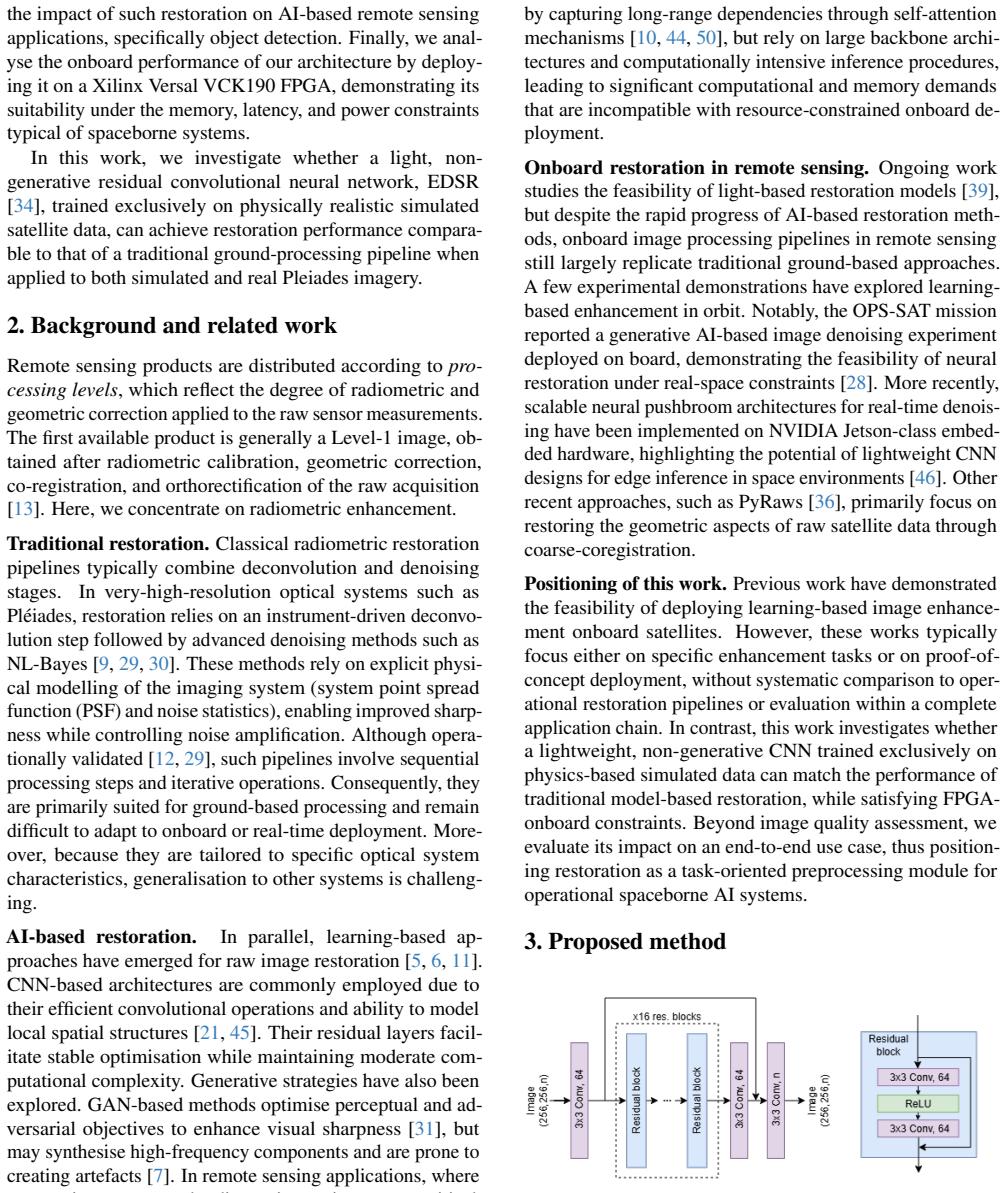
ConvBEERS, a lightweight non-generative residual convolutional network that learns a direct mapping from degraded to restored satellite images.
If this is right
- Restoration becomes fast enough to run before onboard AI tasks such as object detection.
- Image quality gains of 6.9 dB PSNR translate into measurable improvements in detection accuracy of up to 5.1 percent mAP@50.
- The same lightweight architecture fits on space-grade FPGA hardware and runs 41 times faster than the traditional pipeline.
- Satellite systems can reduce reliance on ground-based processing for initial image correction.
Where Pith is reading between the lines
- If simulation fidelity holds across other sensors, the approach could be reused for different satellite missions without per-mission retraining.
- Lower latency and power draw on the FPGA may allow more complex AI models to run in parallel within the same onboard budget.
- Replacing sequential physical models with a single learned residual network simplifies the overall processing chain and reduces the number of tunable parameters.
Load-bearing premise
Degradations created in simulation for training are close enough to the actual noise and blur present in real Pleiades-HR satellite captures that the learned mapping transfers without extra adaptation.
What would settle it
Retraining on a fresh set of real paired degraded-clean Pleiades-HR images and measuring whether PSNR or downstream mAP drops below the reported simulated results would falsify the claim that simulation alone is sufficient.
Figures


read the original abstract
Satellite image restoration aims to improve image quality by compensating for degradations (e.g., noise and blur) introduced by the imaging system and acquisition conditions. As a fundamental preprocessing step, restoration directly impacts both ground-based product generation and emerging onboard AI applications. Traditional restoration pipelines based on sequential physical models are computationally intensive and slow, making them unsuitable for onboard environments. In this paper, we introduce ConvBEERS: a Convolutional Board-ready Embedded and Efficient Restoration model for Space to investigate whether a light and non-generative residual convolutional network, trained on simulated satellite data, can match or surpass a traditional ground-processing restoration pipeline across multiple operating conditions. Experiments conducted on simulated datasets and real Pleiades-HR imagery demonstrate that the proposed approach achieves competitive image quality, with a +6.9dB PSNR improvement. Evaluation on a downstream object detection task demonstrates that restoration significantly improves performance, with up to +5.1% mAP@50. In addition, successful deployment on a Xilinx Versal VCK190 FPGA validates its practical feasibility for satellite onboard processing, with a ~41x reduction in latency compared to the traditional pipeline. These results demonstrate the relevance of using lightweight CNNs to achieve competitive restoration quality while addressing real-world constraints in spaceborne systems.
Editorial analysis
A structured set of objections, weighed in public.
Referee Report
Summary. The paper introduces ConvBEERS, a lightweight residual convolutional neural network for satellite image restoration. Trained exclusively on simulated degraded imagery, the model is evaluated on both simulated data and real Pleiades-HR acquisitions, claiming a +6.9 dB PSNR gain, up to +5.1% mAP@50 improvement on a downstream object detection task, and successful deployment on a Xilinx Versal VCK190 FPGA yielding ~41x latency reduction versus a traditional physical-model pipeline.
Significance. If the reported gains on real data are reliable, the work would show that simple non-generative CNNs can deliver competitive restoration quality while satisfying the strict latency and resource constraints of onboard satellite processing. The FPGA implementation and downstream task evaluation provide concrete evidence of end-to-end practicality for spaceborne AI pipelines.
major comments (3)
- [Abstract and Experiments] The central claims of +6.9 dB PSNR and +5.1% mAP@50 on real Pleiades-HR imagery (Abstract) rest on the unverified assumption that the simulated forward degradation model (blur, noise, atmospheric and sensor effects) produces statistics sufficiently close to actual Pleiades-HR acquisitions. No domain-gap metric, distribution comparison, or ablation isolating simulation fidelity is supplied, leaving the transfer results vulnerable to mismatch.
- [Hardware Deployment] The ~41x latency reduction on the Xilinx Versal VCK190 FPGA is reported relative to the traditional pipeline, yet no implementation details of that baseline (specific physical models, optimization flags, or hardware mapping) are given, nor are FPGA resource utilization, power figures, or timing methodology for ConvBEERS itself.
- [Evaluation Protocol] The evaluation protocol omits the object-detection architecture used for mAP measurement, the precise training protocol (data splits, augmentations, optimizer settings, and stopping criteria), and any statistical testing or variance reporting for the PSNR and mAP deltas.
minor comments (2)
- [Abstract] The abstract uses the phrase 'competitive image quality' without naming the reference methods or tabulating their scores.
- [Abstract] The acronym ConvBEERS is expanded only after first use; a parenthetical expansion on first appearance would improve readability.
Simulated Author's Rebuttal
We thank the referee for the thorough review and constructive suggestions. We address each of the major comments below, indicating where revisions will be made to the manuscript.
read point-by-point responses
-
Referee: [Abstract and Experiments] The central claims of +6.9 dB PSNR and +5.1% mAP@50 on real Pleiades-HR imagery (Abstract) rest on the unverified assumption that the simulated forward degradation model (blur, noise, atmospheric and sensor effects) produces statistics sufficiently close to actual Pleiades-HR acquisitions. No domain-gap metric, distribution comparison, or ablation isolating simulation fidelity is supplied, leaving the transfer results vulnerable to mismatch.
Authors: We agree that the manuscript would benefit from explicit analysis of the simulation-to-real domain gap. Although the degradation model was constructed based on the known characteristics of the Pleiades-HR sensor and acquisition conditions, and the model shows consistent improvements on real imagery, we did not include quantitative domain-gap metrics. In the revised version, we will add a dedicated subsection in the Experiments section providing distribution comparisons (e.g., mean and variance of pixel intensities, frequency domain analysis) and a domain-gap metric such as Fréchet Inception Distance (FID) between simulated and real degraded images. We will also include an ablation study varying the fidelity of the simulation components. revision: yes
-
Referee: [Hardware Deployment] The ~41x latency reduction on the Xilinx Versal VCK190 FPGA is reported relative to the traditional pipeline, yet no implementation details of that baseline (specific physical models, optimization flags, or hardware mapping) are given, nor are FPGA resource utilization, power figures, or timing methodology for ConvBEERS itself.
Authors: We acknowledge the lack of detailed hardware implementation information in the current manuscript. The traditional pipeline refers to the sequential application of physical models for deconvolution, denoising, and atmospheric correction as used in the Pleiades ground segment. In the revision, we will expand the Hardware Deployment section to include: (1) specific details on the baseline implementation, including the physical models employed and any optimizations; (2) FPGA resource utilization for ConvBEERS (e.g., LUTs, DSP slices, BRAM); (3) power consumption estimates; and (4) the timing methodology, including clock frequency and latency measurement approach on the VCK190. revision: yes
-
Referee: [Evaluation Protocol] The evaluation protocol omits the object-detection architecture used for mAP measurement, the precise training protocol (data splits, augmentations, optimizer settings, and stopping criteria), and any statistical testing or variance reporting for the PSNR and mAP deltas.
Authors: We agree that additional details on the evaluation protocol are necessary for reproducibility. In the revised manuscript, we will specify the object detection architecture (e.g., the particular detector and backbone used), provide the full training protocol including data splits, augmentations, optimizer, learning rate schedule, and stopping criteria, and report variance or standard deviations across multiple runs along with statistical significance tests (e.g., paired t-tests) for the reported PSNR and mAP improvements. revision: yes
Circularity Check
No circularity: empirical results from held-out simulated and real data
full rationale
The paper trains a residual CNN (ConvBEERS) on simulated degradations and reports PSNR, mAP, and FPGA latency gains via direct measurement on separate test imagery and hardware execution. No equation, loss term, or architectural choice reduces the claimed +6.9 dB PSNR or +5.1 % mAP improvements to a fitted constant or self-citation by construction. The central claims rest on standard supervised learning and benchmarking, not on any self-definitional loop or imported uniqueness theorem.
Axiom & Free-Parameter Ledger
free parameters (2)
- CNN architecture hyperparameters
- Training hyperparameters
axioms (2)
- domain assumption Simulated noise and blur distributions match real Pleiades-HR acquisition statistics
- domain assumption Standard supervised regression loss is sufficient to learn a restoration mapping that also benefits downstream detection
Reference graph
Works this paper leans on
-
[1]
Deep learning processor unit (dpu) — vitis ai. Xilinx Doc- umentation, 2026. https://xilinx.github.io/ Vitis-AI/. 7
work page 2026
-
[2]
Physics-informed computer vision: A review and perspectives, 2024
Chayan Banerjee, Kien Nguyen, Clinton Fookes, and George Karniadakis. Physics-informed computer vision: A review and perspectives, 2024. 8
work page 2024
-
[3]
Maud Biquard.R ´egularisation avec des r´eseaux de neurones pour la restauration d’images satellites. PhD thesis, 2025. Th`ese de doctorat dirig ´ee par Oberlin, Thomas et Chabert, Marie Informatique et T´el´ecommunications Toulouse, ISAE
work page 2025
-
[4]
R ´egularisation par mod `eles pseudo-g´en´eratifs pour la restauration d’images
Maud Biquard, Marie Chabert, Florence Genin, Christophe Latry, and Thomas Oberlin. R ´egularisation par mod `eles pseudo-g´en´eratifs pour la restauration d’images. InColloque Gretsi 2023, Grenoble, France, 2023. Association Gretsi. 1
work page 2023
-
[5]
Maud Biquard, Marie Chabert, Florence Genin, Christophe Latry, and Thomas Oberlin. Variational bayes image restora- tion with compressive autoencoders.IEEE Transactions on Image Processing, 34:2896–2909, 2025. 2
work page 2025
-
[6]
Maud Biquard, Marie Chabert, Florence Genin, Christophe Latry, and Thomas Oberlin. Deep priors for satellite image restoration with accurate uncertainties.IEEE Transactions on Geoscience and Remote Sensing, 63:1–16, 2025. 1, 2
work page 2025
-
[7]
The perception-distortion tradeoff
Yochai Blau and Tomer Michaeli. The perception-distortion tradeoff. InProceedings of the IEEE Conference on Computer Vision and Pattern Recognition (CVPR), pages 6228–6237,
-
[8]
Rareplanes detection using yolov5 on the versal adaptive soc
Jacob Brown, Colton Yates, Jeffrey Goeders, and Michael Wirthlin. Rareplanes detection using yolov5 on the versal adaptive soc. In2025 IEEE Aerospace Conference, pages 1–9, 2025. 7
work page 2025
-
[9]
Theses, Universit ´e Nice Sophia Antipolis, 2013
Mika¨el Carlavan.Optimization of the compression/restoration chain for satellite images. Theses, Universit ´e Nice Sophia Antipolis, 2013. 1, 2
work page 2013
-
[10]
Hat: Hy- brid attention transformer for image restoration, 2025
Xiangyu Chen, Xintao Wang, Wenlong Zhang, Xiangtao Kong, Yu Qiao, Jiantao Zhou, and Chao Dong. Hat: Hy- brid attention transformer for image restoration, 2025. 2
work page 2025
-
[11]
Chouteau, Laurent Gabet, Renaud Fraisse, T
F. Chouteau, Laurent Gabet, Renaud Fraisse, T. Bonfort, Bouchra Harnoufi, V . Greiner, M. Goff, M. Ortner, and V . Paveau. Joint super-resolution and image restoration for pl ´Eiades neo imagery.The International Archives of the Photogrammetry, Remote Sensing and Spatial Information Sciences, XLIII-B1-2022:9–15, 2022. 1, 2
work page 2022
-
[12]
Chaine de fusion p+xs des images pl´eiades-hr, 2013
Sebastien Fourest Christophe Latry, Gwendoline Blancher. Chaine de fusion p+xs des images pl´eiades-hr, 2013. 2, 5
work page 2013
-
[13]
ESA Copernicus. Senti wiki: S2 products, 2025. https://sentiwiki.copernicus.eu/web/s2-products, Accessed on February, 2026. 2
work page 2025
-
[14]
Enhanced maritime monitoring via onboard processing of raw multi-spectral imagery by deep learning
Roberto Del Prete, Gabriele Meoni, Manuel Salvoldi, Domenico Barretta, Maria Daniela Graziano, Nicolas Long´ep´e, and Alfredo Renga. Enhanced maritime monitoring via onboard processing of raw multi-spectral imagery by deep learning. InIGARSS 2024 - 2024 IEEE International Geo- science and Remote Sensing Symposium, pages 1713–1717,
work page 2024
-
[15]
Lorenzo Diana, Jia Xu, and Luca Fanucci. Oil spill identifica- tion from sar images for low power embedded systems using cnn.Remote Sensing, 13(18), 2021. 1
work page 2021
-
[16]
7nm finfet technology heavy ion sel evaluation using xilinx versal as case study
Arnaud Dufour, J´erˆome Carron, Franc ¸ois Pierron, Matthieu Fongral, David Dangla, Guillaume Bascoul, Franc ¸oise Bez- erra, Julien Mekki, Florence Malou, and Pierre Maillard. 7nm finfet technology heavy ion sel evaluation using xilinx versal as case study. In2021 21th European Conference on Radia- tion and Its Effects on Components and Systems (RADECS),...
work page 2021
-
[17]
Fabien Gallet, Christophe Marabotto, and Thomas Chambon. Exploring ai-based satellite pose estimation: from novel syn- thetic dataset to in-depth performance evaluation. InProceed- ings of the IEEE/CVF Conference on Computer Vision and Pattern Recognition (CVPR) Workshops, pages 6770–6778,
-
[18]
Garc´es-Socarr´as, Raudel Cuiman, Flor Ortiz, Juan A
Luis M. Garc´es-Socarr´as, Raudel Cuiman, Flor Ortiz, Juan A. V´asquez-Peralvo, Jorge L. Gonz ´alez-Rios, Mouhamad Chehaitly, Arkadii Kazanskii, Sahar Malmir, Amirhossein Nik, Jan Thoemel, Sumit Kumar, Marcele Kuhfuss, Swetha Varadajulu, Eva Lagunas, Juan C. M. Duncan, Jorge Querol, and Symeon Chatzinotas. Onboard machine learning for satel- lite edge com...
work page 2025
-
[19]
Fidmtf: An mtf estimator (qgis plugin)
Jorge Gil. Fidmtf: An mtf estimator (qgis plugin). https://plugins.qgis.org/plugins/mtf estimator/. 5
-
[20]
Thomas Goudemant, Benjamin Francesconi, Michelle Aubrun, Erwann Kervennic, Ingrid Grenet, Yves Bobichon, and Marjorie Bellizzi. Onboard anomaly detection for marine environmental protection.IEEE Journal of Selected Topics in Applied Earth Observations and Remote Sensing, 17:7918– 7931, 2024. 1
work page 2024
-
[21]
Wavelet deep neural network for stripe noise removal.IEEE Access, 7:44544– 44554, 2019
Juntao Guan, Rui Lai, and Ai Xiong. Wavelet deep neural network for stripe noise removal.IEEE Access, 7:44544– 44554, 2019. 2
work page 2019
-
[22]
Deep residual learning for image recognition, 2015
Kaiming He, Xiangyu Zhang, Shaoqing Ren, and Jian Sun. Deep residual learning for image recognition, 2015. 3
work page 2015
-
[23]
Deep learning- based ship detection on fpgas
Younis Ibrahim, Li Chen, and Tian Haonan. Deep learning- based ship detection on fpgas. In2022 14th International Conference on Computational Intelligence and Communica- tion Networks (CICN), pages 454–459, 2022. 7
work page 2022
-
[24]
Focal frequency loss for image reconstruction and synthesis,
Liming Jiang, Bo Dai, Wayne Wu, and Chen Change Loy. Focal frequency loss for image reconstruction and synthesis,
-
[25]
Inves- tigating loss functions for extreme super-resolution
Younghyun Jo, Sejong Yang, and Seon Joo Kim. Inves- tigating loss functions for extreme super-resolution. In 2020 IEEE/CVF Conference on Computer Vision and Pat- tern Recognition Workshops (CVPRW), pages 1705–1712,
work page 2020
-
[26]
Hadjim- itsis, Egbert Schwarz, and Stefan Wiehle
Eleftheria Kalogirou, George Melillos, Diofantos G. Hadjim- itsis, Egbert Schwarz, and Stefan Wiehle. Maritime surveil- lance in Cyprus using Sentinel-1 SAR. InRemote Sensing of the Ocean, Sea Ice, Coastal Waters, and Large Water Regions 2023, page 127280N, 2023. 1
work page 2023
-
[27]
Yolov11: An overview of the key architectural enhancements, 2024
Rahima Khanam and Muhammad Hussain. Yolov11: An overview of the key architectural enhancements, 2024. 6
work page 2024
-
[28]
Georges Labr`eche, Cesar Guzman, and Sam Bammens. Gen- erative ai... in space! adversarial networks to denoise images onboard the ops-sat-1 spacecraft. In2024 IEEE Aerospace Conference, pages 1–17, 2024. 2
work page 2024
- [29]
-
[30]
Marc Lebrun, Antoni Buades, and Jean-Michel Morel. Im- plementation of the ”Non-Local Bayes” (NL-Bayes) Image Denoising Algorithm.Image Processing On Line, 3:1–42,
-
[31]
https://doi.org/10.5201/ipol.2013.16. 1, 2
-
[32]
Photo-realistic single image super-resolution using a gen- erative adversarial network
Christian Ledig, Lucas Theis, Ferenc Husz´ar, Jose Caballero, Andrew Cunningham, Alejandro Acosta, Andrew Aitken, Alykhan Tejani, Johannes Totz, Zehan Wang, and Wenzhe Shi. Photo-realistic single image super-resolution using a gen- erative adversarial network. InProceedings of the IEEE Con- ference on Computer Vision and Pattern Recognition (CVPR), pages ...
work page 2017
-
[33]
Dpuv4e: High-throughput dpu architecture design for cnn on versal acap, 2025
Guoyu Li, Pengbo Zheng, Jian Weng, and Enshan Yang. Dpuv4e: High-throughput dpu architecture design for cnn on versal acap, 2025. 7
work page 2025
-
[34]
Ke Li, Gang Wan, Gong Cheng, Liqiu Meng, and Junwei Han. Object detection in optical remote sensing images: A survey and a new benchmark.ISPRS Journal of Photogrammetry and Remote Sensing, 159:296–307, 2020. 6
work page 2020
-
[35]
Enhanced Deep Residual Networks for Single Image Super-Resolution
Bee Lim, Sanghyun Son, Heewon Kim, Seungjun Nah, and Kyoung Mu Lee. Enhanced deep residual networks for single image super-resolution.CoRR, abs/1707.02921, 2017. 2, 3
work page Pith review arXiv 2017
- [36]
-
[37]
Gabriele Meoni, Roberto Del Prete, Federico Serva, Alix De Beusscher, Olivier Colin, and Nicolas Long´ep´e. Unlock- ing the use of raw multispectral earth observation imagery for onboard artificial intelligence.IEEE Journal of Selected Topics in Applied Earth Observations and Remote Sensing, 17:12521–12537, 2024. 1, 2, 8
work page 2024
-
[38]
Virtanen, Ari-Pekka Jokinen, Joni Koskikala, Sakari V¨akev¨a, and Jenni Attila
Janne M ¨ayr¨a, Elina A. Virtanen, Ari-Pekka Jokinen, Joni Koskikala, Sakari V¨akev¨a, and Jenni Attila. Mapping recre- ational marine traffic from sentinel-2 imagery using yolo object detection models.Remote Sensing of Environment, 326:114791, 2025. 1
work page 2025
- [39]
-
[40]
Lvrnet: Lightweight image restoration for aerial images under low visibility, 2023
Esha Pahwa, Achleshwar Luthra, and Pratik Narang. Lvrnet: Lightweight image restoration for aerial images under low visibility, 2023. 2
work page 2023
-
[41]
Eval- uation of xilinx versal architecture for next-gen edge com- puting in space
Noah Perryman, Christopher Wilson, and Alan George. Eval- uation of xilinx versal architecture for next-gen edge com- puting in space. In2023 IEEE Aerospace Conference, pages 1–11, 2023. 7
work page 2023
-
[42]
Enhancing maritime situational awareness through end-to-end onboard raw data analysis, 2024
Roberto Del Prete, Manuel Salvoldi, Domenico Bar- retta, Nicolas Long ´ep´e, Gabriele Meoni, Arnon Karnieli, Maria Daniela Graziano, and Alfredo Renga. Enhancing maritime situational awareness through end-to-end onboard raw data analysis, 2024. 1
work page 2024
-
[43]
Gaurav Upadhyay, C Siva Prasad, V Akash, Ayush Kumar Singh, R Monish Sai, Srijan Ghosal, Subrat Kar, S H Shan- tala, J Thakur LalitKrushna, S Srividhya, and Sunil Alias Bal- wantrao. Enhancing cnn inference time and reducing latency on edge and resource-constrained systems through quantiza- tion. In2024 Second International Conference on Networks, Multime...
work page 2024
-
[44]
Spatial-frequency mutual learning for face super- resolution
Chenyang Wang, Junjun Jiang, Zhiwei Zhong, and Xian- ming Liu. Spatial-frequency mutual learning for face super- resolution. InProceedings of the IEEE/CVF Conference on Computer Vision and Pattern Recognition (CVPR), pages 22356–22366, 2023. 3
work page 2023
-
[45]
Optical imaging degradation simulation and transformer-based image restoration for remote sensing
Hua Wei, Kun Gao, Jing Wang, Qiuyan Tang, Xiongxin Tang, and Fanjiang Xu. Optical imaging degradation simulation and transformer-based image restoration for remote sensing. IEEE Geoscience and Remote Sensing Letters, 21:1–5, 2024. 2
work page 2024
-
[46]
Wenjia Xu, Guangluan Xu, Yang Wang, Xian Sun, Daoyu Lin, and Yirong Wu. Deep memory connected neural network for optical remote sensing image restoration.Remote Sensing, 10(12), 2018. 2
work page 2018
-
[47]
Ziyao Yi, Davide Piccinini, Diego Valsesia, Tiziano Bianchi, and Enrico Magli. Scalable neural pushbroom architectures for real-time denoising of hyperspectral images onboard satel- lites, 2026. 2
work page 2026
-
[48]
Kai Zhang, Wangmeng Zuo, Yunjin Chen, Deyu Meng, and Lei Zhang. Beyond a gaussian denoiser: Residual learning of deep cnn for image denoising.IEEE Transactions on Image Processing, 26(7):3142–3155, 2017. 3
work page 2017
-
[49]
Learning deep cnn denoiser prior for image restoration, 2017
Kai Zhang, Wangmeng Zuo, Shuhang Gu, and Lei Zhang. Learning deep cnn denoiser prior for image restoration, 2017. 3
work page 2017
-
[50]
Efros, Eli Shechtman, and Oliver Wang
Richard Zhang, Phillip Isola, Alexei A. Efros, Eli Shechtman, and Oliver Wang. The unreasonable effectiveness of deep features as a perceptual metric, 2018. 3
work page 2018
-
[51]
Denoising diffusion models for plug-and-play image restoration, 2023
Yuanzhi Zhu, Kai Zhang, Jingyun Liang, Jiezhang Cao, Bihan Wen, Radu Timofte, and Luc Van Gool. Denoising diffusion models for plug-and-play image restoration, 2023. 2
work page 2023
discussion (0)
Sign in with ORCID, Apple, or X to comment. Anyone can read and Pith papers without signing in.