Recognition: unknown
The Material Point Method (MPM) for simulating hypervelocity impact on asteroids
Pith reviewed 2026-05-10 14:34 UTC · model grok-4.3
The pith
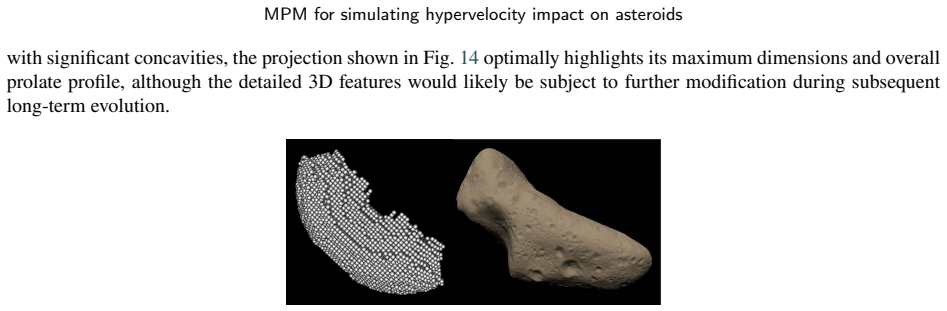
The Material Point Method reproduces large coherent fragments like those on asteroid Eros when simulating hypervelocity impacts.
A machine-rendered reading of the paper's core claim, the machinery that carries it, and where it could break.
Core claim
The Material Point Method implementation, incorporating a pressure-dependent C^1 continuous yield criterion with quantifiable plastic strain and a resolution-independent Grady-Kipp fragmentation model, when applied to asteroid-scale collisions, successfully reproduces the formation of large, coherent fragments analogous to (433) Eros.
What carries the argument
The Material Point Method (MPM) enhanced with a pressure-dependent yield criterion and Grady-Kipp fragmentation model to capture geological material behavior under extreme conditions.
If this is right
- Expands the parameter space that can be explored in asteroid impact simulations.
- Enables treatment of complex contact and boundary conditions that are difficult for traditional hydrocodes.
- Supports more realistic simulations of asteroid evolution, family formation, and planetary defense scenarios.
Where Pith is reading between the lines
- MPM could be combined with other techniques to address internal asteroid structures at multiple scales.
- The method opens paths to simulate specific planetary defense deflection outcomes with varied surface and contact details.
Load-bearing premise
The laboratory-validated MPM with the given yield criterion and fragmentation model will accurately capture the physics of geological materials at the much larger scales, velocities, and durations of asteroid collisions.
What would settle it
If fragment size distributions and shapes from MPM simulations of specific impact conditions fail to match those observed in asteroid families formed by comparable events.
Figures






read the original abstract
Shock-physics numerical codes are essential tools for describing the short but extreme fragmentation stage of the hypervelocity impact process on asteroids. However, accurately representing complex interior structures, surfaces, and contact mechanics in these events remains a significant challenge for traditional hydrocodes. This study introduces and validates an innovative yet underutilized technique, i.e., the Material Point Method (MPM), to simulate hyper-velocity impacts on asteroids. This approach offers new perspectives and solutions for capturing complex interfaces and handling the contact and boundary conditions in asteroid impact simulations. Our MPM implementation incorporates critical improvements to material models, including a pressure-dependent C^1 continuous yield criterion with quantifiable plastic strain, and a resolution-independent Grady-Kipp fragmentation model, to capture the complex physics of geological materials under extreme conditions. The framework is rigorously validated against laboratory impact experiments and benchmarked with smoothed particle hydrodynamics (SPH) simulations, confirming its robustness and precision. Crucially, when applied to asteroid-scale collisions, our model successfully reproduces the formation of large, coherent fragments analogous to (433) Eros. This work establishes MPM as a validated and powerful extension to the planetary scientist's toolkit, enabling the expansion of the parameter space and the treatment of complex contact and boundary conditions, which will enable more realistic simulations of asteroid evolution, family formation, and planetary defense scenarios.
Editorial analysis
A structured set of objections, weighed in public.
Referee Report
Summary. The manuscript introduces the Material Point Method (MPM) for hypervelocity impact simulations on asteroids. It incorporates a pressure-dependent C¹ continuous yield criterion with quantifiable plastic strain and a resolution-independent Grady-Kipp fragmentation model. The implementation is validated against laboratory impact experiments and benchmarked against smoothed particle hydrodynamics (SPH) simulations. Application to asteroid-scale collisions is shown to reproduce the formation of large, coherent fragments analogous to those of (433) Eros.
Significance. If the validations hold, this establishes MPM as a practical extension to existing hydrocodes for asteroid impact modeling, with advantages in handling complex interfaces, contacts, and boundary conditions. The combination of lab validation, SPH benchmarking, and reproduction of Eros-like fragments at larger scales could support expanded studies of asteroid family formation and planetary defense. The provision of implementation details strengthens reproducibility.
major comments (1)
- [Asteroid-scale simulation section] Asteroid-scale simulation section: the central claim that the model reproduces large coherent fragments analogous to (433) Eros rests on extrapolation of the lab-validated yield criterion and Grady-Kipp model. A quantitative comparison (e.g., fragment size distribution statistics or velocity histograms) to observed Eros properties, or a sensitivity test to scale-dependent parameters, is needed to substantiate the scaling assumption.
minor comments (2)
- [Abstract] Abstract: the statement of 'rigorous validation' and 'confirming its robustness and precision' would be more informative if key quantitative metrics (e.g., RMS errors or correlation coefficients from lab/SPH comparisons) were summarized.
- [Material model description] Material model description: the pressure-dependent yield criterion is described as C¹ continuous, but an explicit equation or reference to its functional form (including how plastic strain is quantified) would aid readers in reproducing the implementation.
Simulated Author's Rebuttal
We thank the referee for the positive assessment of our work and the recommendation for minor revision. The single major comment is addressed point-by-point below, with a proposed revision to strengthen the asteroid-scale section.
read point-by-point responses
-
Referee: [Asteroid-scale simulation section] Asteroid-scale simulation section: the central claim that the model reproduces large coherent fragments analogous to (433) Eros rests on extrapolation of the lab-validated yield criterion and Grady-Kipp model. A quantitative comparison (e.g., fragment size distribution statistics or velocity histograms) to observed Eros properties, or a sensitivity test to scale-dependent parameters, is needed to substantiate the scaling assumption.
Authors: We agree that the asteroid-scale application involves extrapolation of the laboratory-validated yield criterion and Grady-Kipp fragmentation model, and that the current comparison to Eros is primarily qualitative. The section is intended to demonstrate that the MPM framework, once validated at laboratory scales and benchmarked against SPH, can produce large coherent fragments under asteroid impact conditions using the same constitutive models. To address the concern, the revised manuscript will incorporate a sensitivity analysis on key scale-dependent parameters (such as the Grady-Kipp fragmentation threshold and pressure-dependent yield strength scaling factors) to illustrate robustness of the large-fragment outcome. We will also add a brief discussion referencing available observational constraints on Eros fragment sizes, while explicitly noting limitations arising from uncertainties in the asteroid's internal structure and material properties. These additions will be placed in an expanded asteroid-scale simulation section. revision: yes
Circularity Check
No significant circularity detected
full rationale
The paper's central claims rest on external laboratory impact experiments and independent SPH benchmarking for validation of the MPM implementation, yield criterion, and Grady-Kipp fragmentation model. The asteroid-scale application to reproduce Eros-like fragments is presented as a downstream use of this validated framework rather than a fitted or self-referential prediction. No load-bearing steps reduce by construction to internal inputs, self-citations, or ansatzes; all described improvements and results draw from independent external benchmarks, rendering the derivation self-contained.
Axiom & Free-Parameter Ledger
Reference graph
Works this paper leans on
-
[1]
2020, Science, 368, 67, doi: 10.1126/science.aaz1701
Arakawa, M., Saiki, T., Wada, K., Ogawa, K., Kadono, T., Shirai, K., Sawada, H., Ishibashi, K., Honda, R., Sakatani, N., Iijima, Y., Okamoto, C., Yano,H.,Takagi,Y.,Hayakawa,M.,Michel,P.,Jutzi,M.,Shimaki,Y.,Kimura,S.,Mimasu,Y.,Toda,T.,Imamura,H.,Nakazawa,S.,Hayakawa, H., Sugita, S., Morota, T., Kameda, S., Tatsumi, E., Cho, Y., Yoshioka, K., Yokota, Y., Ma...
-
[2]
Space Science Reviews 208, 187–212
Scientific Objectives of Small Carry-on Impactor (SCI) and Deployable Camera 3 Digital (DCAM3-D): Observation of an Ejecta Curtain and a Crater Formed on the Surface of Ryugu by an Artificial High-Velocity Impact. Space Science Reviews 208, 187–212. URL:http: //dx.doi.org/10.1007/s11214-016-0290-z, doi:10.1007/s11214-016-0290-z. X. Yan et al.:Preprint sub...
-
[3]
Seismic resurfacing of 433 Eros indicative of a highly dissipative interior for large near-Earth asteroids. Nature Astronomy 9, 347–357. URL:https://doi.org/10.1038/ s41550-024-02411-8, doi:10.1038/s41550-024-02411-8. Bardenhagen, S.,
-
[4]
Journal of Computational Physics 180, 383–403
Energy conservation error in the material point method for solid mechanics. Journal of Computational Physics 180, 383–403. URL:https://www.sciencedirect.com/science/article/pii/S0021999102971032, doi:https://doi.org/10.1006/ jcph.2002.7103. Bardenhagen, S.G., Guilkey, J.E., Roessig, K.M., Brackbill, J.U., Witzel, W.M., Foster, J.C.,
-
[5]
Effective Collision Strengths for Hydro gen and Hydrogen-Like Ions,
The generalized interpolation material point method. CMES - Computer Modeling in Engineering and Sciences 5, 477–495. Benz,W.,Asphaug,E.,1994. Impactsimulationswithfracture.I.methodandtests. Icarus107,98–116. URL:https://linkinghub.elsevier. com/retrieve/pii/S0019103584710098, doi:10.1006/icar.1994.1009. Benz,W.,Asphaug,E.,1995. Simulationsofbrittlesolids...
-
[6]
Compositional distributions and evolutionary processes for the near-Earth object population: Results from the MIT-Hawaii Near-Earth Object Spectroscopic Survey (MITHNEOS). Icarus 324, 41–76. URL:https://doi.org/10.1016/j.icarus.2018.12.035, doi:10.1016/j.icarus.2018.12.035. Bottke,W.F.,Vokrouhlický,D.,Marshall,R.,Nesvorný,D.,Morbidelli,A.,Deienno,R.,March...
-
[7]
URL: http://dx.doi.org/10.3847/PSJ/ace7cd, doi:10.3847/psj/ace7cd. Brundage, A.L.,
-
[8]
Procedia Engineering 58, 461–470
Implementation of Tillotson equation of state for hypervelocity impact of metals, geologic materials, and liquids. Procedia Engineering 58, 461–470. URL:https://linkinghub.elsevier.com/retrieve/pii/S1877705813009594, doi:10.1016/j.proeng. 2013.05.053. Burgess, D., Sulsky, D., Brackbill, J.,
-
[9]
Approximate riemann solvers, parameter vectors, and difference schemes
Mass matrix formulation of the FLIP particle-in-cell method. Journal of Computational Physics 103, 1–15. URL:https://www.sciencedirect.com/science/article/pii/002199919290323Q, doi:https://doi.org/10.1016/ 0021-9991(92)90323-Q. Buruchenko, S.K., Schäfer, C.M., Maindl, T.I.,
-
[10]
Procedia Engineering 204, 59–66
Smooth Particle Hydrodynamics GPU-Acceleration Tool for Asteroid Fragmentation Simulation. Procedia Engineering 204, 59–66. doi:10.1016/j.proeng.2017.09.726. Chen, W.D., Zhang, F., Yang, W.M.,
-
[11]
Key Engineering Materials 525-526, 97–100
Simulation of spall fracture based on material point method. Key Engineering Materials 525-526, 97–100. doi:10.4028/www.scientific.net/KEM.525-526.97. Cheng,A.F.,Agrusa,H.F.,Barbee,B.W.,Meyer,A.J.,Farnham,T.L.,Raducan,S.D.,Richardson,D.C.,Dotto,E.,Zinzi,A.,DellaCorte,V.,Statler, T.S., Chesley, S., Naidu, S.P., Hirabayashi, M., Li, J.Y., Eggl, S., Barnouin...
-
[12]
Momentum transfer from the DART mission kinetic impact on asteroid Dimorphos. Nature 616, 457–460. doi:10.1038/s41586-023-05878-z. Collins, G.S., Melosh, H.J., Ivanov, B.A.,
-
[13]
Modeling damage and deformation in impact simulations. Meteoritics and Planetary Science 39, 217–231. doi:10.1111/j.1945-5100.2004.tb00337.x. Daly, R.T., Ernst, C.M., Barnouin, O.S., Chabot, N.L., Rivkin, A.S., Cheng, A.F., Adams, E.Y., Agrusa, H.F., Abel, E.D., Alford, A.L., Asphaug, E.I., Atchison, J.A., Badger, A.R., Baki, P., Ballouz, R.L., Bekker, D....
-
[14]
Successful kinetic impact into an asteroid for planetary defence. Nature 616, 443–447. doi:10.1038/s41586-023-05810-5. Demeo, F.E., Carry, B.,
-
[15]
Solar System evolution from compositional mapping of the asteroid belt. Nature 505, 629–634. URL:http: //dx.doi.org/10.1038/nature12908, doi:10.1038/nature12908,arXiv:1408.2787. Drucker, D.C., Prager, W.,
-
[16]
A new hybrid framework for simulating hypervelocity asteroid impacts and gravitational reaccumulation. Icarus 321, 1013–1025. URL:https://doi.org/10.1016/j.icarus.2018.12.032, doi:10.1016/j.icarus.2018. 12.032. Elbeshausen, D., Wünnemann, K., Collins, G.S.,
-
[17]
Scaling of oblique impacts in frictional targets: Implications for crater size and formation mechanisms. Icarus 204, 716–731. URL:http://dx.doi.org/10.1016/j.icarus.2009.07.018, doi:10.1016/j.icarus.2009.07
-
[18]
The role of fragment shapes in the simulations of asteroids as gravitational aggregates. Icarus 350, 113871. URL: https://doi.org/10.1016/j.icarus.2020.113871, doi:10.1016/j.icarus.2020.113871,arXiv:2005.14032. Flynn, G.J., Consolmagno, G.J., Brown, P., Macke, R.J.,
-
[19]
Physical properties of the stone meteorites: Implications for the properties of their parent bodies. Chemie der Erde 78, 269–298. URL:http://dx.doi.org/10.1016/j.chemer.2017.04.002, doi:10.1016/j.chemer. 2017.04.002. Fujiwara, A., Tsukamoto, A.,
-
[20]
Continuum modelling of explosive fracture in oil shale. International Journal of Rock Mechanics and Mining Sciences and 17, 147–157. doi:10.1016/0148-9062(80)91361-3. Güldemeister,N.,Moreau,J.G.,Kohout,T.,Luther,R.,Wünnemann,K.,2022. InsightintotheDistributionofHigh-pressureShockMetamorphism inRubble-pileAsteroids. PlanetaryScienceJournal3,198. URL:http:/...
-
[21]
Monthly Notices of the Royal Astronomical Society 527, 10348–10357
SPH–DEM modelling of hypervelocity impacts on rubble-pile asteroids. Monthly Notices of the Royal Astronomical Society 527, 10348–10357. URL:https://academic.oup.com/mnras/article/527/4/10348/7478001, doi:10.1093/mnras/stad3888. Jutzi, M.,
-
[22]
SPH calculations of asteroid disruptions: The role of pressure dependent failure models. Planetary and Space Science 107, 3–9. URL:http://dx.doi.org/10.1016/j.pss.2014.09.012, doi:10.1016/j.pss.2014.09.012. Jutzi, M., Benz, W., Michel, P.,
-
[23]
Numerical simulations of impacts involving porous bodies. I. implementing sub-resolution porosity in a 3D SPH hydrocode. Icarus 198, 242–255. URL:10.1016/j.icarus.2008.06.013, doi:10.1016/j.icarus.2008.06.013. Jutzi, M., Holsapple, K., Wünneman, K., Michel, P.,
-
[24]
doi:10.1016/j.icarus.2020.113867
Collisional heating and compaction of small bodies: Constraints for their origin and evolution. Icarus 350, 113867. URL:https://doi.org/10.1016/j.icarus.2020.113867, doi:10.1016/j.icarus.2020.113867,arXiv:2005.12785. Lian, Y.P., Zhang, X., Liu, Y.,
-
[25]
Computer Methods in Applied Mechanics and Engineering 200, 3482–3494
Coupling of finite element method with material point method by local multi-mesh contact method. Computer Methods in Applied Mechanics and Engineering 200, 3482–3494. URL:http://dx.doi.org/10.1016/j.cma.2011.07.014, doi:10.1016/j.cma.2011.07.014. Liang, Y., Zhang, X., Liu, Y.,
-
[26]
Computer Methods in Applied Mechanics and Engineering 352, 85–109
An efficient staggered grid material point method. Computer Methods in Applied Mechanics and Engineering 352, 85–109. URL:https://doi.org/10.1016/j.cma.2019.04.024, doi:10.1016/j.cma.2019.04.024. Liu,P.,Liu,Y.,Zhang,X.,Guan,Y.,2015. Investigationonhigh-velocityimpactofmicronparticlesusingmaterialpointmethod. InternationalJour- nal of Impact Engineering 75...
-
[27]
International Journal of Mechanics and Materials in Design 15, 361–378
Investigating the cold spraying process with the material point method. International Journal of Mechanics and Materials in Design 15, 361–378. URL:https://doi.org/10.1007/s10999-018-9419-4, doi:10.1007/s10999-018-9419-4. Lundborg, N.,
-
[28]
Strength of rock-like materials. International Journal of Rock Mechanics and Mining Sciences & Geomechanics Abstracts 5,427–454. URL:https://www.sciencedirect.com/science/article/pii/0148906268900466,doi:https://doi.org/10.1016/ 0148-9062(68)90046-6. Luther, R., Raducan, S.D., Burger, C., Wünnemann, K., Jutzi, M., Schäfer, C.M., Koschny, D., Davison, T.M....
-
[29]
URL:https://iopscience.iop.org/article/10.3847/PSJ/ac8b89, doi:10.3847/PSJ/ac8b89. Ma,S.,Zhang,X.,Qiu,X.M.,2009.ComparisonstudyofMPMandSPHinmodelinghypervelocityimpactproblems.InternationalJournalofImpact Engineering 36, 272–282. URL:http://dx.doi.org/10.1016/j.ijimpeng.2008.07.001, doi:10.1016/j.ijimpeng.2008.07.001. McGlaun, J.M., Thompson, S.L., Elrick, M.G.,
-
[30]
International Journal of Impact Engineering 10, 351–360
CTH: A three-dimensional shock wave physics code. International Journal of Impact Engineering 10, 351–360. doi:10.1016/0734-743X(90)90071-3. Melosh, H.J., Ryan, E.V., Asphaug, E.,
-
[31]
Journal of GeophysicalResearch:Planets97,14735–14759
Dynamic fragmentation in impacts: Hydrocode simulation of laboratory impacts. Journal of GeophysicalResearch:Planets97,14735–14759. URL:https://agupubs.onlinelibrary.wiley.com/doi/abs/10.1029/92JE01632, doi:https://doi.org/10.1029/92JE01632. Michel, P., Ballouz, R.L., Barnouin, O.S., Jutzi, M., Walsh, K.J., May, B.H., Manzoni, C., Richardson, D.C., Schwar...
-
[32]
Michel, P., Benz, W., Richardson, D.C.,
doi:10.1038/s41467-020-16433-z. Michel, P., Benz, W., Richardson, D.C.,
-
[33]
Disruption of fragmented parent bodies as the origin of asteroid families. Nature 421, 608–611. URL:https://www.nature.com/articles/nature01364, doi:10.1038/nature01364. Michel, P., Benz, W., Richardson, D.C.,
-
[34]
Catastrophic disruption of pre-shattered parent bodies. Icarus 168, 420–432. URL:https: //linkinghub.elsevier.com/retrieve/pii/S0019103503004342, doi:10.1016/j.icarus.2003.12.011. Michel, P., Benz, W., Tanga, P., Richardson, D.C.,
-
[35]
Collisions and gravitational reaccumulation: Forming asteroid families and satellites. Science 294, 1696–1700. URL:https://www.science.org/doi/abs/10.1126/science.1065189, doi:10.1126/science.1065189. Michel, P., DeMeo, F.E., Bottke, W.F., 2015a. Asteroids: recent advances and new perspectives. Asteroids IV , 3–10. Michel, P., Küppers, M., Bagatin, A.C., ...
-
[36]
Nachrichten von der Gesellschaft der Wissenschaften zu Göttingen, Mathematisch-Physikalische Klasse 1913, 582–592
Mechanik der festen Körper im plastisch- deformablen Zustand. Nachrichten von der Gesellschaft der Wissenschaften zu Göttingen, Mathematisch-Physikalische Klasse 1913, 582–592. URL:http://eudml.org/doc/58894. Mnjiuza, A., Owen, D., Bicanic, N.,
1913
-
[37]
Engineering Computations 12, 145–174
A combined finite-discrete element method in transient dynamics of fracturing solids. Engineering Computations 12, 145–174. URL:https://doi.org/10.1108/02644409510799532, doi:10.1108/02644409510799532. Monaghan, J.J.,
-
[38]
Journal of Computational Physics 159, 290–311
SPH without a Tensile Instability. Journal of Computational Physics 159, 290–311. doi:10.1006/jcph.2000.6439. Nairn, J.,
-
[39]
Velocity distribution of fragments formed in a simulated collisional disruption. Icarus 92, 132–146. URL: https://linkinghub.elsevier.com/retrieve/pii/001910359190040Z, doi:10.1016/0019-1035(91)90040-Z. Nakamura, A.M., Michel, P., Setoh, M.,
-
[40]
Journal of Geophysical Research 112, E02001
Weibull parameters of <i>Yakuno<ı> basalt targets used in documented high-velocity impact experiments. Journal of Geophysical Research 112, E02001. URL:http://doi.wiley.com/10.1029/2006JE002757, doi:10.1029/ 2006JE002757. Neumman, J., Richtyer, R.,
-
[41]
A method for the numerical calculation of hydrodynamical shocks. J. Appl. Phys 21, 232–237. URL: https://doi.org/10.1063/1.1699639, doi:10.1063/1.1699639. Ni,R.,Zhang,X.,2020. Aprecisecriticaltimestepformulafortheexplicitmaterialpointmethod. InternationalJournalforNumericalMethodsin Engineering 121, 4989–5016. URL:https://onlinelibrary.wiley.com/doi/abs/1...
-
[42]
Adaptive Smoothed Particle Hydrodynamics: Methodology. II. The Astrophysical Journal Supplement Series 116, 155–209. doi:10.1086/313100. Pierazzo, E., Artemieva, N., Asphaug, E., Baldwin, E.C., Cazamias, J., Coker, R., Collins, G.S., Crawford, D.A., Davison, T., Elbeshausen, D., Holsapple, K.A., Housen, K.R., Korycansky, D.G., Wünnemann, K.,
-
[43]
Meteoritics & Planetary Sci- ence43(12), 1917–1938 (2008)
Validation of numerical codes for impact and explosion cratering: Impacts on strengthless and metal targets. Meteoritics & Planetary Science 43, 1917–1938. URL:https://onlinelibrary.wiley.com/ doi/10.1111/j.1945-5100.2008.tb00653.x, doi:10.1111/j.1945-5100.2008.tb00653.x. Raducan, S.D., Jutzi, M., Cheng, A.F., Zhang, Y., Barnouin, O., Collins, G.S., Daly,...
-
[44]
Earth and Space Science 7, 1–10
Numerical Simulations of Laboratory-Scale, Hypervelocity- Impact Experiments for Asteroid-Deflection Code Validation. Earth and Space Science 7, 1–10. doi:10.1029/2018EA000474. Richardson, J.E., Melosh, H.J., Greenberg, R.,
-
[45]
Impact-Induced Seismic Activity on Asteroid 433 Eros: A Surface Modification Process. Science 306, 1526–1529. URL:https://www.science.org/doi/10.1126/science.1104731, doi:10.1126/science.1104731. Richardson, J.E., Melosh, H.J., Greenberg, R.J., O’Brien, D.P., . The global effects of impact-induced seismic activity on fractured asteroid surface morphology ...
-
[46]
The DART Mission and Advancements in Planetary Defense. Annual Review of Earth and Planetary Sciences URL:https://www.annualreviews.org/content/journals/10.1146/annurev-earth-032524-125929, doi:https://doi.org/ 10.1146/annurev-earth-032524-125929. Schäfer, C., Riecker, S., Maindl, T. I., Speith, R., Scherrer, S., Kley, W.,
-
[47]
AstronomyandAstrophysics590,A19
A smooth particle hydrodynamics code to model collisions betweensolid,self-gravitatingobjects. AstronomyandAstrophysics590,A19. URL:https://doi.org/10.1051/0004-6361/201528060, doi:10.1051/0004-6361/201528060. Schwartz, S.R., Michel, P., Jutzi, M., Marchi, S., Zhang, Y., Richardson, D.C.,
-
[48]
Catastrophic disruptions as the origin of bilobate comets. Nature Astronomy 2, 379–382. doi:10.1038/s41550-018-0395-2. Shen, L., Zhen, C.,
-
[49]
Uintah: a massively parallel problem solving environment, in: Proceedings the Ninth International Symposium on High-Performance Distributed Computing, pp. 33–41. doi:10.1109/HPDC.2000.868632. Stickle, A.M., Bruck Syal, M., Cheng, A.F., Collins, G.S., Davison, T.M., Gisler, G., Güldemeister, N., Heberling, T., Luther, R., Michel, P., Miller, P., Owen, J.M....
-
[50]
Benchmarking impact hydrocodes in the strength regime: Implicationsformodelingdeflectionbyakineticimpactor.Icarus338,113446.URL:https://doi.org/10.1016/j.icarus.2019.113446, doi:10.1016/j.icarus.2019.113446. X. Yan et al.:Preprint submitted to ElsevierPage 34 of 35 MPM for simulating hypervelocity impact on asteroids Stickle, A.M., DeCoster, M.E., Burger,...
-
[51]
Sulsky, D., Chen, Z., Schreyer, H.,
URL:http://dx.doi.org/10.3847/PSJ/ac91cc, doi:10.3847/PSJ/ac91cc. Sulsky, D., Chen, Z., Schreyer, H.,
-
[52]
Computer Methods in Applied Mechanics and Engineering 118, 179–196
A particle method for history-dependent materials. Computer Methods in Applied Mechanics and Engineering 118, 179–196. URL:https://www.sciencedirect.com/science/article/pii/0045782594901120, doi:10.1016/ 0045-7825(94)90112-0. Sulsky, D., Zhou, S.J., Schreyer, H.L.,
-
[53]
Computer Physics Communications 87, 236–252
Application of a particle-in-cell method to solid mechanics. Computer Physics Communications 87, 236–252. URL:https://www.sciencedirect.com/science/article/pii/0010465594001707, doi:https://doi.org/10.1016/ 0010-4655(94)00170-7. Thomas, C.A., Naidu, S.P., Scheirich, P., Moskovitz, N.A., Pravec, P., Chesley, S.R., Rivkin, A.S., Osip, D.J., Lister, T.A., Be...
-
[54]
part I: Model formulation and application to ALON
Multi-scale defect interactions in high-rate brittle material failure. part I: Model formulation and application to ALON. Journal of the Mechanics and Physics of Solids 86, 117–149. URL:https://www.sciencedirect.com/science/article/pii/ S0022509615302003, doi:https://doi.org/10.1016/j.jmps.2015.10.007. Tonge, A.L., Ramesh, K., Barnouin, O.,
-
[55]
A model for impact-induced lineament formation and porosity growth on Eros. Icarus 266, 76–87. URL:https://www.sciencedirect.com/science/article/pii/S0019103515005357, doi:https://doi.org/10.1016/j. icarus.2015.11.018. Veverka, J., Robinson, M., Thomas, P., Murchie, S., Bell, J.F., Izenberg, N., Chapman, C., Harch, A., Bell, M., Carcich, B., Cheng, A., Cl...
work page doi:10.1016/j 2015
-
[56]
NEAR at Eros:Imagingandspectralresults. Science289,2088–2097. URL:https://www.science.org/doi/10.1126/science.289.5487.2088, doi:10.1126/science.289.5487.2088. Ševeček,P.,2021. SimulationsofasteroidcollisionsusingahybridSPH/N-bodyapproach. Ph.D.thesis.CharlesUniversity,AstronomicalInstitute. Walsh, J.B.,
-
[57]
Annual Review of Astronomy and Astrophysics 56, 593–624
Rubble Pile Asteroids. Annual Review of Astronomy and Astrophysics 56, 593–624. URL:https://www.annualreviews. org/doi/10.1146/annurev-astro-081817-052013, doi:10.1146/annurev-astro-081817-052013. Weibull, W.,
-
[58]
A statistical theory of the strength of materials. URL:http://www.barringer1.com/wa_files/ Weibull-1939-Strength-of-Materials.pdf. Wünnemann,K.,Collins,G.S.,Melosh,H.J.,2006. Astrain-basedporositymodelforuseinhydrocodesimulationsofimpactsandimplicationsfor transient crater growth in porous targets. Icarus 180, 514–527. doi:10.1016/j.icarus.2005.10.013. Ye...
-
[59]
Radio science results during the NEAR-Shoemaker spacecraft rendezvous with Eros. Science 289, 2085–2088. doi:10.1126/science.289.5487.2085. Yu, Y., Richardson, D.C., Michel, P.,
-
[60]
Structural analysis of rubble-pile asteroids applied to collisional evolution. Astrodynamics 1, 57–69. doi:10.1007/s42064-017-0005-6,arXiv:1708.00604. Zhang, X., Chen, Z., Liu, Y.,
-
[61]
Shapes, structures, and evolution of small bodies. Astrodynamics 5, 293–329. doi:10.1007/s42064-021-0128-7. X. Yan et al.:Preprint submitted to ElsevierPage 35 of 35
discussion (0)
Sign in with ORCID, Apple, or X to comment. Anyone can read and Pith papers without signing in.