Quantum-inspired classical simulation through randomized time evolution
Pith reviewed 2026-05-10 15:53 UTC · model grok-4.3
The pith
Representing randomized shallow Trotter circuits as matrix product states yields unbiased classical quantum time evolution with major speedups.
A machine-rendered reading of the paper's core claim, the machinery that carries it, and where it could break.
Core claim
The MPS TE-PAI approach achieves exact time evolution on average as an unbiased estimator by representing an ensemble of randomized shallow Trotter-variant circuits as tensor networks; each circuit instance is deterministic, so the only randomness is in sampling the variants, and the resulting estimator has lower variance than quantum-hardware versions of the same idea because there is no shot noise.
What carries the argument
MPS TE-PAI: the matrix-product-state representation and contraction of an ensemble of randomized shallow Trotter-variant circuits, which decouples the evolution steps into independent parallel tasks whose average recovers the exact dynamics.
Load-bearing premise
The ensemble of randomized shallow circuits stays efficiently representable and contractible as matrix product states for the Hamiltonians of interest, so that entanglement growth or contraction costs do not cancel the parallelization benefit.
What would settle it
Numerical runs on a disordered 1D spin-ring Hamiltonian in which the total wall-clock time under realistic parallelization fails to drop by at least an order of magnitude or in which truncation error exceeds that of ordinary Trotterized MPS evolution at the same bond dimension.
Figures



read the original abstract
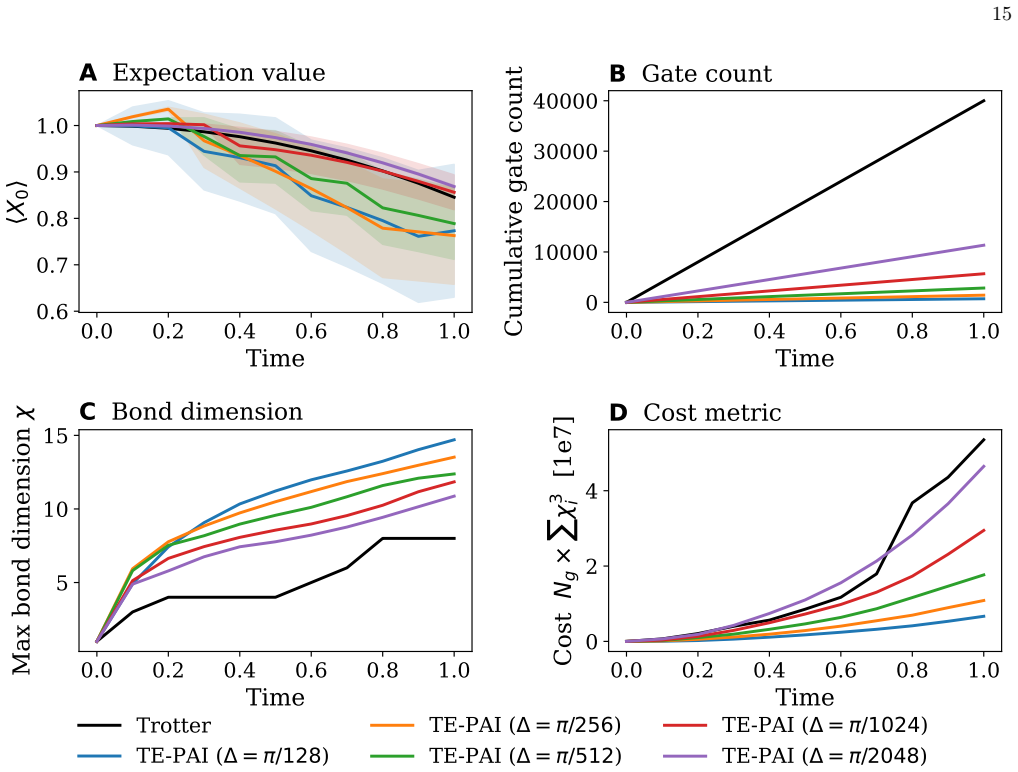
Tensor-network simulations of quantum many-body dynamics are fundamentally limited by entanglement build-up, which leads to exponentially growing computational costs. Furthermore, these classical simulation algorithms are inherently sequential as typically a tensor network representation of the quantum state is updated incrementally at each time step. We build on recently introduced randomized quantum algorithms for time evolution (TE-PAI), and adapt them to the classical simulation context with the purpose of enabling massive parallelisation. Our MPS TE-PAI approach achieves exact time evolution on average (unbiased estimator) and proceeds by representing an ensemble of randomized shallow Trotter-variant circuits as tensor networks. As each circuit instance yields a deterministic quantum state (or observable expecation value), the only source of randomness is the sampling of circuit variants; the absence of shot noise therefore yields a reduced estimator variance relative to quantum hardware implementations of TE-PAI. We simulate representative disordered one-dimensional spin-ring Hamiltonians, and numerically observe reductions in the per-sample gate-count by a factor of up to $10^3$ relative to Trotterized MPS evolution, yielding orders of magnitude reduction in the time-to-solution under realistic levels of parallelisation. Finally, we numerically observe that MPS TE-PAI is substantially more robust against severe bond-dimension truncation than product formulas, potentially making it useful for the simulation of strongly correlated systems where truncation is necessary in practice. We also demonstrate that the approach can be used naturally in combination with existing time evolution algorithms, effectively extending their time depth via parallelisation.
Editorial analysis
A structured set of objections, weighed in public.
Referee Report
Summary. The manuscript proposes MPS TE-PAI, a classical tensor-network method that adapts randomized TE-PAI circuits to matrix-product-state representations of an ensemble of shallow Trotter-variant circuits. It claims to deliver unbiased (exact on average) time evolution for quantum many-body dynamics, with the randomness confined to circuit sampling rather than measurement shots, thereby reducing estimator variance. Numerical tests on disordered 1D spin-ring Hamiltonians report per-sample gate-count reductions up to 10^3 relative to standard Trotterized MPS evolution, orders-of-magnitude faster wall-clock time under parallelization, and markedly improved robustness to severe bond-dimension truncation. The approach is also shown to combine naturally with existing time-evolution algorithms to extend reachable times.
Significance. If the central claims hold, the work offers a practical route to parallelizable, low-variance classical simulation of quantum dynamics that mitigates the sequential nature and entanglement growth of conventional MPS time evolution. The explicit use of an unbiased estimator, the absence of shot noise, and the numerical demonstration of truncation robustness are genuine strengths that could benefit simulations of strongly correlated systems where truncation is unavoidable. The hybrid use with existing algorithms further increases flexibility. These features address long-standing bottlenecks in tensor-network dynamics and could influence algorithmic development in condensed-matter and quantum-chemistry simulation.
major comments (2)
- [§4.2] §4.2 and the associated numerical tables: the reported factor-of-10^3 per-sample gate-count reduction and the parallelization speedup are load-bearing for the central claim, yet the manuscript provides no explicit scaling analysis or bound showing that the randomized shallow circuits remain efficiently contractible as MPS for evolution times or system sizes beyond the tested disordered rings; without this, the claimed orders-of-magnitude time-to-solution improvement cannot be guaranteed once entanglement growth or contraction overhead is taken into account.
- [§3.1] §3.1, the definition of the TE-PAI ensemble and the variance of the estimator: while unbiasedness follows from prior TE-PAI work, the manuscript does not derive or bound the classical MPS estimator variance as a function of the number of samples and the per-circuit bond dimension; this omission leaves open whether the promised variance reduction relative to quantum hardware implementations survives when MPS truncation is applied.
minor comments (2)
- [Figure 3] Figure 3 caption and axis labels: the truncation-error curves are difficult to interpret without an explicit statement of the bond-dimension cutoff values used for each data series.
- [References] The reference list omits several recent works on randomized Trotterization and hybrid classical-quantum dynamics algorithms that would help situate the contribution.
Simulated Author's Rebuttal
We thank the referee for their careful reading, positive overall assessment, and constructive suggestions. We address each major comment below and indicate the revisions we will make.
read point-by-point responses
-
Referee: [§4.2] §4.2 and the associated numerical tables: the reported factor-of-10^3 per-sample gate-count reduction and the parallelization speedup are load-bearing for the central claim, yet the manuscript provides no explicit scaling analysis or bound showing that the randomized shallow circuits remain efficiently contractible as MPS for evolution times or system sizes beyond the tested disordered rings; without this, the claimed orders-of-magnitude time-to-solution improvement cannot be guaranteed once entanglement growth or contraction overhead is taken into account.
Authors: We agree that the manuscript does not contain a general analytical bound on contraction cost for arbitrary system sizes and evolution times. Our central claims rest on numerical evidence for the disordered 1D spin-ring Hamiltonians studied, where the TE-PAI randomization produces shallow circuits with controlled entanglement growth, enabling the observed gate-count reductions and parallelization benefits. We will add a qualitative discussion in the revised §4.2 (and a short paragraph in the conclusions) explaining why the shallow, randomized circuit structure limits entanglement relative to standard Trotterization and why the numerical trends are expected to persist within the regime of moderate disorder and circuit depths considered. revision: partial
-
Referee: [§3.1] §3.1, the definition of the TE-PAI ensemble and the variance of the estimator: while unbiasedness follows from prior TE-PAI work, the manuscript does not derive or bound the classical MPS estimator variance as a function of the number of samples and the per-circuit bond dimension; this omission leaves open whether the promised variance reduction relative to quantum hardware implementations of TE-PAI survives when MPS truncation is applied.
Authors: Unbiasedness is inherited directly from the original TE-PAI construction. The classical MPS estimator has no shot noise, so its variance is determined solely by the finite ensemble size; truncation introduces a systematic bias that is separate from this sampling variance. Our numerical results demonstrate that the method remains accurate at low bond dimensions where standard Trotterized MPS fails, indicating that the practical variance-reduction benefit is retained. We will insert a short clarifying paragraph in §3.1 that distinguishes sampling variance from truncation error and notes the absence of a rigorous bound on the truncated variance, while emphasizing the numerical evidence for robustness. revision: partial
Circularity Check
Minor self-citation to TE-PAI for unbiased estimator, not load-bearing on central claims
specific steps
-
self citation load bearing
[Abstract]
"We build on recently introduced randomized quantum algorithms for time evolution (TE-PAI), and adapt them to the classical simulation context with the purpose of enabling massive parallelisation. Our MPS TE-PAI approach achieves exact time evolution on average (unbiased estimator) and proceeds by representing an ensemble of randomized shallow Trotter-variant circuits as tensor networks."
The central claim of exact unbiased time evolution is justified by reference to TE-PAI (prior work with author overlap) rather than an independent derivation or proof within this manuscript; the remainder of the paper then builds on that imported property.
full rationale
The paper's core derivation adapts the TE-PAI randomization (cited as recently introduced) to MPS tensor networks for parallel classical simulation. The unbiased exact-on-average property is imported from that prior work rather than re-derived here, but the adaptation itself, the deterministic circuit representation, the variance reduction argument, and all numerical observations of gate-count reduction and truncation robustness are self-contained and do not reduce to the citation by construction. No fitted parameters are renamed as predictions, no ansatz is smuggled, and no uniqueness theorem is invoked. This matches the expected minor self-citation case (score 2) without forcing the main results.
Axiom & Free-Parameter Ledger
free parameters (2)
- number of randomized circuit samples
- Trotter depth or step size per circuit
axioms (2)
- domain assumption Randomized shallow Trotter-variant circuits form an unbiased estimator of the exact time-evolution operator.
- domain assumption Shallow randomized circuits admit efficient low-bond-dimension MPS representations for the Hamiltonians considered.
Reference graph
Works this paper leans on
-
[1]
that reduces time-evolution circuit depth by replac- ing a single deep circuit with a statistical ensemble of shallow random circuits. While tensor-network based simulation is well explored in the literature [9], these techniques are inherently serial, propagating the wave- function step-by-step via short-time propagators. In con- trast, our quantum-inspi...
work page internal anchor Pith review Pith/arXiv arXiv 2026
-
[2]
Given an input Hamiltonian, we initialize a Trotter circuitUin Eq. (2) withNTrotter-steps over total 3 q0 q1 q2 q3 × N (a) Standard Trotterization protocol Rz Rz Rz Rz Rxx Rxx Ryy Ryy Rzz Rzz Rxx Ryy Rzz Rxx Ryy Rzz Simulation time Complexity (c) Trotter TE-PAI (fewer gates) Computational limit q0 q1 q2 q3 (b) MPS TE-PAI protocol Rz (+ ) Rz (- ) Rxx (+ ) ...
-
[3]
GenerateN s random circuit variants by ran- domly replacing continuous rotation gatesRk(θkj) inUwith a discrete rotation angle drawn from {0,±∆, π}according to the probabilities defined in Section A3
-
[4]
Execute all circuit variants and in post-processing multiply each measurement outcome with the rele- vant prefactor and sign as detailed in Section A3. As discussed in Section A3, the above protocol pro- vides an unbiased estimator for the time evolution oper- ator as we summarise in the following statement [13, 15]. Statement 1(From Ref. [13]).Replacing ...
-
[5]
For short evolution times and limited bond dimension, Trotterization is relatively cheap
Hybrid TE-PAI Let us illustrate MPS TE-PAI in a practical setting. For short evolution times and limited bond dimension, Trotterization is relatively cheap. Therefore, we evolve for an initial period using a deep Trotter circuit, switch- ing to TE-PAI once the bond dimension approaches a truncation threshold. Furthermore, in this example we apply the boun...
-
[6]
This bias, however, can be controlled by decreasing the rotation angle∆
Full TE-PAI We now consider the opposite extreme of the trade- off, in which biased MPS TE-PAI is applied over the full evolution0≤T≤5, at the cost of an increased bias. This bias, however, can be controlled by decreasing the rotation angle∆. Fig. 6 shows a spin-ring simulation of n= 100qubits withN s = 10samples of biased MPS TE-PAI at∆ =π/2 12. Indeed, ...
-
[7]
Truncation Finally, we demonstrate TE-PAI’s relative robustness to approximation errors induced by truncating the MPS bond dimension. Truncation is imposed by retaining only theχlargest singular values at each bond through- out the tensor network [8]. Truncation permits simula- tion to proceed beyond the point at which unconstrained bond-dimensiongrowthwo...
-
[8]
X. Waintal, C.-H. Huang, and C. W. Groth, Who can compete with quantum computers? Lecture notes on quantum inspired tensor networks computational tech- niques (2026), arXiv:2601.03035 [quant-ph]
-
[9]
Y. Yan, Z. Du, J. Chen, and X. Ma, Limitations of noisy quantum devices in computing and entangling power, npj Quantum Information11, 188 (2025)
work page 2025
- [10]
-
[11]
A. S. Boev, S. R. Usmanov, A. M. Semenov, M. M. Ushakova, G. V. Salahov, A. S. Mastiukova, E. O. Kik- tenko, and A. K. Fedorov, Quantum-inspired optimiza- tion for wavelength assignment, Frontiers in Physics10, 1092065 (2023)
work page 2023
-
[12]
H. Jung, H. Kim, W. Lee, J. Jeon, Y. Choi, T. Park, and C. Kim, A quantum-inspired probabilistic prime factor- ization based on virtually connected Boltzmann machine and probabilistic annealing, Scientific Reports13, 16186 (2023)
work page 2023
-
[13]
C. Oh, Y. Lim, Y. Wong, B. Fefferman, and L. Jiang, Quantum-inspired classical algorithms for molecular vi- bronic spectra, Nature Physics20, 225 (2024)
work page 2024
-
[14]
A. Berezutskii, M. Liu, A. Acharya, R. Ellerbrock, J. Gray, R. Haghshenas, Z. He, A. Khan, V. Kuzmin, D. Lyakh, D. Lykov, S. Mandrà, C. Mansell, A. Mel- nikov, A. Melnikov, V. Mironov, D. Morozov, F. Neukart, A. Nocera, M. A. Perlin, M. Perelshtein, M. Steinberg, R. Shaydulin, B. Villalonga, M. Pflitsch, M. Pistoia, V. Vinokur, and Y. Alexeev, Tensor netw...
work page 2025
-
[15]
R. Orús, A practical introduction to tensor networks: Matrix product states and projected entangled pair states, Annals of Physics349, 117 (2014)
work page 2014
-
[16]
Orús, Tensor networks for complex quantum systems, Nature Reviews Physics1, 538 (2019)
R. Orús, Tensor networks for complex quantum systems, Nature Reviews Physics1, 538 (2019)
work page 2019
-
[17]
M. S. Rudolph, T. Jones, Y. Teng, A. Angrisani, and Z. Holmes, Pauli Propagation: A Computational Frame- work for Simulating Quantum Systems (2025)
work page 2025
-
[18]
T. Begušić, J. Gray, and G. K.-L. Chan, Fast and con- verged classical simulations of evidence for the utility of quantum computing before fault tolerance, Science Ad- vances10, eadk4321 (2024)
work page 2024
- [19]
-
[20]
C. Kiumi and B. Koczor, TE-PAI: Exact Time Evolution by Sampling Random Circuits (2024)
work page 2024
-
[21]
A. M. Childs, Y. Su, M. C. Tran, N. Wiebe, and S. Zhu, Theory of Trotter Error with Commutator Scaling, Phys- ical Review X11, 011020 (2021)
work page 2021
- [22]
-
[23]
Z. Cai, R. Babbush, S. C. Benjamin, S. Endo, W. J. Hug- gins, Y. Li, J. R. McClean, and T. E. O’Brien, Quantum Error Mitigation, Reviews of Modern Physics95, 045005 (2023)
work page 2023
-
[24]
S. Kotz and N. L. Johnson, eds.,Breakthroughs in Statis- tics: Methodology and Distribution, Springer Series in Statistics (Springer New York, New York, NY, 1992)
work page 1992
-
[25]
W. G. Cochran,Sampling techniques, 3rd ed., Wiley se- ries in probability and mathematical statistics (Wiley, New York, NY, 1977)
work page 1977
-
[26]
S. L. Lohr,Sampling: design and analysis, third edition ed., Chapman & Hall/CRC texts in statistical science (CRC Press, Taylor & Francis Group, Boca Raton Lon- don New York, 2022)
work page 2022
- [27]
-
[28]
Koczor, Sparse probabilistic synthesis of quantum op- erations, PRX Quantum5, 040352 (2024)
B. Koczor, Sparse probabilistic synthesis of quantum op- erations, PRX Quantum5, 040352 (2024)
work page 2024
-
[29]
S. Endo, Q. Zhao, Y. Li, S. Benjamin, and X. Yuan, Mit- igating algorithmic errors in a Hamiltonian simulation, Physical Review A99, 012334 (2019)
work page 2019
-
[30]
G. Vidal, Efficient Simulation of One-Dimensional Quan- tum Many-Body Systems, Physical Review Letters93, 040502 (2004)
work page 2004
-
[31]
S. R. White and A. E. Feiguin, Real-Time Evolution Us- ing the Density Matrix Renormalization Group, Physical Review Letters93, 076401 (2004)
work page 2004
-
[32]
M. Zwolak and G. Vidal, Mixed-State Dynamics in One-Dimensional Quantum Lattice Systems: A Time- Dependent Superoperator Renormalization Algorithm, Physical Review Letters93, 207205 (2004)
work page 2004
-
[33]
I. Pizorn, L. Wang, and F. Verstraete, Time evolution of projected entangled pair statesin the single-layer picture, Physical Review A83, 10.1103/PhysRevA.83.052321 (2011)
-
[34]
S. Paeckel, T. Köhler, A. Swoboda, S. R. Manmana, U. Schollwöck, and C. Hubig, Time-evolution methods for matrix-product states, Annals of Physics411, 167998 (2019)
work page 2019
-
[35]
José García-Ripoll, Time evolution of Matrix Product States, New Journal of Physics8, 305 (2006)
J. José García-Ripoll, Time evolution of Matrix Product States, New Journal of Physics8, 305 (2006)
work page 2006
-
[36]
P. E. Dargel, A. Wöllert, A. Honecker, I. P. McCulloch, U. Schollwöck, and T. Pruschke, Lanczos algorithm with matrix product states for dynamical correlation func- tions, Physical Review B85, 205119 (2012)
work page 2012
-
[37]
M. L. Wall and L. D. Carr, Out-of-equilibrium dynamics 12 with matrix product states, New Journal of Physics14, 125015 (2012)
work page 2012
-
[38]
P. Schmitteckert, Nonequilibrium electron transport us- ing the density matrix renormalization group method, Physical Review B70, 121302 (2004)
work page 2004
-
[39]
A. E. Feiguin and S. R. White, Time-step targeting methods for real-time dynamics using the density matrix renormalization group, Physical Review B72, 020404 (2005)
work page 2005
-
[40]
S. R. Manmana, A. Muramatsu, and R. M. Noack, Time evolution of one-dimensional Quantum Many Body Sys- tems, AIP Conference Proceedings789, 269 (2005)
work page 2005
-
[41]
K. Rodriguez, S. R. Manmana, M. Rigol, R. M. Noack, and A. Muramatsu, Coherent matter waves emerging from Mott-insulators, New Journal of Physics8, 169 (2006)
work page 2006
- [42]
-
[43]
J.Haegeman, J.I.Cirac, T.J.Osborne, I.Pižorn, H.Ver- schelde, and F. Verstraete, Time-Dependent Variational Principle for Quantum Lattices, Physical Review Letters 107, 070601 (2011)
work page 2011
-
[44]
J. Haegeman, C. Lubich, I. Oseledets, B. Vandereycken, and F. Verstraete, Unifying time evolution and optimiza- tion with matrix product states, Physical Review B94, 165116 (2016)
work page 2016
-
[45]
J. B. Keller, , and D. W. McLaughlin, The Feynman Integral, The American Mathematical Monthly82, 451 (1975)
work page 1975
-
[46]
M. P. Zaletel, R. S. K. Mong, C. Karrasch, J. E. Moore, and F. Pollmann, Time-evolving a matrix product state with long-ranged interactions, Physical Review B91, 165112 (2015)
work page 2015
- [47]
- [48]
-
[49]
Appendix A: Deferred derivations and TE-PAI implementation details
While not reported in this work, we have implemented next-to-nearest neighbour and 2D-lattice Hamiltonians and found similarly that TE-PAI indeed outperforms simple Trotterization. Appendix A: Deferred derivations and TE-PAI implementation details
-
[50]
Derivation of the first-order product-formula gate-count bound As shown in [14], the error analysis of product-formula decompositions gives rise to the following bound. Statement 4.The single-step error of the first-order Trotter decomposition satisfies: LY k=1 e−ickhk T N −e −iH T N ≤ T 2 2N 2 ∥c∥2 T ,(A1) where∥c∥ 2 T is the Trotterization error norm of...
-
[51]
Time-dependent Hamiltonians and product-formula notation In the case of a time-dependent HamiltonianH(t) =PL k=1 ck(t)h k the unitary evolution operator is approx- imated by a piecewise-constant product formula. Writ- ingt j for the discrete time grid and assuming that the Hamiltonian remains constant within each time step, one obtains the standard first-...
-
[52]
PAI & TE-PAI a. Summary The TE-PAI algorithm [13] based on the PAI algo- rithm [15] approximates the exact time evolution of an infinitely deep Trotter circuit by sampling from randomly generated shallow Trotter-variants. We begin by noting that time evolution operators of both time-independent andtime-dependentHamiltoniansemployedinbothfirst- order and h...
-
[53]
TE-PAI gate-count scaling and asymptotic depth statistics Trigonometric and statistical considerations outlined in [13] imply that the expected number of gates per cir- cuit sample satisfies ν∞ := lim N→∞ E[ν] = csc(∆)(3−cos ∆)∥¯c∥1 T,(A21) which scales linearly withT. This gate-count is bounded from below asν ∞ ≥2 √ 2∥¯c∥1 T, with equality at ∆ = 2 arcta...
-
[54]
Measurement overhead and the∥g∥ 1 factor The overhead factor is obtained by taking the product of the single-gate quasiprobability norms∥γk∥1 across all gates in the PAI protocol: ∥g∥1 = NY j=1 LY k=1 ∥γk(|θkj |)∥1 .(A22) Taking the limitN→ ∞and requiring precisionϵwhen estimating the time-evolution of an expectation value, the required number of samplesN...
work page 2048
discussion (0)
Sign in with ORCID, Apple, or X to comment. Anyone can read and Pith papers without signing in.