Recognition: unknown
Debate to Align: Reliable Entity Alignment through Two-Stage Multi-Agent Debate
Pith reviewed 2026-05-10 14:03 UTC · model grok-4.3
The pith
Two-stage multi-agent debate refines uncertain entity matches across knowledge graphs by verifying candidates and aligning decisions.
A machine-rendered reading of the paper's core claim, the machinery that carries it, and where it could break.
Core claim
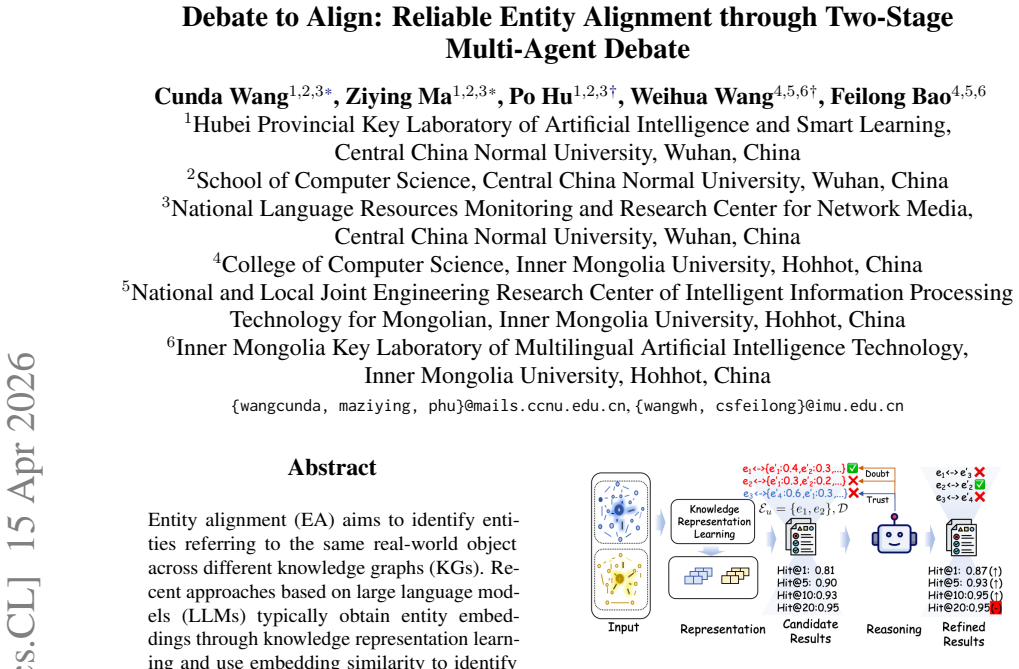
AgentEA improves embedding quality through entity representation preference optimization and then uses a two-stage multi-role debate mechanism consisting of lightweight debate verification and deep debate alignment to progressively enhance the reliability of alignment decisions while enabling more efficient debate-based reasoning.
What carries the argument
The two-stage multi-role debate mechanism, in which a lightweight verification debate first filters or confirms candidate entities before a deeper alignment debate produces the final matching decision, operating on embeddings improved by preference optimization.
If this is right
- Alignment accuracy rises on cross-lingual benchmarks where language differences make raw embedding similarity unreliable.
- Performance holds up under sparse data and large graph sizes because uncertain matches are progressively verified rather than accepted or rejected in one pass.
- Heterogeneous knowledge graphs see fewer erroneous matches once the lightweight verification stage removes poor candidates before the deeper debate.
- Reasoning cost decreases relative to full multi-turn debate on every candidate because the first stage quickly discards obviously incorrect options.
Where Pith is reading between the lines
- The same staged-verification pattern could be applied to other LLM tasks that start with noisy retrieval, such as multi-document question answering or entity linking in text.
- If the debate reliably overrides embedding errors, multi-agent setups might serve as a general post-processing layer for embedding-based retrieval systems.
- Testing the method on time-evolving graphs would reveal whether the two-stage process can be updated incrementally when new entities arrive.
Load-bearing premise
The candidate entity sets initially retrieved by embedding similarity are sufficiently free of systematic errors that the subsequent debate stages can detect and correct mistakes rather than propagate or introduce new ones.
What would settle it
Remove both debate stages, run the same benchmarks with only the optimized embeddings and direct LLM judgment, and check whether accuracy falls to the level of prior embedding-only or single-LLM baselines.
Figures


read the original abstract
Entity alignment (EA) aims to identify entities referring to the same real-world object across different knowledge graphs (KGs). Recent approaches based on large language models (LLMs) typically obtain entity embeddings through knowledge representation learning and use embedding similarity to identify an alignment-uncertain entity set. For each uncertain entity, a candidate entity set (CES) is then retrieved based on embedding similarity to support subsequent alignment reasoning and decision making. However, the reliability of the CES and the reasoning capability of LLMs critically affect the effectiveness of subsequent alignment decisions. To address this issue, we propose AgentEA, a reliable EA framework based on multi-agent debate. AgentEA first improves embedding quality through entity representation preference optimization, and then introduces a two-stage multi-role debate mechanism consisting of lightweight debate verification and deep debate alignment to progressively enhance the reliability of alignment decisions while enabling more efficient debate-based reasoning. Extensive experiments on public benchmarks under cross-lingual, sparse, large-scale, and heterogeneous settings demonstrate the effectiveness of AgentEA.
Editorial analysis
A structured set of objections, weighed in public.
Referee Report
Summary. The manuscript proposes AgentEA, a two-stage multi-agent debate framework for entity alignment across knowledge graphs. It first applies entity representation preference optimization to improve embedding quality, retrieves candidate entity sets (CES) via similarity, and then uses lightweight debate verification followed by deep debate alignment to progressively refine and increase the reliability of alignment decisions. The authors assert that extensive experiments on public benchmarks under cross-lingual, sparse, large-scale, and heterogeneous settings demonstrate the framework's effectiveness.
Significance. If the empirical results and underlying assumptions hold, this work introduces a structured multi-agent debate approach to mitigate reliability issues in LLM-based entity alignment, particularly around flawed CES retrieval and reasoning limitations. The two-stage design for balancing efficiency and depth could be a useful contribution to KG alignment methods that combine embeddings with LLM reasoning.
major comments (2)
- [§3] §3 (Method): The central claim depends on the entity representation preference optimization producing CES reliable enough for the subsequent debate stages to correct remaining uncertainties. The manuscript provides no analysis or evidence that this optimization mitigates systematic biases (e.g., false negatives in sparse regimes or poor cross-lingual alignment), which is load-bearing for the assertion that the two-stage debate progressively enhances reliability.
- [§4] §4 (Experiments): While the abstract and claims reference extensive experiments demonstrating effectiveness across settings, the provided description lacks quantitative results, ablation studies isolating the preference optimization versus debate contributions, or discussion of failure modes where CES quality remains insufficient, weakening support for the load-bearing assumption that debate can resolve embedding-induced errors.
minor comments (1)
- [§3] The description of the lightweight verification and deep alignment stages could include a clearer diagram or pseudocode to illustrate the multi-role prompting and decision flow.
Simulated Author's Rebuttal
We thank the referee for the constructive and insightful comments. We agree that additional analysis and experimental details are needed to strengthen the load-bearing claims regarding the preference optimization and debate stages. We will revise the manuscript accordingly.
read point-by-point responses
-
Referee: [§3] §3 (Method): The central claim depends on the entity representation preference optimization producing CES reliable enough for the subsequent debate stages to correct remaining uncertainties. The manuscript provides no analysis or evidence that this optimization mitigates systematic biases (e.g., false negatives in sparse regimes or poor cross-lingual alignment), which is load-bearing for the assertion that the two-stage debate progressively enhances reliability.
Authors: We agree with this assessment. The current §3 describes the preference optimization but does not explicitly analyze its effect on specific biases such as false negatives in sparse settings or cross-lingual misalignment. In the revision we will add a dedicated paragraph (or short subsection) in §3 that discusses these biases, supported by qualitative examples drawn from the experimental data and quantitative metrics (e.g., CES recall before/after optimization on sparse and cross-lingual benchmarks). This will clarify how the optimization supplies a sufficiently reliable CES for the subsequent debate stages to operate on. revision: yes
-
Referee: [§4] §4 (Experiments): While the abstract and claims reference extensive experiments demonstrating effectiveness across settings, the provided description lacks quantitative results, ablation studies isolating the preference optimization versus debate contributions, or discussion of failure modes where CES quality remains insufficient, weakening support for the load-bearing assumption that debate can resolve embedding-induced errors.
Authors: We acknowledge the gap in presentation. Although the manuscript reports overall performance across the four settings, it does not isolate the contribution of preference optimization from the debate stages nor discuss failure cases where CES quality remains poor. In the revised §4 we will (1) expand the results tables with per-component metrics, (2) add ablation tables that remove or replace the preference optimization and each debate stage individually, and (3) include a short failure-mode analysis (with examples) showing when debate cannot fully compensate for low-quality CES. These additions will directly address the referee’s concern about empirical support. revision: yes
Circularity Check
No circularity in derivation chain
full rationale
The paper presents AgentEA as a procedural framework: entity representation preference optimization followed by a two-stage multi-agent debate (lightweight verification then deep alignment). No equations, first-principles derivations, or predictions are described that reduce by construction to fitted parameters or self-referential definitions. The central claims rest on empirical evaluation against external public benchmarks under varied settings, with no load-bearing self-citations or ansatzes smuggled via prior work. The method is self-contained as an applied pipeline without renaming known results or importing uniqueness theorems.
Axiom & Free-Parameter Ledger
axioms (1)
- domain assumption Multi-agent debate among LLMs can reliably verify and align entities when given candidate sets
Reference graph
Works this paper leans on
-
[1]
Selfkg: Self-supervised entity alignment in knowledge graphs. InThe ACM Web Conference, pages 860–870. Xukai Liu, Kai Zhang, Ye Liu, Enhong Chen, Zhenya Huang, Linan Yue, and Jiaxian Yan. 2023. RHGN: relation-gated heterogeneous graph network for en- tity alignment in knowledge graphs. InFindings of the Association for Computational Linguistics, pages 868...
work page internal anchor Pith review Pith/arXiv arXiv 2023
-
[2]
InThe Web Conference, pages 821–832
Boosting the speed of entity alignment 10 ×: Dual attention matching network with normalized hard sample mining. InThe Web Conference, pages 821–832. Xin Mao, Wenting Wang, Huimin Xu, Man Lan, and Yuanbin Wu. 2020. MRAEA: an efficient and robust entity alignment approach for cross-lingual knowl- edge graph. InThe Thirteenth ACM International Conference on...
2020
-
[3]
InAdvances in Neural Information Processing Systems
Direct preference optimization: Your language model is secretly a reward model. InAdvances in Neural Information Processing Systems. Zequn Sun, Wei Hu, Qingheng Zhang, and Yuzhong Qu
-
[4]
Bootstrapping entity alignment with knowl- edge graph embedding. InProceedings of the Twenty- Seventh International Joint Conference on Artificial Intelligence, pages 4396–4402. Zequn Sun, Jiacheng Huang, Wei Hu, Muhao Chen, Lingbing Guo, and Yuzhong Qu. 2019. Transedge: Translating relation-contextualized embeddings for knowledge graphs. InThe Internatio...
-
[5]
instruction
Iterative entity alignment via joint knowledge embeddings. InProceedings of the International Joint Conference on Artificial Intelligence, pages 4258–4264. Qiannan Zhu, Xiaofei Zhou, Jia Wu, Jianlong Tan, and Li Guo. 2019. Neighborhood-aware attentional rep- resentation for multilingual knowledge graphs. In Proceedings of the Twenty-Eighth International J...
2019
-
[6]
Identify concrete alignment signals from names , attributes , and relationships
-
[7]
candidate_id
Assign a probability - like score based on all evidence . SCORING PRINCIPLES : align_score represents the probability that the entities are the same : 0.9 -1.0: Very high - strong consistent evidence 0.7 -0.8: High - clear evidence with minor uncertainties 0.5 -0.6: Moderate - mixed alignment indicators 0.3 -0.4: Low - limited evidence with discrepancies ...
-
[8]
Identify misalignment evidence from names , attributes , and relationships
-
[9]
candidate_id
Objectively assess the alignment probability based on all available evidence . SCORING PRINCIPLES : align_score represents the probability that the entities are the same : 0.9 -1.0: Very high - minimal discrepancies 0.7 -0.8: High - strong evidence outweighs inconsistencies 0.5 -0.6: Moderate - mixed evidence 0.3 -0.4: Low - significant discrepancies 0.0 ...
-
[10]
Carefully consider both sides : You must evaluate both the proponent's and opponent's scores and supporting evidence for each candidate
-
[11]
Balance the evidence : The align_score should reflect a balanced assessment of both viewpoints , rather than favoring a single side
-
[12]
High proponent + weak opponent = high score : If the proponent assigns a high score ( >= 0.7) with strong evidence and the opponent provides weak or generic counter - evidence , assign a relatively high align_score ( >= 0.6)
-
[13]
Strong opposition = lower score : If the opponent presents specific and factual counter - evidence ( e . g . , conflicting birth dates or locations ) , the align_score should be lowered accordingly , even if the proponent score is high
-
[14]
Both sides weak = moderate score : If both agents provide weak or generic evidence , assign a moderate score around 0.5
-
[15]
Consistent scores : If both the proponent and opponent consistently assign high or low scores to a candidate , the referee score should reflect this consensus
-
[16]
Evidence quality matters : Give greater weight to specific , factual evidence than to generic statements . SCORING GUIDELINES : 0.8 -1.0: Strong alignment - strong proponent evidence and weak or irrelevant objections 0.6 -0.7: Moderate alignment - good proponent evidence with some valid concerns 0.4 -0.5: Uncertain / Neutral - balanced or insufficient evi...
discussion (0)
Sign in with ORCID, Apple, or X to comment. Anyone can read and Pith papers without signing in.